|
| |
|

|
Kidicious
|
 |
Diety of Kidiverse
Mar 2003
time: 21:18
|
|
Slowest GDP growth in 2 years
quote:
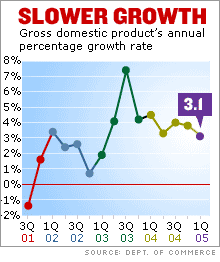
Annual 3.1% rate below economists' estimates; price increase pace quickens.
April 28, 2005: 11:39 AM EDT
By Chris Isidore, CNN/Money senior writer
NEW YORK (CNN/Money) - The nation's economy was hit by both slower growth and higher prices in the first quarter, a government report showed Thursday, presenting both economists and investors with worrisome signs about future economic stength.
The Commerce Department's initial reading on the first quarter gross domestic product, the broadest measure of the nation's economic activity, showed an annual pace of growth of 3.1 percent, down from the 3.8 percent rise in the fourth quarter of 2004.
It was the slowest quarter since the 1.9 percent annual rate reported in the first quarter of 2003.
Economists surveyed by Briefing.com had forecast growth at a 3.5 percent annual pace.
Prices paid by individuals for items excluding food and energy, an inflation measure closely watched by the Federal Reserve, was up 2.2 percent in the report, compared with a 1.7 percent rise in the fourth quarter, marking the steepest climb in that measure since the fourth quarter of 2001. Other closely-watched price measures in the report also showed increasing inflation.
The report therefore raises the prospect of slower economic growth coupled with higher prices, a situation known as "stagflation," which is the worst possible scenario for the economy in the view of many investors.
"Stagflation is rearing its ugly head," said University of Maryland Professor Peter Morici. "Slower consumer spending and disappointing business investment are causing slower growth, high unemployment and wages that lag inflation."
If inflation risks were muted, the Fed might be looking at pausing in its current path of hiking interest rates to give the economic growth a lift. But economists say that in order to combat inflation, the Fed will keep hiking rates, further slowing growth.
"It puts the Fed in a position they probably don't want to be in, but they'll have to keep raising rates," said Drew Matus, senior economist at Lehman Brothers.
The Fed is set to meet next week to consider interest rates and is widely expected to raise rates by a quarter percentage point once again.
Mark Vitner, senior economist with Wachovia Securities, said that he believes that inflation is more in check than the rise in prices in this report would suggest. He said that the slowing economy will likely start to push commodity prices down, and he pointed to oil futures falling below the $50 a barrel mark in Thursday trading.
"That may be the high water mark (for prices)," he said, pointing to the price readings in the GDP report. "Oil could fall to $40 before it start to rebound, and since we normally get a rise in gasoline prices in the spring and early summer, it's quite possible we'll see outright decline in the Consumer Price Index in May and June."
Inventories, imports a concern
While the report disappointed Wall Street, the Bush administration tried to put the best face on the number. Treasury Secretary John Snow said a 3.1 percent growth rate, "shows that the foundation of America's economy continues to be sound and strong."
The report also had some troubling figures on inventories and consumer spending, suggesting that there is more slowing in the economy ahead, said Anthony Chan, senior economist for JPMorgan Fleming Asset Management.
Chan said the growth number, while disappointing, was actually not as strong as it first appears, as much of it was due to a buildup in inventories by businesses.
"Firms are going to move to cut back production to get rid of undesired inventories, thereby pushing growth even lower in the next calendar quarter," he said. "Business spending on equipment and software, which represents the type of spending one needs to see to become more bullish about future growth, proved to be quite disappointing by coming in way below expectations."
The nation's rising trade gap also bit into economic growth. While exports added 0.69 percentage point to the GDP, imports reduced the GDP by 2.19 percentage points.
"Despite the fact that we had a lot of consumption, it seems to be driven by consumption of imported goods," said Matus. "That also sets stage for weaker growth going forward."
Stocks opened lower Thursday. Stock futures, which had already been lower ahead of the 8:30 a.m. ET report, fell further on the disappointing reading. Concerns about slowing economic growth have been a major drag on stocks in recent weeks.
Treasury prices were mostly higher, as the prospects of slower economic growth were balanced by concerns of the Fed needing to hike rates faster to combat inflation.
For more on what the economy means for you and the markets, click here.
|
People are talking about stagflation.
|
|
| |
|
|
|
DanS
|
 |
Kickball Capital of the World
Jan 1970
time: 00:18
|
|
Productivity came in at 2.6% annualized for Q1 today. That's pretty good for this part of the business cycle. Productivity growth was anemic during '93 - '95.
Last edited by DanS on 05-05-2005 at 21:22
|
|
| |
|
| |
|
|
|
Japher
|
 |
Ook! Ook! Ack! Ack! Ack!
Jun 2002
time: 05:18
|
|
quote:
All signs are pointing to a positive job outlook for the more than 1.2 million graduates of the class of 2005. College grads of all majors will see increases in hiring and salaries, the best graduate hiring season since the job boom of the mid-1990s.
Twenty percent of hiring managers plan to hire more associates, bachelors and masters graduates in 2005 than they did in 2004, according to the Collegiate Employment Research Institute (CERI) at Michigan State University. In a similar study, the National Association of Colleges and Employers (NACE) reports that employers expect to hire 13.1 percent more new college grads in 2004-05 than they hired in 2003-04.
CERI reports two key factors are shaping the labor market: productivity demands and skill requirements.
According to NACE's Spring 2005 Salary Survey, the top 10 jobs for grads and their corresponding salaries are:
Accounting (Private) - $44,564
Management Trainee - $35,811
Teaching - $29,733
Consulting - $49,781
Sales - $37,130
Accounting (Public) - $41,039
Financial/Treasury Analysis - $45,596
Software Design and Development - $53,729
Design/Construction Engineering - $47,058
Registered Nurse - $38,775
|
LINK
Nothing to see here, move a long...
|
|
| |
All times are GMT. The time now is 05:18.
Apolyton Time is 00:18. |
top of page
|
|
|
Forum Rules:
You may not post new threads
You may not post replies
You may not post attachments
You may not edit your posts
|
HTML code is ON
vB code is ON
Smilies are ON
[IMG] code is ON
|
|
|
|
|
|





 29-04-2005 05:47


 Attachment:


 |
|