|

|
Vince278
|
|
quote:
Originally posted by TechWins
Either the Greeks or the Romans could be considered the most influential civ in Western history, so that pretty much narrows down the choice to the Greeks for me. |
Wasn't Rome founded by refugees from Greece's city-states?
|
|
| |
|
|
|
DerSchwarzfalke
|
|
Or so their founding myth went. Everyone in the Mediterranean wanted to be Greek or descended from Greeks. In reality, the Romans were just another Latin tribe subject to Etruscan city-states.
For the purposes of gameplay, I think the Incas should go. They are similar enough to the Aztecs on the surface whitewash of civilization that this game will be (has to be, or else it would suck) as to be rather redundant.
|
|
| |
|
|
|
Vince278
|
|
Right. There were even Greek pharohs in Egypt but Egypt never ruled in Greece. Greek influence went as far as India in ancient times.
|
|
| |
|
|
|
Vince278
|
|
Right, and their influence stretched to India at the same time as well.
|
|
| |
|
|
|
DerSchwarzfalke
|
|
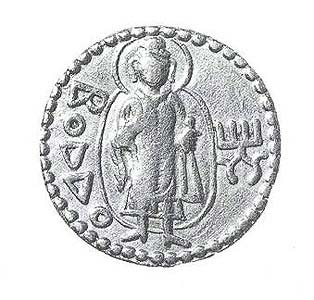
The Buddha statues in Afghanistan that were infamously destroyed by the Taliban were actually part of the Hellenistic influence. Before Alexander marched his armies through that region, the Buddha was never represented in physical form but only through symbols like a wheel. Since then, we have the evolution to the "jolly fat guy" statues you see now.
|
|
| |
|
| |
|
| |
|
|
|
molly bloom
|
 |
Lundenwic
Oct 2001
time: 15:24
|
|
quote:
Originally posted by DarkCloud
But if that's true, then why build them in response to Alexander? To show that they were greater than foreign devils? |
I doubt that there was no depiction of the Buddha pre-Alexander, but time and decay and deliberate iconoclasm may have played part in the destruction of a great many Buddhist images.
I suspect that the Hellenized images of Buddha were more part and parcel of a Greek response to combatting the Achaemenid Empire. The Iranian Achaemenids ruled over a very heterogeneous gaggle of peoples, from the sophisticated Greek city state dwellers in the Mediterranean, to the nomad steppe dwelling horsemen to the north, the relatively primitive peoples on Persian Gulf (some of whom were the Asian equivalent of pygmies) and the various different peoples Afghanistan, northern India, and the Fertile Crescent.
Many languages, different religions, different ways of life, but one ruler, so the image became important to the Achaemenids, to show who was powerful and how tribute should be paid.
Alexander's response was to issue coinage with his image, and art with his image- a counter propaganda war when he succeeded and outstripped the bounds of the Achaemenid Empire.
Successor states to the Seleucid Empire in Afghanistan and India produced a hybrid Hellenized Indian art and culture- the Gandhara style of sculpture fuses Indian religion with Greek & Indian techniques in stonework.
On early Buddhist iconography:
http://www.exoticindiaart.com/article/buddhaimage
From Macedonian Egypt to China's ocean strand:
" Although the art and practices of the heretical Armana dynasty were later suppressed in Egypt, a more naturalistic styling in painting and sculpture persisted throughout the following New Kingdom dynasties and on into the time when Alexander became the first Greek pharaoh. It is purely this author’s speculation that a style originating in the Nile Valley in 1358 BC may have penetrated as far as the Pacific shore of China 1,800 years later. "
http://www.studio-international.co....logy/buddha.htm
 Attachment: kushana_sm.jpg Attachment: kushana_sm.jpg
This has been downloaded 85 time(s).
|
|
| |
|
|
|
DerSchwarzfalke
|
|
The physical depictions of the Buddha before the arrival of Alexander tended to be pure symbolism, understood expressions of his transcendence through symbols like the wheel. Although this is speculation, one could perhaps see it initially as a reaction against Hindu iconography, which of course survives as highly stylized and elaborate gods. Alexander's campaigns and the subsequent centuries of Hellenization brought the ideas of a more "natural" -- though of course highly idealized -- way of showing the human body in art.
|
|
| |
All times are GMT. The time now is 05:24.
Apolyton Time is 00:24. |
top of page
|
|
|
Forum Rules:
You may not post new threads
You may not post replies
You may not post attachments
You may not edit your posts
|
HTML code is ON
vB code is ON
Smilies are ON
[IMG] code is ON
|
|
|
|
|
|






 05-06-2005 10:27








 Mark's DL is Kuci!
 |
|