|
| |
|

|
Kuciwalker
|
 |
of Schmooism
Feb 2001
time: 00:34
|
|
quote:
Bird Flu Drug Rendered Useless
Chinese Chickens Given Medication Made for Humans
By Alan Sipress
Washington Post Foreign Service
Saturday, June 18, 2005; A01
HONG KONG -- Chinese farmers, acting with the approval and encouragement of government officials, have tried to suppress major bird flu outbreaks among chickens with an antiviral drug meant for humans, animal health experts said. International researchers now conclude that this is why the drug will no longer protect people in case of a worldwide bird flu epidemic.
China's use of the drug amantadine, which violated international livestock guidelines, was widespread years before China acknowledged any infection of its poultry, according to pharmaceutical company executives and veterinarians.
Since January 2004, avian influenza has spread across nine East Asian countries, devastating poultry flocks and killing at least 54 people in Cambodia, Thailand and Vietnam, but none in China. World Health Organization officials warned the virus could easily undergo genetic changes to create a strain capable of killing tens of millions of people worldwide.
Although China did not report an avian influenza outbreak until February 2004, executives at Chinese pharmaceutical companies and veterinarians said farmers were widely using the drug to control the virus in the late 1990s.
The Chinese Agriculture Ministry approved the production and sale of the drug for use in chickens, according to officials from the Chinese pharmaceutical industry and the government, although such use is barred in the United States and many other countries. Local government veterinary stations instructed Chinese farmers on how to use the drug and at times supplied it, animal health experts said.
Amantadine is one of two types of medication for treating human influenza. But researchers determined last year that the H5N1 bird flu strain circulating in Vietnam and Thailand, the two countries hardest hit by the virus, had become resistant, leaving only an alternative drug that is difficult to produce in large amounts and much less affordable, especially for developing countries in Southeast Asia.
"It's definitely an issue if there's a pandemic. Amantadine is off the table," said Richard Webby, an influenza expert at St. Jude Children's Research Hospital in Memphis.
Health experts outside China previously said they suspected the virus's resistance to the medicine was linked to drug use at poultry farms but were unable to confirm the practice inside the country. Influenza researchers at the U.S. Centers for Disease Control and Prevention, in particular, have collected information about amantadine use from Chinese Web sites but have been frustrated in their efforts to learn more on the ground.
China has previously run afoul of international agencies for its response to public and agricultural health crises, notably the SARS epidemic that began in 2002. China's health minister was fired after the government acknowledged it had covered up the extent of the SARS outbreak by preventing state-run media from reporting about the disease for months and by minimizing its seriousness.
In interviews, executives at Chinese pharmaceutical companies confirmed that the drug had been used since the late 1990s, to treat chickens sickened by bird flu and to prevent healthy ones from catching it.
"Amantadine is widely used in the entire country," said Zhang Libin, head of the veterinary medicine division of Northeast General Pharmaceutical Factory in Shenyang. He added, "Many pharmaceutical factories around China produce amantadine, and farmers can buy it easily in veterinary medicine stores."
Zhang and other animal health experts said the drug was used by small, private farms and larger commercial ones. Amantadine sells for about $10 a pound, a fraction of the drug's cost in Europe and the United States, where its price would be prohibitive for all but human consumption.
Two months before China first reported a bird flu outbreak in poultry to the World Animal Health Organization in February 2004, officials had begun a massive campaign to immunize poultry against the virus. They have now used at least 2.6 billion doses of a vaccine.
But researchers in Hong Kong have reported that the H5N1 flu virus has been circulating in mainland China for at least eight years and that Chinese farms suffered major outbreaks in 1997, 2001 and 2003. Scientists have traced the virus that has devastated farms across Southeast Asia in the last two years to a strain isolated from a goose in China's Guangdong province in 1996.
The U.N. Food and Agriculture Organization has long recommended that countries try to eradicate infectious animal diseases by slaughtering infected flocks and increasing safety measures on farms. Last year, the FAO also suggested that countries consider vaccinating their poultry against bird flu. But the guidelines never recommended the use of antiviral drugs such as amantadine, which, unlike vaccination, has been proven to make viruses resistant, officials said.
In 1987, researchers at a U.S. Department of Agriculture laboratory demonstrated that bird flu viruses developed drug resistance within a matter of days when infected chickens received amantadine.
Still, a veterinarian with personal knowledge of livestock practices across China said Chinese farmers responded to the bird flu outbreak by putting the drug into their chickens' drinking water. The veterinarian asked that his name not be published because he feared for his livelihood.
"This would explain why we're seeing such high resistance levels," said Michael T. Osterholm, director of the Center for Infectious Disease Research and Policy at the University of Minnesota. While various antibiotics have lost their effectiveness because of overuse, he said, the emergence of resistance to amantadine is unprecedented because it is an antiviral.
"This is the first example of an antiviral drug that was used for animal production that has major implications for human health," Osterholm said.
A popular Chinese handbook, titled Medicine Pamphlet for Animals and Poultry, provides farmers and livestock officials with specific prescriptions for amantadine use to treat chickens and ferrets with respiratory viruses. The manual, written by a professor at the People's Liberation Army Agriculture and Husbandry University and issued by a military-owned publishing company, prescribes 0.025 grams of amantadine for each kilogram of chicken body weight.
Farmers also use the drug to prevent healthy chickens from catching bird flu, giving it to their poultry about once a month or more often when the weather is liable to change and chickens are considered susceptible to illness, veterinary experts said. The antiviral is often mixed with Chinese herbs, vitamins and other medicine.
In the United States, amantadine was approved in 1976 by the Food and Drug Administration for treating influenza in adults. Amantadine and it sister drug, rimantadine, known collectively as amantadines, work by preventing a flu virus from reproducing itself. Both are now ineffective against the H5N1 strain.
International health experts stressed that amantadine could have been vital in stanching the spread of the bird flu virus in the early weeks of an epidemic.
Now, the only alternative is oseltamivir and closely related zanamivir, which stop the flu virus from leaving infected cells and attacking new ones. Oseltamivir is easier to use and has far greater sales.
"Amantadine is the cheapest drug against flu," said Malik Peiris, an influenza expert at the University of Hong Kong. "It is much more affordable for many countries of the region. Now, it is clearly no longer an option."
Special correspondents Ling Jin in Beijing and K.C. Ng in Hong Kong contributed to this report.
© 2005 The Washington Post Company |
Great, I guess the Chinese weren't conent ****ing up the environment worse than anyone else! Now, they have to be so reckless and irresponsible as to risk millions of lives in the event of an epidemic, too! There has got to be some way to get China to actually stop ****ing around like this.
|
|
| |
|
|
|
Lancer
|
|
Oregon Coast, USA! or Bohol, Philippines!
Apr 1999
time: 05:34
|
|
I think I'll get a bucket O chicken tonight. Been a while.
|
|
| |
|
|
|
Drogue
|
 |
Omnipresent conscience
Oct 2002
time: 05:34
|
|
quote:
Originally posted by Kuciwalker
You know, environmental damage isn't measured solely in CO2 emissions...
AIUI, they have a lot more pollution than any of the developed nations. |
It isn't, but IIRC, the US still has the largest amounts of carbon monoxide, sulphur, etc. Ammonia China may have more off, but I though the US had the largest share of the rest.
quote:
Originally posted by Kuciwalker
The worst part is, there are these safeguards, and the Chinese ignored them. |
Hence the word enforce. I'd favour trade restrictions or tariffs with any nation that breaks international code on things that affect the whole world (pollution, disease and terrorism is all I can think of).
|
|
| |
|
|
|
Az
|
 |
MACEDONIA - It's the name of the sovereign country to the north of Greece
Apr 2000
time: 07:34
|
|
quote:
It isn't, but IIRC, the US still has the largest amounts of carbon monoxide, sulphur, etc. Ammonia China may have more off, but I though the US had the largest share of the rest. |
Don't want to get into the thread, but CO, SO2, and ammonia aren't real problematic. not even particles are, in the global sense. In the global sense, water pollution, and heavy metals come into play more.
|
|
| |
|
| |
|
|
|
shawnmmcc
|
|
The two worst cases of drug misuse threatening the rest of the world come in two flavors - US and now Chinese agricutural policies, and abuse of antibiotics as a quick pallitive in modern health care systems coupled with the mostly third world problem of the treatment of human infections requiring intensive drug therapy.
Besides the Chinese creating a pre-pandemic drug resistance ancestor as the basis of the next human version of the Avian flu virus, they have some unique culinary habits that very well may have given us SARS (civets and the various wild animal markets) which was a hideous close call. The US has already changed several millenia of human eating habits (no more rare beef) by developing a deadly form of E.coli that resulted from our feedlot practive of low doses of antibiotics that result in slightly cheaper beef (drugged food causes the cattle to put on weight slightly faster).
The problem is that constant low doses of an antibiotic is the textbook way to produce antibiotic resistant strains of a bacteria. Guess what. 0157:H7 E.coli is resistant to many antibiotics. And the US government, under pressure from farm lobbyists, consistantly over a period of decades refused to do a damn thing about. Both political parties. Just so you know, this is proof the unregulated free markets can indeed to dangerous to your health.
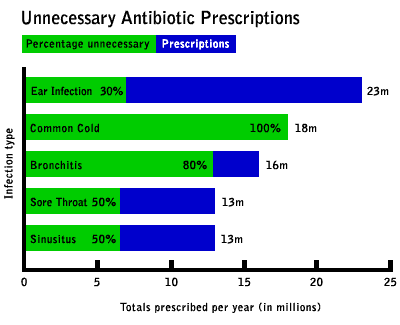
The other posters chart on the misuse of antibiotics in the US pretty much deals with the issue of overuse of antibiotics in industrial countries. However, just as big a danger, if not bigger, is the use of over-the-counter antibiotics in third world countries. People take just enough pills to feel better, and stop purchasing once they do. You end up not killing off the entire infection, and the next person exposed to these new bacteria discovers they are now antibiotic resistant.
It's even worse with TB. That requires months of intensive drug therapy, and in the third world many people simply don't take the entire course of drugs but take however much they can afford. Then they run out of money, get sick again, and start the treatment again. This has resulted in untreatable versions of TB that have fatality rates of around 80%. The problems of people with mental illness who are street people with TB in the US is similiar, it is VERY difficult to get a schitzophrenic bag lady to continue taking the drug once she feels better.
A similiar dynamic exists with AIDS, and the worst drug resistant versions are coming out of poorer countries. Even the new drugs at $1 per day out of India are too expensive for many of the poor across the world, so they buy however many they can afford. If you or I were dying, we would probably do the same. Sadly, it is creating strains of HIV that are resistance to the less expensive drugs, making the disease even more lethal.
|
|
| |
|
|
|
Geronimo
|
|
st cloud USA
Jan 1970
time: 05:34
|
|
quote:
Originally posted by mindseye
Probably part of this (especially the gov't manual) is not so much wanton disregard for world health than ignorance, incompetance, lack of available information, lack of responsibility, etc.
However, even if fully-informed, I have little doubt farmers would not make pretty much the same decision. Just as they have with GM rice which is already "illegally" making its ways into Chinese fields.
In mainland Chinese culture, personal profit takes primacy over public welfare. There really is no question on the matter. In China, it is simply normal to think that way. |
please clarify. How is the decision to grow GM crops in any way comparable to a decision to use human antiviral drugs on chickens?
In case you didn't know, using human medication to treat animals in a way that can make the medications ineffective for treating humans is bad.
|
|
| |
|
|
|
shawnmmcc
|
|
GM crops and soon-to-be animals do not have anything approaching the hazards of the agricultural use of antibiotics for cheap meat. They can pose a risk of creating superweeds and contaminating the wild ancestral genetic stock of food plants. However, they often require less, not more, of an input of chemicals or antibiotics, thus representing a mixed curse or blessing. I for one support them, as long as reasonable precautions are taken. Of course "reasonable" is the subject of much acrimony.
|
|
| |
|
|
|
LDiCesare
|
|
La Ferté sous Jouarre France
Jan 2001
time: 05:34
|
|
quote:
GM crops and soon-to-be animals do not have anything approaching the hazards of the agricultural use of antibiotics for cheap meat. |
Well, when they make crops resistant to things like round-up which is known to cause diseases in humans, GM crops can be very harmful, as they will entice people to use chemicals that the crops are immune to and men are not, and residual traces will be eaten, causing some serious damage to human health. Not to talk of the side effects of pesticides that tend to kill bees, which are themselves useful for agriculture.
|
|
| |
|
|
|
Tingkai
|
|
To find the Northwest Passage
Aug 2001
time: 13:34
|
|
quote:
Originally posted by mindseye
In mainland Chinese culture, personal profit takes primacy over public welfare. There really is no question on the matter. In China, it is simply normal to think that way. |
People the world over think that way. About 300 years ago, Adam Smith pointed out that the butcher does not sell meet for the good of the community. He does it to make money.
Of course there are exceptions. You, undoubtably, are working for free in China out of the goodness of your heart because you want to improve the welfare of the Chinese people.
|
|
| |
|
|
|
Tingkai
|
|
To find the Northwest Passage
Aug 2001
time: 13:34
|
|
quote:
Originally posted by shawnmmcc
The two worst cases of drug misuse threatening the rest of the world come in two flavors - US and now Chinese agricutural policies, and abuse of antibiotics as a quick pallitive in modern health care systems coupled with the mostly third world problem of the treatment of human infections requiring intensive drug therapy.
|
I agree in general with what you're saying, although I would say it is more than just a China problem or a U.S. problem. It's a major global problem.
The question is how do we solve the problem?
|
|
| |
All times are GMT. The time now is 05:34.
Apolyton Time is 00:34. |
top of page
|
|
|
Forum Rules:
You may not post new threads
You may not post replies
You may not post attachments
You may not edit your posts
|
HTML code is ON
vB code is ON
Smilies are ON
[IMG] code is ON
|
|
|
|
|
|






 18-06-2005 21:15


 Attachment:






 |
|