|
| |
|
| |
|

|
fairline
|
 |
of the wing
Sep 2002
time: 05:37
|
|
Eivind: sadly I've got all the info you need, and I'm willing to bet Case has an equally geeky OOB and TO&E for the forces involved. PM me and I'll get something together for you if you want the full gory detail, as my resources are books rather than websites.
It's worth noting that British divisions TO&E changed quite dramatically during the 1940-43 period. As a case in point, take the 7th Armoured Division. It was the 'Mobile Division' in 1940, consisting of a Light armoured brigade of 3 'cavalry' regiments and a Heavy armoured brigade of 2 RTR regiments (the former should have been equiped with cruiser tanks, but was mainly LTVII, while the latter had 1 Matilda regt and a cruiser regiment); support was provided by the 'Pivot Group' of 2 RHA Regts and a KRRC motorised rifle battalion. The armoured brigades became the 4th and 7th, and their constituent regiments chopped and changed many times, as did their equipment. As with other British divisions, Brigades weren't permanent members either; by '42 the 7th was an independant Armoured Brigade fighting in the Far East and had been replaced by 22 ABde. The division had also acquired an infantry Brigade by the time of Alamein (131 Bde). By the end of the campaign, Brit armd divs had become fixed at 1 armoured bde (3 armd regts + 1 mot inf btn), 1 infantry bde (3 inf btns) with support from a recce regt, 2 arty regts, an ATR and a Lt AAR. In the case of 7th Armd, the armoured Bde was the 22nd and the inf Bde was the 131st.
Generally speaking, Brit infantry divisions were simpler (although their TO&E changed also) - 3 Brigades (each 3 Btns), a recce regiment, 3 arty Regiments and other supporting elements was fairly typical.
|
|
| |
|
|
|
Case

|
 |
The backlash starts here
Feb 2000
time: 15:37
|
|
British infantry divisions are easy: they all had 9 infantry battalions (3 per brigade), 3 artillery battalions armed with 25 pounders, an anti-tank battalion and a recon battalion with armoured cars and/or Bren Carriers.
Independant brigades were typically exactly one third of a division (ie, 3 infantry battalions, an artillery battalion, a recon company, etc).
While there were no shortage of oddities (hello 2nd NZ Division!), at the level civ models things, sticking to a basic triangular model should do the job for Commonwealth infantry units.
As Gareth points out, British armoured outfits are a lot more complex. As they make my head hurt, I know nothing about them (Gareth seems to be blissfully unaware of the 7th Armoured Division's brief, and unhappy, conversion to a 'light' armoured division in 1942 equipped only with scout cars and light tanks).
www.britwar.co.uk does a good job of discussing the British WW2 TO&E (when it's working!). http://orbat.com/site/ww2/drleo/000_admin/000oob.htm and www.orbat.com/site/history/1939-45/index.html should also be useful (the first site has the complete OOB for both sides at El Alemain and Operation Torch which should be helpful)
|
|
| |
|
|
|
Case
|
|
The backlash starts here
Feb 2000
time: 15:37
|
|
quote:
Originally posted by Boco
Fairline, Case, any chance you can email your research my way, too? In the scant chance you have any holes, I may be able to dig up something. |
Sorry Dave, but I'm not doing any research on this topic - the war in North Africa isn't obscure enough for me 
I can, however, sumarise the development of the Allied OOB:
In short, the British started off the period the scenario covers with a small but well equiped and very well trained and lead force. To the best of my knowledge, this force steadily grew in numbers throughout the war, with elite units occasionally being replaced with green units and being shipped off to other theatres, ususually with terrible consequences for all the units involved (the Germans tended to go on the offensive after the good units left the line and the good units tended to be sent to meat grinders such as Greece).
While the Germans had a habit of destroying entire British brigades, and even divisions, the British were always able to quickly make good their losses and reconstitute these units, generally faster than the Axis could make good their loses. The overall quality of British units deteriorated over time, however, as green units were thrust straight into combat without training and acclimitisation.
This strategy was ultimately sucessful though, with the combination of a few good units and a massive bulk of poor units delivering Britain victory at El Alemain. It didn't result in cheap or pretty victories however.
In Civ terms, this could be modeled by giving the British a trickle of good quality units and a steady stream of poor units, with the Brits recieving poor quality replacements the first time a good quality unit gets destroyed.
|
|
| |
|
|
|
Eivind IV
|
 |
History will be kind to me for I intend to write it.
Aug 2002
time: 06:37
|
|
Why can't I find anything on the Italians anywhere? (The 55th Savona, the 27th Brecsia, the 25th Bologna, the 17a Pavia and the 132a Corazzata in particular). At least I've failed up to now browsing through the net for OOBs from the march '41 assault. That's the only thing obstructing me at the moment...
Also, Gareth, any news on when you figured all these units were reinforced during the campaign?
Last edited by Eivind IV on 03-08-2005 at 15:40
|
|
| |
|
|
|
worcesteradam
|
|
wonderfull lookings screenshot.
at least the graphics look good
|
|
| |
|
|
|
Exile
|
 |
of the Benighted Realms
Sep 2000
time: 23:37
|
|
See if you can find;
1.) the OOB for the Italian/Germans from the Avalon Hill boardgame Afrika Korps. The regional names of the Italian divisions are on those unit counters.
2.) The SPI boardgame PanzerArmee Afrika. The units in that game are regimental/brigade size and are identified by the numbers.
You can cross-check the divisional size units and their time of appearance in the first game with the timed appearance of the numbered units of the 2nd game to determine relative strength and association of individual regiments with the regional names of the divisions.
This might not be as easy as it sounds.
Here's the AH units; http://www.boardgamegeek.com/image/46654
Last edited by Exile on 03-08-2005 at 07:14
|
|
| |
|
| |
|
|
|
Bostero
|
|
more info that can be useful.
http://213.45.7.251/regioesercito/r...rcito/reorg.htm
(source in italian language)
There you have the organization and how are consisted each Infantry Division, Armored Divison, Regiments,Artillery,etc.
http://www.comandosupremo.com
(source in english )
here you have another site related to the Standard OOB, basically the divisions "Brescia, Bologna, Pavia, Savona" (all these infantry divisions) first saw actions at March-April '41 during first rommel offensives.
*The 132a armored division is the so famous "Ariete".
there is also inlcuded a forum in this page, where you can ask about everything, its very active 
hope to see this released soon.
|
|
| |
|
| |
|
|
|
Bostero
|
|
The infantry division: was the more important unit of the Italian army, had a force of approximately 13.500 men and comprised:
-general commando and quartier
-2 regiments of infantry,
-1 mortar battalion from 81 milimeter
-1 companies guns antitank from 47/32 on 4 platoons
-1 Regiment of artillery
-1 engineer company handicraftsmen,
-1 mixed company telegraphers and wirelesses oparator,
one section fotolettricisti, one medical section, one supply section, one heavy truck platoon.
i guess you are going to represent in your scen the regiments. the AT and AA and engineers could be also placed??if so, take into account the info above.
Regiment of Infantry
At the beggining of 1940, each regiment had assigned 2 battallions, but in 1941 (to reinforce the North Afrika Campaign) the Italian North Afrikan divisions received abother extra battallion. (AFAIK, the Pavia and Brescia did). So yes, Eivind, you was right when you wanted to put 3 Batalions.
The infantry regiment had a force of approximately 3.279 men and it was articulated on:
commando and headquarters company,
2 or 3 battalions of riflemen (constituted from a headquarters company, 3 rifle companies, and a subordinate infantry-support weapons company),
1- 81 mm mortar company,
1- company transported by pack animal guns from 47/32 milimeter on 3 platoons.
Regiment of Artillery
The artillery regiment was constituted:
-unit and headquarters company
-group guns from 75/27 milimeter motorized on 3 batteries of 4 pieces,
-group howitzers from 100/17 milimeter motorized on 3 batteries of 4 pieces,
-group howitzers from 75/13 transported by pack animal milimeter on 3 batteries
-antiaircraft battery from 20mm on 4 sections of 2 pieces.
This is the theorical organization of each division, of course this may variate from one date to even the next day. 3 batt per regiment? this is hard to know, but assuming the pavia and brescia had 3, the rest as well. you should go and ask to the forums. some users have good books with maps, locations of units, constant reinforcements to each division,etc.
woof, i guess this is the most i can contribute to you. 
luck.
|
|
| |
|
|
|
Eivind IV
|
|
History will be kind to me for I intend to write it.
Aug 2002
time: 06:37
|
|
Cheers Bostero!
I got some response in the forum and ombined with the info you've provided Italy is all set.
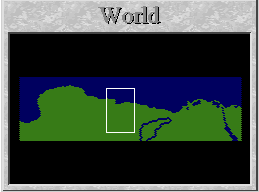
I throw the towel in. I just decided to abondon the Med theatre. I'm working on a map following these lines, with complete focus on the Libya-Egypt theatre. 
 Attachment: desert.gif Attachment: desert.gif
This has been downloaded 98 time(s).
Last edited by Eivind IV on 08-08-2005 at 13:51
|
|
| |
|
| |
|
| |
All times are GMT. The time now is 05:37.
Apolyton Time is 00:37. |
top of page
|
|
|
Forum Rules:
You may not post new threads
You may not post replies
You may not post attachments
You may not edit your posts
|
HTML code is ON
vB code is ON
Smilies are ON
[IMG] code is ON
|
|
|
|
|
|





 17-07-2005 15:21


 |
|