 |
| |
|

|
Rufus T. Firefly
|
 |
is one way of saying it, though I prefer "mensch"
Sep 2000
time: 07:36
|
|
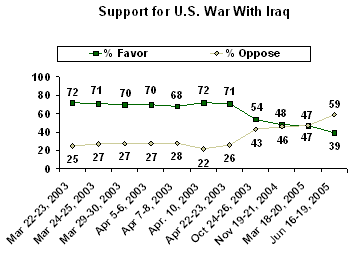
This appeared in yesterday's Washington Post, and I thought I'd pass it along. The basic argument is that support for the Iraqi War has evaporated precisely because there's no large anti-war movement in the US -- which means the Bushies don't have a domestic strawman on which to fix their typical "with us or against us," "they hate America" rhetoric.
quote:
No One to Demonize
By Harold Meyerson
Post
Wednesday, June 22, 2005; A21
In the absence of an antiwar movement, the American people have turned against the war in Iraq. Those two facts, I suspect, are connected.
There was a very real antiwar movement early on. In the months before, during and immediately after our invasion, hundreds of thousands of Americans took to the streets to oppose the intervention. Then chaos, followed by insurgency, enveloped Iraq, and the need for a constable to restore some order became indisputable. Those who had opposed the war -- this columnist included -- argued that the occupation would be less of a lightning rod if conducted by an international force under U.N. aegis. But the Bush administration insisted on U.S. control (a decision that grows less explicable with each passing day), and other nations with real armies made clear that they wanted no part of what was becoming a bloody occupation.
Confronted with a choice between U.S. occupation and chaos, millions of Americans -- chiefly liberals and Democrats -- who'd been against the war decided to give occupation a chance. In the streets, demonstrations dwindled; in Congress, Democrats (save for a handful) did not call for withdrawal. With unprecedented discipline, Democrats who had opposed the war lined up behind the candidacy of John Kerry, whose position on the war was muddled at best. The question of the occupation fell off the liberal agenda. At the Take Back America conference, a national gathering of liberals held this month, the issue barely came up at all.
In Iraq, however, the situation clarified. What had looked like a choice between occupation and mayhem was something even grimmer: The mayhem proceeds, and will proceed, occupation or no. It will doubtless grow worse if we pull up stakes, but our presence has failed to guarantee stability in politics or daily life. More than two years after Saddam Hussein's statue was toppled, the drive from downtown Baghdad to the airport is still a crapshoot with death.
Absent a discernible trajectory of progress, the American people are giving up on the occupation. In last week's CBS News/New York Times poll, 59 percent of respondents said the war was going badly, and just 37 percent approved of President Bush's handling of Iraq. A Gallup poll showed six in 10 Americans favoring full or partial withdrawal of U.S. forces.
These figures already match the polling in the middle and late years of the war in Vietnam -- even though that war was fought with vastly higher casualties and a conscript army. In a series of polls taken in November and December of 1969, the Gallup Organization found that 49 percent of Americans favored a withdrawal of U.S. forces and 78 percent believed that the Nixon administration's rate of withdrawal was "too slow." But there was one other crucial finding: 77 percent disapproved of the antiwar demonstrations, which were then at their height.
That disapproval was key to Nixon's political strategy. He didn't so much defend the war as attack its critics, making common cause with what he termed the "silent majority" against a mainstream movement with a large, raucous and sometimes senseless fringe. When Nixon won reelection in a landslide, it was clear that the strategy had worked -- and it has been fundamental Republican strategy ever since. Though the public sides with the Democrats on more key issues than it does with Republicans, it's Republicans who have won more elections, in good measure because the GOP has raised its ad hominem attacks on Democrats' character and patriotism to a science.
Which is why, however perverse this may sound, the absence of an antiwar movement is proving to be a huge political problem for the Bush administration, and why the Republicans are reduced to trying to turn Dick Durbin, who criticized our policies at Guantanamo Bay, into some enemy of the people. The administration has no one to demonize. With nobody blocking the troop trains, military recruitment is collapsing of its own accord. With nobody in the streets, the occupation is being judged on its own merits.
Unable to distract people from his own performance, Bush is tanking in the polls. And with congressional Democrats at least partly muting their opposition to an open-ended occupation, it's Bush's fellow Republicans -- most prominently, North Carolina's Walter Jones -- who are now calling our policy into question.
The lesson here for liberals and Democrats is not that they should shun oppositional politics -- after all, they confronted Bush head-on over Social Security and prevailed. My hunch is that candidates in the 2006 elections -- not to mention, 2008 -- who call for putting a date on U.S. withdrawal from Iraq will be rewarded at the ballot box. But it will probably help such candidates, and certainly confound the Bushites, if antiwar activists forget about the streets and focus on the polls.
meyersonh@washpost.com
© 2005 The Washington Post Company |
http://www.washingtonpost.com/wp-dy...5062101361.html
If accurate, this would give lie to the arguments of those folks -- like, say, Ned -- who keep arguing that criticizing the war is hurting teh war effort. The Bushies seem to be being hoisted by their own petards, and the American people seem to see that clearly.
|
|
| |
|
| |
|
|
|
Max Webster
|
|
I get the impression that the war in Iraq is going just the way the Americans want it. Sure its a tough slog and out of control in certain regions. But I hardly hear of Americans dying over there. Just how many US soldiers are dying over there on a regular basis, does anybody know. Very few I think. This low mortality rate among US troops really helps with PR at home. It seems the Iraq police and military are taking the main hits when it comes to deaths. Also it seems like the US and Iraq forces are searching for and finding insurgents all the time. Is there an endless stream of these insurgents? Everytime they engage the US forces they lose alot of their men. I think its going to take a few more months but I think once the Iraq military and police get stronger, your going to see less US ground troops. But I bet the US keeps a base there for years to come.
Seems to be alot of action these days in Afghanistan between insurgents and US forces.
|
|
| |
|
|
|
Dr Strangelove
|
|
The problem is that even if you're against the war how could you be in favor of the insurgency? I mean, my God, they're taking up where Saddam left off in the genocide department. We're stuck. If we stay the insurgency will linger on, but if we leave it appears certain that there will be a Sunni - Shiite bloodbath. In the end I can't find a reason to wish Sunni tyranny upon the Kurds and Shiites of Iraq.
|
|
| |
|
| |
|
|
|
lord of the mark
|
 |
FUKCOV - Former United Kingdom Colony of Virginia
Dec 2000
time: 00:36
|
|
quote:
Originally posted by GePap
What insurgency in Algeria? That ended a few years ago, after 100,000 dead plus.
|
"2005-06-21 Africa: North
Algeria violence claims army troops
Two army troops were killed and 13 others injured in fighting in western Algeria, reports said Tuesday. French-language daily Le Soir D'Algerie reported that the casualties occurred in the region of Kabael when explosive charges allegedly planted by armed Islamic groups blew up cutting through army patrols combing the area. The Salafi Group for Daawa and Fighting, one of Algeria's most feared groups, is known to be quite active in Kabael. In another incident, security forces rounded up 21 people in the province of Saida, 250 miles west of Algiers, on charges of offering support to armed groups, including laundering money. "
Now that was on the 21st. On the 20th we get the following:
"More casualties in Algeria violence
Three members of Algerian security forces and an Islamic gunman were killed and two civilians were kidnapped by armed groups, officials said Monday. A security source said Monday that a land mine planted by Islamic armed groups blew up under a police vehicle in the province of Galfa, 187 miles south of Algiers, killing two policemen and injuring three others. In another incident, army troops clashed with Islamist gunmen as they were patrolling an area in the same province Saturday. A soldier and a gunman were killed. The source said an armed group kidnapped two civilians at a roadblock in the province of Boumedras in eastern Algeria. The gunmen posing as security forces snatched the men from their car and took them to an unknown destination. "
Last edited by lord of the mark on 23-06-2005 at 21:58
|
|
| |
|
|
|
GePap
|
 |
of the Big Apple
Nov 2001
time: 23:36
|
|
quote:
Originally posted by lord of the mark
Right, which means that the key question in Iraq is the progress of training and equipping Iraqi forces. According to Sen Joe Biden, (D-Del) there are now about 5,000 troops who are capable of fighting effectively without US advisors or backup, another 70,000 or so who are trained and equipped but still need US advisors and back up (army and NG, excluding police, i think). IIUC he stated that there would be 160,000 or so effective Iraqi troops within 2 years. |
Which makes you wonder why, four years after we invaded Iraq, we will have a trained army less than half the size of saddam's forces before we invaded.
There are many questions you miss, like for example, the status of the 100,000 strong Peshmerga, which remains intact, or the Shia Militias which also remain armed.
As for Algeria, I was not aware the violence continued, which should actually be a sad sign, since Algeria certainly has a large trained and standing army and after 13 years they have been unable to quelch the violence, even with extreme brutality at times.
|
|
| |
|
|
|
lord of the mark
|
|
FUKCOV - Former United Kingdom Colony of Virginia
Dec 2000
time: 00:36
|
|
[QUOTE] Originally posted by GePap
"Which makes you wonder why, four years after we invaded Iraq, we will have a trained army less than half the size of saddam's forces before we invaded."
Im NOT defending the competence of everything that was done in Iraq.
Though it should be added that Saddams force was hardly a competent force through and through. Im not sure we wont have a more effective, but smaller force. Different military models, I think - iraq still followed the old Soviet approach of lots of large formations.
"There are many questions you miss, like for example, the status of the 100,000 strong Peshmerga, which remains intact, or the Shia Militias which also remain armed."
IIUC there was an agreement on the Peshmerga, that they would be integrated into a regionally controlled national guard. There is of course much I dont cover. Im making a broad picture, not giving every bit of news from Iraq. Thats the advantage of having different people post, it gives us a fuller picture.
"As for Algeria, I was not aware the violence continued, which should actually be a sad sign, since Algeria certainly has a large trained and standing army and after 13 years they have been unable to quelch the violence, even with extreme brutality at times."
Sad? Im more grimly resolved than sad. Its certainly a sign of how difficult it is to completely end a radical Islamist insurgency, even when the people overwhelmingly hate it. OTOH its also a sign that such an insurgency CAN be reduced to a level where the local security forces can at least contain it, life can go on, and folks who dont watch these things closely arent even aware it exists. My point being, that we will likely reach a stage where the Iraqi insurgency is no more threatening than the Algerian insurgency, and is equally contained by local forces, well before the body count stops creeping upward. I guess im searching for a victory metric thats somewhere between Cheneys "we killed a bunch of bad people - YAY!" and a zero level of insurgent activity.
|
|
| |
|
|
|
GePap
|
|
of the Big Apple
Nov 2001
time: 23:36
|
|
quote:
Originally posted by lord of the mark
Though it should be added that Saddams force was hardly a competent force through and through. Im not sure we wont have a more effective, but smaller force. Different military models, I think - iraq still followed the old Soviet approach of lots of large formations. |
Which if the issue were foreign wars might matter, but the issue if an internal insurgency, and large formations are useful in such a conflict.
quote:
IIUC there was an agreement on the Peshmerga, that they would be integrated into a regionally controlled national guard. There is of course much I dont cover. Im making a broad picture, not giving every bit of news from Iraq. Thats the advantage of having different people post, it gives us a fuller picture. |
And the fact that regional ethnic militias are being retained is a sign that worries me greatly.
quote:
Sad? Im more grimly resolved than sad. Its certainly a sign of how difficult it is to completely end a radical Islamist insurgency, even when the people overwhelmingly hate it. OTOH its also a sign that such an insurgency CAN be reduced to a level where the local security forces can at least contain it, life can go on, and folks who dont watch these things closely arent even aware it exists. |
The algerian insurgents udnermined themselves through immense brutality far greater than that of the insurgents. As of yet the insurgents are suing bombings, including attackes meant to fuel secterian hatred, but they haven't gotten to the wholesale massacre of villagers like in Algeria.
quote:
My point being, that we will likely reach a stage where the Iraqi insurgency is no more threatening than the Algerian insurgency, and is equally contained by local forces, well before the body count stops creeping upward. I guess im searching for a victory metric thats somewhere between Cheneys "we killed a bunch of bad people - YAY!" and a zero level of insurgent activity. |
Algeria's insurgency was and is directed against an established and powerful state, not a non-existant state. That makes it different.
Besides, the insurgency's greatest threat is not itself or even the victory of some sunni militant regime, which is the least likely outcome, but in creating a vaccuum that becomes even more conducive to secterian violence and the disintegration of the state.
|
|
| |
All times are GMT. The time now is 05:36.
Apolyton Time is 00:36. |
top of page
|
|
|
Forum Rules:
You may not post new threads
You may not post replies
You may not post attachments
You may not edit your posts
|
HTML code is ON
vB code is ON
Smilies are ON
[IMG] code is ON
|
|
|
|
|
|





 23-06-2005 10:13





 |
|