|

|
VetLegion
|
|
Have Chinese dialects diverged as much from each other as European languages have since fall of Rome? If not, it would be interesting to know why.
|
|
| |
|
|
|
lord of the mark
|
 |
FUKCOV - Former United Kingdom Colony of Virginia
Dec 2000
time: 00:33
|
|
quote:
Originally posted by Immortal Wombat
I suspect most of the problems with building an empire in Europe are due to an already highly regionalised population. Oceans are as good for preventing cultural diffusion as mountain ranges are. Italy, Greece, Iberia, Britain, Denmark, Scandanavia, Gaul/Germany north of the Alps all have good reasons to be culturally distinct from one another. Without the flow of peoples and languages and cultures, regions diverge, and become increasingly difficult to unify.
Under detailed scrutiny, perhaps the contingent reasons turn out to be at least partly geographical in nature as well. |
ya but
case 1 France - the massif central divides two very different linguistic and cultural areas, IIUC. Yet France has been united across that barrier since the the 13th c.
OTOH, there is, IIUC, substantial cultural contininuity along the Med coast, from northwest Italy, to Provence, to Catalonia - yet they have NOT been united politically.
I think purely political contingencies are quite important.
|
|
| |
|
|
|
GePap
|
 |
of the Big Apple
Nov 2001
time: 23:33
|
|
quote:
Originally posted by VetLegion
Have Chinese dialects diverged as much from each other as European languages have since fall of Rome? If not, it would be interesting to know why. |
They have diverged more.
http://www.nytimes.com/2005/07/10/i...10chinese.html?
quote:
Uniting China to Speak Mandarin, the One Official Language: Easier Said Than Done
By HOWARD W. FRENCH
Published: July 10, 2005
DATIAN, China - As a crowd formed around a rare foreign visitor in this town's open-air market, the conversation turned quickly from the price of dried fish and fresh fruit to how many dialects people here could muster.
Hoisting her cherubic 6-month-old daughter, Lin Jinchun, a 29-year-old dumpling seller, claimed that she could speak two, drawing a quick counterclaim of three from her mother, Lin Guimei.
What was the third dialect? someone asked. "Putonghua," the mother answered, counting the standard national language of China as if it were just another minor tongue. Meanwhile others, shouting above the din, chimed in that they could speak four, five or even six tongues.
As seen by many outsiders, China is a behemoth: the world's most populous country with a galloping economy and a more or less unified culture. But if Putonghua - Mandarin - is one of the world's most heavily spoken languages, in many parts of China it is lost in the mazes of local dialects.
In recent years migrant labor, which has brought about huge population movements from the hinterlands to China's prosperous eastern cities, has obliged millions of Chinese to learn more Mandarin, but by official estimates even today barely half of the population can speak the official dialect.
China has 55 ethnic minorities, many of them with cultural roots in neighboring countries. The linguistic diversity among these minorities, however, pales in comparison with the variety of tongues spoken among China's Han, the ethnic group that makes up more than 90 percent of the population. The Han speak as many 1,500 dialects, with the bulk of those concentrated in the southern half of the country.
The official view here is that all of the tongues spoken by Han are variants of one language, Chinese. But in a country with a traumatic history of civil war and fragmentation, many specialists say this theory may have more to do with politics than with linguistic reality. Many of the Han dialects are almost entirely mutually incomprehensible, more distinct than languages from disparate regions of Europe.
"No one can clearly answer the question how many dialects there are in China," said Zhang Hongming, a professor of Chinese linguistics at the University of Wisconsin who is in China doing fieldwork. "The degree of difference among dialects is much higher than the degree of difference among European languages. In Europe they call them languages, but in China we share a culture, so the central government would like to consider that one language is shared by many different peoples. It is simply a different definition."
Linguists say the Wu dialect widely spoken in Shanghai, to take one prominent example, shares only about 31 percent lexical similarity with Mandarin, or roughly the same as English and French.
The encounter at the Datian market began when the dumpling seller approached the foreigner with a phrase that sounded like "goodbye" in the Wu dialect. Knowing it must mean something else, the foreigner guessed she was asking his name, and provided it, producing a laugh from the woman who explained, switching to Mandarin, that she had asked if he had eaten lately.
For China, the consequences of this linguistic fragmentation are immense. Although no one in government says that local languages should be eliminated, there is a growing awareness that the country's national construction cannot be considered complete until all Chinese can speak a common language, which remains a distant goal.
Indeed, a government survey published last year said only 53 percent of the population "can communicate in Putonghua." In recognition of this fact, broadcasters commonly include subtitles - the meaning of Chinese characters is stable, even as spoken dialects vary - on television programs here to help people overcome comprehension problems.
A 2001 national language law decrees that Mandarin be used in all mass media, government offices and schools, and bars the "overuse" of dialects in movies and broadcasting.
Even by the standards of China's complicated language matrix, Fujian Province stands out for its richness, a dense thicket of tongues laid down by waves of migration over time from central China.
"We have an expression, that if you drive five miles in Fujian the culture changes, and if you drive 10 miles, the language does," said Zhang Zhenxing, a linguist from Fujian at the Chinese Academy of Social Sciences in Beijing. "In recent years, because of economic growth things have been getting better, but there are still an extraordinary number of dialects in Fujian."
If Fujian Province can be said to have a Babel, tiny Datian County can stake a pretty solid claim. In this 800 square miles of rural central Fujian, where fields of rice and tobacco grow in the shadow of tall mountains, no fewer than five dialects are spoken in addition to Mandarin.
To drive a few miles down the road from one village to another is indeed to plunge into a new linguistic universe. Things can be as confusing for someone from the next town as they are for the total outsider.
In one village near the county seat, where an old Daoist shrine sits high above the roadside, a man who said he spoke southern Min, one of Fujian's most widely spoken dialects, tried to exchange words with some boys who said they also spoke southern Min. A few words from each side, however, sufficed to show they were mutually unintelligible.
Chen Wenxian, a shopkeeper in his late 20's in another village, grimaced with incomprehension when a driver pulled up and inquired about the price of shoes in his glass display case. The two switched into heavily accented but mutually comprehensible Mandarin.
Mr. Chen, slouched in his chair behind his counter, shrugged when asked the name of the village's language. Consultations with a cluster of family members did not unearth a name either.
"It's just what we speak here," he said. Asked if he could understand the language in the next village, a short distance down the road, he said: "I have no idea what they speak. Those people talk too fast." |
|
|
| |
|
|
|
GePap
|
|
of the Big Apple
Nov 2001
time: 23:33
|
|
quote:
Originally posted by Berzerker
Gepap
Pretty smart, huh? It is dangerous if you need a long time to adapt and people wont help. But you keep assuming the Bushman gets help but wont allow the New Yorker help. from Bushmen. The point is the NYC system is more complicated than the Bushman's system. I believe more isolated peoples were just far enough away from sufficient contacts for their traditional lifestyles to survive. Technology expanded thru war and trade and the crossroads of the old world had plenty of contact. Civilisation spread out from those crossroads... |
I don;t assume the Bushman gets a lick of help. Tens of thousands of people live in the streets of New York without help from anyone, yet one does not see large numbers of people dying from the elements in NYC. The same is not true of the Khalahari.
quote:
True, but the slavery example mimics both eugenics and survival of the fittest. |
Not natural selection. In human driven processes, the choices are based on human needs and ideas- people breed for the traits they consider best- which might not actually be best, since men could be mistaken. Natural selection is far more rigorous and less driven by ideology.
quote:
We didn't get to see the farmers in the show, they just showed an aerial shot. But I didn't say New Guinea was easier than NYC, I said it wasn't that demanding, i.e., closer to NYC than the Kalahari. |
They did show the farmers0 those people hacking at the Taro.
While the availability of water certainly makes the jungle a slightly easier environment than a desert, it does not make it "easy" by any stretch.
|
|
| |
|
|
|
GePap
|
|
of the Big Apple
Nov 2001
time: 23:33
|
|
quote:
Originally posted by Drake Tungsten
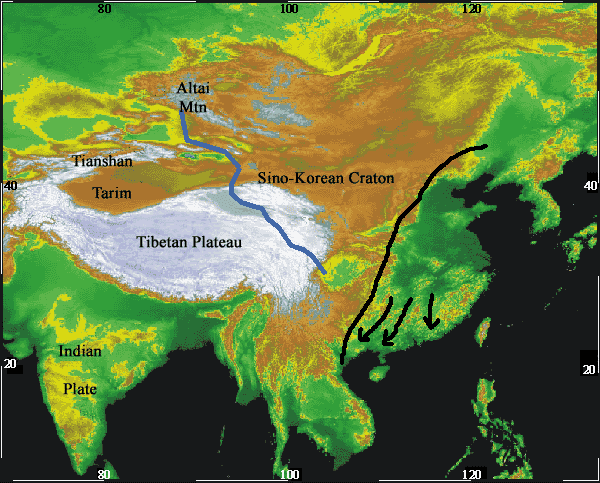
Here's another map for you.
http://www.china.org.cn/english/en-...004/zr/gq20.htm
This one has the added bonus of showing a significant portion of Japan. I don't think anyone would deny that Japan is a mountainous country and was quite difficult to unify because of it. Looking at the map, you can see that the mountains in southern China are comparable to those in Japan. If you throw in Sichuan, which you left out of your cordoned off area above but which was very much a part of historical China, you'll find that southern China is more formidably mountainous than Japan is. |
The issue is what kind of barrier will the mountains make. Just looking at that map, the funny thing is that the mountains in Southern China are not labelled as being part of any chain, and for the most part, from the coloring, they fall under 3000 feet in altitude. So you don;t have chains of 10,000 feet high peaks cutting southern China of from northern, like you do, say, Italy or Iberia from the rest of Europe.
quote:
Basic point being that China is at least as topographically diverse as Europe, if not more so. Any claims that China is "relatively flat" and easily unified while Europe is not simply do not conform to the facts. |
Greater China, certainly. Historic China, not as much.
|
|
| |
|
|
|
GePap
|
|
of the Big Apple
Nov 2001
time: 23:33
|
|
quote:
Originally posted by Drake Tungsten
1000m is 3,281 feet. 2000 meters is 6,562 feet. So, even at the low end of the scale, very few of the mountains in southern China fall under 3000 feet in elevation, as you mistakenly claimed. |
The tallest peaks in most of southern China are in the 1500 Meter range. Those are the peaks, ie, the tallest possible parts. Meaning the land around, you know, that land people live in and will ride around in, is 3000 feet or less.
Maybe you should go out and buy yourself a good, detailed Atlas and look at it....
quote:
You live in a funny world, GePap. Mountain ranges are "relatively flat" and being completely wrong somehow becomes being "generally right"...  |
Oh Potemkin, its funny when your point falls flat.
And if you forgot, the point is what kind of obstacle would those mountains pose.
|
|
| |
|
|
|
GePap
|
|
of the Big Apple
Nov 2001
time: 23:33
|
|
quote:
Originally posted by Drake Tungsten
quote:
The tallest peaks in most of southern China are in the 1500 Meter range. |
The map gives you average elevation! So, obviously, the average elevation in a huge section of southern China is more than 3000 feet. In most cases, it is far more than 3000 feet, up to over twice as high.
Good lord, why am I even explaining this?  |
Unlike yourself, I actually have access to maps at home detailed enough to point to most villages under 10,000 people in Southern China.
Average elevations are just that, so if 60% of the lanbd is 2000 Feet or less and 40% of the land is 5000 feet or more, then the average would be 3200 feet. Or are you unaware of the meaning of average?
If I wanted to go from Nanjing in Jiangsu province to Nanchang in Jiangxi province, I never really have to go over land more than 500 meters high, just head south to Wuhu on the Yatntgze, then follow the river southwest to Jiujiang, then south along the shores of Poyanghu lake.
|
|
| |
|
|
|
shawnmmcc
|
|
Before you two pull out trebuchets and fire at 200 paces - maybe the issue is the number of rivers and mountain passes in China. The issue is not just the mountains - passes and communications through them are just as iumportant. I don't know, that is the kind of localized info natives know.
To give you an idea, the Appalachians are sigificantly lower than the Rockies, but due to the broken nature of the Appalachians and the extensive tree cover, having an aircraft emergency out of range of an airport is actually more dangerous in the Appalachians. In the same vein for this discussion - which mountains are more effective barriers to trade and armies?
The barrier aspect is the real issue. Huge mountain ranges with multiple passes that are not all defensible by the same country are actually a worse barrier than a lower range with crap access. If you want to look at how big a pain mountains can be, look at the Civil War campaigns in Eastern-Southeastern Tennesseee. Now, I haven't got my Atlas, nor am I a caravan trader or a general for a pre-gunpowder army. How do the mountain ranges stack up in that context?
|
|
| |
|
| |
All times are GMT. The time now is 05:33.
Apolyton Time is 00:33. |
top of page
|
|
|
Forum Rules:
You may not post new threads
You may not post replies
You may not post attachments
You may not edit your posts
|
HTML code is ON
vB code is ON
Smilies are ON
[IMG] code is ON
|
|
|
|
|
|






 13-07-2005 16:39








 Attachment:


 |
|