|
| |
|

|
lord of the mark
|
 |
FUKCOV - Former United Kingdom Colony of Virginia
Dec 2000
time: 00:33
|
|
quote:
Originally posted by GePap
:Like a drew on one of those maps, the mountains in southern China are dotted with passes, so they are not nearly as significant a barrier as say the Alps, or the Pyranees. I don;t know how much of an obstacle the Carpathians and the ranges of the Balkans are. |
Oddly, though, the Romans seemed to have managed to work around both the alps and pyrenees, and their is more cultural continuity between Catalonia, Provence, and Nothwest Italy, then there is say, between northern France and Germany. Again, I suspect the importance of the sea connections via the Med is neglected.
|
|
| |
|
| |
|
| |
|
|
|
GePap
|
 |
of the Big Apple
Nov 2001
time: 23:33
|
|
quote:
Originally posted by lord of the mark
Oddly, though, the Romans seemed to have managed to work around both the alps and pyrenees, and their is more cultural continuity between Catalonia, Provence, and Nothwest Italy, then there is say, between northern France and Germany. Again, I suspect the importance of the sea connections via the Med is neglected. |
Mountains are not impassable, but they do make for worthwhile barriers-why borders, specially why borders tend to follow them for so long.
Yes, the Romans crossed both of those, and Alexander crossed the Zagros mountains, and the Mongols had a huge land empire. That these things happen does not invalidate any notion that geography can be a strong barrier.
|
|
| |
|
|
|
GePap
|
|
of the Big Apple
Nov 2001
time: 23:33
|
|
quote:
Originally posted by Drake Tungsten
quote:
So in short, you want to debate the micro-issues and ignore the macro-issues |
I only wanted to correct a glaring falsehood on your part. This whole discussion would've been over a long time ago if you were capable of admitting you are wrong... |
The issue is political unity and how geography takes a role. The maps you showed from wikipedia show that China;s culture begins in the flat north, unifies, then spreads eastward and southward, southward first long the many river valleys though the mountains.
As for your assertion that China is somehow more topographically diverse than Europe, this is false, and why is aid relatively. For example, this is Spain:

NOte how most of the country is over 1000 meters in height, making it as mountanous as Southern China.
her is greece:

Here in the Northern Balkans, parts of Italy, and the Alps"

So the south of Europe is very rugged, and the northern flat plain is then cut by large rivers like the Rhine, then the Elbe further, then the Oder, so forth.
So, one, the historical China is not more mountanous that Europe as you claim. And the issue remains how the geography of Europe makes it harder to unify the place.
|
|
| |
|
| |
|
|
|
molly bloom
|
 |
Lundenwic
Oct 2001
time: 15:33
|
|
quote:
Originally posted by GePap
Europe did not "want" to colonize anything. Where the hell do you get that notion?
|
Well, at times European states or peoples were willing to 'colonize' various non-European territories- even those seen now as marginal- and in the face of determined opposition from native inhabitants- the Normans established kingdoms in England, northern France, Sicily and attempted to seize parts of North Africa, the Middle East and southern Italy and Greece.
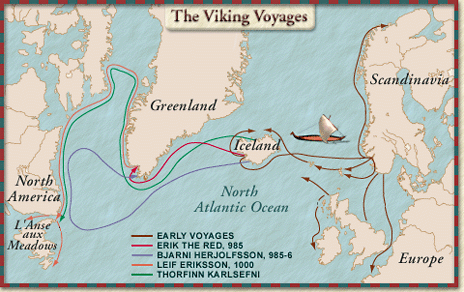
Their predecessors, the Vikings, were willing to colonize the Faeroes, Iceland, Greenland and even to have a stab at Newfoundland, as well as creating the Danelaw in eastern England, and kingdoms based on Jorvik and Dublin and the Isle of Man.
The Teutonic Knights were willing to 'colonize' areas of northern Europe- despite fierce opposition from Prussians, Poles, Lithuanians and Russians.
quote:
"Vikings: The North Atlantic Saga," a travelling exhibition produced by the National Museum of Natural History, is about an extraordinary people who set out from their European homelands for unknown places beyond the horizon, including North America, 1000 years ago. This remarkable territorial expansion has recently become far better understood from historical, archaeological and environmental research. Presented through a spectacular array of artifacts and archaeological finds, the exhibit explores a previously unknown chapter in the history of North America. |
http://www.mnh.si.edu/vikings/start.html
 Attachment: vikingvoyages.gif Attachment: vikingvoyages.gif
This has been downloaded 100 time(s).
|
|
| |
|
|
|
shawnmmcc
|
|
I first wanted to bring up the aspect that all mountain barriers are not equal impediments. I have a paticular loathing for so-called colonists, the last true human colonists on any scale were the people who crossd over the Siberian land bridge into North America at the end of the last Ice Age (and there may have been small struggling human communities in NA before them). Everything else has been conquest at best, while ethnic cleansing and genocide have hardly been rare. Colonists my a**.
|
|
| |
|
|
|
Adam Smith
|
 |
Maryland, USA
Jan 1970
time: 00:33
|
|
I wonder if the argument about centralization has things backwards. China might have been easier to conquer but it was much more difficult to govern. The basic argument in this thread seems to be that centralized government meant that the Chinese were condemned to live with bad governmental decisions. But that only applies if the government�fs decisions could be made to stick. One link off the Wikipedia article Gepap posted contains the following:
quote:
The Hai jin (ŠC‹Ö) was a ban on maritime activities during the mid-Ming Dynasty of China. Indeed to curb piracy, the ban was ineffective and posed huge hardships on communities of the coast. After extreme pressure from the bureaucracy, the ban was lifted by 1550.
Some have argued that the Hai jin marked a retreat from maritime activities such as the voyages of Zheng He and was a symptom of a period of technological decline and stagnation which culminated in humiliation against Europe in the 19th century. This view was popularized in the Chinese film River Elegy.
Most current historians of China take issue with this view, and point out that the Hai jin was lifted in the mid-Ming and that China was very active in maritime commerce and the global economy after that.
Retrieved from "http://en.wikipedia.org/wiki/Hai_jin"
|
This would seem to indicate that, centralization or not, the Emperor�fs ban was rescinded after pressure from another part of the government, and did not have a huge effect.
An alternative hypothesis is that China was too large to be effectively governable given the transportation and communication technologies of whatever the time. As the saying goes, �gThe mountains are high and the Emperor is far away.�h The fact that most new dynasties began by trying to improve the transportation and communications infrastructure would suggest that at least the initial rulers understood the nature of the problem. But with transportation and communication difficult, the initial reforms of each dynasty were gradually eroded by corruption, resulting in a cycle of higher taxes, tax evasion, and eventual fiscal collapse (often abetted by flood, drought, or threat of invasion). (In Europe was the HRE / Hapsburgs too large to be effectively governable?)
It might be argued that Chinese centralization limited risk taking and the development of ideas. A Chinese Columbus, once refused, would have had nowhere else to seek a patron. Confucius wanderings during the Warring States period would also seem to support this argument. But I don�ft think this argument holds up. Even during periods of centralized Chinese rule, there were other alternatives within China, due in part to the difficulty of governing effectively. Reformers such as Li Yuan (founder of the Tang dynasty) and generals such as An Lushan (rebelled against Tang Dynasty) built up power bases in remote provinces. Powerful regional families affected imperial politics innumerable times. A Chinese Da Vinci, refused by the Emperor, could easily have received patronage from one of these families.
|
|
| |
|
|
|
Epublius Rex
|
|
quote:
Originally posted by JohnT
quote:
I have quoted only part of what you quoted, and my bit does not include the word racist at all. So what the frak are you talking about? |
However, China was just as advanced as Europe in the 1500's (probably more so) and had their sailing fleets ready to take over the world... until China stopped supporting their oceanic voyages in favor of more localized (SE Asia) trade. The fact that China was a monolithic state might have hindered it in the 15th century, but it doesn't necessarily mean that they couldn't do it because of a lack of GGS. They just didn't. |
WHat proof do you have for that? Chinese Junks are woefully suited to plying the North Atlantic- less so then the cumbersome Spanish Galleons that floundered so notably when they tried to invade England. The Chinese were not more advanced then Western Europe in 1500- they were still living, in all ways, like the Europeans were in the 1200's.
They had no cannon on the ships and thus even the Venetians were a more powerful naval force then the Chinese. They had no guns and thus could not hope to achieve a significant landing by sea of an invasion force.
I suspect you are referring to the book that makes claims of a giant Chinese flotilla circumnavigating the globe long before Europeans- a book that even the Chinese themselves scoff at. Like GGS, that book makes fantastical claims while negating facts that are clearly in front of everyone. The Chinese did not even have plumbing in 1500- something that existed in Europe for several thousand years at that point.
|
|
| |
|
|
|
Epublius Rex
|
|
quote:
Originally posted by Berzerker
Put a Bushman in NYC and see how smart he is... Put a New Yorker in the Kalahari and...you get the picture... |
You get yet another 3rd worlder on refugee status welfare maybe driving a cab in the former case, you get the British Empire in the later case.
Cultural relativism has it's roots in Marxian philosophy- it has no place in science.
|
|
| |
|
|
|
Epublius Rex
|
|
Some people here are forgetting that Europe was invaded many times over the millennia- some took a hundred years to drive out, but drive them out they did. The Turks last tried to invade Europe proper by attempting to take Vienna in the year 1683.
http://en.wikipedia.org/wiki/Battle_of_Vienna
Which again, makes GGC a joke. He acts as if Europe were totally immune from what they "inflicted" on the rest of the world, they were not- they were just better at defending themselves against it.
Furthermore, the Europeans had long gone east in search of trade before they ever went West- as a main force. The wealth and military superiority of Western Europe was already a fact when Columbus set sail for the "New World". The so called "vast resources" that were "stolen" from the "Native Americans" already existed in other places- including Europe. The one resource that Europe ever lacked was gold- none exists there in a natural state.
|
|
| |
|
|
|
Epublius Rex
|
|
Another note-
A major difference between the East and the West is the East's dependence upon unquestioning loyalty to tradition- never questioning why someone does something, only simplistic acceptance of it. Ancestor worship is a classic example of this.
The West, on the other hand, has taken great pride in questioning everything. That is the foundation of science and discovery.
|
|
| |
|
|
|
Epublius Rex
|
|
quote:
Originally posted by shawnmmcc
I first wanted to bring up the aspect that all mountain barriers are not equal impediments. I have a paticular loathing for so-called colonists, the last true human colonists on any scale were the people who crossd over the Siberian land bridge into North America at the end of the last Ice Age (and there may have been small struggling human communities in NA before them). Everything else has been conquest at best, while ethnic cleansing and genocide have hardly been rare. Colonists my a**. |
I agree with that-
You see, I believe that in NA, there were small, struggling communities of neolithic peoples in 1600, when a wave colonialists bringing superior technology, education and edification showed up in NA and tried to share it with a people who were very war like and insisted upon attacking remote settlements.
Today, in Europe, there are a great many non-indegenous ethnic groups attempting to colonize it. Most of these are from the Middle East and bring with them not only a foreign culture and backward belief systems, but also a foreign religion which, as stated by the leaders, seeks to impose itself and it's morals on the people of Western Europe. I believe they seek to do this through migration as well as violent overthrow.
What do you think of that?
Oh, BTW, Hannibal proved mountains were not insurmountable. But the Romans found it easily enough to counter the threat of his Elephants with man made engines of war, rather then relying on mother nature to aid them.
java script:smilie(' ') ')
|
|
| |
|
| |
|
|
|
Epublius Rex
|
|
quote:
Originally posted by JohnT
It was precisely this sort of answer which Diamond wanted to avoid and which GePap finds so abhorrent, for it implies that ones culture has to do with your relative success or failure as played out on the historical stage.
I agree: culture matters. It's not enough to have plenty of metal, ocean-going armed ships and other assundry technologies, and a relative immunity to (say) smallpox, you have to want to use those things as well. |
Yes, I agree. His view is ultra simplistic and is nothing more then another diatribe against Western Culture.
I would also look askance at anything which suggests that China was capable of doing the same as Europe has done- it was more then a simple lack of desire. China did invade Japan many times as well as korea- China is an Empire. My view was that China spent itself long before and was content to live in isolation, with the court historians making things up to appease the Emperor's xenophobic natures. It was an order of the court for the official historians to fabricate history in order to preserve the belief that China was the center of the world and that the Chinese were the "chosen" people of intelligence and knowledge. The last thing they were going to do was admit that these strange fellows showing up with round eyes were superior- it would have meant their heads would role. Today, the Chinese even assert the notion that they invented Iron.
And, in that regard nothing has changed. China's current Stalinist taskmasters are also at great pains to silence history:
http://www.pbs.org/wgbh/nova/transc...02chinamum.html
It seems as though the ancient Chinese owe all of their rise from the neolithic period to the bronze age by a non Chinese people. This had always been surmised, as there were no "early" findings of artifacts in China as there were on the steppes of Russia and Anatolia. Instead, we find in China, a sudden jump from the stone age to the high bronze age with no finds in between. One wonders how much else they later got through trade. It is known that Alexander at "touched" them and it is known that both the Egyptians and later the Romans traded with them. But when the West was cut off from trade with China via the collapse of the Roman Empires and the spread of Islam, China stagnated and remained as such until modern times when an infusion of Western technology allowed change to once again commence.
All wonderful food for thought.
|
|
| |
|
|
|
Epublius Rex
|
|
quote:
Originally posted by Kuciwalker
I know.
IIRC, the important cultural aspects he mentioned were those of capitalist-style (used very loosely) competition, which derived from the previously mentioned diversity of Europe, which was derived from the geographic barriers in Europe. |
The problem with that is this- the Chinese were capitalists as well- they had no problem with trade, as long as it was on their terms.
I would not call Arabs Europeans and they were great traders as well- you know, Caravans? The Indians in India and North America all liked trade too. What they lacked was the ability to control their markets. China had that ability as did Europe. Sub-Saharan Africa and the Americas did not. China lost that ability when England sent a fleet up the river and took the capital and the Emperor. What is so amazing, is how easily they did it.
You know, when India had a population of 300 million, there were never more then 3 million English men, women and children there to hold down the Empire. Think about that one. There is no way that guns alone could explain that, particularly in the age of the single shot musket or breechloader.
|
|
| |
|
|
|
Epublius Rex
|
|
quote:
Originally posted by JohnT
Which explains the capitalistic tendencies of, say, pre-modern Japan, a country that had banks, currency, a national market with free trade in agricultural and manufactured products? Of course, it wasn't exactly as European capitalism (the merchant had a lower social standing in Japan than in Europe, for example), but it wasn't so different as to be unrecognizable for what it was. |
Originally, the merchant class was also looked down upon in Europe. They were the ugly bourgeoisie of Marxian lore. They did not achieve social status until the great sociological turnover in the political spheres which involved the institution of democratic forms of government. England being amongst the first, but also some German states as well. That's why their status arrived late in places like Russia, where feudalism persisted longer.
The biggest impetus to the rise of the merchant classes in Europe was warfare. When armies were small, Kings could make war without loans. But as the armies grew ever larger, the need to borrow money grew as well. Hence, the rise in importance in the merchant class, which was the birth of the middle class. As Europe began to look beyond itself for new territories and trade routes, it again looked to the mercantilist. India is a classic example of Western capitalism in it's highest form. The East India Company was formed in a London pub, established a board directors, sold stock to raise money and hired unemployed English soldiers to go out and conquer a continent. It wasn't until nearly 400 years later that it actually came under the control of the British EMpire and it's government. The British East India Company is still considered the most successful capitalist venture of all time. Not even Microsoft or IBM comes close.
Of course military mechanization hastened all of this, as well.
|
|
| |
|
|
|
GePap
|
|
of the Big Apple
Nov 2001
time: 23:33
|
|
quote:
Originally posted by molly bloom
Well, at times European states or peoples were willing to 'colonize' various non-European territories- even those seen now as marginal- and in the face of determined opposition from native inhabitants- the Normans established kingdoms in England, northern France, Sicily and attempted to seize parts of North Africa, the Middle East and southern Italy and Greece. |
And the Chinese "colonized" all of southern China, and Sichuan, Yunnan, Tibet eventually then the western deserts-they colonized Taiwan, they took over parts of nothern Vietnam for a while.
The Inca took the altiplano, the Aztecs expanded their empires continually.
JohnT is trying to paint a cultural difference. Territorial expansion is NOT a dervative of culture. Otherwise one might as well say the Mongols were the pinnacle of western culture, or the Arabs.
|
|
| |
|
| |
All times are GMT. The time now is 05:33.
Apolyton Time is 00:33. |
top of page
|
|
|
Forum Rules:
You may not post new threads
You may not post replies
You may not post attachments
You may not edit your posts
|
HTML code is ON
vB code is ON
Smilies are ON
[IMG] code is ON
|
|
|
|
|
|






 15-07-2005 16:45





 I'm smelling bullshit here.
  |
|