|

|
sophist
|
|
If there are 11 civs on the other continent, chances are they're too busy fighting each other to rush over to your continent and attack you. Sending a big enough force to take you down, even weakened, would leave them too vulnerable to their local enemies. That's especially true given how bad the AI was at waging overseas wars in Civ3.
|
|
| |
|
|
|
H Tower
|
|
any implementation of this in the game would cause players to beeline for medicine or whatever tech would eventually put a stop to this. The number of plagues described happening above would ruin the game for me, but if only one or two occurred in the game using a lot of civs, that might not be so bad.
|
|
| |
|
|
|
sophist
|
|
Think of it as a way to balance the ridiculous advantage that the first player to make contact has. In Civ3, it was in your best interest to go traipsing around the world and discover every civilization in it. That was both unrealistic and hugely beneficial. However, if you risk infecting your people with a plague every time you encounter a new nation, it becomes more of a cost/benefit trade-off, as opposed to unvarnished benefit. On the other hand, you also face a risk every time a civ you know makes a contact you don't know, so maybe it doesn't balance out.
The beeline to Medicine could be countered by it only reducing, not eliminating plagues. Sanitation is far more important for that. In addition, the benefits wouldn't come from just having the tech, but also from having the improvements allowed by the tech. Hospitals, sewage systems, aqueducts, etc. all would work to reduce the effect of a plague.
|
|
| |
|
|
|
sophist
|
|
Er... only if they program the AI to behave that way. They wouldn't, though, because that would be really annoying and unfair if plagues were in the game.
|
|
| |
|
|
|
H Tower
|
|
quote:
Originally posted by sophist
Er... only if they program the AI to behave that way. They wouldn't, though, because that would be really annoying and unfair if plagues were in the game. |
then that's exactly what they would do.
|
|
| |
|
|
|
sophist
|
|
quote:
Originally posted by molly bloom
Better sanitation reduces the likelihood of certain killers- cholera, typhoid, dysentery- but then so does improved personal hygiene.
Better sanitation (or at least reservoirs of potable drinking water) helped the mosquito population to thrive in ancient and mediaeval Sri Lanka, and better sanitation would not necessarily eliminate smallpox or bubonic plague, or influenza- three big historical killers.
|
I lumped that all under Sanitation since Civ doesn't have a separate tech for Bathing and Not Being Gross.
quote:
Originally posted by H Tower
then that's exactly what they would do.
|
Do you think maybe then the problem is the programmers, not the plagues? You can make every single feature annoying, too powerful, too weak, etc. If it's implemented badly, don't blame the feature, blame the implementors.
|
|
| |
|
|
|
ShaboobalaKhan
|
|
I don't think the plague would be a whole lot of fun.
Nothing bothers me more than having a city lose inhabitants to disease because they haven't figured out mosquito nets in civ 3
|
|
| |
|
|
|
Alexander D
|
|
extend that thing of disease to units in foreign territory. Also it would be a good idea to increase the chance of disease if swamps or jungles are nearby, affecting either units or cities.
|
|
| |
|
|
|
molly bloom
|
 |
Lundenwic
Oct 2001
time: 15:37
|
|
quote:
Originally posted by Alexander D
extend that thing of disease to units in foreign territory. Also it would be a good idea to increase the chance of disease if swamps or jungles are nearby, affecting either units or cities. |
Not just the tropics though: Napoleon's Grand Army marching on Russia were severely afflicted by scorched earth tactics and lack of potable and clean water, leading to great outbreaks of typhus.
quote:
Within a few days of crossing the Niemen, several soldiers began to develop high fevers and pink rashes on their bodies. Typhus had broken out in the Grande Armée, and, because of this scourge, most soldiers would not see Moscow. |
quote:
Typhus has always been associated with war. Indeed, one of its many colloquial names is war fever. Zinsser (1934) stated, "Typhus had come to be the inevitable and expected companion of war and revolution; no encampment, no campaigning army, and no besieged city escaped it." Rickettsia prowazekii (da Rocha-Lima), a bacterialike organism, causes the dreadful disease. The human body louse, Pediculus humanus L., has been a scourge to humans for centuries. It transmits typhus to humans and humans return the "favor" by infecting the louse, which is also a victim of the disease, seldom surviving its attack. Typhus truly is a disease of humans and lice; no animal reservoirs are known to be involved in the disease cycle. |
http://scarab.msu.montana.edu/histo...phus_russia.htm
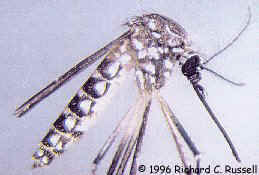
Tropical diseases saw off many of the first Europeans to explore West Africa and the Indonesian archipelago, and yellow fever transmitted to the Caribbean carried off American troops in the Spanish-American War.
quote:
American soldiers were jaundiced and running high fevers (the term Yellow Fever stems from the combination of jaundice and fever). In its advanced stages, victims often vomited dark blood, giving the deadly malady another nickname..."the black vomit". Secretary Alger ordered General Shafter to separate his forces into two camps: the sick camps, and the well camps. The largest of the sick camps was the makeshift tent hospital at Siboney. Those who were well, did their best to keep a distance from those who were sick. |
http://www.homeofheroes.com/wallofh...15_closing.html
 Attachment: aedesaegypti.jpg Attachment: aedesaegypti.jpg
This has been downloaded 94 time(s).
|
|
| |
|
|
|
The_Aussie_Lurker
|
|
Adelaide, South Australia, Australia
May 2001
time: 05:37
|
|
I have to say that I never did understand why players were so hostile to plagues being introduced in Civ3. I never play the game without plagues being on-and when I do suffer from them, I just play on until I get over it! If I had a complaint about Civ3 plagues, it was that there felt like an 'all or nothing' approach to it. I reckon that with the health system they will have in Civ4, plagues can be given greater 'gradations' of intensity-where how quickly it spreads, and how long it lasts-or even whether it occurs or not-will depend on the overall health of your nation. This way, players can have a greater role to play in reducing the impacts of plagues-thus increasing the realism of the game, whilst at the same time making the whole thing a lot fairer.
Yours,
Aussie_Lurker
|
|
| |
|
|
|
sophist
|
|
In some ways, it might be better for game balance to extend and strengthen the current disease from flood plains and jungles. Civs that live there would hurt from it, but it would also provide a natural defense against invaders. Of course, that presupposes modelling immunities as well, but that shouldn't be hard. Instead of having one generic disease, perhaps they should have a number of them (say, seven?) that are prevalent in certain areas of the world. People who live there suffer, but eventually garner an immunity, but there is occasionally an outbreak that spreads along their trade routes to other areas.
|
|
| |
|
|
|
Alexander D
|
|
I'd say one (potential) disease type per continent (the further the better) per epoch. Like in America, before the spaniards arrive, and with the Black Death, these diseases were carried from one continent to another by either a trade route or just exploration. Just assign a random number associated with "first contact" with a civilization overseas to unleash a epidemy. Also, in time to time, a random number can pop-up a disease that connect two civilizations that already have contact, like China and Europe.
Cities near jungles are a interesting thing: As a rule of thumb, I'd say for the city located near or in flood plains or jungles, if the civilization that founded the city is originary of the area, a certain immunity level is assigned (valid for the area only), if not, inmunity can be archived after many turns (say 20 generations). To keep things simple, just a immunity factor to continental diseases is set for each city at the time of the founding. Also another immunity factor is set for the entire specific civilization, based on the location of their original city and valid for the continent they are in. If that civilization starts spreading to other regions (i.e., other continents or portions far away) the immunity factor for new cities will be lower, and when this factor is compared against the terrain health hazard, and if lower, a smaller growing rate can be used there.
|
|
| |
|
|
|
sophist
|
|
Give each citizen of a city a degree of immunity (0-100, say) for each of the seven diseases. Then it's a die roll to see who dies if the disease appears in a city. Settlers and Workers are built using citizens, so they bring along whatever immunity the citizens have. New citizens and units constructed by a city have the average immunity of the city in which they appear. A citizen's immunity changes randomly over time (mutation). Certain scientific discoveries (Vaccination, for instance) increase citizens' immunity.
The spread of disease is a little trickier. Is the disease carried or does it spawn randomly from time to time? In the former case, anytime two foreign units come into contact (or a unit with a city), with contact being defined as being in neighboring tiles, any diseases carried by one will be transmitted to the other. Diseases should also spread along trade routes.
Edit: Also, I'm realizing that most people are assuming that the only outcome of plague is death. Even the worst plagues had "only" about a 33% fatality rate, and that only in some places. Many people didn't get infected, and many of those didn't die. So maybe what happens with a plague is that some number of citizens become sick. Sick citizens can't work. Then some number of them die and the rest recover.
Last edited by sophist on 03-08-2005 at 19:22
|
|
| |
|
|
|
sophist
|
|
quote:
Originally posted by Impaler[WrG]
I realy dont think theirs much need to do disease and Imunity at any levele lower then Empire wide. If plauges jump from city to city then eventualy your whole empire will be effected anyway. Its just simpler to make a Plauge hit your whole empire at once over the course of several turns. The destruction can be spread out so no one city is ruined completly but the whole empire feels a big sting overall.
|
You still need some reasoning about how the disease spreads and how hard it hits. This kind of mechanism also makes it clearer to the player what is happening, giving them the ability to manage it. I think players would find it frustrating if it was completely random, and they were completely powerless to do anything about it. The way I describe is mostly deterministic and suggests ways that a player could protect his/her civ from such an epidemic. A player should be able to make sense of it.
Candidates for diseases in the game:
Bubonic plague
Smallpox
Cholera
Typhus
Influenza
|
|
| |
|
| |
All times are GMT. The time now is 05:37.
Apolyton Time is 00:37. |
top of page
|
|
|
Forum Rules:
You may not post new threads
You may not post replies
You may not post attachments
You may not edit your posts
|
HTML code is ON
vB code is ON
Smilies are ON
[IMG] code is ON
|
|
|
|
|
|






 24-07-2005 17:08
![Visit Impaler[WrG]'s homepage!](/forums/images/homepage.gif)









 |
|