|
| |
|

|
sophist
|
|
quote:
Originally posted by molly bloom
And mistakes are still mistakes, no matter how common.
Calling Mumbai Bombay when the inhabitants called (and call it) Mumbai is still inaccurate- even if it reflects a period when the British crown and East India Company once ruled in parts of India. |
We call Espagne Spain, Nippon Japan, Munchen Munich, etc. Bombay was its official English name, not just a colloquial name. That it has been different for the last 10 years doesn't mean Firaxis needs to change the name in a game that spans 6000 years. Choosing one of several names for a city is a lot better than inventing a city that never existed (I'm looking at you, Ganges).
|
|
| |
|
|
|
LDiCesare
|
|
La Ferté sous Jouarre France
Jan 2001
time: 05:37
|
|
quote:
Calling Mumbai Bombay when the inhabitants called (and call it) Mumbai is still inaccurate |
I know a guy from Pune who called it Bombay too, so that's probably not that inaccurate.
|
|
| |
|
|
|
sophist
|
|
You mean Poona, right ;-) ?
|
|
| |
|
|
|
sophist
|
|
That was a joke. Poo-nah is how the Brits pronounced it and they spelled it Poona.
|
|
| |
|
|
|
sophist
|
|
The population problem is rooted in the "is it a city or a state?" problem. If you have 200 cities in your game, then presumably that's 30 million people per city, on average, with some cities having double that. People will protest that as unrealistic. You can't win.
|
|
| |
|
|
|
LordShiva
|
 |
Washington, DC and Bangalore, India
Aug 2002
time: 00:37
|
|
quote:
Originally posted by sophist
The population problem is rooted in the "is it a city or a state?" problem. If you have 200 cities in your game, then presumably that's 30 million people per city, on average, with some cities having double that. People will protest that as unrealistic. You can't win. |
6 billion - for a planet, that's not so bad. Better than 50 million.
Perhaps city populations could scale with time as well - a size 12 city in 1000 AD might hold 200,000 inhabitants, while in 2000 AD it would hole 5,000,000.
|
|
| |
|
|
|
sophist
|
|
quote:
Originally posted by LordShiva
6 billion - for a planet, that's not so bad. Better than 50 million.
|
6 billion global population = good. 60 million city population = bad.
quote:
Originally posted by LordShiva
Perhaps city populations could scale with time as well - a size 12 city in 1000 AD might hold 200,000 inhabitants, while in 2000 AD it would hole 5,000,000. |
What would that accomplish besides confusion?
|
|
| |
|
|
|
sophist
|
|
I think some combination of health and a well chosen function relating city size number with an actual population would be better.
|
|
| |
|
| |
|
|
|
LordShiva
|
|
Washington, DC and Bangalore, India
Aug 2002
time: 00:37
|
|
quote:
Originally posted by sophist
I think some combination of health and a well chosen function relating city size number with an actual population would be better. |
It should definitely scale with time, I think. And since health affects city size, that's already accounted for. Or it could be used as an offset, like so:
population = f(health) + (number of turns) * (city size) * 1000
so a city of size 1, turn 1 would have 1000 inhabitants, city of size 12, turn 100 could have 1.2 million, city of size 20, turn 500 = 10 million, assuming f(health) = 0. Add an appropriate offset for the health function.
|
|
| |
|
|
|
sophist
|
|
I don't understand why you want to have the actual population per pop point be variable over time. What's wrong with saying 12 people = 500,000 and 30 people = 9 million and structuring the game such that you were only able to get to 30 in the modern era?
|
|
| |
|
|
|
sophist
|
|
Is that true in Civ4? I hope not. I hope health has been implemented so that there are no hard caps like 6 and 12, so that it's more organic. It would just so happen that without certain improvements (which depend on certain technologies), you cannot improve the health of a city enough to sustain such high populations. i.e., you could force a city to have a population of 25 even in 1 BC by merging workers and settlers, but any citizens above, say, 8, would die off rapidly.
|
|
| |
|
| |
|
| |
|
|
|
molly bloom
|
 |
Lundenwic
Oct 2001
time: 15:37
|
|
quote:
Originally posted by LordShiva
But in any case, I think Firaxis is set on Gandhi and Ashoka (please, not Asoka), with leaderheads and all. Oh well.
|
Ugh. 
quote:
Akbar was a 3rd generation immigrant , though, so that pretty much made him Indian. |
Stretching a point, I know, it's a little known fact that India also had rulers who were sons of African slaves.
Re: Kanishka- I've just been looking at a coin of his that shows how diverse in terms of culture and religion and ethnicity the rulers of Indian empires were-
on one side is a portrait of the standing Buddha, clad in the sanghati, with the topknot/chignon, halo around the head, extended earlobes, a bodily halo and his right hand is blessing in the abhaya mudra gesture.
An inscription in Greek (!) says 'BODDO', and Kanishka's monogram is across from this, on the left hand side.
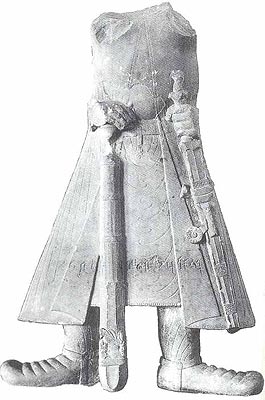
On the other side is a standing portrait of Kanishka, very dramatic, very martial. He's placing an offering on a fire altar, he's bearded, wears a crown, and holds a spear upright, and has the typical northern long baggy trousers, heavy calf length boots, and long tunic caught in at the waist by a belt, so that it flares out below.
As well as the Zoroastrian/Parthian fire altar, he also has Parthian style regal flames on his shoulders, identifying his kingship.
It's here:
http://www.bpmurphy.com/COTW/week2.htm
|
|
| |
|
| |
All times are GMT. The time now is 05:37.
Apolyton Time is 00:37. |
top of page
|
|
|
Forum Rules:
You may not post new threads
You may not post replies
You may not post attachments
You may not edit your posts
|
HTML code is ON
vB code is ON
Smilies are ON
[IMG] code is ON
|
|
|
|
|
|





 04-08-2005 16:00


 Attachment:

 |
|