|
| |
|

|
DanS
|
 |
Kickball Capital of the World
Jan 1970
time: 00:37
|
|
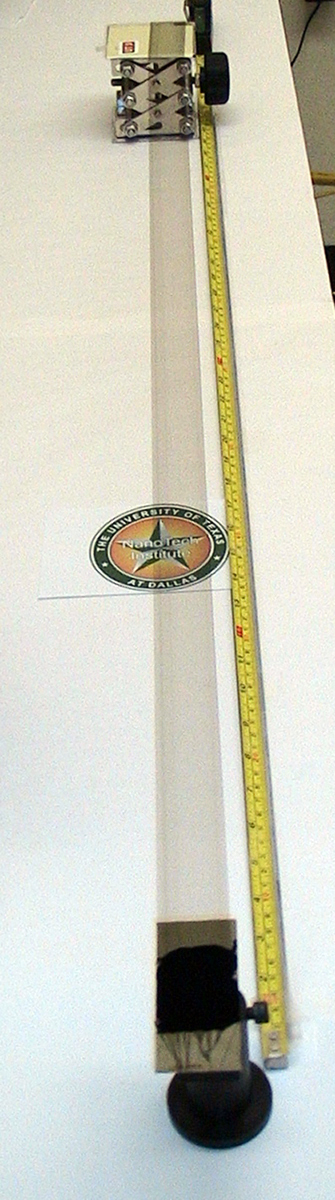
Scientists at the University of Texas - Dallas and a collaborator from the Commonwealth Scientific and Industrial Research Organisation have successfully manufactured sheets of carbon nanotubes in usable sizes. It was surprisingly easy!
This is a big breakthrough.
Here's the Houston Chronicle's article on the subject.
quote:
Aug. 19, 2005, 1:33PM
Research team finds way to link nanotubes
By ERIC BERGER
Copyright 2005 Houston Chronicle
There's an old Monty Python gag about a man who inherits 122,000 miles of string and wants to cash in. Unfortunately, the string comes in 3-inch lengths, rendering it useless.
A similar hitch has stalled carbon nanotubes on their march from lab-bench wonder toward commercial stardom.
The tiny, submarine-shaped bits of carbon have amazing strength, electrical conductivity and other properties that make materials scientists drool. But they typically can be manufactured in only very short lengths, and scientists have had little success clumping them together efficiently.
A research team at the University of Texas at Dallas has changed that. According to a study published today by the journal Science, researchers have succeeded at weaving trillions of nanotubes together into long, ultra-thin sheets.
"We think we've solved the classic nanotube problem," said Ray Baughman, a study co-author and director of the NanoTech Institute at UT-Dallas. "How do you take individual carbon nanotubes and assemble them while retaining some degree of desirable features?"
Tools for transformation
Local scientists who have long grappled with nanotubes hailed the research, which could transform a variety of items, including computer displays and artificial muscles.
"What they did is not intuitive; it's really innovative," said Wade Adams, chairman of the Texas Nanotechnology Initiative and director of the Center for Nanoscale Science and Technology at Rice University. "It's just really cool."
Starting with a "forest" of nanotubes chemically grown in a drum, the research team devised a method to spin carbon nanotube sheets at a rate of more than seven yards per minute.
Commercial wool, by comparison, is spun at about 20 yards per minute.
The nanotube sheets are about 2 inches wide and just 50 nanometers thick, or about 2,000 times thinner than the width of a human hair. At this thickness, 250 acres of a solar sail made of nanosheet material would weigh less than 70 pounds.
Transparent and flexible
The nanosheets have another appealing property: They're transparent and can function as light-emitting diodes, the same technology that lights up the giant billboards in Times Square.
And the new sheets are flexible, raising the prospect of inexpensive displays that could be rolled up or wrapped around a pole — and even luminous clothing.
In their paper, the researchers suggest myriad other applications, which Baughman thinks could come to pass in three to five years. The sheets, for instance, absorb microwaves, allowing them to become transparent heating elements and antennas for car windows.
Much of the new research was funded by the Department of Defense, which is interested in using nanotechnology to improve specialized aircraft and soldiers' protective gear.
To make its nanosheets, the UT-Dallas research team used so-called multiwalled carbon nanotubes. Those with just one wall are prized because they typically are stronger, with more alluring properties such as electrical conductivity.
But in recent months, Japanese researchers also have succeeded in growing "forests" of single-walled nanotubes, so Baughman said the new sheet-making process should apply to this premium type of nanotube.
The new discovery was watched closely in Houston, long a center for research into nanotubes. These carbon cylinders are really just an extension of buckyballs, the spherical form of carbon created in a lab at Rice University two decades ago.
Share a similar problem
Nobel laureate Rick Smalley wasn't the first to create single-walled nanotubes, which he calls buckytubes, but he did invent the first process to produce them in measurable quantities.
Smalley's production process, and the forest-growth method, have a similar problem: The nanotubes they produce come in varying lengths, diameters and other chemical properties.
If his lab or another research group develops a process to deliver a specific type of nanotube, it would make the new nanosheets stronger, more electrically conductive or both.
Nanotube research, both in Houston and elsewhere, has emerged as one of the hottest areas in chemistry. Scientists and start-up companies have studied nanotubes for use in such different applications as electrical wires and the next generation of spacecraft.
It hasn't always been this way. For a time, some scientists wondered whether the much-hyped buckyballs and nanotubes were merely chemical curiosities.
But, that's no longer the case. And Baughman's new process to develop nanosheets should only accelerate the pace of discovery and increase interest, said James Tour, a Rice chemist who works with nanotubes.
Scientists say the development of a commercial process to produce nanosheets bolsters the view of nanotubes as a can't-miss technology.
"It's just going to bring more smart people into the field," Tour said.
eric.berger@chron.com
|
|
|
| |
|
|
|
DanS
|
|
Kickball Capital of the World
Jan 1970
time: 00:37
|
|
Not very strong, since the carbon nanotubes used were multiwalled, among other factors. They said that weight-for-weight, the ribbon was stronger than steel, mylar, and kevlar, which I guess isn't that exotic for carbon nanotubes.
Looking forward, I think they would use at least a slightly different method for applications like the space elevator, which would require the highest tensile strength. They would also use single-walled carbon nanotubes. The following MSNBC article says that after some tweaking, they will try to win NASA's space elevator materials prize...
http://msnbc.msn.com/id/8976160/
http://www.elevator2010.org/site/competition.html
The first competition is in September, so maybe they'll submit something for that.
Last edited by DanS on 20-08-2005 at 06:37
|
|
| |
All times are GMT. The time now is 05:37.
Apolyton Time is 00:37. |
top of page
|
|
|
Forum Rules:
You may not post new threads
You may not post replies
You may not post attachments
You may not edit your posts
|
HTML code is ON
vB code is ON
Smilies are ON
[IMG] code is ON
|
|
|
|
|
|





 20-08-2005 01:00


 Attachment:






 |
|