|
| |
|

|
ElmoTheElk
|
 |
Leiden, The Netherlands
Jul 2000
time: 06:14
|
|
Military/Combat Model 0.1
Originally created by ElmoTheElk on July 9, 2001
This military and combat model will try to describe the way combat and military will be seen in GGS. It will first give a general impression of the way combat is used in the game and then step by step go into further detail.
Contents
Philosophy
Unit types
Ranges
Supply Routes
Production
Giving orders
Diplomats and spies
Guerilla warfare
Philosophy
GGS will hopefully have a combat system which is both realistic and entertaining. The duration of turns in game time will be long enough to make micromanaging single units obsolete, and instead a very strategic level of playing is necessary in all military conflicts. Therefor we will use armies in stead of single units.
As a rule of thumb, large armies will be more effective than many small ones, and the main reason to split armies is to distribute the attack or defense capabilities geographically. The number of armies should be around 20 for a large civilization, in peace time even less. This may sound boring, but in fact there will be a lot of things for the player to do besides moving the units: managing logistics, supply routes, observing and analyzing the weak spots of the enemy, and so on. Air strikes, scouting and guerilla warfare will be implemented as well.
The player should feel that he really is in charge of full military forces of a nation, not just individual tanks or cavalries.
Unit types
'Armies' is the name that refer to the enitities on the map that representate ground forces, naval forces or air forces. They are all treated as equal, but they cannot be mixed together in one army. The thought behind this is that an 'army' is more like a division of your national army than like the way the word 'army' is used in real life.
Ranges
The game will have two types of movement ranges for armies - deployment range and operating range. The deployment range is the area within which the army can be moved to within one turn. The movement could include an attack on an enemy army or something else, but would take the whole turn. The operating range will be the area in which the units of the army could just move around freely. If the army has sufficient scouting the whole acting range could be visible, and enemy units entering the range could be intercepted. So the army could be set to guard the whole area within the operating range.
Supply routes
Every army needs a supply route to a region of your own (or an ally) to support the army. An army without a supply route cannot exist longer than 1 turn, since it will then starve from hunger or haven't got enough weapons. Therfor you define a region for an army where support comes from. As long as the game algoriths will can come up with an valid supply route, the army has support. When it can't, for exaple when an army is surrounded by enemy armies or it's to far away for a descent supply route, then the army has 1 turn to turn the tide or else it will be destroyed.
Production
Armies most of the time consist of more than one type of unit. This could be for example chariots, legions and phalanx. The building of an army is the full task of the player, representing the goverment of your civ. If you want to create a new army, you open the 'military screen'. You can see all your current armies here and create new ones. Armies can then be build by selecting how many units of which sort you want. The military factories in your regions will then produce the units at the lowest possible cost. This is dependant on your local resources, connections with other civs and number of factories. If there are to less factories to satisfy your needs, your people will probably build new ones automaticly, or you can order them to do so. The army can be produced in multiple factories, but they have to be connected by trade routes. After it's finished, it will placed on the map near the city of your choice (again, this has to be trade-route connected).
If you want to add units to an existing armie they either have to return home or have a well establshed supply route.
Giving orders
The order system will, as well as all the things in this game, be mostly mouse driven. Armies have an order queue which they move, attack, defend or whatever you order them to do. An army can execute one or more of these order in one turn, depending on the type of action. The direct orders the armies have will be visually representsated on the map.
The operative range, as pointed out before, will be an extra option. It can be uses for example to 'get control' over an area (supress unrest) or to secure a certain passage.
Diplomats and spies
Special usits like spies and diplomats will not be a visual part of the game. In stead, you can open a diplomacy screen which not only gives the 'ordinary' diplomacy functions, but also include options like 'bribe', 'city revold' or 'investigate'. Of course all diplomatic restrictions apply here, like you cannot contact a civ when you have made no contact. Spies are also included here. When you have discovered the knowlenge of espionage you get extra diplomatic options like 'sabotage'.
Guerilla warfare
When you invate enemy territory you can get in touch with guerilla warfare. The way these are implented in GGS is like native unrest. By the time a civ has implented guerila warfare in there army (after dicovering the tech behind it), it will be a lot harder to suppress this unrest. So generally it isn't a whole different system, but it is seen as normal native unrest.
Guerilla warfare can also pop up in your own civ. When people aren't happy with you as there goverment and your cannot cease them, more and more unrest and guerilla will come up and they can eventually take over control of your civ. This is one of the major aspects from our 'The Rise And Fall Of Great Civilizations'-model.
Elmo
|
|
| |
|
|
|
S. Kroeze
|
 |
the Hague, the Netherlands, Old Europe
Dec 1999
time: 05:14
|
|
quote:
Production
Armies most of the time consist of more than one type of unit. This could be for example chariots, legions and phalanx. The building of an army is the full task of the player, representing the goverment of your civ. If you want to create a new army, you open the 'military screen'. You can see all your current armies here and create new ones. Armies can then be build by selecting how many units of which sort you want. The military factories in your regions will then produce the units at the lowest possible cost. This is dependant on your local resources, connections with other civs and number of factories. If there are to less factories to satisfy your needs, your people will probably build new ones automaticly, or you can order them to do so. The army can be produced in multiple factories, but they have to be connected by trade routes. After it's finished, it will placed on the map near the city of your choice (again, this has to be trade-route connected). |
I sincerely hope GGS will at least have a 'recruitment' system. This brilliant idea was originally developed by The Diplomat. Here is his draft from the ECIII Wish List. (for some unexplained reason it received but a few votes, most strange!)
quote:
FINAL DRAFT
The idea of the recruitment system is that you build a unit by building only the weapons and using a certain population to create the unit.
to make recruitment work properly, I suggest using the "x10 system" for population where pop is multiplied by a factor of 10. ( "real" population instead of "heads" would be ideal but it would require too many changes in the other areas of civ3 and probably won't make it into civ3, so I think that the "x10" system" is therefore preferable).
recruitment would work in the following way:
let's say we have a city of pop 20. (what use to be pop 2 under the current civ2 model). The player would set the production queue to a certain weapon say "tanks". A certain number of tanks would be produced every turn depending on the city's industrial capacity. When you have enough tanks for 1 pop to use, you could take 1 pop away from whatever it is doing and make it into a "tank unit". (notice that it's only 1/20th of the pop, that is why a x10 model for pop is needed) If that same city also produced guns for example, you could combine both (1 pop as infantry and 1 pop as tanks) into one single unit that would be called an "army" and would be composed of the corresponding infantry and tanks together.
NOTE: If you disband the unit, the pop would return to work but you would keep the weapons, so you could reconstitute your army by simply rerecruiting your pop. This is a big change from civ2 where disbanding a unit is more final.
The major improvements that I believe recruitment brings to civ3 are:
1) as in History, population itself would be the primary ressource to building an army. Building the weapons is not enough! Raising an army now has an effect on your city, since that pop is unavailable to work in the city, and if it is killed off in combat that pop is lost. This makes war more authentic! This makes raising an army more interesting as well as making war more balanced. Long protracted wars will be more difficult. In civ2 you could basically wage war from the beginning of the game to the end.
2) war planning is simpler and more interesting. Instead of dozens of units wondering around the map, recruitment gives the player "armies" which can be moved around. For example, I could have my entire military force split into three "armies". Now the player only has three units to move. Also, it would have a more authentic feeling of being an general. You would move Army I ( composed of X infantry, Y tanks, Z artillery) to the South toward Gedansk, as you move Army II, around Leningrad to capture Smolensk, for example. There is a sense of military planning.
Final comments:
1)support costs (food+gold+shields) should be reduced (especially food) in a way that is balanced and that does not make raising an army too difficult.
2)building weapons would take less time than building the equivalent unit in civ2. This solves the famous problem of a warrior taking 200 years to build. As you could build a warrior unit in one turn.
------------------
No permanent enemies, no permanent friends.
|
I have always and consistently supported this idea. Here is one of my more extensive posts on the subject:
quote:

Originally posted by Urban Ranger on 05-19-2000 04:43 AM
I don't think building a unit will reduce the population of the city that builds it. The size of a unit is generally much smaller than a population point.
It's also a silly idea to stockpile weapons and such. A unit isn't just a mob with a bunch of weapons. A unit requires training to function as a conherent whole. So I don't think it is necessarily to build any training facilities although doing so will make the game to appear more realistic. A related idea here then is you can't rush build units, or not more by 50%, say. This represents the inherent necesscity for spending sufficient time in training.
|
"I'm really surprised that a rather intelligent person like Urban Ranger would post such rubbish. I know some don't like my citations, but I think it will assure the reliability of my statements. The intelligent reader can draw his/her own conclusions.
'In a limited sense, the industrialization of war is almost as old as civilization, for the introduction of bronze metallurgy made specially skilled artisans indispensable for the manufacture of weapons and armor. Moreover, bronze was rare and expensive. Only a few privileged fighting men could possess a full panoply. It followed, that warrior specialists emerged alongside metallurgical specialists, one class enjoying near monopoly of the other's products, at least to begin with.
But the phrase "industrialization of war" does not really fit the ancient river valley civilizations, whether of Mesopotamia, Egypt, India, or China. In the first place, priests and temples competed with warriors and army commanders as consumers of bronze and other artisan products; and the earliest rulers probably based their power more on their religious than on their military roles. In the second place, in society at large the great majority of the population remained in the fields, toiling to produce food for their own support. Surpluses were small; and the number of rulers -whether priestly or military or both- and of artisans remained proportionately modest. Moreover, within that small number, the industrial element was inconspicuous. Arms and armor, once molded into shape, lasted indefinitely, and even if blunted or dented in battle could be restored to usefulness with a little sharpening or hammering. Armorers therefore remained relatively few, even in proportion to warriors.
Since tin and copper ores did not usually occur in the same places, and since tin was relatively scarce and often had to be sought at great distances, the really critical limit upon ancient metallurgy and warmaking capacity was more often the availability of suitable metal ingots or ores than manufacturing skill. Traders and transport personnel, in other words, mattered more than artisans. Public policy had to take into account relations with potential metal suppliers who lived beyond the range of direct administrative control. Safeguarding trade routes from rivals and marauders was also important and sometimes difficult. On the other hand, availability of skilled metal workers could usually be taken for granted once the appropriate artisan tradition had become established in the community.
Wars were normally fought with existing stocks of arms and armor, modified only by gains or losses through capture in the course of operations. What an army needed along the way was food and forage. Hence the availability of food constituted the principal limit upon military actions and the size of armies. Occasionally and by exception, an outbreak of epidemic disease intervened to alter the military balances abruptly -miraculously, indeed, as the biblical account of the Assyrian failure before Jerusalem in 701BC attests.
Guarding against disease and other evidences of divine displeasure was the province of priests with their knowledge of religious rituals and prayers. Doing something to increase local supplies of food and forage for the support of an itinerant army was the province of rulers and administrators. It was always easiest to rely on direct exercise of force, i.e., to plunder local food producers by seizing their stocks of grain or animals in order to consume them on the spot or at very short remove. Such an army had to overwhelm opposition quickly and then move on, for it rapidly exhausted local supplies, leaving devastation in its rear. Peasants deprived of their stocks were likely to starve and were sure to have the greatest difficulty in finding seed for their fields in the following year. Several years, even decades, had to pass before the ravages of such a campaign could be remedied.
The career of Sargon of Akkad, who plundered all the lands of Mesopotamia around his capital of Kish about 2250BC, illustrates the potentialities and limits of this sort of organized robbery. A perpetual following of 54,000 {this number is contested; it seems rather high} men no doubt gave the great conqueror an assured superiority over any local rival; hence his thirty-four victorious campaigns. But to keep such a force in being also required annual campaigning, devastating one fertile landscape after another in order to keep the soldiers in victuals. Costs to the population at large were obviously very great. Indeed Sargon's armies can well be compared to the ravages of an epidemic disease that kills off a significant proportion of the host population yet by its very passage confers an immunity lasting for several years. Sargon's armies did the same, since the diminished productivity of the land that resulted from such plundering made it impractical for an army of similar size to pass that way again until such time as population and the area under cultivation had been restored.
If we shift attention from the time of Sargon to the time of the Achaemenid Empire(539-332BC), we see that war had become less destructive to a great king's subjects during that long interval of time. When Xerxes determined on his famous invasion of Greece(480-479BC), for example, he issued commands from his palace at Persepolis, instructing his agents to gather food supplies from territoties under their control, and deliver them to stations along the intended route of march. As a result, Xerxes was able to march into Greece with an army a little larger than Sargon's without devastating the landscapes through which he passed. To be sure, he could not maintain such a force for more than a few weeks in a land as poor in local supplies as Greece. So, when a handful of Greek cities in the extreme south refused to submit, the Great King had to withdraw a substantial part of his invading force, because there was no way he could feed the entire army in the field over the winter.'
(source: W.H.McNeill:'The Pursuit of Power',1983)
A picture of rather short military campaigns emerges. Now something about recruitment among the Romans, who during almost every year of the Republican period were waging at least one war.
'Rome and most other Italic states were traditionally bellicose communities, where the social position of every freeman was closely bound to his capability to contribute actively to the almost annual campaigns. He, who couldn't fight, though a freeman, didn't count politically. Military service always was a duty and a right, reserved to those having the means to assert that right. As a result warfare was largely, just as in classical Greece, a rather 'amateurish' affair and armies more like a militia than a professional military force. Most Romans in the third century BC were peasant smallholders and Rome's economic basis was agricultural. For that reason military campaigns were conducted during the summer, when the land required no great effort. Only campaigns waged at a greater distance or protracted sieges of enemy cities could necessitate to keep an army mobilized for a period longer than a summer and the entire winter. In the First Punic War this had occurred a few times during the struggle for Sicily and would still more frequently occur during the war with Hannibal starting in 218 -with often evil effects for the individual soldier like neglect of the fields at home.
So the Roman military organization was based upon the militia service of a large part of the free population of Rome itself and a proportional part of the allies. Everywhere an official census existed, dividing the citizens in those available for military duty and the poor, who were granted a release. In Rome every five years such a census was held. And every year part of the citizens available for compulsory service at the age of 17 till 46, the iuniores, were mobilized by the new consuls of that year by a careful but time-consuming procedure: the dilectus(literally: the selection). Only those already mobilized sixteen(!) times were automatically exempt; other reasons, for example unpaid debts, could result in exemption. For that matter military service of sixteen years was exceptional; but four or five years of service were common in this period. In normal years -with no major war waged- the consuls only conscripted four legions at the beginning of their term of office. A legion contained 4200 men and a squadron of 200 or 300 cavalry; together these two 'consular' armies of each two legions consisted of nearly 18,000 Roman troops. Moreover, we should count the contingents of the Italic allies, making as a rule a force at least as large, likewise divided into four legions or 'wings'(alae), commanded by Roman officers. But this mobilization of four Roman legions with the equivalent contribution of the allies was only a fraction af all forces the Italic League could muster in an emergency. Out of some hundred thousands of Roman citizens and at least as many Latini and socii it was possible to recruit four or five times as many legions without causing a lasting disruption of society.
(source: H.P.Vogel/H.W.Singor/J.A.de Moor:'Een wereld in oorlog',1995; my translation)
To illustrate my point I will give some numbers. In ~200BC Italy had only three large 'cities':
Roma: ~150,000 inhabitants
Syracuse: ~100,000
Capua: ~30,000
For comparison's sake:
Alexandria: ~300,000
Carthago: ~150,000
The total number of inhabitants of Italy at this period is estimated at 5 or 6 million. But the northern part of the peninsula was not under Roman control. So the number of potential soldiers was definitely smaller.
At the battle of Cannae(216BC) the Romans lost at least 40,000 men, which is a conservative estimate, in one day. This would amount to roughly 2% of all males, Romans and allies. Immediately they conscripted new legions, allowing even slaves to bear arms. In the years preceding Cannae they had suffered two other severe defeats, losing also many casualties. Cannae was of course an exception, but these numbers show realistic proportions of conscription in Ancient society. During an all-out mobilization the army was as large as Rome itself! This cannot have remained without consequences.
It is true that most soldiers didn't come from the city, but were peasants. Since unfortunately CivII doesn't acknowledge the existence of a rural population -only of commuters working surrounding tiles- recruited soldiers can only be conceived as part of this urban population. The argument that an army needs more training cuts no ice. The Roman army was far better organized than most contemporary armies. Yet a few weeks of training and use of available weaponry sufficed in this relatively militaristic society. They didn't need to wait hundred years to build one legion.
As a result of the Second Punic War the Italian countryside became depopulated, relatively speaking. It resulted in a growing demand for slaves and social unrest.
I hope CivIII will have a much larger map, but will also allow a lot more movement poits to units.
Conclusion
I tried (and in my opinion succeeded quite well) to show:
-that a recruitment/mobilization system in many societies was the accepted rule
-that stockpiling of armour and weaponry was also most common
-that armies could have a size large enough to concern a substantial part of the population, which is an argument to subtract these numbers from your population
-that armies can be built/trained in a short period of time
-that an army that actually was a militia(=not-professional) could be almost invincible
And most of these conclusions apply at least for the whole of military history until the Industrial Revolution, which is more than 90% of recorded history, and even partly beyond."
Later on the idea was further developed by Youngsun, who has contributed many excellent posts and is truly knowledgeable about warfare. The best advice I can give is to contact him and ask if he is willing to help us/you. He is also an extremely nice person.
|
|
| |
|
|
|
S. Kroeze
|
|
the Hague, the Netherlands, Old Europe
Dec 1999
time: 05:14
|
|
quote:
Originally posted by Youngsun
New unit stats
Melee:basic fighting power/close combat ability
Support:when accompanied with melee units add bonus to the melee units
Armour:absorb some of enemy hit including enemy support fire
Mobility: this is not map(strategic) mobility this is battlefield mobility.
1~4 Bf mobility equals 1 map mobilit
4~8 Bf mobility equals 2 map mobility
8~12 Bf mobility equals 3 map mobility
Battlefield mobility affects actual battle as a combined arms effect and map mobility ,as you know, reflect how many square you can move.
Raw Conscripts
Melee/support/armour/mobility
Primitive men 2/0/0/3
Ancient men 2/0/0/4
Renaissance men 1/0/0/3
Modern men 1/0/0/2
*Prehistoric*
Stone axe +3 melee
Hunting spear +2 melee +1 support
Primitive bow +2 support
Leather armour +1 armour
*Ancient*
Bronze spear +4 melee +1 support
Bronze sword +5 melee
Scale armour +2 armour -1 mobility
Iron spear +5 melee +1 support
Iron sword +6 melee
Iron armour +2 armour -1 mobility
Wooden shield +1 armour
Bronze shield +2 armour -1 mobility
Iron shield +3 armour -1 mobility
Composite bow +3 support
Horse armour +2 armour -1 mobility
Marius's mule allows a unit to fortify -1 mobility +1 logistics
Chain mail +3 amour -1 mobility
Transport(Anceint to early Modern)
Light Horse +6 mobility(no armour allowed)
Medium Horse +5 mobility(armoured men allowed)
War Horse +4 mobility(Horse armour allowed)
Chariot(arse) +2 mobility
Chariot(horse)+3 mobility
Elephant +2 mobility -2 enemy melee(only cavalry)
*Midieval & Early Rennaissance*
Long sword +7 melee
Pike +5 melee X2 melee vs mounted(only inf)
Lance +5 melee X2 melee vs mounted(only cav)
Plate armour +4 armour -2 mobility
Mace +5 melee ignores enemy armour 50% -1 mobility
Longbow +5 support ignores enemy armour 60%(inf only)
Crossbow +3 support ignores enemy armour 80%
Stirrup +2 melee(only mounted)auto upgrade if discovered
*Renaissance to Modern*
After the discovery of gunpowder new stat(firepower) will be added to all units which use firearms(many thanks to Evil capitalist)
Infantry primary
Arquebus +1 firepower
Musket +2 firepower
Later musket(Napoleonic) +3 firepower +4 melee
Early rifle(Napoleonic) +5 firepower +4 melee
Breech loader rifles(Colonial) +6 firepower +4 melee
Magazine rifle(WWI) +7 firepower +4 melee
Semi Automatic rifle(WWII) +10 firepower +4 melee
Advanced rifle(Modern) +15 firepower +3 melee
Cavalry firearms
Pistol(handgun)+1 firepower
Carbine +4 firepower
Armour
Basic tank(or Inf-tank) +8 armour +6 firepower +1 mobility(1.ignores trench effect 2.Ancient enemy melee/support negated ->applied to all armour)
Heavy Tank +10 armour +6 firepower(X2 vs hard target) +2 mobility
'Blitzkrieg' tank(WWII) +12 armour +7 firepower(X2 vs hard target) +5 mobility can "blitz"->applied to all armours after this
MBT(post WWII) +16 armour +12 firepower(X2 vs hard target) +7 mobility
MBT(next generation) +30 armour +16 firepower(X2 vs hard target)
+8 mobility(finally it equals 3 map mobility)
Note: All armours developed during and after WWII can blitz which means your unit can get through enemy unit without necessarily destroying it. Blitzed and enveloped enemy unit will suffer from penalty of reduced firepower,etc.
Siege support
Captapult/trebuchet +1 siege support can break city wall
Medieval bombard +2 siege support can break city wall
Mortar/Howitzer(Napoleonic) +3 siege support ignore city wall(applied to all artillery after these)
Mortar/Siege gun/Railgun(World war) +4 siege support
Field firepower support
Cannon(Napoleonic) +1 Firepower support
Breechloading cannon +2 FP support
Field Howitzer(world war) +3 FP support
SPA/Mobile rocket launcher(WWII) +3 FP support +5 mobility
SPA/MLRS(Modern) +4 FP support +6 mobility
Misc. support
Flak gun +4 firepower X3 vs Air target X2 hard target
SAM +16 firepower air target only
AT gun +2 firepower X4 hard target
ATGM +16 firepower hard target only
Transport(Modern)
Truck(motorised) +6 mobility
Half tracked(mechanised) +7 mobility +2 armour +1 FP support
Tracked(APC) +6 mobility +4 armour +1 FP support
Tracked(IFV) +7 mobility +8 armour +2 FP support
Note:Field guns can be horse-drawn by combining horses and guns. Other type of transport can be used for that function such as trucks.
Ground Reconnaissance
Motor cycle +2 recon bonus +7 mobility
Armoured vehicle(WWII) +2 recon +8 mobility +2 armour
Combat recon(modern) +4 recon +12 mobility +4 armour
*Navy(Ancient to Rennaissance)*
(Many thanks to Evil capitalist)
Note: Diffrent sea access
Coastal only
Calm sea only(+Coastal)
Rough sea only(+Calm+Coastal)
Ocean going(+Rough+Calm+Coastal)
Outrigger(canoe) +1 naval scout, coastal sea only
Merchant vessel(Early) +1 transportation, calm sea only
Tririeme +1 naval melee, can carry troops,Greek fire modification(+1 fire power),calm sea only
Longboat +1 naval melee,can carry troops,rough sea,Amphibious assault allowed
Galley +2 naval melee,can carry troops
Cog +2 transportation,rough sea
Junk +3 transportation,rough sea
Dhow +4 transportation,calm sea
Battleship(Medieval) +3 naval melee,can carry troops,cannon modification(+2 firepower)
Ocean going vessel
Caravel +2 transportation
Carrack +2 naval melee,can carry troops,cannon modification(+3 firepower)
Galleon +6 transportation,cannon modification(+3 firepower)
Fluyte +7 transportation,cannon modification(+4 firepower)
Sloop/Privateer +3 naval melee,can carry troops,can disrupt trade route +3 firepower
Frigate +4 naval melee,can carry troops,+6 firepower
Ship of the line +4 naval melee,can carry troops,+7 firepower,Steam engine modification(+1 mobility),Heated cannon shot modification(X2 vs wooden ship)
Indiaman +8 transportation,cannon modification(+5 firepower)
Industrial age ships
Clipper ship +6 transportation +2 mobility
Early steamship +8 transportation +3 mobility
Early Ironclad +4 firepower +3 armour +3 mobility, naval melee negated,coastal only
Later Ironclad +6 firepower +4 armour +4 mobility
Cruiser +8 firepower +6 armour +5 mobility ,AA modification,steel armour modification,AV missile modification,
Battleship +12 firepower +10 armour +3 mobility,AA modification
Battlecruiser +10 firepower +8 armour +4 mobility,AA modification
Submarines(U-boat WWI~WWII) +1 under sea attack +2 mobility
Submarines(Modern) +3 under sea attack +3 mobility,Stealth modification,missile pod
Destroyer +6 firepower(X2 vs subs)+4 armour,AA modification,+6 mobility,AV missile upgrade
Frigate +4 firepower(X3 vs subs) +4 armour,AA modification,+7 mobility,AV missile upgrade
Carrier +6 firepower,+6 armour,AA modification,+5 mobility,Engine upgrade,Catapult upgrade,Deck upgrade
Liner +16 transportation need port facility +3 mobility
Container ship +32 transportation need advanced port facility +4 mobility
Trimarin ?
Stealth boat ??
Modification/upgrade(Modern ship)
Engines: Steam turbine engine. Gas/oil turbine. Nuclear reactor.
ASW abilities: Torpedos, sonar etc.: spot and attack submarines in adjacent squares. (made more effective with Sonar)+1 underwater melee
Spotter plane: Popular in WW2 ships, these were used to keep track of the battle and report of shot accuracy before radars and computers. See 2 squares. +1 naval recon
Electronic aids: Does all the processing of data and collects it all in one room. See 2 squares, +1 naval support
Fibre-optic link: Allows ships to maximise communication. further +1 firepower support.
Missile launch facilities: Allows a ship to launch cruise(Tomahawk) or Anti vessel(Exocet)missiles
AA countermeasures: AA missiles and chainguns(Phalanx)give a ship almost total protection from aerial and missile attack.
AEGIS Radar Air defence system upgrade: X3 vs air/missile target
*Air Force*
Bi-plane(WWI) +3 recon +1 firepower can intercept air target
Mono-plane fighter(WWII) +2 recon +3 firepower can intercept air target
Bomber(WWII) +4 recon +2 firepower can bombard X3 vs ground target
Jet fighter(Me262,sabre jet) +2 recon +5 firepower can intercept
Multi-role jet(F4, F16,etc) +4 recon +7 firepower can intercept/bombard
Stealth fighter +4 recon +6 firepower can intercpet/bombard X2 ground target
Stealth bomber +5 recon +5 firepower can bombard X3 ground target
Air transport
Prop-engined +3 logistics
Jet-engined +4 logistics
Utility helicopter +1 logistics can be attached to ground unit
Misc. air
Early warning system +8 recon
Electronic warfare system 5 surrounding squares -50% enemy airforce FP power.
Attack helicopter +2 FP support X3 hard target
Anti-sub heli reveals enemy subs within 3 surrounding squares +1 naval support
Masking upgrade -3 enemy air unit firepower
Missiles
Early missiles +1 bombard
ICBMs(intercontinental balistic missiles)NBC warhead, MIRV upgrade,
IRBMs (Intermediate range balistic missiles)
NBC warhead,MIRV upgrade,
SLBMs: (Submarine launched balistic missiles)
NBC warhead,MIRV upgrade,
Cruise missiles +3 bombard, destroyes any target city improvement, NBC warhead
SAM/ATGM listed above(Misc. support section)
Misc. kit(used construction/irrigation,etc)
Stone tools allows settler function
Bronze tools +1 settler bonus
Iron tools +2 settler bonus
Tools(Industrial) +4 settler bonus
Tools(Modern) +5 settler bonus
Sapper kit allows "combat engineer function"
Animal powered +1 settler support
Machine powered +2 settler support
Bullet-proof vest +7 armour -1 mobility(inf only)
Kevlar +10 armour -1 mobility(inf only)
Any other suggestion would be welcome.
Contributors:Special thanks to Evil Capitalist and Thanks to Shadowstrike,Darkcloud,Biddles,Admiral Naismith,Stuff2(once he was a fan of unitworkshop  ),Par4,Yuvo,ember. Also thanks to the Diplomat for his "recruitment" idea! ),Par4,Yuvo,ember. Also thanks to the Diplomat for his "recruitment" idea!
[This message has been edited by Youngsun (edited August 30, 2000).] |
More information on the subject can be found in the thread "Unit Workshop" Module List
|
|
| |
|
|
|
I like the recruitment idea... GGS will probably be a lot more population focused than civs ever were, so this fits perfectly to what we need.
|
|
| |
|
|
|
ElmoTheElk
|
|
Leiden, The Netherlands
Jul 2000
time: 06:14
|
|
Thanks for your post agian kroeze. I like some of the ideas presented herem but I also see big objections to some other features mentioned in your post.
Generally I like you are going into too much detail. I see the recrutement system is very realistic, but I think we have to define the realistic<->gameplay line here more towards gameplay. Let me explain that.
I really like a detailed recrutement system. I even love a detailed total combat model, just like we have a pretty detailed and realistic economy model. However, the economy model can be implented very detailed while the player doesn't necesairily see it. You can still macromanage your economy while the underlying algorithms are very detailed.
The combat model is a whole other story though. Of course the underlying statistics, pre-s and con-s can be very detailed, but again it should not be visible to the player.
So...
I think a less detailed system (for the player) is needed. I then think about the original system I decribed in the Combat Model 0.1. I like the recrutement system's idea though. We can certainly implent it in our own way. I see a good idea in substracting people from your (working) population since armies contained large groups of men in acient times.
I also like the idea to store and reuse arms and armor. The best way to melt this into my own model have to been overthought, but I am certainly going to try this.
I also read thought the type of stats you suggested to use for the units. I see a good system in it, but we might want to work out the general system, first I guess..
Hopefully I can make a new model this week. I do think so. But don't hesitate to share us your thought of course! (Yeah, you there!  ) For now, I have spoken.. Elmo ) For now, I have spoken.. Elmo
|
|
| |
|
|
|
amjayee
|
 |
Jyväskylä, Finland
Oct 1999
time: 07:14
|
|
Military will be one of the key elements of the game, so it's good to discuss it. I generally agree with all that S.Kroeze said (again). Recruiting is needed; my former idea was, that to build an army you need men, equipment and training. There would be several ways of acquiring the men, like conscription. Equipment you would build; from that, would come stockpiling of weapons, which is also a good thing and required. For training, different amounts could be required by different kinds of armies. Militia-kind of army would require only very little, perhaps just building and funding training areas would suffice. You would build an army by giving a build order. Then, you would require a recruiting system that provides you with men; I'm not sure how that should be done excactly, or is any special system needed at all. If you don't have enough men or enough stockpiled weapons, the building would be on hold until the necessary amount of both is available.
Then of course organization is an important part of the army. Like Sander said, the Roman army was succesful because it was better organized than the other armies. That could be modeled with the leaders of the army; the armies would need general units, like proposed earlier. Also developing military tactics technology would help in making better organized armies.
Like we have talked in the design doc thread, war should be strategic and a little like war in Diplomacy. Well, I guess I will elaborate on these things later.
|
|
| |
|
|
|
chrispie
|
 |
Manchester UK
Oct 2000
time: 05:14
|
|
All good in my opinion, I very much agree that armies and military will be a vital part of the game.
For the recruitment system, maybe the troops come from the general populace at a certain flow speed dependant on factors like goverment types and technology. Government styles like those of modern Democracies would find it harder to find troops than an ancient warring nation.
I assume the unit workshop will be used in the style of building a set of generic unit types that a player would use? This is something I think we'd have to put a lot of thought and testing into, to make sure that all objects availble have a use, and there is a good balance - so that say, not all people playing in ancient times only build light cavalry style units.
Oh, and just to add - S. Kroeze, just wanted to say that I consider you very much a part of the team with all of your excellent contributions - so please feel free to use the word "us", I'm sure everyone else agrees.
Last edited by chrispie on 12-06-2001 at 23:46
|
|
| |
|
| |
|
|
|
Nath
|
|
quote:
Every army needs a supply route to a region of your own (or an ally) to support the army. An army without a supply route cannot exist longer than 1 turn, since it will then starve from hunger or haven't got enough weapons. Therfor you define a region for an army where support comes from. As long as the game algoriths will can come up with an valid supply route, the army has support. When it can't, for exaple when an army is surrounded by enemy armies or it's to far away for a descent supply route, then the army has 1 turn to turn the tide or else it will be destroyed. |
I suggest than an army can survive two turns without support. This seems more realistic because armies didn't (and don't) promptly die the instant their supply routes were cut.
|
|
| |
|
|
|
chrispie
|
|
Manchester UK
Oct 2000
time: 05:14
|
|
Okay, my system is this;
Firstly, we all agree we need to put new units somewhere right? Let's say this is a region capital. So there we will have a base army, where all new units go when they are built in a region - it can defend that location - but cannot leave it.
To make new armies, you'd use something like an army button  , which has options like create army, list armies, find army etc. Maybe we could use the Photoshop style button here. Remember those buttons in Elmo's excellent GUI, the little square ones...we could have those, where on a single short click - the current option would be selected, or if the player holds down on it, he gets a bar pop out of it, and has the rest of the options in that button set. Anyone like those? , which has options like create army, list armies, find army etc. Maybe we could use the Photoshop style button here. Remember those buttons in Elmo's excellent GUI, the little square ones...we could have those, where on a single short click - the current option would be selected, or if the player holds down on it, he gets a bar pop out of it, and has the rest of the options in that button set. Anyone like those?
Anyway, on selecting make new army, you'd get a double window, one side you'd define your army - name, aggression perhaps etc. And on the other, you'd select units from the base army to move into this new army. Possibly we'd have a set window for transfering units between armies, and we could use this - you'd have the armies perhaps across the top, and the units listed in the main part of the window.
That's it 
|
|
| |
|
|
|
amjayee
|
|
Jyväskylä, Finland
Oct 1999
time: 07:14
|
|
What I think is best, and what I think also Chris meant, is that the player has a set of unit types (possibly created with a unit workshop). Then, he builds new units just by selecting unit types and how many of each is built. Then, the required resources are allocated automatically by the economic system, and the men required are recruited from the workforce - there could be several options for this, like volunteer conscription, forceful conscription, or even hijacking men from the countryside. The men could be paid, when money is required for upkeep, or not. If resources run out, the player is notified and the production is halted. If it seems unlikely that there will be enough resources to build units, the player is warned when he is about to start building the new units.
Training would happen automatically. For each new unit type is defined the amount of training, which affects the unit's abilities somehow. Then, when the unit is built, certain amount of time goes for training. When the training is done, the unit is ready. Of course, if we use real people, the soldiers grow old, or their service period ends. Then, those men need to be replaced. So, upkeeping a unit requires also constant flow of fresh men, and also constant training for those new men. For training, you would need to spend certain amount of money per year for upkeep, and perhaps you need to build some garrisons and training facilities to make training possible.
Weapons and equipment would be considered the "resources" required to build an army. For certain unit type, you need certain amounts of different gadgets. Before the unit can be built, you need to produce that amount of the gadgets in question. The gadgest can include spears, swords, shields, armors, rifles, tanks, jet planes, sapper equipment, electronic interference equipment, anything. The built weapons would be stockpiled, and they could require certain amount of resources for upkeep. Also, you could buy things from enemies, and after winning battles, you would gain certain percentage of the equipment from the killed or captured enemies (quite high percentage I think, 80-90%).
|
|
| |
|
|
|
S. Kroeze
|
|
the Hague, the Netherlands, Old Europe
Dec 1999
time: 05:14
|
|
quote:
Originally posted by amjayee
What I think is best, and what I think also Chris meant, is that the player has a set of unit types (possibly created with a unit workshop). Then, he builds new units just by selecting unit types and how many of each is built. Then, the required resources are allocated automatically by the economic system, and the men required are recruited from the workforce - there could be several options for this, like volunteer conscription, forceful conscription, or even hijacking men from the countryside. The men could be paid, when money is required for upkeep, or not. If resources run out, the player is notified and the production is halted. If it seems unlikely that there will be enough resources to build units, the player is warned when he is about to start building the new units.
Training would happen automatically. For each new unit type is defined the amount of training, which affects the unit's abilities somehow. Then, when the unit is built, certain amount of time goes for training. When the training is done, the unit is ready. Of course, if we use real people, the soldiers grow old, or their service period ends. Then, those men need to be replaced. So, upkeeping a unit requires also constant flow of fresh men, and also constant training for those new men. For training, you would need to spend certain amount of money per year for upkeep, and perhaps you need to build some garrisons and training facilities to make training possible.
Weapons and equipment would be considered the "resources" required to build an army. For certain unit type, you need certain amounts of different gadgets. Before the unit can be built, you need to produce that amount of the gadgets in question. The gadgest can include spears, swords, shields, armors, rifles, tanks, jet planes, sapper equipment, electronic interference equipment, anything. The built weapons would be stockpiled, and they could require certain amount of resources for upkeep.
Also: you could buy things from enemies, and after winning battles, you would gain certain percentage of the equipment from the killed or captured enemies (quite high percentage I think, 80-90%). |
I almost completely agree with this post! I also like the idea of buying (and selling) weapons and the introduction of the spoils of the battle. Realistic and fun!
Yet especially for Prehistoric and Ancient times there should simply be the possibility to draft recruits into the army and to equip them with all available weaponry.
Let's assume you decide in February that you need to defend some province of your kingdom, because something unexpected has occurred. In this province (Tuscany, why not?) live about 200,000 people, of whom 40,000 are adult males (=15 years or older). You decide to summon 5% which is a lot, so 2,000 recruits appear next turn. Next month -March- would be most realistic in my opinion, but others will doubtless disagree.
Then you can inspect your regional armoury. It contains 200 Stone axes, 1,000 Hunting spears, 500 Primitive bows, 100 Bronze spears, 50 Bronze swords, 400 Wooden shields, 100 Chariots and 200 Light Horses, which could pull your Chariots.
Use all availabe arms? Yes/No
When choosing 'No' you could further specify your selection
Generally some advisor would decide in what manner the equipment would be distributed. As you can see, in this example many recruits would not have any weapon or body protection at all, which is quite realistic. (Many Chinese in WWII went to battle without having a gun. They just took over when a comrade in arms was killed)
Do you want to train these recruits? Yes/No
In Ancient times a month of training would do, while you could even send your army into battle without any training. This would make the difference between Green and Very Green recruits. So in March or April you could start your military expedition!
I still think my former post on wastage/attrition makes sense:
I also would like to make some remarks about warfare in general. Most games -and Civilization is no exception- present a completely distorted picture. The units in CivII seem to possess some 'divine' immortality. In reality most military campaigns were relatively short and armies disintegrated as quickly as they were recruited.
"Disease was a greater threat to the health of Civil War soldiers than enemy weapons. This had been true of every army in history. Civil War armies actually suffered comparatively less disease mortality than any previous army. While two Union or Confederate soldiers died of diseases for each one killed in combat, the ratio for British soldiers in the Napoleonic and Crimean wars had been eight to one and four to one. For the American army in the Mexican War it had been seven to one. Only by twentieth-century standards was Civil War disease mortality high. Nevertheless, despite improvements over previous wars in this respect, disease was a crippling factor in Civil War military operations. At any given time a substantial proportion of men in a regiment might be on the sicklist. Disease reduced the size of most regiments from their initial complement of a thousand men to about half that number before the regiment ever went to battle.(!)
Here are some hard figures about the Thirty Years' War(1618-1648), underlining this same point:
'One might wonder why any man would freely join such a force; and indeed, many soldiers served in the ranks against their will. The troops from Sweden and Finland, for example, were recruited by a form of conscription known as the indelningsverk, which obliged a specified community to provide a certain number of soldiers. Most of them were peasants: in the voluminous (but as yet little analysed) records of the Swedish and Finnish forces serving Gustavus Adolphus and his daughter, bönde (peasant farmer) is by far the commonest entry in the enrolment lists. They came from villages like Bygdeå in northern Sweden, which provided 230 young men for service in Poland and Germany between 1621 and 1639, and saw 215 of them die there, while a further five returned home crippled. Enlistment was thus virtually a sentence of death and its demographic impact was profound. The number of adult males in Bygdeå parish steadily decreased -from 468 in 1621 to 288 in 1639- and the age of the conscripts gradually fell as more and more teenagers were taken, never to return. The social impact was also high: at first, the 'idle poor' tended to furnish most of the recruits, but after a while it became the turn of the younger sons of more prosperous families, and finally the only sons of even rich peasants were called to die away in Germany. In some smaller settlements, by the end of the 1630s, every available adult male was either on the conscription lists, already in the ranks, or too crippled too serve. Total losses in the Swedish army between 1621 and 1632 have been estimated at 50,000 to 55,000; those between 1633 and the war's end were probably twice as high. Clearly the war was causing depopulation in Sweden and Finland on an unprecedented and -ultimately- unbearable scale.
(NB.: Since the population of Sweden in 1600 is estimated at only well over one million these were unbearable losses indeed; Finland had only about 200,000 inhabitants)
Wastage rates in selected regiments:
4 English regiments:
1627 June: 4,913
1627 Oct.: 3,764
1628 Apr.: 1,882
1628 May : 1,630
4 Scots regiments:
1630 Jan.: 1,900
1632 Mar.: 1,300
1634 Oct.: 200
3 Swedish regiments:
1631 Sept: 2,577
1632 Mar.: 1,212
1632 Dec.: 828
(source: G.Parker: 'The Thirty Years' War',1997)
Parker arrives at a monthly loss of lives ranging from 2 to 20%.
Thus, despite the legend of the subsequent retreat from Moscow, it was the advance which caused most damage to the invaders. There was never any need for the Russian army to fight a set-piece battle, for Napoleon's forces were disintegrating day by day. However Kutuzov was persuaded by public opinion, pressure from St.Petersburg, and the enthusiasm of his junior officers, to make one stand before Moscow. So in early September the Russian army stopped retreating and formed up in a defensive position on high grounds near the village of Borodino, commanding the Smolensk-Moscow highway about seventy miles west of Moscow. The Russian forces numbered about 120,000, of whom 10,000 were hastly raised and half-trained militia sent out from Moscow.
By this time the French army had shrunk from the half-million, with which it had begun the campaign, to a mere 130,000, and was already slightly inferior to the Russians in artillery."
And I agree with Chrispie that supplying your army in a fertile region should be quite easy, especially during the harvest, though it would truly be a disaster for the inhabitants. Hannibal succeeded in more or less maintaining a formidable army in Italy from 218BC to 203BC, though all direct supply routes out of Carthago were cut off. Historians have often wondered why Hannibal did move around as he did. Now it seems supply of his forces more or less dictated his movements. As soon as a province was sqeezed dry he had to move on!
A modern example is the expedition of general Sherman through Georgia and the Carolinas during the American Civil War.
quote:
Oh, and just to add - S. Kroeze, just wanted to say that I consider you very much a part of the team with all of your excellent contributions - so please feel free to use the word "us", I'm sure everyone else agrees. |
Thank you for your these very nice words! You are truly kind.
Sincere regards,
S.Kroeze
|
|
| |
|
|
|
I am getting fairly excited about the wonderful ideas presented here, but I'm a little bit uncertain how to do all this in practise. To me, it seems that there are no more "units" in this model, just armies. I think that it will get very confusing for the players if they need to build whole armies from raw materials and recruits, because in a fairly sized civilization that will be an enormous job: you might have dozens of different types of weapons, a few different levels of training and several things that the armies can do. This is why I believe we need to define the relationship between units and armies explicitly, because at least in my vision the units are essentially production units, which partition the armies to manageable chunks.
To clarify my point:
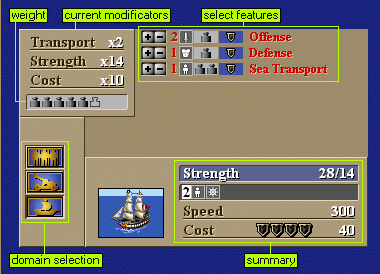
Units are the building blocks of armies, and they have a fixed amount of resources they need. Here, resources are weapons, recruits and food. Weapons are relatively persistent and can even be used after battles, recruits will die at a slow rate for diseases and as casualties, and food is the resource that needs to be supplied to the army continuously to keep it running. The player would have a unit workshop at his disposal, where he could create new units, but there should be a cost involved in designing (and testing) new unit types, so that the number of different units doesn't explode (in the worst case scenario, every unit would be tweaked independently and that would really be a micromanagement nightmare.
Units have a number of abilities like "transportation", "melee", "ranged combat", "biological warfare" or "scouting". New abilities can be discovered with new tech, and they represent a qialitative change in units. For every ability, units have a level which determines how good they are at that one thing. This could be a number between 1-10 or something to that effect. Abilities would correspond to different weapons, armour, engines, chassises (sp?) and so on.
I believe that this would make it easy for the player to create armies. Here's how I think it could possibly happen:
- Player starts the unit worshop, and starts to build a new unit.
- The Worshop shows a list of accessories that can be chose, categorized based on abilities. For example swords and guns would be under close combat, missiles and catapults under ranged combat and chariots and jeeps under transportation.
- Let's assume that this is a primitive or ancient civilization, which needs just regular grunts. The player selects swords from the list, and no transportation (meaning, bare feet).
- The combination of accessories will determine the number of people needed in the unit. It is not meaningful to have an exact number of swords, instead an approximation of a hundred or a thousand swords should be enough. Consequently, since one people can hold one sword, the number of people in the unit in this example would be the same as the number of swords.
- Player would be shown the cost to design the unit. This may not be entirely realistic, but I think we can assume that there is some effort made in organizing a new type of soldiers. Some of the most primitive armies might be defined beforehand, so that the player doesn't need to pay money for glorious units like "angry men with rocks".
- If player accepts, the new unit is added to his selection. This needs to be just once, from now on the player can build all the swordsmen he wants. He can also update the swordsmen into something else, if there are some specific technological advancements.
- Now, the player would produce units the same way as was suggested by many people in previous posts. He'd choose the place where they're built, and the army to which the units are attached (or create such an army). The rest is up to the game, and the player would receive information on how many units can be produced in a certain place. This can be tweaked many ways, for instance by buying weapons elsewhere or using stockpiled weapons.
- The armies consist of units, and each army would serve as a supply node for the units. If an army doesn't get as much food (or ammunition, or whatever) the units in it need, it will get weaker due to people dying.
Hmm... I'm not at all certain if that made any sense. Comments are welcome.
Last edited by on 18-06-2001 at 03:57
|
|
| |
|
|
|
ElmoTheElk
|
|
Leiden, The Netherlands
Jul 2000
time: 06:14
|
|
Hum, I hadn't really had the time last few days to reply, but just a short reply here:
I like your system in the way that it is relaly realistic, and it might be fun as well too. However we have to face our goal for the game. I really, really think we are going into too much detail when we let the player desgin units.
THe player is the goverment of your civ. We all agree with that. And also you have no full control over your civ. I think we all agree on that too. But why would the goverment of a civ, the player, have to much control over the type of units? I think you can choose what type of units a civ buys and also how many etc. But to manage if some army contains 20 bowman with a heavy sword on there back and an wooden shield in there right hand is really far too detailled.
I never liked the unit workshop from SMAC too, so I might be somewhat conservative, but we are going to micromanage things in Kroeze's/Leland's system. And that's just what we didn't wanted it to.
Therfore, I'll try to explain what I like to see. Just give me some time... (Wanted to descipe it here, but I found out it isn't that easy.)
ELmoTheElk
|
|
| |
|
|
|
Darkstar
|
 |
Huntsville, AL, USA
May 1999
time: 23:14
|
|
Ok...
I know I'm the new guy and the new village idiot... but, here's something for you guys.
1) This unit design and army system sounds very much like Destiny. Have any of you ever tried that or played it? Not that it is bad, just that I found it stupid to design an army like this:
Unit Workshop: 10 men with big sticks, 10 men with long, pointy throwable sticks. Name: Half Angry ******.
Army Queue: Build 10 units of Half Angry ******, 1 of basic light cav, 1 of early lancers.
If you guys HAVE Destiny, fire it up. It failed as the "ultimate" civ game for a couple of reason. But the unit and army stuff wasn't it.
2) Armies unsupplied should shrink (due to desertion, diseases, accidents, and whatever else, like possible starvation) and lose morale. If their morale doesn't break, the army vanishes when it drops below min % to qualify(5, 10, whatever). If morale BREAKS first (drops below a certain level), the whole thing goes rogue, deserts to another, or dissolves and joins the locals.
3) You need training facilities to TRAIN troops. I'd suggest Barracks, Military Academies and the like. You, the government, may say, hey! Make me 20,000 armor cleaving swords! But that doesn't get you 20,000 men to USE them. Armies are the men... building a tank doesn't get you a tank commander, a driver, and a loader.
4) Disease... And not just the killers, determines an infantries (and to a lesser extent, every other fighting unit) strength. VD put down more soldiers in Civil War then all the bullets EVER did. Anywhere you have SOLDIERS, you get the social diseases. And it's a long time in history before there was anything that could even offset it, let alone make it go in remission or go away. In the American civil war, they dosed the heck out of soldiers with a sulfuric compound.
5) Supplies... I love this. But... It takes more then FOOD to keep an army up. You have a whole collection of (camp) followers that generally looked after an army. Whether it was wives and lovers, or merely profession taylors, ferriers and what not. The more EQ you have, the more time and support is required. So an army requires: New recruits to replace the out mustering or dead men, food, material (to replace worn "perishables" such as shoes, uniforms, glasses, whatever), and currency (to pay the non-slaves).
related tangent... wherever you position an army for a decent time, you will get a town to support them. It will spring up around the needs of the army. After crossroads (supporting the trade and traders/travellers), this was one of the reasons to found a town.
6) Supply lines... This is something that has been needed forever and a day in more TBS games. I would think that ultimately, you would found "depots" or supply stations. Towns (and bigger) can act like one, but founding an actual supply base would be more efficent (game effect cheaper to transport any and all to the army). The further an Army is from a depot, the more it costs to TRANSPORT 'supplies' to it. This cost would be modified on technology... so certain advances would HELP you more economically field an Army. There is a maximum range at which you can supply an Army as well. At that point, either a new supply depot has to be built, or your army suffers from lack of resupply. With Alliances and what not, your Armies could use your Allies supply chain.
Depots would then play 2 roles on the players map...
they make real military targets that have to be protected...
and wherever you have a depot for a time, a town will grow. (Jobs, economic opportunity to service the military service sector).
7) Training, War Games, and Military Exercises.
I think you would want these in the game. To help keep your Armies trained at a higher skill level. Over time, without use, Armies loose their experience. This is just a fact. The BEST experience is in the field, but lacking that, you can keep them at a higher level then never doing anything. I see barracks and what not as training your raw personnel into your basics. Mil. Acad help train your leadership and special units (medical, pilots, navigators, whatever).
Just some thought for you...
|
|
| |
|
|
|
Nath
|
|
A few suggestions and comments (some might already have been thought of elsewhere):
Armies shouldn't lose morale with time, only with distance from the kingdom.
quote:
You need training facilities to TRAIN troops. |
Agreed.
quote:
You have a whole collection of (camp) followers that generally looked after an army. |
I've never heard of this. Can you give a few examples?
quote:
Over time, without use, Armies lose their experience. |
Agreed, but experience shouldn't fall below a certain percentage of its maximum level. A former war veteran is always more experienced than a new recruit.
Nath
|
|
| |
|
|
|
chrispie
|
|
Manchester UK
Oct 2000
time: 05:14
|
|
quote:
Armies shouldn't lose morale with time, only with distance from the kingdom |
I can't see why this would be the case - surely a medieval army wouldn't know the difference between somewhere 300 miles from home, and somewhere 1000 miles from home.
In my opinion morale should be based on distance travelled (even in a circle), time spent out in the field, supply and how often they are fighting.
As for needing to train armies, I think that is more of a luxury than a necessity - the better trained army will almost always win, but that doesn't mean than you have to train them.
quote:
Agreed, but experience shouldn't fall below a certain percentage of its maximum level. A former war veteran is always more experienced than a new recruit. |
Well, that depends on the time scale involved - after 30/40 years of non fighting, any unit would lose experience of any level surely.
I liked Darkstar's idea about the supply depots (but only cos I was going to use that idea myself a while back  ). It makes the game more tatical - but keeps a good feeling on simplicity IMO. I've always been a bit uncomfortable with the idea of having to acutally trace a solid supply line - it seems too fiddly. ). It makes the game more tatical - but keeps a good feeling on simplicity IMO. I've always been a bit uncomfortable with the idea of having to acutally trace a solid supply line - it seems too fiddly.
Maybe the supply depot or similar named could be the pre-cursor for the town in GGS, where towns wouldn't just grow from nowhere, but instead need nurturing right from square 1.
|
|
| |
|
|
|
Darkstar
|
|
Huntsville, AL, USA
May 1999
time: 23:14
|
|
A vet will always be more experienced. True. But that vet can't live for 100 years. Eventually, he's going to be gone and replaced with a recruit.
Camp followers? There is plenty of this documented for the American Civil War. And some references to the American Revolutionary War. Basically, it's just part of the Army's logistics. Family of the soldiers following along, earning money by providing services such as laundry and what not. But from my past readings, it tended to be pretty big (around the size of the army itself). These days, our modern army has effectively eliminated this thanks to taking care of its logisitics itself. Aside from some MINOR exceptions. And the common soldier's wife won't have the same means of transport as the army, either. So that helps cut down on it. But when the army used wagons and feet... and the army didn't worry about very much in the way of supporting the soldier, that left a great amount of logistical services that people could fill. And did. Whether to just make a living, or follow their family. It wasn't THAT uncommon that a retired soldier on hard luck would become part of the non-government "wagon train" that followed. Serving the current crop of soldiers as whatever.
|
|
| |
|
|
|
S. Kroeze
|
|
the Hague, the Netherlands, Old Europe
Dec 1999
time: 05:14
|
|
quote:
Originally posted by ElmoTheElk
I like your system in the way that it is really realistic, and it might be fun as well too. However we have to face our goal for the game. I really, really think we are going into too much detail when we let the player design units.
THe player is the goverment of your civ. We all agree with that. And also you have no full control over your civ. I think we all agree on that too. But why would the goverment of a civ, the player, have to much control over the type of units? I think you can choose what type of units a civ buys and also how many etc. But to manage if some army contains 20 bowman with a heavy sword on there back and an wooden shield in there right hand is really far too detailled.
I never liked the unit workshop from SMAC too, so I might be somewhat conservative, but we are going to micromanage things in Kroeze's/Leland's system. And that's just what we didn't wanted it to.
ELmoTheElk |
Dear Elmo, Leland, newbies and others,
Of course everone is entitled to have his own opinion, but would it be true that an order like: "Recruit 2% of all adult males in province X (and why not Tuscany?) and equip them with all available weaponry" inevitably causes micromanagement?
I don't think so.
Another point:
I already showed that wastage/attrition rates ranging from 2 to 20% a month would be most realistic. Assuming an average wastage of only 5% -which is rather low- this would result in a rather swift disintegration of military forces. A battalion starting with 1,000 recruits would contain only 540 healthy soldiers after only one year of campaigning.
Think about it!
|
|
| |
|
|
|
On another note:
1) It's probably been mentioned but let me add that the player should have the ability to merge their armies at will. It's annoying to play a strategy game where a weaker army can't merge with a stronger army and thus is doomed to fail in its task (remember Robert E. Lee?).
2) Customization of the armies by allowing them to be named but in addition I'll suggest the player can also name a general to any army they wish. Now I'm not looking for something that requires allot of coding or any kind of module (not like NewGame's The General) but merely having it where when the player builds a new army and they have an icon they can click on to name the army there will also be a second field in this pop up box where they can list a name of a General. Merely a simple customization kind of like all those flight sims that let you paint your plane - they don't affect game play but just add to the level of control and customization for the player.
3) Back on supply and recruitement. I agree it should take 2-3 turns of an army being without its supply lines to have any affect on its performance. I also agree that an army should be able to foriage the land which it occupies. All the depth and complexity mentioned in this thread I would suggest that they be included in the backend (or background), or allow the player to turn them "off" so they don't have to fiddle with it if they don't want to.
my two cents,
DrPerrier
|
|
| |
|
|
|
ElmoTheElk
|
|
Leiden, The Netherlands
Jul 2000
time: 06:14
|
|
It's been to long I replied in this post... I am pretty busy lately, but here some quick remaks for all of you...
Simplification
Sorry Kroeze to say this, but I still cannot beleave why such great detail is needed.
First of all the player needs to manage his armies as quick as possible since he will not have endless time to do say. There are more things to do to keep up his empire. Espacially compared to civ2.
Second, what makes you thing the player wants such detail. I know there are a lot of die-hard silmulation fans who want absolute control, but I'm thinking more large personally. I really hope someday, there will be as much regular players of ggs as a commercial game has these days. It's not realistic that ggs will be the top of strategic computer games, but we might give it a try! I am more wanting to make a game that is actually played then a game that is played by a group of 200 die-hard sim-games players.
Third; is the player really going to use such detailled functionality? If we give him only limited modification control, we are back to civ2 or smac or so style and the player will never know it's so detailed. And we wasted our time on it then...
Supply and recruitment
As I said earlier, I agree on the term of 2 to 3 turn before an army suffers from it. I don't think tough we have to hard code any kind of detial with it, like increasing hunger, diseases and weaker morale. It's just 1 very small feature after all.
If an army is foriaged it would take longer. About 4 or 5 turns seam reasonable to me.
Army management
I agree with you DrPerier on this issue. We should make it possible to add, merge, delete, etc. armies as the player likes and sees fit.
Losing experience
Don't really care about this, but if you guys want to see this feature in, I won't disagree. I am not the one who will have to program it.
Depots
I think I like this idea. I say we go for it. Depots can (has to?) be build by the player like improvements I think. That will be queit fun.
But, as always, try to convince me! I am easily convinced by difficult words and programming slang, so try me... Enough for now.
Elmo
|
|
| |
|
|
|
Nath
|
|
quote:
As I said earlier, I agree on the term of 2 to 3 turn before an army suffers from it. I don't think tough we have to hard code any kind of detial with it, like increasing hunger, diseases and weaker morale. It's just 1 very small feature after all.
If an army is foriaged it would take longer. About 4 or 5 turns seam reasonable to me. |
I thought the 2-3 turns was to take into account the fact that the army would be able to forage about for its food for a while. Isn't one turn meant to be a few months or years or something? If so, 4-5 seems like a lot.
|
|
| |
|
|
|
Darkstar
|
|
Huntsville, AL, USA
May 1999
time: 23:14
|
|
Nath, as I understand it, the Player Turn is 1 year. There might/will be sub units in a turn for how things are handled internally, but that's nothing to worry about from the Player/User point of view.
Yes, I would think that 4 or 5 YEARS with no resupply or replacements is asking for a bit much.
Elmo... Depots are just one more nodal system. No problem.
Customizing Armies is a good idea. Easy merger and splitting, sounds fantastic. A definate must.
And you should make the game you WANT to play. Allowing the player to set his level of involvment is always welcome... allows you to play different kinds of "games" for your different moods.
If only 200 people play the game, Elmo, that would be a good success, for something that is FREE. Shoot for fun. Not bragging rights or pride. Games are meant to be fun.
But what do I know? I'm just the newest village idiot.
|
|
| |
|
| |
All times are GMT. The time now is 05:14.
Apolyton Time is 00:14. |
top of page
|
|
|
Forum Rules:
You may not post new threads
You may not post replies
You may not post attachments
You may not edit your posts
|
HTML code is ON
vB code is ON
Smilies are ON
[IMG] code is ON
|
|
|
|
|
|






 09-06-2001 18:44


 I am glad someone else then me played it. You just reminded me to download the newest version now.
 Attachment:
  |
|