|
| |
|
| |
|
| |
|
| |
|
| |
|
| |
|
| |
|

|
Dr. Nick
|
 |
Mola mazo!
Oct 2000
time: 01:15
|
|
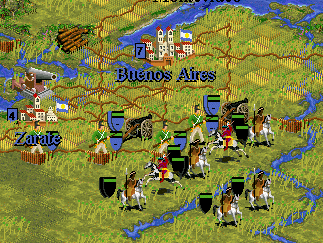
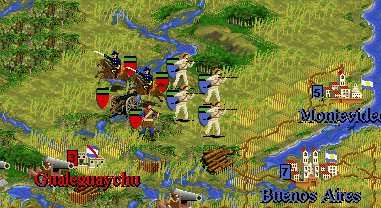
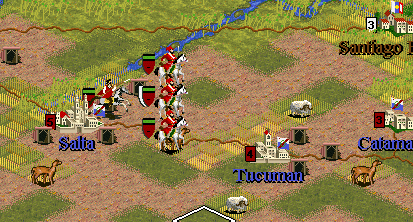
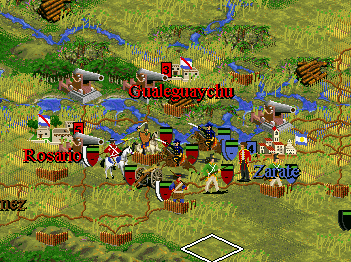
Well, I'm still in the thick of production. I am going to try and make the events as accurate as possible... only bad thing is that the historical coverage of this period is dodgy at best due to the high politization of the material available.  Battles and such I will try to recreate as best as possible... To help with that I have made around nine unique "leader" units with the main political "caudillos" of the period. They will all appear via events, and I hope to make the events a complex thing here (not so complex as to require a *.bat though, I hate those) Battles and such I will try to recreate as best as possible... To help with that I have made around nine unique "leader" units with the main political "caudillos" of the period. They will all appear via events, and I hope to make the events a complex thing here (not so complex as to require a *.bat though, I hate those)
As to the graphics, I'm a perfectionist, let it be known that graphics in my modpacks are always under construction.
ANd, Fiera, this is a radical improvement del primero que se vio, definitivamente... pensar que I whipped it all up en una tarde sorprende. I've played it a bit and it's quite innovative in the concept of warfare, as it makes defensive units practically obsolete... I still need to work on the game balance, but I'm sure that I can count on all of you to help playtest, VERDAD?   
Y, si, Kindal, la llama la queria mejorar antes pero no me dio el tiempo... ahora con la de Fiera se arregla rapido. Gracias FIera!
|
|
| |
|
| |
|
|
|
Dr. Nick
|
|
Mola mazo!
Oct 2000
time: 01:15
|
|
After the independence wars, the River Plate lived a period of tumult and chaos: the "Cabildantes" (congressmen) could not come to a decisition over the final organisation of Argentina. Soon, two distinct factions appeared:
The Unitarios (Unitaries) who advocated for a strong, centralised state, based in Buenos Aires, with a central government for all the provinces of the United River Plate Provinces. This central government would be in charge of all decisions of state.
The Federales (Federals) who advocated for strong provincial governments that would come together for national legislation only, strong provincial governments that decided their budget, their social policies, their commercial affairs, and a centrally organised figurehead to act as the executive branch to arrange foreign policy outside the River Plate.
The main argument was about the moneies generated by the Customs House in Buenos Aires: the Spaniards had never developed the colonial industry and the provinces of Argentina (which excluded the rich silver mines of Bolivia) had no industry. Argentina had very few exportable goods and the provincial cash boxes lay empty. The country was ruined. The only thing that kept the national economy going was the Customs House income. The situation was that the Unitarios stated that the central government (which would always be ruled from Buenos Aires) would decide expenditures, and the Federals from the provinces remained distrustful of Buenos Aires and its real intentions, and they expected that the money would be spent in the enrichment of Buenos Aires to the detriment of the provinces. They demanded that Buenos Aires redistribute the money of Customs House equitably amongst the provinces for them to administer their "share".
In 1820 the whole affair rose to unexpected levels of hostility when the Unitarios came to power in Buenos Aires and refused to redistribute the Custom's House money. Both sides armed, and the pronvincial caudillos (leaders) took into unto themselves to cause the fall of the "corrupt Unitarian regime of Buenos Aires" in order to establish a strong federal state.
But in the course of the civil war the whole Federal and Unitarian ideology became little more than a tag for the different caudillos who in the end were fighting for their own wealth and enrichment.
The whole dispute over the supremacy of Buenos Aires over the provinces remains an issue until 1852 when the Brigadier Juan Manuel de Rosas, who had come to power in Buenos Aires in the late 1820s/early 1830s, was defeated in the battle of Caseros by a joint provincial force led by Justo Jose de Urquiza.
In between these years there's disputes with England and France with Buenos Aires and many bloody battles and a story of the modernisation of some of the new provinces in order to attain the so long wanted national unity through the annexation of Buenos Aires to the provinces and the creation of a National Constitution.
The whole issue wouldn't be settled in its entirety until 1862, comprising the bloodies period of Argentine history.

|
|
| |
|
| |
|
| |
|
|
|
Fiera
|
 |
Proud Member of the Spanish Gang
Mar 2000
time: 06:15
|
|
quote:
Originally posted by El Awrence
ANd, Fiera, this is a radical improvement del primero que se vio, definitivamente... pensar que I whipped it all up en una tarde sorprende. I've played it a bit and it's quite innovative in the concept of warfare, as it makes defensive units practically obsolete... I still need to work on the game balance, but I'm sure that I can count on all of you to help playtest, VERDAD? |
Ah, me haces recordar el Spanglish Forum...
quote:
Y, si, Kindal, la llama la queria mejorar antes pero no me dio el tiempo... ahora con la de Fiera se arregla rapido. Gracias FIera! |
Gracias, hombre, para eso estamos! Y si en la próxima partida no me das por detrás, te puedo ayudar en alguna otra cosita si quieres...
|
|
| |
All times are GMT. The time now is 05:15.
Apolyton Time is 00:15. |
top of page
|
| archivepost |
|
Forum Rules:
You may not post new threads
You may not post replies
You may not post attachments
You may not edit your posts
|
HTML code is ON
vB code is ON
Smilies are ON
[IMG] code is ON
|
|
|
|
|
|





 22-10-2001 07:31


 Attachment:



 what do we (I) do with the Crisis scenario?


 |
|