Apolyton Archive  |  Preserved copy of the Apolyton Civilization Site and its forums as they stood in September 2005. Read-only; nothing here can be posted to or replied to.  |  Forum index |  About this archive |  The 1998–2001 UBB forums
Today on Apolyton WARDELL INTERVIEW PROMO A.C.S. HISTORY CHAPTER 4 GET CIV4 /w FREE PLUS! A.C.S. PHOTO GALLERY GET A.O.M. V1.1
Apolyton Civilization Forums
main| civ2| civ3| civ4| smac| ctp2| ron| moo3| galciv| galciv2| alt| about|
ApolytonPLUS | register | search | faq | new posts | pm (-/-) | upload | members
hall of fame new! | civgroups | civgroups news | interviews | the column | radio | chat | directory | news | store | PLUS
Apolyton Civilization Forums : Powered by vBulletin version 2.0.3 Apolyton Civilization Forums > Miscellaneous > Archive > Off-Topic-Archive > GDP, M&A, EBITDA, P/E, NASDAQ, Econo-thread Part 11
Show a Printable Version | Email This Page to Someone! | Receive updates to this thread | Report this to Apolyton news!

bottom of page
  
Author
Thread   
Pages (17): [ <<   8   9   10   11   12   13   14     >> ]
< Last Thread     Next Thread > Post New Thread     Post A Reply
Colon is offline Colon
Emperor
Antwerp, Colon's Chocolate Canard Country
Jan 1970
time: 06:18
  Old Post 16-09-2002 19:44
Edit/Delete Message Reply w/Quote
#301 Report this post to a moderator
Support Apolyton, pre-order Civilization IV

I don't believe in the argument that you shouldn't worry about real estate price hikes because they would be caused by purely regional factors. For instance, if immigration into a certain region causes price hikes, emigration from another region depresses prices, thereby cancelling out the impact on macrolevel. This doesn't seem the case and that exactly is the issue here.
Besides, aren't estate booms always concentrated into a couple of hot spots? (Tokyo, London...) It doesn't seem to alleviate the hangover though.

DanS is offline DanS
Emperor
Kickball Capital of the World
Jan 1970
time: 00:18
  Old Post 16-09-2002 19:57 Visit DanS's homepage!
Edit/Delete Message Reply w/Quote
#302 Report this post to a moderator
Support Apolyton or Terrorists Win

When he was over here in the States, Colon and I were wondering about the economic basis for highrises and why we have them in the States and why they don't (by and large) in Europe.

Does anybody have some real-world numbers on why people build skyscrapers? For instance, how much land costs, how much it costs to build a high rise, what is the rent premium expected, etc.

Roland is offline Roland
Emperor
Auf'm Jahrmarkt :(
May 1999
time: 06:18
  Old Post 16-09-2002 20:12
Edit/Delete Message Reply w/Quote
#303 Report this post to a moderator
Increase the size of your Attachments

Two problems: First building permits, second the market. They work in a few areas (London, Frankfurt etc), but recently they had a large development project in Vienna with towers (relatively small for US standards, I guess) and they are now giving them away at rockbottom rents.

Colon is offline Colon
Emperor
Antwerp, Colon's Chocolate Canard Country
Jan 1970
time: 06:18
  Old Post 16-09-2002 20:24
Edit/Delete Message Reply w/Quote
#304 Report this post to a moderator
Lose 30 kilos (of popups)

Well that just shifts the question, why are building permits more restrictive and why doesn't the market here encourage it a lot.

Of what I've seen the entire construction pattern in a relatively new city as Atlanta is completely different from European cities, with a fairly small downtown with skyscrapers and huge suburbs surrounding it. I'm wondering whether this is just cultural or whether it would occur in Europe as well if cities would be a lot younger.

BTW Dan, remember I mentioned La Defense?

DanS is offline DanS
Emperor
Kickball Capital of the World
Jan 1970
time: 00:18
  Old Post 16-09-2002 20:25 Visit DanS's homepage!
Edit/Delete Message Reply w/Quote
#305 Report this post to a moderator
Support Apolyton, pre-order Civilization IV

I guess we were wondering more about why people would build them, other than that they are cool and distinctive. For instance, Atlanta is a very spread out city and downtown isn't much of a downtown. But sure enough, in Midtown there's the NationsBank Building with I guess ~80 stories.

Edit: Oops. We cross-posted, but were thinking the same thing.

Roland is offline Roland
Emperor
Auf'm Jahrmarkt :(
May 1999
time: 06:18
  Old Post 16-09-2002 20:31
Edit/Delete Message Reply w/Quote
#306 Report this post to a moderator
Support Apolyton buy from Amazon

"Well that just shifts the question, why are building permits more restrictive and why doesn't the market here encourage it a lot."

More restrictive is a cultural thing IMO as is that people do not want to live and work in those things. The old city thing is essential too - the central areas are those with the land prices where skyscrapers make sense, I suppose, and those are already occupied.

DanS is offline DanS
Emperor
Kickball Capital of the World
Jan 1970
time: 00:18
  Old Post 16-09-2002 20:32 Visit DanS's homepage!
Edit/Delete Message Reply w/Quote
#307 Report this post to a moderator
Support Apolyton, buy Call to Power 2

I might note that it is further puzzling, considering the the low population density of the US versus Europe. Also, the city of skyscrapers, Chicago, is in the midst of farmland and is only the third largest MSA.

Colon: That black obelisk is about as ugly as the Sears Tower in Chicago.

Kropotkin is offline Kropotkin
Emperor
of Ålidhem
Mar 1999
time: 06:18
  Old Post 16-09-2002 20:41
Edit/Delete Message Reply w/Quote
#308 Report this post to a moderator
Support Apolyton buy from Amazon

The low population density is partly explained by the fact that compared to many countries in Europe for example it also includes wast areas of unusable land. Both today and in a historical perspective. One should also consider that the US was populated in a different way than Europe where many immigrants arrived in N.Y. that might have influenced the population in the area. There's also the fact that the relatively late arrival of cities in the country meant that there wasn't a premodern city in the way. Few cities in Europe are built like many in the US with long straight roads with numbered rather than namned streets. Old cities are infamous for stopping a modern city plan. There's of cource also the possibilty of cultural diffrences and the fact that the phenonomen was invented during the time when the US was becoming a leading nation.

That's just a few ideas out of my head.

DanS is offline DanS
Emperor
Kickball Capital of the World
Jan 1970
time: 00:18
  Old Post 16-09-2002 20:47 Visit DanS's homepage!
Edit/Delete Message Reply w/Quote
#309 Report this post to a moderator
Support Apolyton, buy Civilization III: Complete

I brought up the planned nature of American cities as well, with Atlanta being founded in 1840 or so. But we're really more interested in why people would build them, if given an economic choice, not why people would not want to build them (well, I would be interested in whether the reasons have changed and if that impacts future development--Sten hinted this circa 9/11/01).

Last edited by DanS on 16-09-2002 at 20:55

DanS is offline DanS
Emperor
Kickball Capital of the World
Jan 1970
time: 00:18
  Old Post 16-09-2002 21:50 Visit DanS's homepage!
Edit/Delete Message Reply w/Quote
#310 Report this post to a moderator
Avatar Enlargement: We've got the solution

An interesting interview...

http://www.techtv.com/news/specialr...3399173,00.html

Klemencic: Even before 9/11, the economic situation in the country in regard to the technology sector and all of that had put a big damper already on tall-building development. Then the concerns of safety and security in tall buildings post-9/11 just kind of put fuel to that fire. The economics of building a supertall building start to fall apart once you get to about 80 stories. Once you get to 80 stories it's really hard to make an economic case. And so the financial entities that fund these buildings... are reluctant to participate financially. And so there is already a big pressure in the system to not really go supertall anymore.

Nine-eleven really closed the door I think from an emotional point of view. No one wants to take that kind of risk, financial risk, to begin with. But then even if you build this thing, it's not like the "field of dreams," where if you build it they will come. So, 9/11 kiboshed that for, in my view, probably the next generation or two. I don't think my generation or even the next generation's going to build a building in the United States that's that tall. There's no economic reason to do it.


So what's this economic case that falls apart after ~80 stories?

Kropotkin is offline Kropotkin
Emperor
of Ålidhem
Mar 1999
time: 06:18
  Old Post 16-09-2002 22:03
Edit/Delete Message Reply w/Quote
#311 Report this post to a moderator
Support Apolyton, buy Call to Power 2

So in this case economic reason was really a euphemism for penis enlarger...

Colon is offline Colon
Emperor
Antwerp, Colon's Chocolate Canard Country
Jan 1970
time: 06:18
  Old Post 16-09-2002 22:05
Edit/Delete Message Reply w/Quote
#312 Report this post to a moderator
Browse Apolyton AD-FREE

quote:
Colon: That black obelisk is about as ugly as the Sears Tower in Chicago.


Jealous that you guys aren't the only ones building big ugly boxes?

quote:
More restrictive is a cultural thing IMO as is that people do not want to live and work in those things. The old city thing is essential too - the central areas are those with the land prices where skyscrapers make sense, I suppose, and those are already occupied.


That's sort of my guess too, since European skyscrapers tend to be located in the peripheries of the city centre.

But I still wonder why we didn't build a lot of them before the second WW2, as did happen in the US. AFAIK people weren't as concerned about the value of old historical centres and buildings as we are now either.

A guess of mine is that when skyscrapers arrived on the scene, Europe was quite poorer relative to the US so that there was less of an economic rationale. A lot of skyscrapers were build or started construction in New York during the roaring 20's for instance. After the WW2, when Europe catched up relative to the US, skyscrapers did appear.

Colon is offline Colon
Emperor
Antwerp, Colon's Chocolate Canard Country
Jan 1970
time: 06:18
  Old Post 16-09-2002 22:09
Edit/Delete Message Reply w/Quote
#313 Report this post to a moderator
Support Apolyton, buy Alpha Centauri

Dan, the elevator issue probably makes it too expensive to build beyond 80 stories.

Kropotkin, when I was in Atlanta I didn't see much of that suchcalled planned nature. They began well but after that it all turned chaotic.

DanS is offline DanS
Emperor
Kickball Capital of the World
Jan 1970
time: 00:18
  Old Post 16-09-2002 22:12 Visit DanS's homepage!
Edit/Delete Message Reply w/Quote
#314 Report this post to a moderator
Got spare money?

"Jealous that you guys aren't the only ones building big ugly boxes?"

If I had my way, we would build those big ugly boxes to 200 stories high. 2x the damn Chinese and Malaysians! Now that would be grand!

GP's going to have to invent a substitute material to steel and the elevators are going to have to go on the outside a la Minority Report. Sten's going to have to make the case for financing it.

Let's get to work.

"A guess of mine is that when skyscrapers arrived on the scene, Europe was quite poorer relative to the US so that there was less of an economic rationale."

Good point. Luxury has to be affordable to somebody.

Kropotkin is offline Kropotkin
Emperor
of Ålidhem
Mar 1999
time: 06:18
  Old Post 16-09-2002 22:21
Edit/Delete Message Reply w/Quote
#315 Report this post to a moderator
Enter the AD-FREE zone

I came up with a new pseudo-economic reason why there might be a reason for tall buildings thanks to Colon.

Lets say that there's a solid economic reason to build X stories due to the landvalue and location. Then consider that if you add ten stories (thus a height of X+10) it would turn the buildning into the tallest building in the city, country, world, univerese etc. With that follows some free commerical in the form of fame and prestige. If there's enough fetichists of tall buildings like Colon out there it would be a solid economic reason to do so.

Colon is offline Colon
Emperor
Antwerp, Colon's Chocolate Canard Country
Jan 1970
time: 06:18
  Old Post 16-09-2002 22:34
Edit/Delete Message Reply w/Quote
#316 Report this post to a moderator
Enter the AD-FREE zone

Kropotkin, interesting...

Dan, look at this list. Face it man, the Chinese are beating you hands down!

I think it's interesting how many of those Asian skyscrapers were build in the later years of the bubble. There seems to be a strong connection with real estate bubbles.

Kropotkin is offline Kropotkin
Emperor
of Ålidhem
Mar 1999
time: 06:18
  Old Post 16-09-2002 23:10
Edit/Delete Message Reply w/Quote
#317 Report this post to a moderator
Support Apolyton

Wasn't many of the early skyscrapers in the US built during the late 20s, early 30s? IIRC the empire state building was finished in 1931 and has since then had a chronic problem getting companies to hire their office space. That would put them in the same period as the boom days when people thought the sky was the limit in more ways than one.

I would also link it with the introduction of the NY subway as better and faster communications was needed to get the people to and from the buildings. That meant that the increase in real estate could lead to large buildings (a quantitative solution) instead of more expensive houses for the elite(a more qualitative solution).


(just some thoughts, I shall leave you grey foxes to your numbercrunching)

Last edited by Kropotkin on 16-09-2002 at 23:53

Roland is offline Roland
Emperor
Auf'm Jahrmarkt :(
May 1999
time: 06:18
  Old Post 17-09-2002 13:08
Edit/Delete Message Reply w/Quote
#318 Report this post to a moderator
Help yourself to an AD-FREE life

"A guess of mine is that when skyscrapers arrived on the scene, Europe was quite poorer relative to the US so that there was less of an economic rationale."

The question is if there was an economic rationale for the US towers in the 1920s. Empire state, Chrysler etc were mostly prestige things.

DanS is offline DanS
Emperor
Kickball Capital of the World
Jan 1970
time: 00:18
  Old Post 17-09-2002 19:34 Visit DanS's homepage!
Edit/Delete Message Reply w/Quote
#319 Report this post to a moderator
Support Apolyton, buy Galactic Civilizations

"IIRC the empire state building was finished in 1931 and has since then had a chronic problem getting companies to hire their office space."

Yes, until the '50s, the Empire State was a real loser. Today, it has a 15% vacancy rate, which is high. Much higher than the office market overall, which is I guess about 4-7% in NYC after the attack.

You bring up a good point about the densities involved here. I am guessing that the economic benefits to the community are pretty extreme for this density. But I would love to see the math from a developer's perspective.

Kropotkin is offline Kropotkin
Emperor
of Ålidhem
Mar 1999
time: 06:18
  Old Post 17-09-2002 20:57
Edit/Delete Message Reply w/Quote
#320 Report this post to a moderator
Increase the size of your Attachments

I've tried to find info on the internet that tells more about the economic reasoning of building skyscrapers. As the internet once again has shown that's it's not a good source for anything I've failed yo find much beyond what has already been said.

However, I found a quote that adds to the earlier reasons:
quote:
Eventually, in cities like New York, we began seeing the closing in of light and air to the point where you got blackened, lightless streets like Wall Street. Zoning laws began changing, where they limited the height of street walls and began to force the towers to set back. Then we had the 25 percent rule, where the tower beyond a certain street wall height could only cover 25 percent of the site, which is what drove them up very tall.

Thus not only land cost as the result of urbanization and public transports lead to a increased incetive to build up instead of out but legalization had its influence.

I would suppose that happened when the land value reached the level when the height had to be higher than the law permitted for it to cover the entire area. With a limited piece of land you had to go for skyscrapers quicker than would otherwise be needed to get enough space if the zonal laws had not been.

This from the assumtion that what's most important is the ratio between land costs and the office or living space needed to finance the purchase of the land as well as the building itself.

edit: To put it in plain english: after lets say 10 floors (for arguments sake) you would have to build 4 floors to get the same income as for any one of the first 10 floors as those can take up all the space at the ground level but beyond that you can only use 1/4 of it. So if you want 15 floors you would have to make it into 30 because of he 25 percent rule.

Don't have a clue if this is just about NY and if cities like Chicago has/had simular rules but it seems reasonable as the problem that caused the rule is/was the same.

Last edited by Kropotkin on 17-09-2002 at 23:11

Colon is offline Colon
Emperor
Antwerp, Colon's Chocolate Canard Country
Jan 1970
time: 06:18
  Old Post 18-09-2002 15:13
Edit/Delete Message Reply w/Quote
#321 Report this post to a moderator
Support Apolyton, buy Civilization III: Complete

Roland, I've considered the prestige factor too, but that only explains why one wants to build the tallest, like the Empire State Building or the WTC, and not why developers built and keep building fairly ordinary skyscrapers (of say 40 stories). In a city like NYC that hardly gets even noticed.

And it leaves the question of why Europeans didn't build any skyscrapers for prestige. The least you can say is that it was easier to extract necessary funds from a relatively richer economy.

Kropotkin, I think that's very interesting, but it seems to me that it doesn't really explain why someone wants to build a skyscraper in the first place, just why they get a lot taller.

Washington is an interesting case in the skyscrapers issue as well, since you aren't allowed to build higher than 13 stories or so. That has as result the commercial district is very spread out and yet very dense (compared to Atlanta, but not to European cities) without open spaces between office buildings. The city doesn't seems to suffer from it though.

Roland is offline Roland
Emperor
Auf'm Jahrmarkt :(
May 1999
time: 06:18
  Old Post 18-09-2002 15:29
Edit/Delete Message Reply w/Quote
#322 Report this post to a moderator
Tired of ads?

"and not why developers built and keep building fairly ordinary skyscrapers (of say 40 stories)"

Well that's not so unusual for a big city. There's even a couple of those in the 30/40 stories region in Vienna, and that despite a quite restrictive zoning law and the city having about the same population (numberwise ) since 1910.

Kropotkin is offline Kropotkin
Emperor
of Ålidhem
Mar 1999
time: 06:18
  Old Post 18-09-2002 15:52
Edit/Delete Message Reply w/Quote
#323 Report this post to a moderator
Tired of ads?

quote:
Originally posted by Colon
Kropotkin, I think that's very interesting, but it seems to me that it doesn't really explain why someone wants to build a skyscraper in the first place, just why they get a lot taller.

True, it was the best I could find. It still help to explain a reason why people build skyscrapers, just not ordinary but tall buildings. Depends on the definition I guess. That is when they chose to build on their propably overpriced piece of land. It do seem to be hard to understand why anyone would want to buy a expensive site and then build a expensive building.

Think it's hard to really get away from prestige and/or faulty predictions about the future. As far as I know the empire state buildings location isn't optimal so the land value alone shouldn't explain that one. But that's just one single case.

DanS is offline DanS
Emperor
Kickball Capital of the World
Jan 1970
time: 00:18
  Old Post 18-09-2002 18:28 Visit DanS's homepage!
Edit/Delete Message Reply w/Quote
#324 Report this post to a moderator
Browse Apolyton AD-FREE

"Washington is an interesting case in the skyscrapers issue as well, since you aren't allowed to build higher than 13 stories or so. That has as result the commercial district is very spread out and yet very dense (compared to Atlanta, but not to European cities) without open spaces between office buildings. The city doesn't seems to suffer from it though."

In my view, the city does suffer for it, because the most dense areas are unable to realize their fullest value. This hinders rents and property taxes, increases traffic, makes public transport less efficient, etc.

It is true that people build outward instead of upward, but I wonder how long that will last. Put a ballpark downtown and you've almost run out of zoned commercial space. I guess it's possible to rezone and tear down some of the worst neighborhoods.

My sense is that there's a certain point in land value where it becomes much more advantageous to build upward than to buy add'l land. It doesn't make sense to me to try to manage down that advantage. Why throw away the value that steel has made possible? Steel and glass structures must be relatively cheap to build.

Of course, I want to see a real-world example. Maybe Sten can help us out here.

In my web travels the other day, it was stated that Paris is by far the most dense city in the Western world. Interesting...

Krop: New York has been doing a public space/extra stories trade-off with developers for 10 or 15 years. If you create a public space in the lobby, open to anyone, you can build a couple of extra stories. Post 911, I'm not sure if there are any restrictions, but some of the public spaces were quite nice a couple of years ago.

Last edited by DanS on 18-09-2002 at 18:40

Roland is offline Roland
Emperor
Auf'm Jahrmarkt :(
May 1999
time: 06:18
  Old Post 18-09-2002 18:45
Edit/Delete Message Reply w/Quote
#325 Report this post to a moderator
Suffering from ads?

Paris ? Only within the administrative borders of the municipality I'd assume, and that is just 20 % of the agglomeration's population...

DanS is offline DanS
Emperor
Kickball Capital of the World
Jan 1970
time: 00:18
  Old Post 18-09-2002 19:40 Visit DanS's homepage!
Edit/Delete Message Reply w/Quote
#326 Report this post to a moderator
Support Apolyton, buy Civilization 2

OK, here are some numbers...

Pritzker Bldg. -- Chicago (Planned) = 50 storeys, 1.3m ft^2, $300m --> $230/ft^2
Empire State -- NYC (1931) = 102 storeys, 2m ft^2, $45m --> $22.5/ft^2
Petronas Towers (1998) -- Malaysia = 88 storeys, 8m ft^2, $1.6b --> $200/ft^2

For comparison purposes...

The Pentagon is 6.5m ft.^2.

A typical American suburban house will cost about $100/ft^2 (DanS WAG) in construction costs, furnished.

For context, class A office space can run over $100/ft^2 per annum, not built out, but including services. Consider maybe 1/4 of the space unusable. Apartment rents may run about $65/ft^2 per annum in NYC with fewer services, but more built-out. My rent runs about $15/ft^2 per annum.

The Pritzker Building will sit on 1.4 acres of land.

It seems pretty apparent to me that high rises are good buys. Maybe 2x or 2.5x the construction costs, true.

Last edited by DanS on 18-09-2002 at 20:02

el freako is offline el freako
Prince
Bristol, European Union
Oct 1999
time: 05:18
  Old Post 18-09-2002 20:52
Edit/Delete Message Reply w/Quote
#327 Report this post to a moderator
Enter the AD-FREE zone

Very similar costs per sq ft there.

(adjusting the Empire State figures using the GDP deflator gives $230/ft^2)

DanS is offline DanS
Emperor
Kickball Capital of the World
Jan 1970
time: 00:18
  Old Post 18-09-2002 21:01 Visit DanS's homepage!
Edit/Delete Message Reply w/Quote
#328 Report this post to a moderator
Increase Your PM Length

Hmmm... So I guess using the numbers given above and some assumptions (2,000 ft^2 houses sit on 1/4 acre lots, etc.), the towers/suburbs trade-off common in some place like Atlanta intersects at land values of about ~ $1.1 million per acre.

Anybody want to correct or add to this? Anybody have a sense on how common are $1.1 million per acre values? I think that some of these subdivision house mills charge about $200k per acre. I guess it's less, if you consider unused space, etc.

ef: Yeh, that's really interesting. Hmm....

Last edited by DanS on 18-09-2002 at 21:11

Sten Sture is offline Sten Sture
Emperor
SF, CA don't call it frisco... Striker!!
Mar 1999
time: 21:18
  Old Post 19-09-2002 01:59 Visit Sten Sture's homepage!
Edit/Delete Message Reply w/Quote
#329 Report this post to a moderator
Enter the AD-FREE zone

On the tall building cost issue I have very limited wild ass guesses that I could throw out, but no real info... I'll look around and see what I can find.

On the housing vs rental values front I can lend ( ) a bit more of a hand. Because housing is essentially a cost of carry instrument - ie: what matters most is the monthly payment - low inflation actually can increase the asset "value" of real estate because it lowers the monthly cost of any given property. Much like a bond! When interest rates decline, bond prices increase.

Because of the myriad of financing structures open to home buyers in the States Utd, the well developed secondary market for packaged loans, and the decline in interest rates, it is no surprise that housing values have increased substantially over the past twenty years.

Instead of a local bank offering me a 30 year fixed rate loan, I can now borrow from anyone of 50 originators, at say a 5 year fixed (then adjustable at UST3mos+275bp) rate, and the loan is packaged up for sale in the secondary market.

Because of the steepness of the yield curve and the cheaper hedge risk, the interest rate on a short ARM (adjustable rate mortgage) is much lower than a long fixed rate loan. Therefore a borrower can pay the same monthly rate and buy a house ~40% more expensive than the used to do.

Is this a fake, bubble type of market though? Not necessarily; I believe it is a permanent structural improvement in the method of financing a home. Since the average homeowner in the States only lives in their property ~7 years, a shorter average life loan option, benched to a shorter part of the yield curve makes a great deal of sense to a large number of borrowers.

Sure there are pockets of unsustainably high residential real estate values, my area certainly included. But we aren't talking about a level of magnitude suffiecient to qualify in my mind as a bubble. A couple of zero revenue companies with a market cap of billions is a bubble. A slew of 25% over values homes in a small geographical area is just a bump.

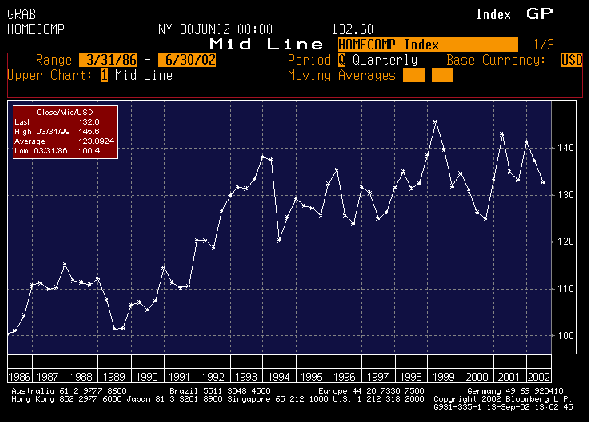
As an interesting footnote, I have attached a chart showing the affordability of the median home in the states, compared to the median income. A higher number means housing is more affordable on a monthly payment basis.

Attachment: homecost.gif
This has been downloaded 45 time(s).

Roland is offline Roland
Emperor
Auf'm Jahrmarkt :(
May 1999
time: 06:18
  Old Post 19-09-2002 13:04
Edit/Delete Message Reply w/Quote
#330 Report this post to a moderator
Support Apolyton, buy Civilization 2

"Is this a fake, bubble type of market though? Not necessarily; I believe it is a permanent structural improvement in the method of financing a home."

And I think it is a Fed and GSE induced flood insurance game.

"Instead of a local bank offering me a 30 year fixed rate loan, I can now borrow from anyone of 50 originators, at say a 5 year fixed (then adjustable at UST3mos+275bp)..."

And that is new how ?

"what matters most is the monthly payment - low inflation actually can increase the asset "value" of real estate because it lowers the monthly cost of any given property. Much like a bond! When interest rates decline, bond prices increase."

That's a bit oversimplified - lower interest rates yes, but they are artificially low. I'm not sure what you mean by the lower monthly cost due to lower inflation - from a pure inflation pov:

Asset 100, rent it out at 10. Inflation is 10 %, So next year it will be 110 at 11.

Inflation now drops to 0. What happens according to your reasoning ?

 
Pages (17): [ <<   8   9   10   11   12   13   14     >> ]
< Last Thread     Next Thread > Post New Thread     Post A Reply
All times are GMT. The time now is 05:18.
Apolyton Time is 00:18.
    top of page
Rate This Thread:
archivepost
Forum Jump:
Forum Rules:
You may not post new threads
You may not post replies
You may not post attachments
You may not edit your posts
HTML code is ON
vB code is ON
Smilies are ON
[IMG] code is ON


Contact Us - Apolyton Civilization Site - Support Us!

Building a better Apolyton through better information. Click here and take our poll!
Non-US visitors, click here!

Powered by: vBulletin Version 2.0.3
Copyright ©2000, 2001, Jelsoft Enterprises Limited.

Page generated in 0.0752 seconds (90.81% PHP - 9.19% MySQL) with 31 queries
Page Loading Time:

Support Apolyton: Amazon USA | Amazon UK | Amazon DE | Amazon FR |
Support Apolyton and get FREE PLUS, Buy from Chips&Bits: Galactic Civilizations | Galactic Civilizations: Deluxe Edition | Call to Power 2 | Civilization: The Boardgame | GURPS/ Alpha Centauri | Alpha Centauri | Civilization IV | Civilization III: Complete |


Front Page | Civilization IV | Civilization III | Civilization II | Call to Power II | Alpha Centauri | Master of Orion III
Rise of Nations | Galactic Civilizations | Galactic Civilizations II | Misc
Alt.Civs | Civ I | C:CtP I | About | News | Directory | Apolyton Store | Forums | Chat | Columns | Interviews | Newsletter
Scenario League | CSC | Clash of Civs | Spanish Site | CtP Maps | Cradle of Civ | WesW's Ctp1/2 Site | Civ3 Haven

apolyton.net | apolyton.com | civilization2.net | civilization3.net | civilization4.net | civilizationiv.info | calltopower.net | galciv.net | galciv2.net | moo3.net