|
| |
|

|
DrSpike
|
 |
Enthusiastic member of Apolyton
Sep 2001
time: 05:18
|
|
Hehe I like you Roland........I think I would enjoy a few beers and some debate with yourself. Sorry I didn't respond earlier; I just got back from teaching a seminar, albeit not one where people had silly ideas about recession and deflation. 
Deflation did not set in immediately after the bursting of the bubble; in this you are correct. The BOJ kept interest rates way too high for too long: this started the ball rolling.
I admit defeat on one thing. I can think of no simple way how to explain why Japan's immense fiscal stimulus in the 90s was never going to work without referring to the seminal works in this area. I wasn't b*llshitting about this being a technical area earlier, it truly is and I'm sure a man of your clear intelligence can realise that sometimes descriptive analysis is insufficient, and laypeople should listen to those whose profession it is to understand such issues.
Ok I lied. I can think of one way, but it might not be clear. Once a deflationary spiral kicks in it feeds upon itself, and you need a massive boost to demand to free the economy. But that isn't enough, as I'll explain in a second. You also need to realise that the element that makes the situation analysis to the laughable liquidity trap ideas is that there is a floor to monetary policy in that nominal interest rates cannot fall below 0. Should the equilibrium real rate (say the rate at which the GDP gap is closed - not quite right, but it'll do for now) given the inflationary/deflationary situation be below this the crucial element is in the beliefs of the consumer sector. The only way to break the cycle is to credibly (this is paramount) commit oneself to a postive inflation target and do whatever it necessary to attain that target. If the BOJ had done this early enough they may have escaped.
Now although the BOJ and the institutional wrangling within Japan was a factor I should point out we know far far more about these things now..........which is part of the reason it should be avoidable in the US.
That's my last shot at this, and it's not great.  If you truly want to understand the situation there are some great articles I can refer you to (I even wrote one myself when this problem started to fascinate me in early 2000). If you truly want to understand the situation there are some great articles I can refer you to (I even wrote one myself when this problem started to fascinate me in early 2000).
I cringe at the quote you offer in your last post. Fortunately for every dumbass comment made by some economist wannabe I can show you academic articles stating the true state of affairs. However, if truth be told part of the problem is the lack of interest held by experts in communicating their thoughts. Coupled with this is the apparent joy taken (by such individuals as Robert Reich, Lester Thurow, whoever wrote that Dow 32,000 book to name but a few) in peddling rubbish, rubbish that gets read by intelligent people and fills them with dumb ideas.
There are a few great resources out there now for the hobby economist. I suggest you check out Brad DeLong's site, and read everything that Paul Krugman writes in his NYT column, Fortune and Slate (incidentally Krugman has a brutal piece on the Hayek and the Austrian school's views on recession, if I can find it I'll give you a link). Also if you haven't done so already a basic macro text is useful, Mankiw or Blanchard and Fisher's texts are quite accessible. Though we economists are all blind and conventional it remains a fact that with 6 models you can understand the world macroeconomy better than 99% of individuals. These are the basic Keynesian model, IS-LM (this is the jumping off point as well if you want to understand deflationary spirals), AS/AD, Mundell-Fleming, Dornbusch and finally the Solow model.
Phew, long, long posts.
To the Taylor-rule guy, yeah, the Taylor rule is a great first approximation in normal times. Actual policy-making uses many more complex modesl, but the Taylor rule has its heart in the right place. Kinda tricky to apply outside of 'normal' times though.
|
|
| |
|
|
|
Sten Sture
|
 |
SF, CA don't call it frisco... Striker!!
Mar 1999
time: 21:18
|
|
re: Wayne Angel - at least Bear Stearns has John Ryding (a Brit) on staff to temper the crazy Texan's Wylie Coyote collection of witicisms. As an aside Angel's son is named Wylie - coincidence??
re: Japan vs the USofA - prelude or divergence - Two interesting divergences are employment and non-performing loan realization.
When Japan's economy started contracting and their bubble burst they pursued a policy of adding employment ~70% of the working age populace in 1988 to ~74% in 1992, and held there until this past year. In the US, companies immediately began shedding workers as they had in the early 1990s. This should help the States Utd to reduce overcapacity, improve profitability and repair corporate balance sheets and attract capital much quicker than Japan - provided of course that the small companies, that provide the real strength of American job growth, are able to avoid the disappointing corporate governance issues facing some of the big boys.
US lending institutions have also acted quickly to 'mark-to-market' significant bad loans made during the past decade. While I still believe there is quite a bit more to do in that area, the initial movement contrasts sharply with the abject refusal of Japanese banks to break their affililiation ties and cut off deliquent credit. Leaving underperforming capacity in the pipeline is a recipie for deflation - certainly not what Japan, Inc. needs.
As a market watcher I would put the probability of the US doing a Japan at less than 10%, and am somewhat encouraged by the nascent recovery in the US manufacturing sector and the early process of a return to rational capital market investing.
re: The US budget deficit and its affordability.
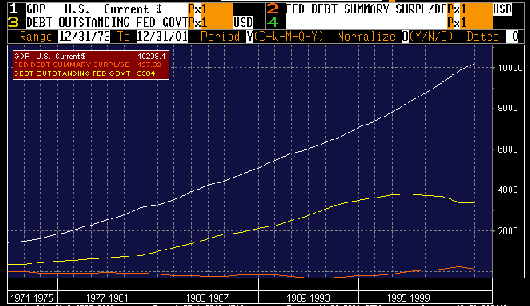
I readily admit to el freako that if the US was to consistently borrow funds where the sum of real interest and net borrowing was greater than the growth in real GDP, we would eventually have a problem. However, the affordability of such drastic debt increases would take tens of years to create a situation where the annual interest expense was significant relative to the size of GDP. Current dollar GDP in the States is a little over US$10 trillion and the annual interest expense of government debt is around US$180 billion - a paltry 1.8% of GDP. Easily affordable even at much higher levels.
The chart below shows the level of US debt compared to the GDP, and while the graph is not logrythmic, you can still see that the growth rate of GDP has been in excess of the growth rate in the Govt's debt, and that the recent increases in the deficit are reasonable.
edit: a bit hard to read the chart - sorry - it was Greenspan's idea... 
 Attachment: us debt to gdp5.gif Attachment: us debt to gdp5.gif
This has been downloaded 46 time(s).
|
|
| |
|
|
|
el freako
|
 |
Bristol, European Union
Oct 1999
time: 05:18
|
|
Sten,
Again you are confusing my argument about foreign financing of the US's current account deficit with domestic financing of the US governments budget deficit.
I am talking about the former, not the latter.
In the former case the US's Income payments and transfers already amount to over 25% of total foreign income (from exports, investments etc) and it's current account deficit (borrowing) amounts to a third of it's foreign income.
Applying those figures to the latter example about governmental finance, how worried would you be if the federal government was spending 1/3rd more than it's revenues and the interest on the current debt amounted to a quarter of those revenues.
Good job showing up two important differences between the US and Japan though.
Last edited by el freako on 07-09-2002 at 01:34
|
|
| |
|
|
|
DrSpike
|
|
Enthusiastic member of Apolyton
Sep 2001
time: 05:18
|
|
I should start by saying I am really impressed at the spare time you guys must put into economics.
Sten Sture are you in investment banking?
Coupla comments. The regression stuff: I'm not sure exactly what you've done or why you've done it (I am too lazy too read all that has gone before we started talking about deflationary spirals ), but remember correlation does not necessarily imply causality. For your regression to be valid the explanatory variables must be truly exogenous and there must be no glaring omitted variables. You should also avoid regressing something on something else of which it is a component. If your regression is time series, (ie regressing investment in period t on some explanatory variables at time t for t=1970-2002 say) then you also need to check for stationarity.
I am not quite clear on what it is you are trying to deduce.
What is for sure is that the dollar will still fall a bit yet, and the current account deficit will contract..........No, I don't know when..........hell, economists have been saying the dollar is overvalued for a long time. Exchange rate forecasting is a mug's game. Scenario 1 is a nice steady decline, giving a nice boost to aggregate demand just as it is needed to offset the probable fall in consumption as savings rates adjust to the new equilibrium. Scenario 2 is a less controlled fall, which could potentially put the fed in a tricky situation. Currencies tend to overshoot (the Dornbusch model mentioned above was the first model to show why), so this isn't out of the question.
However, my personal view is that the correction of this imbalance will not by itself cause any grief in the US. It's spectacularly boring of me not to talk of wondrous recoveries or Japanese style deflationary slumps, but the reality is probably one of treading water for some time, around a year, maybe more. The dollar will fall, not too wildly, and yes, I do think consumption will fall and savings rise over this hypothetical year. Certains areas of the stock market still look a touch overvalued to me - expect further shenanigans there. Outside of the TMT sector more and more investment opportunities will emerge soon though, and I think the US will be growing around about its 'trend' rate in say 18 months time.
My you're in a good mood I hear you cry. Well I'll have to leave on a sombre note. The overstretched consumer may well snap (man that is a cool metaphor, I'm going to use that again). But my biggest fear on your behalf is instability in the oil market in the face of any potential conflict. The dynamics of oil market pricing are complex, characterised by mulitple equilibria, and it may turn out that world demand is not sufficient to 'kick' the market into the high price equilibrium. Hehe Russia is your saviour, lol, how ironic. However the US is soooooooo vulnerable to a negative supply side shock from this quarter it worries me. If the timing is wrong this could be the dollop of sh1t that hits the fan and makes things really bad.
|
|
| |
|
|
|
Sten Sture
|
|
SF, CA don't call it frisco... Striker!!
Mar 1999
time: 21:18
|
|
fyi - I am a domestic (US only) bond market portfolio manager - worked with a couple of serious macro guys in the past, but its been a few years, I can be pretty rusty. I get to read the wall street econo stuff for work, luckily the coffee is provided by my firm. I usually stick to the US stuff, but occasionally pick up a guy like Gavyn Davies with Goldman on the Int'l side...
I think Adam Smith is the only poster around here that is 'gainfully' employed as an actual economist; I know with a handle like that who would have thought??
The (small) good news for the US on a potential oil shock, is that the bulk of our imports come from the western hemi, iirc, from old API data. The price would still go wack-o, and the drag would be serious, but supply should be available to get heating oil to Boston in January.
We need to very seriously pursue some alternatives. How about an investment boom in alternative fuels and mass transit? Or at least wool blankets. 
|
|
| |
|
|
|
DanS
|
 |
Kickball Capital of the World
Jan 1970
time: 00:18
|
|
Wow, this thread exploded!
Last things first, I am highly skeptical about any oil taxes. The pace of technological change with regard to energy production cannot be dictated so easily, even though I readily admit that the pace of change might be hastened by incentives through taxing the true cost.
But, as a challenge, what has Europe gotten for the many billions of petrol taxes it has paid? Is it only "a bit"? I would argue that it received insufficient rewards, with proceeds going to everything but addressing the costs inherent in the energy source.
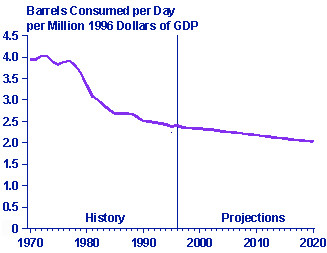
There's a lot that can be talked about on this subject, but I do note that an oil shock could be withstood by the United States without calamity. Oil, both domestically produced and imported, is about 18 million barrels a day, which represents about 2% of GDP, depending on the price.
Put another way, since 1973, the US has successfully halved its oil consumption/GDP intensity. This indicates that we did learn our lessons, even in the absence of petrol taxes.
What is forgotten often about the 70s and 80s is that it was a series of shocks over 13 years. Nowadays, there are more credible non-OPEC and non-Arab players in the market, as Spike alluded to. Further, most large oil reserves holders (Iraq excepted), realize that oil shocks do not maximize the long-term value of large reserves. That's why they weren't continued! Also, they do not maximize the value of equity holdings in Western equities markets.
Anyway, this continues to be interesting reading.
Last edited by DanS on 09-09-2002 at 02:58
|
|
| |
|
| |
|
|
|
DrSpike
|
|
Enthusiastic member of Apolyton
Sep 2001
time: 05:18
|
|
"Ecomomic analysis of law, economic constitutional law, central bank law.... all part of the job. Macro is a good part of law studies here, and I've done some semesters of macro. Anyway it is quite pointless to rely on formal qualifications for a discussion on an internet board."
Well maybe. But surely someone who has spent years studying economics and has worked professionally on the problem being discussed has more insight. I don't want to hide behind titles, and I have tried to persuade through analysis. However, it is hard with the restrictions I am under; this is a technical issue, and descriptive analysis is at times too ambiguous. I am
all for non-economists making an effort to understand the pressing issues of our time, but frankly it grates a little when you seemingly make little effort to listen to some of the things I am telling you, the parts that are not at all subjective.
1) Deflation is the problem. When an economy's production is limited by its capacity to produce — the normal state of affairs — it is important to make sure that scarce resources like capital are used efficiently, put to work where they yield the highest return. But Japan isn't limited by its capacity. It is plagued by chronic insufficiency of demand — that is, consumers and businesses are unwilling to buy as much as the economy is already capable of producing.
This is a fact. Japan knows it, the BOJ knows it and every economist whose opinion is worth anything knows it.
2) Why is there deflation?
Everyone agrees that what is happening in Japan right now is that the saving Japanese residents would want to undertake at full employment exceeds the investment (including net foreign investment) that businesses find profitable. This means, more or less by definition, that the price of current goods in terms of future goods is above its equilibrium level. This is true despite the fact that the nominal interest rate is virtually zero. In a world in which there was no nominal floor to interest rates there is no problem. It is precisely because there is this floor that the adjustment must take place (slowly and debilitatingly)through a fall in prices.
3) Why is deflation a problem?
Well, once the spiral starts it gets built in to price expectations, which exacerbates the problem. This comes out crystal clear in the models I link to below, but is tricky to understand without knowledge of such models. All I can say is a few arguments about consumer delaying spending (and also firms delaying investment - I did not mean earlier to marginalise the corporate sector, I merely highlighted the consumer sector since that is what is keeping the US afloat at the moment).
Another factor is of course the rising real value of debt, a factor discussed at length by Fisher (an economist you seem to like) in regard to the US in the 30s. The underlying problem is the same in Japan now.
4) What to do? The whole point is that monetary policy as conventionally transmitted to the real economy DOES NOT WORK WHEN NOMINAL RATES ARE 0 WITHOUT THE ECONOMY BEING AT A FULL EMPLOYMENT EQUILIBRIUM. Remember the real equilibrium rate is negative.
Fiscal policy can help in the short term, but is not going to right the underlying problem. Of course we live in a world of nominal rigidities and if the authorities had acted soon enough conventional monetary and fiscal policy would have worked. But once deflation had really kicked in radical thinking is required. The ONLY way to solve the underlying problem is to induce inflationary expectations, which means that the price level need no longer fall to return the economy to full employment equilibrium. Again I apologise, this is by no means obvious, and will not be realised without understanding of the relevant models. Until Krugman wrote some pieces in the late 90s this was not understood even by professionals.
"Wouldn't you agree that virtually all the errors committed in Japan during the bubble evolved were repeated in the US ? "
No. And should deflation start to kick in we know exactly what needs to be done and why. There are sets of circumstances that would prove tricky to deal with........hence the positive probability I mentioned earlier.
Some links as promised:
Damn the site is down. The most important piece to read is "Thinking about the liquidity trap", by Krugman (1999). Also good (and slightly less technical) are Japan's Trap and Japan: Still trapped. All of these pieces are in the Japan section at pkarchive.org, which you should check out when the site is working.
Enjoy!
|
|
| |
|
|
|
DrSpike
|
|
Enthusiastic member of Apolyton
Sep 2001
time: 05:18
|
|
Aha! Success at last. Now I see your reasoning (I would see it immediately if we were talking in models - a social science is still a science) and see exactly why you are wrong.
Overcapacity is annoying. Sure, everything else being equal there is less reason to invest when you already have overcapacity. Fine.
So, say all the law professors in the world snap their fingers simultaneously and overcapacity in Japan is wiped out as a result. Why not say they also make banking reforms........sort out all NPLs etc.......so there are no supply side problems left in this hypothethical economy.
Great you cry, except that of course the real interest rate is still negative, and there is still unemployment, and the deflationary spiral is not broken.
You indicate you do not understand about the role of deflation is raising the real value of existing debt. I apologise for not clarifying this earlier - I thought you understood due to some comments I remembered you making on the US in the 30s. This is a critical strand to understanding the problem. Deflation raises the real value of existing debt in the same way that inflation erodes the value of existing debt. If I borrow £100 from you today and agree to pay back £105 in a years time, the real rate of interest on that loan is 5% - inflation, so inflation redistributes from lenders to borrowers. Deflation works in reverse, making people and firms more indebted in relation to income as prices and wages fall.
When initially wading in to this debate a few years ago I shied away from saying thing like 1) above.......you don't want to get labelled a neanderthal-type Keynesian , and supply side issues sure made the problem worse, and solutions harder.
But the problem (sing along, you all know the words) is still one of lack of incentives to invest and consume with the given real rate of interest and deflationary price expectations. This continues until inflationary expectations are credibly induced.
For what's its worth (even if you understand a little better now I don't see you suddenly agreeing with me now, you have too much at stake here) it's not just me. Every economist under the sun whose voice mattered told the central bank of Japan what to do, and when they stopped denying the problem existed they started following the procedure of trying to induce inflationary expectations. It is ongoing now; it is largely the world macroeconomic outlook that is delaying things.
Last edited by DrSpike on 10-09-2002 at 03:19
|
|
| |
|
|
|
Colon
|
 |
Antwerp, Colon's Chocolate Canard Country
Jan 1970
time: 06:18
|
|
Dan, I wouldn’t be so sure that the US has become less dependant on oil because “it learned it lesson”. It seems to me that it became less dependant because of a general technological evolution, decreasing intensity globally. I assume this because the US’ economy is a lot more energy intensive than the EU and especially Japan. (see this eurostat tabel)
If you have time-tables of oil-intensity, comparing the US with the EU and Japan, I'd be happy to see them.
DrSpike, you missed my point re Taylor rule, which is that the BOJ seemed to have reacted similarly to changing economic conditions as the Fed does. The reason they cut rates more slowly is because the Japanese economy wasn’t going down the drain as fast. It’s easy to argue in hindsight that the BOJ was too slow to cut rates, but the fact was that the Japanese economy was holding up very well for a couple of years after the stock bubble burst. (not the least because consumption and real estate were strong)
Re real estate, it doesn’t surprise me that debt/asset ratios look good, they often look good in bubbles, as the asset part of ratio is inflated. The issue here is what happens after asset prices deflate because, after all, we live in a world of world of nominal rigidities and because the income/mortgage debt ratio is already at record heights.
|
|
| |
|
|
|
el freako
|
|
Bristol, European Union
Oct 1999
time: 05:18
|
|
DanS,
I have data for Europe (indeed the entire OECD) for 1990 and 2000.
Using the slightly different measure of GDP at constant 1996 US prices*/tonnes of oil:
GDP produced per tonne of oil consumed:
United States:
1990: $8,710
2000: $10,350
growth: 1.7% per annum
EU15:
1990: $12,130
2000: $14,650
growth: 1.9% per annum
Japan:
1990: $10,420
2000: $11,760
growth: 1.2% per annum
OECD total:
1990: $10,040
2000: $11,710
growth: 1.5% per annum
*this is derived from the US national accounts for the US and from the relative shares of current GDP converted using PPPs for other countries.
|
|
| |
|
|
|
Colon
|
|
Antwerp, Colon's Chocolate Canard Country
Jan 1970
time: 06:18
|
|
Dan, it's interesting the intensity dropped precipitiously after the second oil shock in '79. My guess is that the high oil price was a strong incentive to invest in fuel efficiency. And if so, why couldn't the same effect be obtained by raising energy taxes? The govt could separate the revenues from normal expenditures to invest it in
EF, I should have guessed you'd have the data.
quote:
Originally posted by Ned
Dr. Spike, I am sorry I hadn't looked at this thread earlier. I thought it was about M&A primarily.
I only went back two pages, but, let me say, that I agree with your analysis that deflation is a re-inforcing phenomenon that is caused by high real interest rates that are in turn kept high on a real basis because, as we all know, "nominal interest rates cannot go below zero."
But, is this latter point true - at least with overnight discount rates? Let us assume they could go negative? What would be the adverse consequences, if any? |
Sort of what I am thinking, I don't see why a central bank couldn't lend money paying a fee instead of receiving one. It's not like it can't print the money to finance this.
|
|
| |
|
|
|
Roland
|
 |
Auf'm Jahrmarkt :(
May 1999
time: 06:18
|
|
DrSpike:
"Aha! Success at last. Now I see your reasoning"
No you don't. Btw there is no point in turning into a macro textbooks on legs. I fully understand your pov, I just don't share it. No need to explain Adam and Eve to me.
"You indicate you do not understand about the role of deflation is raising the real value of existing debt.... If I borrow £100 from you today and agree to pay back £105 in a years time, the real rate of interest on that loan is 5% - inflation... Deflation works in reverse, making people and firms more indebted in relation to income as prices and wages fall."
I did indicate that I was not sure whether you meant anything but exactly that effect as I said: "What do you mean there ? That rise is already in real rates, is it not...."
How is that different ? The only possible effect depends on how the loan deals are structured wrt interest payments and principal payments, and that is minimal at best.
"This continues until inflationary expectations are credibly induced."
Well, what happens to prices when excess capacity is liquidated ?
"For what's its worth (even if you understand a little better now I don't see you suddenly agreeing with me now, you have too much at stake here) it's not just me."
Look taking this condescending attitude won't get you any brownie points. How about answering my questions: Why did the real rate go that low ? Why did deflation start ? Did the Fed make the same mistakes as the BoJ (and I was referring to the time when the bubble was building, not when it popped) ? What should the Fed do if it looks like deflation gets a grip on the US - do you agree with unorthodox measures like buying all kinds of financial assets, including stocks ? Why did economies recover from deflationary recessions, eg the post WWI recession in the US ?
PS: Where was you article on Japan published ? If it'sn ot online I'll check whether we have it in the library.
PS2: Krugman is sometimes overdoing his liquidity trap thinking. Eg he siad in 1998/99 that the ECB's policy was too tight with the rate at 2.5 % risking a deflation trap, but a year later the eurozone economy was growing at a 3.5-4 % pace. What is your take on this ? Agree with Krugman ?
Last edited by Roland on 10-09-2002 at 15:02
|
|
| |
|
| |
All times are GMT. The time now is 05:18.
Apolyton Time is 00:18. |
top of page
|
| archivepost |
|
Forum Rules:
You may not post new threads
You may not post replies
You may not post attachments
You may not edit your posts
|
HTML code is ON
vB code is ON
Smilies are ON
[IMG] code is ON
|
|
|
|
|
|





 06-09-2002 20:30


 Attachment:
 |
|