|

|
MosesPresley
|
|
To avoid culture flipping:
I bombard the city down to about a 4 or less population. I then send a settler or two to bolster the city's population with my citizens.
or
If I want to retain at least some of the city's infrastructure, I will do what Arrian suggested in quote:
capture or raze nearby AI cities quickly, moving the AI cultural borders back |
, but I still send in some settlers to homogenize the population.
|
|
| |
|
|
|
Soren Johnson Firaxis
|
|
Hunt Valley, MD
May 2001
time: 00:19
|
|
quote:
Originally posted by Sn00py
So when the Germans invaded Paris, the French decided they didn't like the German culture and revolted back to France.
Wait, does that sound right? Well it would to Firaxis!
I took a tiny city, placed 14 tough men inside, 2 turns later, the ppl decided to revolt back to Greece. Excuse me, but if the people decide to do anything, I should be able to stop them because of my army who should be controlling the people. |
I am not sure what you mean by a "Tiny" city, but if this happened under 1.17 or 1.21, that sounds like a bug. The only way a city of, say, size 2 would revolt if you had 14 troops in the city was if their total culture was 3.5 times your total culture, which is pretty unlikely. If this sounds like a bug, please post a save.
Of course, if you are using 1.16, all bets are off because under that version there was always a minimum (albeit very slim) chance of a revolt.
|
|
| |
|
|
|
Akron
|
|
quote:
Originally posted by cyclotron7
Cultural reversion only happens in cities whose culture borders that of another city's |
I've had several instances where a city that i captured culturally flips even though the enemy civ is on a tiny island on the other side of the map.
Seriously, if there are 3 or more troops in a city, cultural flipping should very rarely happen.
|
|
| |
|
|
|
Sn00py
|
 |
From New Zealand
Aug 2001
time: 13:19
|
|
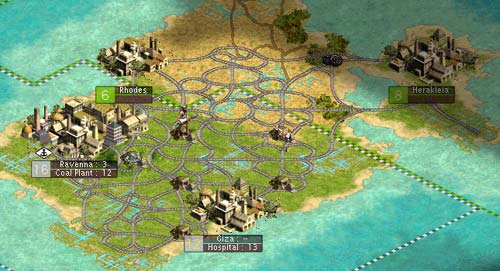
ok, I am roman, the white guys, the greeks are the green guys and as you can see my cities are much larger than theirs and this is just an island, this piece of land is not our main land.
Also you'll notice that Herakleia has rubber (one of two in the whole game), and since I didn't have any, I decided I better take it or get lost in time. So I thought I'll do it the 'nice' way, the american way; and culturally take their two close cities. First I investigated the cities to see how much culture they had and how much I might need in order to take them. They both had a temple and that's it for their culture. So I thought, great, I'll just build a temple, colleseum and a cathedral in both my cities and take them over that way. It never came to pass and time was moving on, so I thought stuff it, I'll go to war.
When I took that city, it was a size 4, coz I had used artillery on it.
I got order back in the city, built a temple on the next turn and thought it was mine forever. But on the next turn, it flipped back to Greece.
The only reason I didn't demolish the city is because I needed that rubber asap to hold off against the greeks when they start to mobilize (which didn't take them long  ). ).
maybe the paris analogy was not a good one, but seriously, shouldn't my armies have the control of the people, rather than the people have control of my armies?
btw some might be wondering why I am not using my gfx, and that is becoz I am starting on the new one. so I have to reset the terrain gfx back to normal.
|
|
| |
|
|
|
Soren Johnson Firaxis
|
|
Hunt Valley, MD
May 2001
time: 00:19
|
|
quote:
Originally posted by Sn00py
ok, I am roman, the white guys, the greeks are the green guys and as you can see my cities are much larger than theirs and this is just an island, this piece of land is not our main land.
Also you'll notice that Herakleia has rubber (one of two in the whole game), and since I didn't have any, I decided I better take it or get lost in time. So I thought I'll do it the 'nice' way, the american way; and culturally take their two close cities. First I investigated the cities to see how much culture they had and how much I might need in order to take them. They both had a temple and that's it for their culture. So I thought, great, I'll just build a temple, colleseum and a cathedral in both my cities and take them over that way. It never came to pass and time was moving on, so I thought stuff it, I'll go to war.
When I took that city, it was a size 4, coz I had used artillery on it.
I got order back in the city, built a temple on the next turn and thought it was mine forever. But on the next turn, it flipped back to Greece.
The only reason I didn't demolish the city is because I needed that rubber asap to hold off against the greeks when they start to mobilize (which didn't take them long ).
maybe the paris analogy was not a good one, but seriously, shouldn't my armies have the control of the people, rather than the people have control of my armies?
btw some might be wondering why I am not using my gfx, and that is becoz I am starting on the new one. so I have to reset the terrain gfx back to normal. |
well, it would be more useful to see a pic (or better yet, a save...) from just before the flip. If there are tiles of Greek territory in the city radius, they count just as much as citizens. So if there were four Greek squares in your radius and four Greek citizens, you would have needed 16 combat (don't count artillery) units (assuming your overall culture is at least equal to their's) to have no chance of a flip. Of course, the probability goes down with each unit added to the city. So if you had 14 units, the probability of a flip was probably < 1%. But it happens...
I should also add that in the scenario I just outlined, if you had twice the total culture of the Greeks, you would have only needed 8 units. If you had 3 times their culture, 6 units. 4 times, 4 units...
Last edited by Soren Johnson Firaxis on 24-04-2002 at 20:14
|
|
| |
|
|
|
Jon Miller
|
|
I havr always wa*ted to k*ow this
Jo* Miller
|
|
| |
|
|
|
petey
|
|
I like the way that culture flipping works.
It forces you to have to deal with the cities that you've just captured and not just take them over and then run on to another city the next turn. You have to spend some time, units and energy to hold the city rather than just have a massive blitzkreig across the continent. It adds another element to the game play that forces you to go beyond the attack, attack, attack strategy that is the hallmark of so many computer games.
Yes, it is annoying when you're running over an AI's civ and then have to turn around and retake a city or two, but it forces you to add more elements to your startegy and makes for a richer gaming experience. In my present game, two Russian cities flipped back during the same turn just as I was about to drive them off the continent. It bugged me and I lost the units that were garrisonned there, but it made me have change my short-term strategy to deal with it and added more to the game.
In terms of having a unit attack your garrison like in Civ2, it just means that you could ignore the problem if you're stronger than your enemy. The way it is, the game can throw you a curveball and force you to react in a way you didn't plan for. It makes it more fun.
|
|
| |
|
|
|
Fitz
|
 |
& Anarchist
Mar 2000
time: 21:19
|
|
quote:
Originally posted by Soren Johnson Firaxis
well, it would be more useful to see a pic (or better yet, a save...) from just before the flip. If there are tiles of Greek territory in the city radius, they count just as much as citizens. So if there were four Greek squares in your radius and four Greek citizens, you would have needed 16 combat (don't count artillery) units (assuming your overall culture is at least equal to their's) to have no chance of a flip. Of course, the probability goes down with each unit added to the city. So if you had 14 units, the probability of a flip was probably < 1%. But it happens...
I should also add that in the scenario I just outlined, if you had twice the total culture of the Greeks, you would have only needed 8 units. If you had 3 times their culture, 6 units. 4 times, 4 units... |
Soren, this seems like an afwully simplified desription compared to factors we were told affected flips in prior versions. Has it really been this simplified in game, where the only factors are other-civ citizens, other-civ squares, military forces, and overall civ cultural amounts? I believe other factors previously mentioned included distance to capitols, and city specific culture. It would be nice to know if building a temple is no longer necessary to prevent a flip (or even has any effect at all), just stocking up enough military.
Also, in my latest game I have a city with 4 greek citizens (only) and four squares in zulu territory. Do 8 military units counter the flip chance to each civ, or do I need 16 (assuming no other factors)?
|
|
| |
|
|
|
Soren Johnson Firaxis
|
|
Hunt Valley, MD
May 2001
time: 00:19
|
|
quote:
Originally posted by Arrian
Something wrong with your "n" Jon?
Soren, thanks for the answer. What about proximity to the capitols? Say their capitol is 12 squares away and yours is 24. Will that cancel out a 2 to 1 culture ratio in your favor?
The culture issue, btw, is why I think religious/militaristic is the best combo for war.
-Arrian |
The capital factor affects how big the "die" is, if that makes sense. For example, in the case above, there are 4 greek citizens and 4 greek tiles. That equals 8, which is then doubled because Greek culture _in that city_ is greater than Roman culture in that city. So that is 16. Let's say Snoopy has 4 units and has twice as much total culture as the Greeks. That would be 16 - (4 X 2) = 8. So if we "roll" an 8 or less, the city flip. How big are the dice? Well, it depends on the distance to the two capitals, but it ranges from two extremes of 500 and 8000 (for an average of 2000...), so in the average case, the probability of a flip would be 8/2000, which is 0.4%.
|
|
| |
|
|
|
Soren Johnson Firaxis
|
|
Hunt Valley, MD
May 2001
time: 00:19
|
|
quote:
Originally posted by punkbass2000
Well, assuming the two cities are equal distance from the given square, it goes to whichever has the higher culture in my experience. |
correct.
|
|
| |
|
|
|
Soren Johnson Firaxis
|
|
Hunt Valley, MD
May 2001
time: 00:19
|
|
quote:
Originally posted by Fitz
Soren, this seems like an afwully simplified desription compared to factors we were told affected flips in prior versions. Has it really been this simplified in game, where the only factors are other-civ citizens, other-civ squares, military forces, and overall civ cultural amounts? I believe other factors previously mentioned included distance to capitols, and city specific culture. It would be nice to know if building a temple is no longer necessary to prevent a flip (or even has any effect at all), just stocking up enough military.
Also, in my latest game I have a city with 4 greek citizens (only) and four squares in zulu territory. Do 8 military units counter the flip chance to each civ, or do I need 16 (assuming no other factors)? |
yes, all these factors still affect the flip. (I tried to keep the example simple...) An important one is having more culture in that city than the previous owner. If you don't, the value of the citizens and tiles is doubled for the flip calculations. Being in civil disorder also doubles their value. Being in WLTKD halves their values. I explained the capital factor is a previous post.
|
|
| |
|
| |
All times are GMT. The time now is 05:19.
Apolyton Time is 00:19. |
top of page
|
| archivepost |
|
Forum Rules:
You may not post new threads
You may not post replies
You may not post attachments
You may not edit your posts
|
HTML code is ON
vB code is ON
Smilies are ON
[IMG] code is ON
|
|
|
|
|
|





 24-04-2002 00:35


 He's always a pain in the @$$, but I love rolling over Hoplites with Panzers!
 Attachment:


 |
|