|
| |
|

|
Oerdin
|
 |
of Internet Music.
Sep 2001
time: 21:19
|
|
I'm reposting some old info about the Celts that I had written several months ago on the Civ3:civilizations forum. Hopefully it will help add to everyones understanding of the Celts; to read the whole thread go to http://apolyton.net/forums/showthre...?threadid=29913
-----------------------------------------------------------------------
Historical Significance: A widely spread cultural group that dominated Europe from 500B.C. to 200A.D.; Celtic artifacts have been found in Asia Minor and as far away as the Tarim basin, Xinjiang provience, China.
Description:
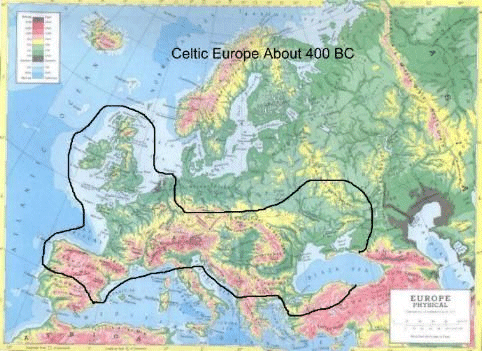
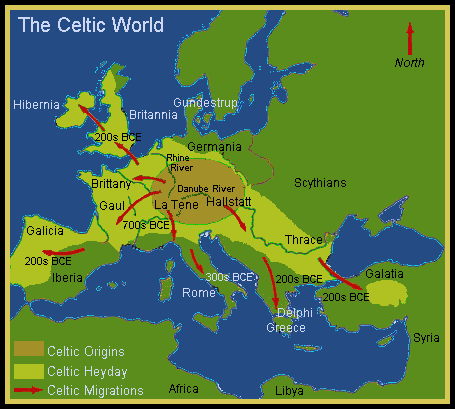
CELTS:- An ancient people who dominated much of Western , Central , Eastern Europe and Asia Minor in the 1st millennium bc, giving their language, customs, and religion to the other peoples of that area.
History:- The earliest found archaeological evidence associated with the Celts places them in what is now France and western Germany in the late Bronze Age around 1200 bc. In the early Iron Age, they are associated with the Halstatt culture (8th-6th cent. bc) named for an archaeological site in Upper Austria. They probably began to settle in the British Isles during this period. Between the 5th and 1st centuries bc , their influence extended from what is now Spain , the islands of the British Isles to the shores of the Black Sea , from the Ukraine to Turkey. This huge land/cultural region ( never an 'Empire') encompassing the areas mentioned influenced much of the continent of Europe and was greater in size then modern European Russia. Despite the shared religion/language and culture this large area was never politically united , finding only brief periods of unity when threatened by common foes. The later Iron Age phase of Celtic Culture is called La Tene, after a site in Switzerland and dates from the previously mentioned 5th to 1st centuries bc. Evidence from this period suggests that the Celts were the first peoples of Europe to actively use and work with iron. The word Celt is derived from Keltoi, the name given to these people by Herodotus and other Greek writers. To the Romans, the Continental Celts were known as Galli, or Gauls; those in Britain were called Britanni. In the 4th century bc the Celts invaded the Greco-Roman world, conquering northern Italy and sacking Rome, whilst also conquering Macedonia and Thessaly. They plundered Rome in 390, sacked Delphi in 279, and penetrated Asia Minor, where they were known as Galatians. The "Cisalpine Gauls" of northern Italy were conquered by the Romans in the 2nd century bc .Transalpine Gaul (modern France and the Rhineland) was subdued by Julius Caesar in the 1st century bc. and most of Britain came under Roman rule in the 1st century ad. In the same period. the Celts of central Europe being fragmented came under the domination by the Germanic peoples. In medieval and modern times the Celtic tradition and languages survived in Brittany ( Western France), Cornwall, Galicia ( North Western Spain) , Galatia ( Central Turkey), Wales, the Scottish Highlands, Isle of Man and Ireland, and to a lesser extent in the Norse/Celtic culture of Iceland.
Way of Life:- The various Celtic tribes were bound together by common speech, customs, and religion, rather than by any well defined central governments. There government was through the use of a feudal system with each tribe being headed by a king/chief and was divided by class into Druids (priests), warrior nobles, and commoners/freemen and slaves . Politically there was a great degree of democracy within the society with both men and women being treated equally and all important decisions being made at tribal gatherings in which women had an equal voice. Rulers were subject to removal at these gathering if found unsatisfactory or incompetent and succession was not necessarily hereditary. The absence of any large scale political unity amongst the tribes contributed substantially to the extinction of their way of life, making them vulnerable to their enemies. Their economy was pastoral and agricultural and they had no real urban life however trade played a large part in there economy . The nobles fought on foot with swords and spears and were fond of feasting and drinking. Celtic mythology, which included earth gods, various woodland spirits, and sun deities, was particularly rich in elfin demons and tutelaries, beings that still pervade the lore of peoples of Celtic ancestry.
Celtic Christianity:- The Christian faith was well established in Celtic Britain by the 4th century ad, but in the 5th century the Saxons and other Germanic peoples invaded the country, driving most of the Celtic Christians into Wales and Cornwall. At the same time. St. Patrick and other British missionaries founded a new church in Ireland, which then became the centre of Celtic Christianity. The Irish church developed a distinctive organization in which bishops were subordinate to the abbots of monasteries .The Irish monks, devoted to learning as well as religion, did much to preserve a knowledge of ancient Roman literature in early medieval Europe. Between the late 6th and the early 8th centuries, Irish missionaries were active in Christianizing the Germanic peoples that had conquered the Western Roman Empire, and they founded numerous monasteries in present-day France, Germany, Switzerland , and Italy. Celtic Christianity in Ireland was weakened by the Viking invasions of the 9th and 10th centuries, and by the 12th century its characteristic institutions, which were incompatible with those of the dominant Roman church, had largely disappeared from Europe.
Art:- Celtic art is considered the first great contribution to European art made by non Mediterranean peoples. Its roots go back to the artisans of the Urnfield culture and the Hallstatt culture (8th-6th cent. bc) at the beginning of the Iron Age. It flowered in the period of the La Tene culture. Although Celtic art was influenced by ancient Persian, Greek, Etruscan, and Roman art and by that of the nomads of the Eurasian steppes it developed distinctive characteristics. These are evident in its major artefacts-weapons, vessels, and jewelry in bronze, gold, electrum and occasionally silver. Many of these objects were made for chieftains in southern Germany and France and were recovered from their tombs. The Celtic style is marked by a preference for stylised plant motifs, usually of Greek origin, and fantastic animals, derived from the Scythians and other steppe peoples; however the human figure tended to play a secondary role. Other favourite motifs are elliptical curves and opposing curves. spirals, and chevrons, also derived from steppe art. These elements were combined in dynamic yet balanced, intricate geometrical patterns carried out in relief engraving, or red, yellow, blue, and green champleve enamel on shields, swords, sheaths, helmets, bowls, and jewelry. They also appeared on painted pottery cinerary urns, food vessels, incense bowls, and drinking cups. Examples of Celtic art include torcs, or neck rings, with the two open ends ornamented with animal heads, the silver repousse Cundestorp cauldron (c. 400 bc . National Museum, Copenhagen), a bronze lozenge-shaped shield with circular medallions and small enamel circles (1st cent. bc - 1st cent. ad ), and a bronze mirror with enamelled decoration (1st cent. bc) (both British Museum. London). Also surviving are roughly carved stone monuments and wooden objects. During the period of Roman domination of Western Europe in and after the 1st century bc the art of Celtic peoples on the Continent gradually lost its distinctive style. The Celts of Ireland continued to work with traditional motifs but as Christianity took hold, they combined them with Christian motifs and employed their skills in the service of the church.
Celts Today:- Today the people who call themselves Celts or still strongly identify with there celtic history can be found in the following areas:- Brittany France, Cornwall, Galicia Spain, Galatia Turkey, Ireland, Isle of Man, Scotland and Wales. All these areas have strong Celtic elements to there culture with some of them still speaking Celtic Languages whilst others though not speaking a Celtic language have strong Celtic cultural rootes. The modern Celts have a varied and rich history and have influenced many of the worlds current great nations with their pioneering spirit and love of adventure helping to found some of the worlds most progressive and greatest nations.
|
|
| |
|
| |
|
| |
|
|
|
Oerdin
|
|
of Internet Music.
Sep 2001
time: 21:19
|
|
Here's some info about Ogham the unique alphabet developed by the Celts. For more info follow the link http://www.crystalinks.com/celts.html
-----------------------------------------------------------------------------------
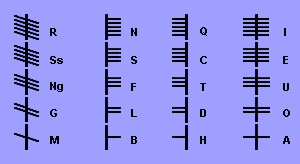
The ancient Celts had a form of writing called ogham (pronounced OH-yam). It was the writing of Druids and Bards. Ogham is also called 'Tree Alphabet' because each letter corresponds to a tree and an associated meaning. The letters were, in fact, engraved onto sticks as well as larger standing stones.
In keeping with Druidic concepts, each of the Ogham's twenty letters bears the name of a tree. A-Ailim (Elm), B-Bithe (Birch), C-Coll (Hazel), for example. The Celts had an oral tradition so it was not used to write stories or history as these were memorized.
The Ogham alphabet contains twenty letters and is read from the bottom up. The letters are constructed using a combination of lines placed adjacent to or crossing a midline. An individual letter may contain from one to five vertical or angled strokes. Vowels were sometimes described as a combination of dots. The midline was, most often, the edge of the object on which the inscription was carved.
Ogham was named after the Celtic god of literature, Ogma. It was used on the edges of burial stones and boundary markers. They usually held the name of a person. Examples exist to this day.
It was also used on rods or strips of wood that were fastened together at one end. These wands were opened and closed to present stories or poems.
Since these wands were made of wood, none survive today. Only the messages on stone survived.
The wooden sticks with the Ogham marking were used for divination similar to the way Runes were used by Norse peoples. Only the Druids and Bards understood the system and could have great influences on their people when they demonstrated its power.
There are 369 verified examples of Ogham writing surviving today. These exist in the form of standing stones concentrated in Ireland, but scattered across Scotland, the Isle of Man, South Wales, Devonshire, and as far afield as Silchester (the ancient Roman city of Calleva Attrebatum).
Similiar markings have been found on standing stones in Spain and Portugal. The markings in Spain are believed to be much older than the ones in Ireland, perhaps dating from 800 BC. It is from this area of the Iberian Peninsula that the Celts who colonized the British Isles may have come.
Ogam can still be seen inscribed on hundreds of large and small stones, on the walls of some caves, but also on bone, ivory, bronze and silver objects. The Ogam script was especially well adapted for use on sticks. Sticks are part of the Basque word for "alphabet": agaka, agglutinated from aga-aka, aga (stick or pole) and akats (notch). The meaning of the word agaka therefore isn't so much "alphabet" as "writing", a stick with Ogam notches conveying a message. The name Ogam likely comes from oga-ama, ogasun (property, wealth) ama (Priestess, mother) property of the Priestess, which indicates that the script was originally designed for use by the clergy of the pre-Christian religion.
Ogam was adopted and further developed by the first monks in Ireland. Our earliest information indicates that they were not sure as to where Ogam came from. According to the "Auraicept" the origin of Irish and Ogam must be sought in the Near East: "In Dacia it was invented, though others say it was in the Plain of Shinar" (line 1105-06). A "made in Ireland" version is recorded in "In Lebor Ogaim" in which the inventor is "Ogma mac Elathan who is said to have been skilled in speech and poetry and to have created the system as proof of his intellectual ability and with the intention that it should be the preserve of the learned, to the exclusion of rustics and fools" ( McManus 8.4).
The script was used by the monks as a monument script between 450 and 800 A.D. and they used it for literary purposes between 650 and 900 A.D. Every time the script was inscribed in stone it must have been used thousands of times on sticks, for which medium the script was obviously designed. Over 500 Ogam inscriptions are known from Ireland (collected by R.A.S. Macalister), some 40 from Scotland ( A. Jackson) and a growing number from the east coast of North America.
The fact that not a single one has been successfully translated is not so much the fault of the monks who wrote the texts, as of our linguists, all of whom assumed that the language of the script was Gaelic. However, this assumption appears to be without foundation, because the syntax of the Gaelic language in no way lends itself to be written in traditional Ogam.
|
|
| |
All times are GMT. The time now is 05:19.
Apolyton Time is 00:19. |
top of page
|
| archivepost |
|
Forum Rules:
You may not post new threads
You may not post replies
You may not post attachments
You may not edit your posts
|
HTML code is ON
vB code is ON
Smilies are ON
[IMG] code is ON
|
|
|
|
|
|






 30-05-2002 13:17


 ) leader.







 they also don't seem to grasp the difference between being Castilian and Spanish. Queen Isabella was as Spanish as Elizabeth I was British.
 )
)
 Attachment:
  !
!

 Attachment:



 |
|