|
| |
|

|
Spiffor
|
 |
CPA - Evil Clone brigade
Nov 2001
time: 06:21
|
|
This thread is about a technical aspect of the $mini-game. If you don't belong to the game, it might pretty well confuse you. If you're interested in joining the minigame, you'd better check that thread rather than this one.
OK, now the topic :
As you fellow landowners noticed, we're always in a situation where supply is higher than demand, and the price shrinks. I didn't know our country could give so much food to its citizens, and that everyone in Apolytonia could eat as much as they want.
Now, this situation is bad and will get worse : when we'll make more roads and mines, the market will be flooded by our commerce and shields. We'll probably never balance supply and demand, simply because the nobles' demand (shields and labor) will never outweight the supply excess.
The major flaw of the system is that basic supply and demand are the same thing : if Termina produces 6 shields and wastes one, then demand = 6-1 (waste), and supply = 6.
I thought of several solutions :
- don't count the nobles' territory output in the base supply. For Example, Frances has tile 002 (2 food, 2 shields, 1 commerce), which is being used in Apolyton. Hence, base supply in 'Poly isn't 10 (food produced there), but 8 (these 10 - the 2 of Frances' domain).
Doing this would be great, as we really become true suppliers, rather than "extra" suppliers.
However, there are several major flaws : we need a clear map showing all domains, and to whom they belong. Currently, it's hard to know who has the tile W-NW of 'Poly for example. The second flaw is that it would demand much more work to the market assessor.
- count corruption / waste as an extra demand. With corruption being a lower demand, we are currently sure supply will always outweight demand. Inverting this is a simple way to make demand higher than supply.
It would be more realistic IMO too : after all, "waste" are wasted shields, who need replacement.
- completely overhaul the whole supply / demand paradigm. This is a trickier part. We could make demand directly depend from population and military of a city : for example, 1 pop point demands 2 food, and a military unit within the market territory demands one food. By the same token, 1pop and 1 soldier require 1 shield each. etc.
Shield demand could come from the buildings in a city, but I don't know how to do this properly. Indeed, we can't just say : "this temple needs 20 shields to be built, it means 20 more demand. Yay, the prices will go higher !"
We can't say this, because our supply has no actual effect in the game : we could supply like hell, the city won't build faster.
But it's possible to say N shields are wat the state is ready to buy each turn for its buildings (where N is the number of unwasted shields in a city). Unwasted shields will raise the shield demand that already comes from people / units.
By the same token, people and units could have needs in commerce, as much as the state. It could be 1 commerce per population + N commerce by the state (where N is the number of non-corrupt commerce in this city).
These are my ideas, but I know they aren't perfect. Please share yours to solve this problem which will only rise with time : our excess supply over demand.
|
|
| |
|
|
|
Franses
|
|
I fully agree that there is a basic problem here and you provide a number of solutions to it.
I suggested to solve the problem by enabling the nobles to build buildings that convert the three base commodities into something else (I used beer as an example). This suggestion was excepted but is deferred to a later stage. First we want to define the more simple buildings. I fear that this it to late so I proposed in the building poll to add at least a simple building (a trade post) that converts commerce into cash. This to offer a short term solution to the problem. If you agree with this relatively simple solution I ask you to support it in the thread.
|
|
| |
|
|
|
GhengisFarb
|
 |
I want my HAMBURGERS!!
May 2002
time: 23:21
|
|
I agree we need to come up with an alternate system as the current system will make Market One the only viable market IMHO.
I proposed a Bakery that would convert Food into Bread, but we need a better method to determine Markets.
I think D:S system could work, we just need an alternate way of determining beginning Demand and Supply numbers.
Easily available numbers:
POPulation-currently 14, simply count the numbers on each settlement.
Mil Units(MU)- currently 8 in our market, count the number of units in each city- you could say that they don't consume food as the government provides it from reduced rate contracts or that they provide 1 demand for beer each.
Literacy Rate(LR)- currently 3%, thought about having a Bindery that converted Commerce into Books, and the demand would be a function of the Literacy Rate and Population.
Disease(Ds)-currently 45%, thought about something like a Herbal Remedy (where would it come from?), demand would be a function of Disease and Pop.
Annual Income(AI)- currently 3 per capita, might be useful for determining demand as it represents the purchasing power of the Populace.
code:
Using this number, we could say the current purchasing power
of our Market is 84 and any Trade Good affects that supply line
(It'll support the sale of 84 items) then have bonus for various products.
Say Cloth is base rate(Ending Price), Books are a 10% premium (multiply
final Ending Price by 10%- can still sell only 10 (LR*POP*2=10)
as that's the maximum demand from the literate populous, etc.)
This method would have books competing against books but also
have them competing against Cloth and other products for the
consumers overall money.
Family Size(FS)-currently 1, could represent growth rate or shield demand for housing starts.
Random Market One stats:
Purchasing Power POP*AI=84 (Purchasing Power of Market populace)
Literate PP POP*AI*LR=2.5 (Possibly multiply by 10 to represent that the literate population would buy up to 10 books per capita during a Business Cycle?)
We could set Corruption at specific rates to alter prices, say Anarchy(30%), Despotism(20%), Monarchy(15%), Republic(10%), Communism(No Business), Democracy(5%) to provide the demand:supply starting numbers.
Using the PP example current rate would be 67(84-20% of 84):84=$79, Prices/demand would improve as we moved up to better governaments.
Last edited by GhengisFarb on 24-08-2002 at 18:36
|
|
| |
|
|
|
Franses
|
|
Fellow nobles,
Can one of you explain to me what is wrong with my suggestion for a trade post? I would very much appreciate that.
Summary:
A trade post converts commerce into cash. There already are buildings proposed that convert food and shields into commerce. That means that we can generate as much demand as we want.
Problem solved.
Now in the future we might (and I think should) define solutions that are more creative. But it beats me why we do not start with this simple one.
|
|
| |
|
|
|
Franses
|
|
jdd, thanks for your respons.
GF, it looks like you do not support the trade post idea. Why not? What is wrong with it?
|
|
| |
|
|
|
GhengisFarb
|
|
I want my HAMBURGERS!!
May 2002
time: 23:21
|
|
quote:
Originally posted by Franses
jdd, thanks for your respons.
GF, it looks like you do not support the trade post idea. Why not? What is wrong with it? |
The ONLY reason I don't like the idea is that if the players simply produce product for cash: no market, no interaction, no fluctuation. I feel it takes the "game" out of it.
Side note, if the shopkeeper group bought that 14 commerce right now, that is the EXACT amount of excess commerce we have..............
Last edited by GhengisFarb on 25-08-2002 at 02:00
|
|
| |
|
|
|
Franses
|
|
quote:
Originally posted by GhengisFarb
The ONLY reason I don't like the idea is that it the players simply produce product for cash, no market, no interaction, no fluctuation. I feel it takes the "game" out of it.
|
OK, thanks. I too would prefer another commodity like beer or weapons as I originally proposed, but it was decided to postpone that. I would love to come back to that and define e.g. a bakery as you proposed earlier that converts two food into bread. The demand of bread is then dependent on the number of citizens.
Also simple and also effective and even more fun than the trade post. I would certainly be in favor of such a solution.
|
|
| |
|
| |
|
|
|
GhengisFarb
|
|
I want my HAMBURGERS!!
May 2002
time: 23:21
|
|
quote:
Originally posted by Epistax
It does make sense to add levels of refinement to each of the three basic products. Buildings of different kinds take labor, transforming the products up a level or two. Now supply and demand for the products, despite level, is the same (food-5 is in the same pool as food-2), but food-5 would get sold for more by a % increase (as with taverns and such).
This does add complicated however. Are we to later have laborers who are more tech savvy? Maybe a later factors will take two level one workers, and a level two worker every turn. (I'd expect this place to do a lot  ) )
There are VERY few workers in the pool right now. This may or may not be good. Saying there are 14 workers means it's completely impossible, even mobilizing every private contractor (or is that us).
Perhaps we do it this way. If a town has a library (or maybe university), the # of workers is double the population (or maybe some other building). The same could be done with demand for products. Perhaps one building increases shield demand. The way it is now, we dread factories and marketplaces because they flood the supply with no increase in demand. |
I don't see us using laborers for the basic things, we ARE Nobles, and we HAVE servants.
I was thinking the next trading session we could try something different as this is the Beta version.
FOOD
Bananas-Food produced from jungle squares (Get 10% bonus to sale price representing our cultures banana heritage-we eat a lot of them)
Grain-Food produced from grassland/plains squares(no base bonus, but will eventually be able to refine into beer and bread)
SHIELDS
Timber-Shields produced from forest squares
Brick-Shields produced from grassland.plains squares
Stone-Shields produced from hill.mountain squares
Figured out something to do with them, for now we can use the same Demand/Supply system. They are merely different types of shields, any of them can be used for buildings, but their ending price bonus fluctuates based on what happened in the turns before.
Timber gets a 5% bonus to final sale price for every wooden ship built or upgraded to.
Brick and Stone get a 5% bonus for every City Improvement built.
For Example, if during the turns played tonight the cities in our market built a temple, and aqueduct and upgraded a Galley to a Caravel (not going to happen-just an example), in the next series of trading sessions Timber would get a 5% bonus to ending price(Galley to Caravel) and Brick and Stone would get 10% bonus to ending price (temple(5%) + aqueduct(5%)).
Fortunately, the President posts a list of what happened in the game turns.
COMMERCE-Need ideas.....
AND THE ABOVE ARE OVERRIDDEN BY RESOURCES:
Thoroughbreds-Commerce produced from the Horse resource
Dye-Commerce produced from the Dye resource
Iron-Shields produced from the Iron resource
Etc...............
Comments/Suggestions?
|
|
| |
|
|
|
Franses
|
|
I like many of the ideas listed above. I think however that we should add things slowly and not complicate things to quickly. This to be able to distinguish between good and bad additions clearly. Therefore I suggested to add one building that adds value to the three base commodities and see what the effects are.
I suggest to have a poll about it. Unless there is much opposition against this poll I will start one tomorrow afternoon(GMT). In view of above discussion I will suggest a:
Bakery (cost: 20 shields/labor) converts 2 food into 1 bread
The default price of bread is $150.
Bread can not be stored.
Demand of bread is "50% of the citizens of the city the bakery is build in.
Supply of bread is "50% of the citizens of the city the bakery is build in.
Market assessment D:S = 100% = $150
Last edited by Franses on 25-08-2002 at 03:00
|
|
| |
|
|
|
Franses
|
|
quote:
Originally posted by GhengisFarb
Can we change that to "requires two grain"?
I'd like to start calling product by the specific names so we can get used to them as described in the post above.
Sure, no problem to me. May be confusing though for the voters until they are used to the new name for food. So I suggest to keep food in for the poll and, if accepted, call it grain in the rules.
[QUOTE]
I still think the Consumer Purshasing Power thing where the total demand for consumer products is Population times Annual Per Capita Income is more realistic (14X3=42) for commerce. |
OK with me. How is supply defined in this case?
Noted that you disobeyed your suggested rule to limit the trade thread to trades only.  Nice post though! Nice post though!
Last edited by Franses on 25-08-2002 at 03:52
|
|
| |
|
| |
|
|
|
Spiffor
|
|
CPA - Evil Clone brigade
Nov 2001
time: 06:21
|
|
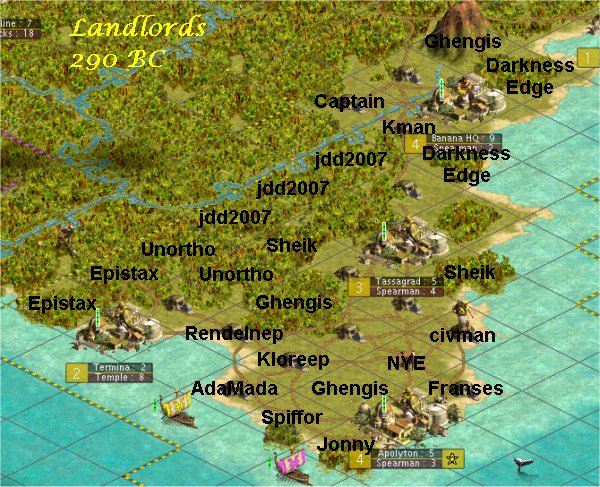
Here are the D:S calculations if we make the nobles' estates (attached picture) not to be part of the basic supply :
Apolyton produces 6 food, 5 shields and 3 commerce from nobles' estates (Franses, civman2000, Kloreep)
Termina produces 2 food, 1 shield, and 1 commerce from nobles' estates (Rendelnep)
Tassagrad has a wholly independent production
BHQ produces 4 food, 2 shields and 4 commerce from nobles' estates (Captain and Kramerman)
Then, basic supply is :
Apolyton : 4 food, 2 shields, 5 commerce
Termina : 4 food, 2 shields, 2 commerce
Tassagrad : 8 food, 4 shields, 4 commerce
BHQ : 6 food, 3 shields, 5 commerce
Total basic supply : 22 food, 13 shields, 16 commerce
These figures didn't take corruption / waste into account. They were calculated from the raw production of lands.
Now, if we consider corruption / waste ADDS to demand rather than substracting from it, the base demand is :
Apolyton : 10 food, 8 commerce, 7 shields
Termina : 6 food, 3 shields, 3 commerce
Tassagrad : 8 food, 4 shields, 4 commerce
BHQ : 10 food, 5+1 shields, 9+2commerce.
Total demand : 34 food, 21 shields, 25 commerce
 Attachment: landlords.jpg Attachment: landlords.jpg
This has been downloaded 91 time(s).
|
|
| |
|
| |
|
|
|
Franses
|
|
quote:
Originally posted by Spiffor
Here are the D:S calculations if we make the nobles' estates (attached picture) not to be part of the basic supply :
|
IMO you have sound arguments for the model you present and thank you for the picture  . .
but assuming I understand it correctly I have one suggestion:
1. If all lands are sold, the basic supply will always default to the supply of the city tile (which by the way equals the proposal of GhengisFarb). In fact, if a few more players would have taken part, this would have been the case from the start of the game. So why not start with basic supply = city tile production from the beginning and avoid adding extra calculations that are needed for the first couple of turns only?
Last edited by Franses on 27-08-2002 at 12:10
|
|
| |
|
|
|
Franses
|
|
quote:
Originally posted by Spiffor
Frances :
You're right. But I think we should use my model once (next turn), and your suggestion after, to compare if your suggestion is practicble at the beginning of the game. After all, there is a risk of imbalance. |
OK. Sounds good to me but with a little tweaking. I suggest to use the city tile approach first, simply because this is also proposed by GhengisFarb and is the final (if not start) result of your model. If there appear to be unbalances that can be repared by your model, we switch (this all assuming that the other nobles support this approach). Does that sound fair to you?
|
|
| |
All times are GMT. The time now is 05:21.
Apolyton Time is 00:21. |
top of page
|
| archivepost |
|
Forum Rules:
You may not post new threads
You may not post replies
You may not post attachments
You may not edit your posts
|
HTML code is ON
vB code is ON
Smilies are ON
[IMG] code is ON
|
|
|
|
|
|





 24-08-2002 12:49





 Since Region One's official name is now Mingapulco, I could call the fortress "Ming Sing". That's where we house all the spammers sent "on vacation".
 |
|