|

|
Iron Chancellor
|
|
The only thing to make is perfect would be William Wallace for a leader...Maybe too Medieval, but who is this Brennus guy?
Also, with the new upgrade path for swordsmen (Swordsmen->Medieval Inf.->Guerilla Inf.) the Celts will be a force to be reckoned with.
Last edited by Iron Chancellor on 12-10-2002 at 07:51
|
|
| |
|
|
|
Sean
|
|
Auckland, New Zealand.
Jan 2001
time: 05:22
|
|
William Wallace is an obscure celtish leader, from a time when they were well past their "hayday".
He is not a good choice.
|
|
| |
|
|
|
History Guy
|
 |
Reads too many books...
Oct 2001
time: 23:22
|
|
The Brennus who is in the game is a superb choice, actually. This guy, in the early 300sBC, led the Celtic army from northern Italy that actually sacked Rome and inflicted upon Rome it's greatest military embarrassment in it's long history. Brennus was the fellow who tossed his sword onto the scales with 'Vae Victis', and the second Brennus, as noted above, led the invasion of Greece, but fared far worse off than his elderly predecessor, the fellow who leads the Celts in the game. Brennus the Elder, the guy in the game, thus did something that even the much more famous Hannibal never could, he destroyed Rome (or at least a hefty chunk of it), and inflicted upon them a defeat which they were still upset about in the times of Vespasian four hundred years later.
|
|
| |
|
|
|
molly bloom
|
 |
Lundenwic
Oct 2001
time: 15:22
|
|
quote:
Originally posted by monkspider
Those two fit the Celts perfectly, IMO. |
Nope, I'm sorry to disagree with you here.
Let's consider what we consider to be militaristic traits- the Celts had no regular, or standing army, no military caste, and had no concerted campaigns of conquest.
Compare their 'militarism' with that of the cultures/societies we normally associate with militarism: Sparta, the Teutonic Knights, Ancient Rome, Prussia, the Ottoman Turks, Cromwell's Republican Commonwealth, and in all cases you have either a professional standing army, a warrior caste, or a society founded on an expansionist militaristic base.
What distinguishes the Celts for the other societies is their love of wine, extensive trading links and their lack of a written language. The Celts rise to pan-European prominence through two main routes- control and trade of salt (and there is a plethora of European place names that are derived from words meaning salt along the Celtic trade routes) and the use of iron implements.
The ordinary Celtic warrior on horseback may have presented a fearsome and daunting prospect to the 'civilized' peoples of the Mediterranean, but it doesn't transform him into a spahi, Junker or Spartan free warrior.
Secondly- the supposedly religious Celts did indeed have a priestly caste, in the Druids, but their religion seems to have been a fairly nebulous affair, with local deities (as well as pan-European deities), and is more centred on 'holy' places in the surrounding geography, such as wells, fords, stretches of river, trees and hills. If we don't consider the Greeks or Romans to be particularly or significantly, religious, and they erected temples to their gods and had priestly castes and sacred groves and grottoes, then I think the Celts who as far as we know erected no temples or oracles, should not be deemed religious either.
I'd rather play them as commercial/mercantile expansionists- if they are meant to be represented by their heyday.
http://emuseum.mnsu.edu/cultural/ol...e/halstatt.html
http://cynthia.spindler.fr/builth/History/Celts.htm
|
|
| |
|
|
|
Iron Chancellor
|
|
Wasn't Vercingetorix a Gaul, rather than a Celt? While I'm thinking about this, why is the Celtic UU the "Gallic Swordsman?" That like, the UU of of China being the Samurai, non?
|
|
| |
|
|
|
LionQ
|
 |
Capelle aan den IJssel [near Rotterdam], The Netherlands
Jul 2002
time: 06:22
|
|
quote:
Originally posted by Iron Chancellor
Wasn't Vercingetorix a Gaul, rather than a Celt? While I'm thinking about this, why is the Celtic UU the "Gallic Swordsman?" That like, the UU of of China being the Samurai, non? |
First, Gauls and Celts are the same. Second, the Gallic Swordsman is not a wrong CSU because it is called Gallic, but indeed the Chariot would be much more realistic.
quote:
Originally posted by molly bloom
Nope, I'm sorry to disagree with you here.
Let's consider what we consider to be militaristic traits- the Celts had no regular, or standing army, no military caste, and had no concerted campaigns of conquest.
Compare their 'militarism' with that of the cultures/societies we normally associate with militarism: Sparta, the Teutonic Knights, Ancient Rome, Prussia, the Ottoman Turks, Cromwell's Republican Commonwealth, and in all cases you have either a professional standing army, a warrior caste, or a society founded on an expansionist militaristic base.
What distinguishes the Celts for the other societies is their love of wine, extensive trading links and their lack of a written language. The Celts rise to pan-European prominence through two main routes- control and trade of salt (and there is a plethora of European place names that are derived from words meaning salt along the Celtic trade routes) and the use of iron implements.
The ordinary Celtic warrior on horseback may have presented a fearsome and daunting prospect to the 'civilized' peoples of the Mediterranean, but it doesn't transform him into a spahi, Junker or Spartan free warrior.
Secondly- the supposedly religious Celts did indeed have a priestly caste, in the Druids, but their religion seems to have been a fairly nebulous affair, with local deities (as well as pan-European deities), and is more centred on 'holy' places in the surrounding geography, such as wells, fords, stretches of river, trees and hills. If we don't consider the Greeks or Romans to be particularly or significantly, religious, and they erected temples to their gods and had priestly castes and sacred groves and grottoes, then I think the Celts who as far as we know erected no temples or oracles, should not be deemed religious either.
I'd rather play them as commercial/mercantile expansionists- if they are meant to be represented by their heyday.
http://emuseum.mnsu.edu/cultural/ol...e/halstatt.html
http://cynthia.spindler.fr/builth/History/Celts.htm |
Good points, I think you're right. The should be expansionist, since they were constantly expanding their borders. And it were great merchants too, indeed. They exported a lot. Industrious is a less good choice, but it would can also, since they were great mine builders.
|
|
| |
|
|
|
Iron Chancellor
|
|
quote:
Originally posted by CivilopediaCity
First, Gauls and Celts are the same. Second, the Gallic Swordsman is not a wrong CSU because it is called Gallic, but indeed the Chariot would be much more realistic.
|
Very well. I stand corrected. Thank you.
|
|
| |
|
|
|
Oerdin
|
 |
of Internet Music.
Sep 2001
time: 21:22
|
|
[QUOTE] Originally posted by molly bloom
Nope, I'm sorry to disagree with you here.
Let's consider what we consider to be militaristic traits- the Celts had no regular, or standing army, no military caste, and had no concerted campaigns of conquest.
[/q]
Sorry to disagree with you here molly but it really doesn't matter that the Celts had no regular standing army because other groups such as the Aztecs, Zulu, and medieval European states also had no standing army. The Army was raised only when it was needed and thus the warriors could "keep their day jobs" as it were. Since the Celts never formed a true conhensive nation state it makes sense that expensive items, such as standing armies, would only be raised for defense or when a charismatic leader could ensite them to pillage or plinder neighboring peoples.
That said Pillaging and plundering is something the Celts did a lot of and they were quite good at it. The whole society, both male and female, was ranked according to one's abilities to fight and lead in combat. Valor and courage were their highest held virtues and success in battle was the primary means of social advancement thus I think it is clear that a society who bases itself upon martial skill should be considered militeristic.
quote:
What distinguishes the Celts for the other societies is their love of wine, extensive trading links and their lack of a written language. |
The Celts actually did have a written language though a crude one which was only taught to the Druids. The Celtic Ogham runes seem to have originated in northern Ireland though Scotland soon became the most prolific creaters of Ogham runes. Runes simalar to Ogham have also been found in Germany (Rhine Valley), Spain (Galacia), & even Turkey (Galatia). Here's a quote from http://celt.net/Celtic/History/ogam.html
"Ogham (OH-yam) is believed to have been devised by the Irish somewhere between the first and third centuries AD. Surviving examples place its' primary use to the Christian period, however, some Celtic scholars believe it to be of far greater antiquity.
Existing examples suggest that Ogham was used primarily on grave and boundry markers. Indeed, most inscriptions read "so and so, son of so and so, son of so and so" and so on. Evidence exists, however, supporting its' use by Druids for recording tales, histories, poetry, geneologies, and the like. Bards are thought to have carried a Táball-Lorg or 'Poets Staff'. This would have been a staff comprised of several wooden wands, fastened at the bottom so as to open into a fan shape. It was on these wands that the poets would have inscribed their tales. In the 'Voyage of Bran' the hero is described as having committed some 50 or 60 quatrains in Ogham to a Táball-Lorg, which he then cast into the sea. Having been constructed of wood, it is highly unlikely that a Poet's Staff would have survived to the present day.
The name Ogham or Ogam (Ohm) was derived from that of the Celtic god of literature and eloquence, Ogma, who is credited with its' invention. The letters are constructed using a combination of lines placed adjacent to or crossing a midline. An individual letter may contain from one to five vertical or angled strokes. Vowels were sometimes described as a combination of dots. The midline was, most often, the edge of the object on which the inscription was carved. Ogham is read from top to bottom, left to right.
In keeping with Druidic concepts, each of the Ogham's twenty letters bears the name of a tree. A-Ailim (Elm), B-Bithe (Birch), C-Coll (Hazel), for example. This is not surprising until it is realized that not all of the twenty plants of the Ogham were found in the post-Christian Celtic world of the British Isles. This fact would seem to lend some credence to the theory that Ogham predates the first century AD. According to Curtis Clark, "If one were to pick a region where the plants of the Ogham were best represented, it would be the valley of the Rhine River, home of the Iron Age La Tené culture that is regarded to be ancestral to the Celts."
There are 369 verified examples of Ogham writing surviving today. These exist in the form of gallán (standing stones) concentrated in Ireland but scattered across Scotland, the Isle of Man, South Wales, Devonshire, and as far afield as Silchester (the ancient Roman city of Calleva Attrebatum). Similar markings, dating to 500 BC, have been found on standing stones in Spain and Portugal. It is from this area of the Iberian Peninsula that the Celts who colonized Ireland may have come. The discovery of similar carvings in the state of West Virginia in the United States, has caused some speculation that the Celts may have come to the New World as early as 100 BC. "
|
|
| |
|
|
|
Oerdin
|
|
of Internet Music.
Sep 2001
time: 21:22
|
|
A brief overview of the Celts curtasy of http://member.rivernet.com.au/manxm...istorycelts.htm
General History of the Celts
CELTS:- An ancient people who dominated much of Western , Central , Eastern Europe and Asia Minor in the 1st millennium bc, giving their language, customs, and religion to the other peoples of that area.
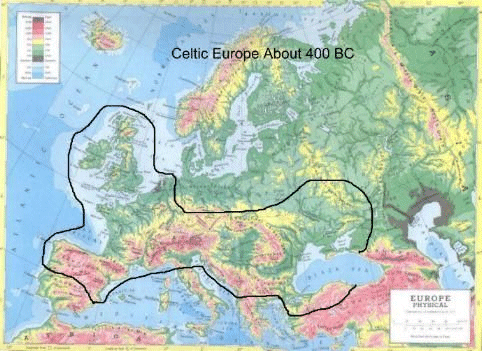
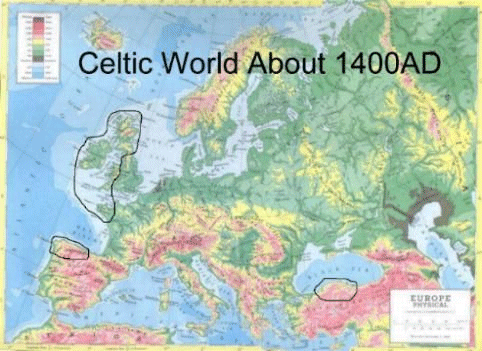
History:- The earliest found archaeological evidence associated with the Celts places them in what is now France and western Germany in the late Bronze Age around 1200 bc. In the early Iron Age, they are associated with the Halstatt culture (8th-6th cent. bc) named for an archaeological site in Upper Austria. They probably began to settle in the British Isles during this period. Between the 5th and 1st centuries bc , their influence extended from what is now Spain , the islands of the British Isles to the shores of the Black Sea , from the Ukraine to Turkey. This huge land/cultural region ( never an 'Empire') encompassing the areas mentioned influenced much of the continent of Europe and was greater in size then modern European Russia. Despite the shared religion/language and culture this large area was never politically united , finding only brief periods of unity when threatened by common foes. The later Iron Age phase of Celtic Culture is called La Tene, after a site in Switzerland and dates from the previously mentioned 5th to 1st centuries bc. Evidence from this period suggests that the Celts were the first peoples of Europe to actively use and work with iron. The word Celt is derived from Keltoi, the name given to these people by Herodotus and other Greek writers. To the Romans, the Continental Celts were known as Galli, or Gauls; those in Britain were called Britanni. In the 4th century bc the Celts invaded the Greco-Roman world, conquering northern Italy and sacking Rome, whilst also conquering Macedonia and Thessaly. They plundered Rome in 390, sacked Delphi in 279, and penetrated Asia Minor, where they were known as Galatians. The "Cisalpine Gauls" of northern Italy were conquered by the Romans in the 2nd century bc .Transalpine Gaul (modern France and the Rhineland) was subdued by Julius Caesar in the 1st century bc. and most of Britain came under Roman rule in the 1st century ad. In the same period. the Celts of central Europe being fragmented came under the domination by the Germanic peoples. In medieval and modern times the Celtic tradition and languages survived in Brittany ( Western France), Cornwall, Galicia ( North Western Spain) , Galatia ( Central Turkey), Wales, the Scottish Highlands, Isle of Man and Ireland, and to a lesser extent in the Norse/Celtic culture of Iceland.
Way of Life:- The various Celtic tribes were bound together by common speech, customs, and religion, rather than by any well defined central governments. There government was through the use of a feudal system with each tribe being headed by a king/chief and was divided by class into Druids (priests), warrior nobles, and commoners/freemen and slaves . Politically there was a great degree of democracy within the society with both men and women being treated equally and all important decisions being made at tribal gatherings in which women had an equal voice. Rulers were subject to removal at these gathering if found unsatisfactory or incompetent and succession was not necessarily hereditary. The absence of any large scale political unity amongst the tribes contributed substantially to the extinction of their way of life, making them vulnerable to their enemies. Their economy was pastoral and agricultural and they had no real urban life however trade played a large part in there economy . The nobles fought on foot with swords and spears and were fond of feasting and drinking. Celtic mythology, which included earth gods, various woodland spirits, and sun deities, was particularly rich in elfin demons and tutelaries, beings that still pervade the lore of peoples of Celtic ancestry.
Celtic Christianity:- The Christian faith was well established in Celtic Britain by the 4th century ad, but in the 5th century the Saxons and other Germanic peoples invaded the country, driving most of the Celtic Christians into Wales and Cornwall. At the same time. St. Patrick and other British missionaries founded a new church in Ireland, which then became the centre of Celtic Christianity. The Irish church developed a distinctive organization in which bishops were subordinate to the abbots of monasteries .The Irish monks, devoted to learning as well as religion, did much to preserve a knowledge of ancient Roman literature in early medieval Europe. Between the late 6th and the early 8th centuries, Irish missionaries were active in Christianizing the Germanic peoples that had conquered the Western Roman Empire, and they founded numerous monasteries in present-day France, Germany, Switzerland , and Italy. Celtic Christianity in Ireland was weakened by the Viking invasions of the 9th and 10th centuries, and by the 12th century its characteristic institutions, which were incompatible with those of the dominant Roman church, had largely disappeared from Europe.
Art:- Celtic art is considered the first great contribution to European art made by non Mediterranean peoples. Its roots go back to the artisans of the Urnfield culture and the Hallstatt culture (8th-6th cent. bc) at the beginning of the Iron Age. It flowered in the period of the La Tene culture. Although Celtic art was influenced by ancient Persian, Greek, Etruscan, and Roman art and by that of the nomads of the Eurasian steppes it developed distinctive characteristics. These are evident in its major artefacts-weapons, vessels, and jewelry in bronze, gold, electrum and occasionally silver. Many of these objects were made for chieftains in southern Germany and France and were recovered from their tombs. The Celtic style is marked by a preference for stylised plant motifs, usually of Greek origin, and fantastic animals, derived from the Scythians and other steppe peoples; however the human figure tended to play a secondary role. Other favourite motifs are elliptical curves and opposing curves. spirals, and chevrons, also derived from steppe art. These elements were combined in dynamic yet balanced, intricate geometrical patterns carried out in relief engraving, or red, yellow, blue, and green champleve enamel on shields, swords, sheaths, helmets, bowls, and jewelry. They also appeared on painted pottery cinerary urns, food vessels, incense bowls, and drinking cups. Examples of Celtic art include torcs, or neck rings, with the two open ends ornamented with animal heads, the silver repousse Cundestorp cauldron (c. 400 bc . National Museum, Copenhagen), a bronze lozenge-shaped shield with circular medallions and small enamel circles (1st cent. bc - 1st cent. ad ), and a bronze mirror with enamelled decoration (1st cent. bc) (both British Museum. London). Also surviving are roughly carved stone monuments and wooden objects. During the period of Roman domination of Western Europe in and after the 1st century bc the art of Celtic peoples on the Continent gradually lost its distinctive style. The Celts of Ireland continued to work with traditional motifs but as Christianity took hold, they combined them with Christian motifs and employed their skills in the service of the church.
Celts Today:- Today the people who call themselves Celts or still strongly identify with there celtic history can be found in the following areas:- Brittany France, Cornwall, Galicia Spain, Galatia Turkey, Ireland, Isle of Man, Scotland and Wales. All these areas have strong Celtic elements to there culture with some of them still speaking Celtic Languages whilst others though not speaking a Celtic language have strong Celtic cultural rootes. The modern Celts have a varied and rich history and have influenced many of the worlds current great nations with their pioneering spirit and love of adventure helping to found some of the worlds most progressive and greatest nations.
|
|
| |
|
|
|
Oerdin
|
|
of Internet Music.
Sep 2001
time: 21:22
|
|
I doubt any of you will be interested but on the off chance that a few of you may want to know more about Celtic subgroup of the Indo-European language family I'll post this info.
Modern Celtic Languages
CELTIC LANGUAGES:- A subfamily of the Indo-European family of languages. Geographically and historically, this subfamily is divided into a Continental group (now extinct) and an Insular group. On linguistic grounds the Insular languages fall into two groups: the Brythonic (or British) which includes Breton, Cornish, and Welsh .A Girdle (or Gaelic) comprised of Irish, Scottish Gaelic (or Errs), and Manx. Until the 5th century Continental Celtic languages, among them, Gaullist, were spoken throughout western Europe, but little information survives about them. Only the Brythonic and Girdle groups survive, limited to the British Isles, Brittany, and some North and South American communities where Welsh amongst others remain spoken. The characteristic of Celtic languages that most conspicuously distinguishes them from other Indo-European linguistic groups is their loss of the original Indo-European sound p. Thus, a Latin, Greek, and Sanskrit word containing an initial or medial p will appear in the Celtic language family without it (for example, Lat. process, Girdle roc). The Girdle and Brythonic groups of Celtic languages differ in that Girdle preserves the velar element of the Indo-European labiovelar qu sound (later written c), whereas Brythonic renders this sound asp. Thus Irish cUig or coo-ig (or cuig), "five" corresponds to Welsh pump. The rules of pronunciation in all the Celtic languages are extremely complicated; the spelling generally does not correspond to the pronunciation, and initial consonants change according to the final sound of the preceding word. For example, in Irish, full is "blood," but "our blood" is or bhfuil . In Welsh tad ("a father") becomes fy nhad for "my father," ei thad for "her father," and I dad for "his father." All modern Celtic languages use the Roman alphabet. They have only two genders, feminine and masculine; adjectives usually follow nouns. Like some non-Indo-European languages they use verbal nouns instead of present participles, always beginning sentences with the verb, and express agency by means of the impersonal passive.
Breton. The Breton language is spoken today in various dialects in Brittany; most Breton speakers also speak French. Developed between the 4th and 6th centuries by Welsh and Cornish exiles fleeing invaders, it differs from the Welsh and Cornish of their homelands in its use of nasals and loan-words from the French.
Cornish. Once the language of Cornwall, Cornish has been extinct since the late 18th century, despite recent efforts to revive it. It survives only in a few proper names and certain words in the English dialect spoken in Cornwall.
Welsh. Welsh, called Cymraeg or Cymric (from Cymru, "Wales") by its speakers is the native language of Wales and is the most flourishing of the Celtic languages. It is spoken in Wales (where the majority of its users also speak English) and in some communities in the United States of America and in Argentina. Organizations such as the Society for the Welsh Language have saved the language from dying out and are working to assure its official status along with English. Several schools in Wales now use Welsh as the medium of instruction, and television and radio broadcasts are made in the language. Like Breton, Welsh has discarded case endings for nouns. Verbs, however, are elaborately inflected. The alternation of consonants, called mutation, plays a role, as in all Celtic languages. Welsh spelling is phonemic, representing unambiguously the pertinent sounds. In most cases Welsh speakers will know how to pronounce a word they have never seen before. The letter w can represent either a consonant or a vowel, however, and y stands for two vowel sounds. The consonant f has the sound of English v; ff of f dd of th, as in then; and th of th, as in thin. Popular attempts to describe pronunciation of double l (ll) all fail. It is a voiceless lateral fricative, and facile comparison to English thl is invalid. Welsh words are accented on the next to last syllable and have a characteristic intonation. Scholars recognize three periods of Welsh: Old (800-1100), Middle (1100-1500), and Modern (from 1500). Old Welsh survives only in isolated words and names, plus a few lines of verse. Welsh has borrowed words throughout all these periods from Latin, Anglo-Saxon, Norman French, and extensively from English, but it still has a large native vocabulary of Celtic origin. Forty dialects have been identified in Wales. Standard Welsh has both a Northern and Southern variety.
Irish. Irish, or Irish Gaelic, is the oldest of the Goidelic group of Celtic languages. Ancient written examples exist in the ogham inscriptions, on about 370 gravestones scattered through south-western Ireland and Wales. Dating from the 5th to the 8th century, the inscriptions consist almost entirely of proper names. Irish can be grouped into four periods: Old (c. 800-1000), Early or Early Middle (1200-1500), Middle (1200-1500), and Modern (from 1500). Originally a highly inflected language, Irish retains essentially two noun cases, nominative and genitive, with the dative surviving in the singular of feminine nouns; the language has only two verb tenses in the indicative mood. It is chiefly spoken in the western and south-western parts of the Republic of Ireland, where it is an official language, and to some extent in Northern Ireland. In the past century, the number of Irish speaking persons has declined from 50 percent of the population of Ireland to less than 20 percent but is undergoing a revival.
Scottish Gaelic. A form of Gaelic which was brought to Scotland by Irish invaders about the 5th century, where it replaced an older Brythonic language. By the 15th century, with the accretion of Norse and English loan-words, the Scottish branch differed significantly enough from the Irish to warrant definition as a separate language. The alphabet of Irish and Scottish Gaelic is identical, consisting of 18 letters. Scottish Gaelic employs four cases of nouns these being nominative, genitive, dative, and vocative. Like Irish, the accent is on the initial syllable. Scottish Gaelic exists in two main dialects, Northern and Southern, roughly geographically determined by a line up the Firth of Lorne to the town of Ballachulish and then across to the Grampian Mountains, which it follows. The Southern dialect is more akin to Irish than is the Northern, and is more inflected. The main difference is the change of the C' sound, which is eu in Northern dialect and Ia in Southern. Thus, the word for "grass" is pronounced feur in Northern and fiar in Southern. Scottish Gaelic also has a few thousand speakers in Nova Scotia. A sub-dialect of this language is also spoken in Northern Ireland the result of a later emigration of Protestant Scotts to Northern Ireland.
Manx. The language of the Isle of Man Classed as a dialect of Scottish Gaelic, with strong Norse influence. It began to decline in the 19th century, and in the early 20th century it became virtually extinct with the death of its last native speaker John KNEEN. The first written records are from the 17th century comprising Manx literature and legal documents . Today like other celtic languages the language is undergoing a revival and as per the Islands legal tradition remain in force for all Government decrees or acts.
|
|
| |
|
|
|
molly bloom
|
|
Lundenwic
Oct 2001
time: 15:22
|
|
quote:
Originally posted by CivilopediaCity
The Picts were a Celtic tribe, weren't they? Or am I having a wrong point here? |
Some Celtic experts believe that the Picts are a Celtic tribe with some distinctive elements; the Scotti, who were to give their name to the land where they settled, were actually a Celtic tribe from Ireland.
In response to Oerdin's points: with regards to militarism and the Celts, I have to say that treating an intermittently warlike people as if they were the equivalent of the Spartans or the Ottoman Turks is a mistake. When the Celts came into contact with the Romans, (notwithstanding their notable victory at Rome) they had to change the way they fought. No longer could the Continental Celts fight duels between champions of either tribe to settle disputes, because they had met an organised enemy with an organised army, and a different way of fighting- with very different aims. It seems absurd to describe the Celts as militaristic, when even a citizen army of Greek city states can defeat a Celtic group of superior numbers- as happened after the sack of Delphi, and when Pergamum defeated the Galatian forces.
Not all Celts were judged by their ability to fight or their martial valour- the druids and bards were exempt from bearing arms- and there is some evidence that wheelwrights/blacksmiths also had a degree of exemption, as their crafts were invaluable to the Celts.
With regard to ogham- I think you're overselling its importance. It doesn't seem ever to have been used as much as Graeco-Roman lettering on the continent for instance, and its use in areas of Ireland and parts of Great Britain where the Irish settled would seem to indicate who brought the 'script' with them. The Coligny calendar is a very good example of Celtic astronomical knowledge transmitted to a permanent medium from the oral tradition:
http://www.christophergwinn.com/cel...col/calleft.htm
As Caesar mentions, the continent Celts he came into contact with did not have a written language- he speculates that the reason the druids kept their knowledge secret/oral, was so that rather than rely on easy reference to written texts, the future generations of druids would also have to commit the knowledge to memory, thus continuing their distinguished status, and preventing the lore becoming public property.
|
|
| |
|
| |
All times are GMT. The time now is 05:22.
Apolyton Time is 00:22. |
top of page
|
| archivepost |
|
Forum Rules:
You may not post new threads
You may not post replies
You may not post attachments
You may not edit your posts
|
HTML code is ON
vB code is ON
Smilies are ON
[IMG] code is ON
|
|
|
|
|
|






 11-10-2002 07:58




 )
)



 Attachment:
  |
|