|
| |
|

|
Jeremy Buloch
|
 |
Apparently on the computer
Jan 2002
time: 21:23
|
|
Here are some types of Armor and Shielding:
-composite alloy - Polymer, metallic, and carbon fiber tech. into light, durable alloy
-Ceramic Alloy - Ceramic metal providing strength, lightness, and rigidity.
Spider Alloy- Similar to Spider silk in SMAC. It is able to be produced in todays world. This is stronger than any other metal and is genetically made. Its spider web. Today we put spider genes in Goats and they produce milk with web in it. Thats as much as I know.
-NanoMetal - Nano technology is put into the alloy that regenerates it and provides strength, and flexibility.
-Neutronium- Based on physics found only in the cores of a certain type of collapsed star. Neutron I think. (this is a mabye. I think it would be hard to make on a planet. Although it could be used by alien technology on the planet and from the enemy aliens or friendly aliens.)
-Statis Crystal metal - Reduces time flow in its immediate vicinity. This makes it nearly imperveous to damage.
~Shielding technology~ --> Just another Idea.
-Magnetic shields
-Static Shields
-Gravity Shields
-Energy Screen
-Wave Shield
-Bubble Field
-Temporal Shielding
~I was inspired by various games and this topic.~
I hope to change the names on some of these. Yet keep the same concept.
-J.B.-
Last edited by Jeremy Buloch on 16-10-2002 at 10:04
|
|
| |
|
|
|
Jeremy Buloch
|
|
Apparently on the computer
Jan 2002
time: 21:23
|
|
Here are some websites that have information on "Spider Silk"
This is an example of some information obtained from a website on http://www.nexiabiotech.com
quote:
"Spider silk has long fascinated man for its elegant evolutionary solution - a unique combination of enormous tensile strength and elasticity with an ultra-lightweight fiber. Silk fibers are composed completely of silk proteins which have made an irreversible transition from a soluble silk protein solution inside the spiders' silk gland into an insoluble fiber outside the spider. Silk is produced within the silk glands of spiders. Spiders produce a number of different silks with different mechanical properties for use in spinning webs or forming cocoons. Of these silks the "dragline" or "frame" silk has been the object of desire for materials engineers because of its extreme performance mechanical properties, particularly strength.
Spider dragline silk is widely recognized as the strongest material known.
BioSteel® - Man-made Spider Dragline Silk:
Despite its superior mechanical properties, spider silk is not used commercially because of an absolute constraint on supply. Spider farming is simply not practical. Unlike silk worms, the spider's territorial and aggressive nature precludes intensive cultivation. Further, it is not the spider cocoon silk that is desired but certain components of the web silk, namely the frame silk.
Recently, the modern tools of biotechnology have offered, for the first time, the possibility of mass producing man-made spider dragline silk. This process has two parts, first isolate the gene from the spider that codes for the silk protein, then introduce the spider silk gene into a system that can read the genetic instructions and produce authentic silk proteins. To date several spider genes have been isolated and well characterized (Guerette et al., 1996; Gosline, 1996; Lewis 1992). As expected, the genes are long and repetitive and have proven problematic for use in manufacturing silk protein (Fahnestock & Bedzyk, 1997; Fahnestock & Irwin, 1996). Bacterial and other fermentation systems, which work well with other recombinant proteins, are inadequate in producing silk protein. These primitive organisms appear to truncate silk genes because of their repetitive nature thus leading to shorter silk proteins.
Nexia's proprietary silk production system is an innovative approach, proven successful in producing the most authentic, man-made spider silk to date. The result is "BioSteel®", a family of spider silk proteins. Nexia's technology relies on the anatomical similarities between the spider silk gland and goat mammary glands. In both cases, epithelial cells manufacture and secrete water soluble, complex proteins in large amounts. Nexia has successfully completed the first phase of its program by producing and secreting fully soluble silk protein in vitro within its patented MAC-T mammary cell lines (Huynh, Robitaille and Turner, 1991; Turner and Huynh 1991). No truncation of the silk genes is observed.
The success of this cell-based, prototype system has encouraged Nexia to continue the scale up of manufacturing spider silk protein within its transgenic BELE® (Breed Early, Lactate Early) goat system. Dairy animals have obvious utility in this application because they have a very large number of mammary cells. Nexia has the demonstrated ability to put the spider gene into all the cells of the goats including the mammary gland. This process termed "transgenics" is a proven and patented technology at Nexia."
|
Here are some URL's -->
http://www.google.com/search?hl=en&...2Spider+Silk%22
http://www.ufsia.ac.be/Arachnology/Pages/Silk.html
http://www.szgdocent.org/ff/f-ssilk.htm
http://www.nexiabiotech.com
BTW maybe some one other than Death by the sword and I will post and contribute to this project.
-J.B.-
|
|
| |
|
|
|
Gateway103
|
|
Some information about Neutronium:
Neutron Stars don't emit Neutronium waves. What Neutroniums are made of is nothing but densely packed neutrons and only neutrons. So a Neutron Star is in many ways just a big chunk of neutronium.
The bigger problem with neutronium is not necessarily the gravitational pull from the materials (consider you can use a monofilm neutronium plating on armours. And couple with force fields and perhaps some gravitation reduction devises, this wouldn't be too serious), but rather the production of it.
To begin with, you need a lot of neutrons, which means a lot of raw materials. Second, you'll need to generate tremendous pressure surpassing electron degeneracy pressure (electron degeneracy is what keeps white drawf stars from collapsing further into neutron stars), and this would require a lot of energy.
Anyway, just some thoughts.
-Gateway103
|
|
| |
|
| |
|
|
|
Gateway103
|
|
Some ideas on Armours and Shields:
Regarding DeathByTheSword's suggestion of keeping old armour useful with addition mods, I have some thoughts on that too. This is influenced by MOOs' model.
1) Each new armour technology, when discovered, costs say 120% of nominal cost (nominal being the values specified in the rule text files)
2) When you have made technology advance in the Technology Fields related to any old armour type, the cost for using those older types is reduced.
For example, you may obtain Spidersilk Armour from say Construction Field level 4. Then as you advance in the Construction Field, the cost of Spidersilk Armour is reduced per each level at constant or vaiant rate (e.g. -20% 1st level, -18% 2nd level, -15% 3rd level, -11%, -6% 5th) until some minimum values definable by the rule text (say 50% minimal cost or something like that)
3) Armours allow special Mods, or the general use of certain Special Equipment. Not all armours allow the same Mods, and some Mods require you to first make a certain number of advance in the Technology Field pertinent to the particular Armour Type inquestion before you can apply it.
For example, say there is this Heavy Armour mod that "triple the armour thickness" (<- text description), which bestows increasing cost (e.g +100%) and protection (eg. +75%). But in order to apply it to the Spidersilk Armour (if that is allowed), you have to say advance to Construction Field level 6 (i.e. 2 levels above the base level), before you can use this mod. Of course, if the Mod requires some other technology, such as nanites, you must also acquire the relevant tech too.
4) The cost of Sepcial Equipment, those whose application is independent of Mods requirement, may be lowered and/or reduced for older Armours, reflecting better understanding and experience working/enhancing the old Armours.
5) The size of the Armour may be reduced with advancement in the Technology Field pertinent to the discovery of the Armour in question. This works best in a design workshop model more akin to by those used by MOOs (i.e. design by space), rather than the one Blake has in mind (i.e. design by hardpoints).
Nevertheless, even with design by hardpoints, this idea may still come in handy, not necessarily for Armours (since armours should cover most of the chassis regardless), but perhaps this idea would allow some Special Equipment that does the job of two other older special equipment, and require only 1 hardpoints, etc.
6) Multiple Armour Plating (MAP):
This is like a Mod, but a bit different. The idea is as follows, at the expense of cost, space, and increasing weight (i.e. reduced mobility), the player may create multiple layers of armour plating (the number of layer may depend on overall tech level). In each layer, player may use the same Armour materials, or mix various available types, providing the armour materials has undergone sufficient levels of advancedment perhaps (i.e. same requirement as for Mods).
The purpose of this is that players can mix the properties of various armour types to create a more versatile, but vastly more expensive and less efficient model (the individual properties of various armours are less effective this way than if all the layers used the same materials). This may allow you to combine the more thermal resistant Armour Type 1 with the energy refractory properties of Armour Type 2, and so on.
That's it for now, later if I got some other strange ideas 
-Gateway103
|
|
| |
|
| |
|
| |
|
|
|
Gateway103
|
|
quote:
Originally posted by Leland
I'm not sure if I understood this idea, but wouldn't the only case when the nano-fluid can regenerate the armor be when it has already been pierced, and it might be a bit too late then? Or maybe the armor consists of thing layers which the nanites build from materials carried within the fluid (makign it a bit like circulatory system), so that the armor can strengthen itself from the inside in any places where it becomes weakened (or broken) on the outside...
|
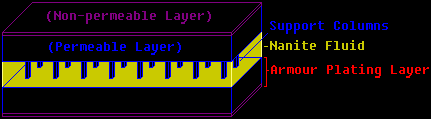
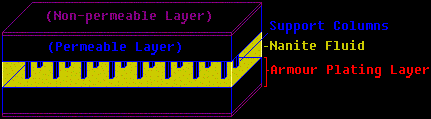
I think what JB meant was this. Please refer to the attached diagram while reading this (The attached file is BMP format, which apparently don't show up directly, see the next post for the GIF format, if you don't want to download the BMP file and open another window)
Rather than having a single layer of armour platings, use two or more thinner layers, connected by support columns of the same materials (as shown in the diagram). In the cavity between the two layers, a nanite fluid is present. The nanite fluid are composed of nano-robots, and a thick mineral and/or organic soup (depending on the armour plating), from which the nanites can extract the necessary materials for making repairs.
Furthermore, the armour plating itself should be treated so that the nanite fluid naturally adhere to its surface. This can be done electrostatically through molecular polarization, porus design, and other methods. The nanite fliud itself should also be self-adhesive, like water.
You'll notice that for the top and bottom Main Armour Plating Layers, it is actually composed of a thin non-permeable layer and a thick permeable layer. By permeable, I mean permeable to nanite fluids, not necessary including other fluids, such as water.
Anyway, the idea is that under normal situations, the nano-robots would likely be dormant, or on low-power-consumption mode.
When the armour is damaged outside due to say projectile impact, the very thin non-permeable layer would break (if it didn't than the impact is so weak the armour probably doesn't need repair) and the nanite soup would leak out a bit. Yet because the surface of the armour plating is treated so the nanite fluids adhere to it, it would quickly clog the breach, like clotting of wounds on our body. This would generally work even if the breach is large, since the nanite-fluid is self-adhersive, so can create a thin fluid film, so to speak. And since the permeability of the permeable layer isn't too high (perhaps not too porus), even if the nanite fluids are leaking, it wouldn't be very fast (diffusion is slow)
After the clogging, or rather during the clogging stage (because the breach can be rather big, and you don't necessary want to wait), the nano-robots would start repair/replicate the armour using minerals/orgran materials available from the soup.
Now as these nano-robots leak to the surface, it comes into contact with air, so perhaps you can program it to become active when exposed to air. But perhaps it would be better if there is also some sort of localized centralized control system (perhaps a small group of nano-robots, kinda like queens and kings, in the nano-robot hierachy) that tells the nano-robots nearby when to become active, and where to go (these nano-robots are probably best having some mobility, since passive diffusion can be really slow).
This also would work for internal damage, perhaps due to thermal stress, electrostatic discharge, etc. Which means these controlling nano-robots would need to be more sophisticated than the repair nano-robots, but that is conceivable.
Lastly, the nano-bots can replicate/repair itself with materials from mineral/orgranic soup, as well as repair the armour. The only concern is that the mineral-orgranic soup would need to be replenished if being continuously used up. The nano-robots may break down damaged armour/nano-robots back to constituent mineral/orgranic materials and put it back to the soup, but it is unlikely this would be a self-sustaining system. Nonetheless, replenishment shouldn't be too difficult.
This is one way how nano-robots can work for armour repairing. These nano-robots may extract energy from molecular vibration, but some small energy source, embedded inside the inner armour plating layer and/or the units employing these armours may be better, at least act as a supplement system.
This is how I think the nanite fluid may work, comments and questions are welcomed.
-Gateway103
 Attachment: armour.bmp Attachment: armour.bmp
This has been downloaded 2 time(s).
Last edited by Gateway103 on 20-10-2002 at 23:27
|
|
| |
|
|
|
Gateway103
|
|
Ooops, BMP files needed to be downloaded, can't be seen directly on the browser... oh well, here is the GIF version of the image, in case you don't want another window opened.
 Attachment: armour.gif Attachment: armour.gif
This has been downloaded 81 time(s).
|
|
| |
|
|
|
Gateway103
|
|
Err... I actually meant that the nano-robots would first clog the breach, then replicate/repair the armour using mineral/orgranic materials that are available in the soup... guess I was not being very clear. I'll go edit my post to make it clearer, hopefully.
Thanks for point this out.
-Gateway103
|
|
| |
|
|
|
Leland
|
|
Alright, now I'm beginning to see the light... so the self-repairing armor would be something like a regular armor, plus a "skin" covering it which holds the nanite fluid? That's a cool idea.
As for support systems, I'm thinking of power supply and some sort of communications array. I don't know much about nanotech, but I have the impression that these two are the biggest hurdles... nanites are too small to have individual radio transmitters (or so i've heard), and this idea of generating power from "molecular vibrations" sounds a bit dubious.
|
|
| |
|
|
|
Leland
|
|
Well, it sounds kinda flaky. What technolocy or scientific principles is this "invisible energy field" based on, or is it just magic? Does it show up in the game before or after the invention of nanotechnology?
|
|
| |
|
| |
All times are GMT. The time now is 05:23.
Apolyton Time is 00:23. |
top of page
|
|
|
Forum Rules:
You may not post new threads
You may not post replies
You may not post attachments
You may not edit your posts
|
HTML code is ON
vB code is ON
Smilies are ON
[IMG] code is ON
|
|
|
|
|
|





 16-10-2002 09:43


 until then.........spidersilk idea it great and well it can be the second armor or thirth armor........i have just read something about the human body.....or bones are structure like wespsnests.....in a hexagon....because of this our legbones can withstand a pressure of 1.5 tons kg......if you would combined that with constructing on celluair level you can build armor that is very strong you could combine that with every armor availible....it could be a technology that from then on out every armor it +1 or something like that
 )
) anyways it remains the same that it would be very expense IF even possible......i dont agree with this armor and i looked up on it and they transmit Neutrinos....
 wauw great that is just what i had in mind! great! superb! and so on.......i will post probably tonight or tomorrow some other ideas on the subject!


 If the alloy were to have armor on the inside of the object (vehicle. etc.) and on the outside of the object and have fluid inside the object. Then The nanites would be able to travel more smoothly and benefically. We would need to specify the fluid. I dont know what type of fluid it is yet; any ideas are welcome. Yet the fluid would make the armor seem unstable. But if we were to make it have beems in it to hold it more securly. Then have the best armor around it. The nanites would be able to regenerate the armor when damaged and provide increased strength to the armor.
 |
|