|

|
HershOstropoler
|
|
Funny. I read this as "Let's get ready for the big GSE bailout, just in case..."
|
|
| |
|
|
|
HershOstropoler
|
|
Yeah well, but he can't just say "let's make it official". That would be... dare I say it... honest.
|
|
| |
|
|
|
DrSpike
|
 |
Enthusiastic member of Apolyton
Sep 2001
time: 05:25
|
|
quote:
Originally posted by DanS
Are you saying "less progressive" rather than "more regressive"? Also, as a matter of economics, do you believe that removing capital taxes will encourage economic growth? |
Sure, less progressive. For what its worth the recent changes in capital taxes have the support of most economists........but the effects on growth, whilst positive, are marginal at best.
The effect of sustained large budget deficits on growth would be far from marginal however.
Last edited by DrSpike on 12-03-2003 at 02:58
|
|
| |
|
|
|
DrSpike
|
|
Enthusiastic member of Apolyton
Sep 2001
time: 05:25
|
|
quote:
Originally posted by DanS
For what its worth the recent changes in capital taxes have the support of most economists
Do you mean that most economists support Bush's proposal to eliminate dividend taxes?
but the effects on growth, whilst positive, are marginal at best
The White House claims it will increase growth by about .5 percentage points per annum. Does that sound about right? |
STOP DANS'ing me!!
Ok, economists don't like capital taxes in general, but I don't want to lead you to believe all economists are behind the abolition of taxes on dividends. You see this too is a cut that lowers the progressivity of the overall tax system since if you have stocks in a 401(k), your dividends are already tax-sheltered. Hence Bush's plan helps only people who have lots of stock outside their retirement accounts.
What is more it was sold as expansionary (which it isn't), and as the end of double taxation in this circumstance, though of course much income is taxed twice anyway. I can see why people like Krugman get worked up over these issues.
So it is a little underhand. We're talking about reducing distortions that hinder a market economy when allocating scarce resources. Now this is of course desirable, which leads to many economists supporting such changes, but I don't see how anyone could credibly come up with a figure of .5% per annum additional growth.
Last edited by DrSpike on 12-03-2003 at 03:26
|
|
| |
|
|
|
HershOstropoler
|
|
quote:
Originally posted by DrSpike
Ok, economists don't like capital taxes in general... |
Hmm... what do you mean? Taxes on capital, taxes on capital gains, or taxes on capital income?
"We're talking about reducing distortions that hinder a market economy when allocating scarce resources."
Hmm... will the abolition of the taxation of dividends really achieve this?
|
|
| |
|
|
|
DanS
|
 |
Kickball Capital of the World
Jan 1970
time: 00:25
|
|
but I don't see how anyone could credibly come up with a figure of .5% per annum additional growth
I'll try to find more backup for these calculations. I believe the .5% per annum is how they derive the expected bump up in equities prices as well--i.e., discount .5% additional growth per annum with a suitable discount rate to get a 9% increase in equities prices.
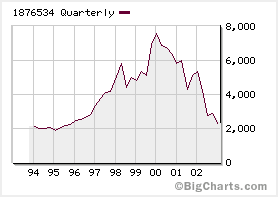
On another topic, it's pretty amazing how bad the CAC40 and DAX have been doing. Here's the DAX...
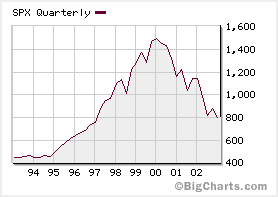
Does this suggest that the S&P/FTSE are trailing CAC40/DAX and still have a ways to go on the downside? It's amazing to me that Germany and France aren't in a depression. Are these markets really that small? Or have we learned our lessons sufficiently well that a 70% plummet in equities prices doesn't create instability?
 Attachment: chart-dax.asp.gif Attachment: chart-dax.asp.gif
This has been downloaded 100 time(s).
Last edited by DanS on 12-03-2003 at 23:21
|
|
| |
All times are GMT. The time now is 05:25.
Apolyton Time is 00:25. |
top of page
|
| archivepost |
|
Forum Rules:
You may not post new threads
You may not post replies
You may not post attachments
You may not edit your posts
|
HTML code is ON
vB code is ON
Smilies are ON
[IMG] code is ON
|
|
|
|
|
|






 08-03-2003 00:11


 |
|