|

|
cumi
|
 |
Austria
Jul 2002
time: 06:26
|
|
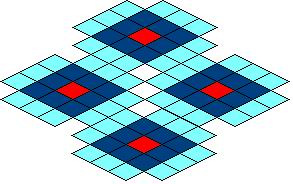
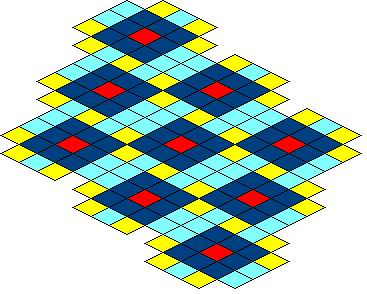
2.) A little bit better but 3x4 placement, with loosing 2 tiles for each city on the map
 Attachment: var_2.jpg Attachment: var_2.jpg
This has been downloaded 240 time(s).
Last edited by cumi on 26-02-2003 at 15:07
|
|
| |
|
|
|
cumi
|
|
Austria
Jul 2002
time: 06:26
|
|
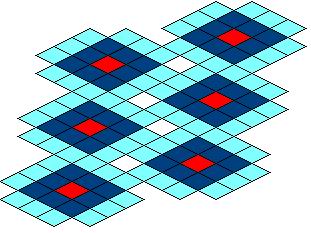
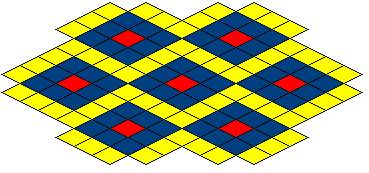
6.) An interesting 3x3 strategy. All the 2 ring city tiles are divided, but only between 2 cities. So each city has 6 tiles less than the maximum to work on.
Hmmm... This is actually 2x3 strategy
Attachment: var_6.jpg
This has been downloaded 231 time(s).
Last edited by cumi on 26-02-2003 at 20:33
|
|
| |
|
|
|
cumi
|
|
Austria
Jul 2002
time: 06:26
|
|
quote:
Originally posted by Arrian
The best laid plans of mice and men...
Nice visuals, but that will immediately fall apart when you try to apply that to anything but endless stretches of grassland. Add in river systems, coastlines, mountains... and it all goes to hell.
-Arrian |
Yes, I know...
I also posted a message in this thread:
http://apolyton.net/forums/showthre...223#post1760223
I wrote my oppinion about city placement in some of the typical and non-optimal map terrain, like cities on coaslines or surrounded only by hills.... I these cases, the cities will not (or there is no need to) grow over a limit and 3 or 4 tiles between the cities can not be a strategy, there will be no overlappings and the city will not exceed even its first ring tiles (dark blue on the images)...
In these cases the pattern must be modified - like a curved dimension or curved space where the axes (x,y) are non-linear functions.
I studied about these vector spaces in the university. There are not simple. Or a complex spaces (complex-vector spaces) with singular point. Very perverz.
cheers
Last edited by cumi on 26-02-2003 at 20:30
|
|
| |
|
| |
|
|
|
Catt
|
 |
California - SF Bay Area
May 2002
time: 21:26
|
|
Excellent visuals, cumi! 
I think the real tension in city placement strategies comes down to whether or not one is willing to sacrifice "wasted" tiles in the first half (or two-thirds) of a game in exchange for cramped cities, with all the resulting upsides (happiness and pollution, for example) and downsides (increased corruption, perhaps smaller land under one's control, absence of very powerful cities, increased mainteenence costs, for example) in the later game.
A converted 3-tiler would point out that preserving 17 or 18 tiles of worakble terrain for any given city means that, until Sanitation and hospitals, 5 or 6 of those tiles will remain unworked and fallow. A tighter spacing will prevent any one city from working 18 tiles later in the game, but from some point in the middle ages through at least the early industrial times, few, if any, workable tiles will be unproductive.
Catt 
|
|
| |
|
|
|
vmxa1
|
 |
Oviedo, Fl
Nov 2001
time: 21:26
|
|
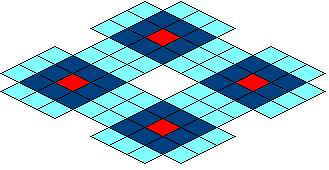
Someone posted (way back) a pattern map for size 1-23 or something. I attacked the pat19. I had to blow it up in paint and turn on the grid to see, but it has no lost tiles and all cities have 19 tiles that can be worked.
Yes, you will often run into terrain issues and things that force a a change, but it is a good guide.
When you want to use closer spacing use a smaller pattern.
 Attachment: pat19.bmp Attachment: pat19.bmp
This has been downloaded 39 time(s).
Last edited by vmxa1 on 27-02-2003 at 07:52
|
|
| |
|
| |
|
|
|
cumi
|
|
Austria
Jul 2002
time: 06:26
|
|
Thanks for the numerous comments.
Many of you have wrote, that the terrain can modifie the CP strategy, and these patterns are rarely usefull. I aggre with that.
But, do you prefer to use denser CP when possible? Or you think there are some useless tiles, it is better to have sometimes more tiles than the pattern dictates.
If you have a given size of a territory on the map, that can be settled and used by you, are you trying to build as much as you can cities (but still to able to have metropolises and some very productive cities later)?
Is a city size of over 30 a must, to be productive in modern era? I usually don't have cities over 30. My cities having size 20 can sometimes be more productive, than the bigger ones (building in 2 turns MA - not bad I think).
The reason why I am analysing the CP strategy and trying to visualize it, is because I think I am placing my cities too far from each other. I have been quite like shocked, when I read here, that most of you are using 3 (or less !!!) tile CP strategy on higher difficulty game levels.
Thansk again for your oppinions,
-- cumi --
|
|
| |
|
|
|
badams52
|
 |
near the magic kingdom
May 2002
time: 21:26
|
|
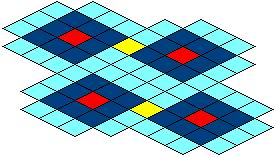
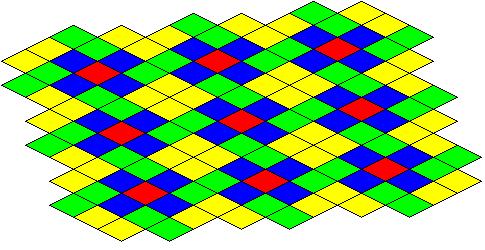
# 6 is as close as you get to the true 3-tile strategy employed by a decent portion (see corresponding poll) in the strat forum. The idea behind a "true" 3 tile strategy is to get as many cities as possible within 3 tiles for working land and faster reinforcement by roads. Sir Ralph showed the most effecient 3-tile system here in the city placement redux (for the third time) thread.
I took his plan, and made it into a tile plan with your same coloring code except I added a green color for the tiles that are in the 2-ring of the city but shared. This method works out for 12 workable tiles per city on the inside and the center city had 3 spacing with the 4 closest cities.
We've had many recent discussions about city placement with the newest thread right here.
As you can see in the poll, many people use many different style of spacing. 3-tile spacing has the added benefit of fast movement between cities for the ancient era, less pollution and less unhappiness when the cities start to grow as they cannot get much larger than 12. Also allows more free units when under despotism and monarchy.
In short, 3-tile spacing is much more condusive to building an army and going to war which most people on this forum (like me) use when playing a higher difficulty level. Often going to war and taking a few of the AIs cities helps out loads in the later stages of the game. More land = more production. It also allows a person to work more of the land inside his cultural borders before hospitals come into place and allow cities to grow in size.
Optimal city placement (OCP) which is seen in your plan #3 allows larger cities which may be able to build tanks and other units in 1 turn but have more pollution and take more luxuries and improvements to keep the city from revolting. OCP is better for builders and reaps it's rewards in the late stages of Civ where cities get large and use all 19-21 tiles in it's workable radius.
Most people don't like to go larger than OCP cause then you lose valuable workable tiles inside your cultural borders, and what if one of those tiles happens to have aluminum, rubber, oil, etc. on it which increases your productivity for the city?
By the way, I try to keep my cities from going over the 20 population barrier since you can mine most of the tiles that will put you over 20 and use them for production instead of entertainers, scientists and taxmen. Though I don't know if it's "better" it just gives most cities its maximum productive capability given the land arrangement.
I used to think overlap was bad, but having read much about city placement, I'm more likely to overlap than to leave any gaps when REXing. Now when you're conquering other civs, then that's a different matter and I often leave the AIs city placement alone.
Attachment: 3-tile.jpg
This has been downloaded 95 time(s).
|
|
| |
|
| |
All times are GMT. The time now is 05:26.
Apolyton Time is 00:26. |
top of page
|
| archivepost |
|
Forum Rules:
You may not post new threads
You may not post replies
You may not post attachments
You may not edit your posts
|
HTML code is ON
vB code is ON
Smilies are ON
[IMG] code is ON
|
|
|
|
|
|





 26-02-2003 14:51






 |
|