|
| |
|
| |
|
| |
|
| |
|

|
MichaeltheGreat

|
|
Apolyton Grand Executioner
|
 |
mooning the house that Ruth built.
Oct 1999
time: 21:27
|
|
30 tanks driving down one road does not make for taking over a city of five million. 
RPGs can easily penetrate roof armor on an Abrams, as well as rear turret or hull armor.
The Abrams' ammo storage for its main gun rounds is via a separate rear section of the turret, with blowout panels in the roof and armored doors on the inside of the turret operated by a pressure switch at the loaders right knee. This works so that the loader can keep both hands free to retrieve a round, and the armored doors automatically close when the loader removes his knee from the switch.
Kramerman - there's basically two types of modern anti-armor penetrators, kinetic energy penetrators (sabot rounds), and chemical energy penetrators (HEAT rounds and ATGMs). The Abrams and Challenger series are purpose built to defeat chemical penetrators with their Chobham armor - basically, there's a matrix of metal and ceramic (with a 30mm DU covering layer on the M1A1 and higher) that is designed to dissipate the heat jet from a shaped charge round.
The 75 mm rear armor can be penetrated by large CEP ordnance, including the larger RPGs, and the roof armor is something like half that thickness, so it's even more vulnerable. Frontal and side armor is in the 350-410mm range.
CEP ordnance has two main characteristics - penetration depth of a given armor type is a function of the cross-section of the round, so larger is better, and penetration is independent of range. Kinetic penetrators are the opposite - they are velocity (thus range) dependent, and the smaller the size, the better.
|
|
| |
|
|
|
CerberusIV
|
|
quote:
Originally posted by Kramerman
I also heard that the Iraqis obtained some kind of shaped charge antitank missile launchers from russia. From what I know of the HEAT warheads, shaped charges are pretty mean, and could conceivablely defeat M1 armor head on, i would think. Where's MtG? |
Chobham armour is a laminate of steel, aluminium and ceramic material. A HEAT or shaped charge round generates and focuses a jet of superheated gas/molten metal against the armour. The largest shaped charge projectiles used in WW2 could, in ideal conditions, cut through 8 inches of steel plate. However if there are two plates with an air gap between them (spaced armour) the molten jet dissipates between the plates and its ability to cut through the inner plate is much reduced. Chobham armour takes this a stage further and the shaped charge jet is diffused between the laminate layers, and possibly the ceramic layer doesn't vaporise anyway, so HEAT rounds don't do anything against the main armour.
The British Challenger 2's, with similar armour, have been used in Iraqi towns and RPG-7 rounds were ineffective. RPG-7's have fairly small warheads anyway and limited use against modern tanks. They would probably be more effective against Bradleys.
Modern AT missiles are more powerful but the fancy wire or laser guided types have a minimum range which makes them difficult to use in confined areas. They would still have to hit an Abrams from the side, rear or better still above, to stand an chance of doing significant damage.
EDIT: Damn, MtG beat me to it.
|
|
| |
|
|
|
Lord Merciless
|
|
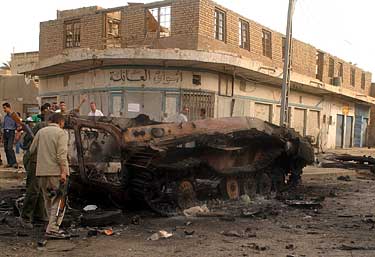
Come on, this can't possibly be an Abrams. Do you see the twin doors at the back of this burnt-out tank? The only APC in American arsenal that has twin doors is LAV25, used by the Marine Corps. However, LAV25 uses wheels, not tracks. Thus, it's more likely that this burnt-out vehicle is an Iraqi one.
|
|
| |
All times are GMT. The time now is 05:27.
Apolyton Time is 00:27. |
top of page
|
| archivepost |
|
Forum Rules:
You may not post new threads
You may not post replies
You may not post attachments
You may not edit your posts
|
HTML code is ON
vB code is ON
Smilies are ON
[IMG] code is ON
|
|
|
|
|
|






 04-04-2003 11:11





 .
.


 Attachment:
 |
|