|
| |
|

|
chegitz guevara
|
 |
Ft. Lauderdale, FL Communist Party of Apolyton
Jun 2000
time: 00:27
|
|
Why the antiwar movement was right
The speedy fall of Baghdad proves a preemptive strike was unnecessary.
- - - - - - - - - - - -
By Arianna Huffington
April 16, 2003 | The Bible tells us that pride goeth before the fall. In Iraq, it cameth right after it.
From the moment that statue of Saddam hit the ground, the mood around the Rumsfeld campfire has been all high-fives, I-told-you-sos, and endless smug prattling about how the speedy fall of Baghdad is proof positive that those who opposed the invasion of Iraq were dead wrong.
What utter nonsense. In fact, the speedy fall of Baghdad proves the antiwar movement was dead right.
The whole pretext for our unilateral charge into Iraq was that the American people were in imminent danger from Saddam and his mighty war machine. The threat was so clear and present that we couldn't even give inspectors searching for weapons of mass destruction -- hey, remember those? -- another 30 days, as France had wanted.
Well, it turns out that, far from being on the verge of destroying Western civilization, Saddam and his 21st century Gestapo couldn't even muster a halfhearted defense of their own capital. The hawks' cakewalk disproves their own dire warnings. They can't have it both ways. The invasion has proved wildly successful in one other regard: It has unified most of the world -- especially the Arab world -- against us.
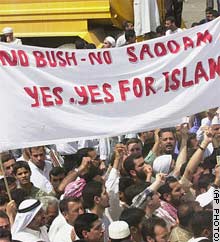
Back in 1991, more than a half-dozen Arab nations were part of our Desert Storm coalition. Operation Iraqi Freedom's "coalition of the willing" had zero. Not even the polygamous potentates of Kuwait -- whose butts we saved last time out and who were most threatened by whatever threat Iraq still presented -- would join us. And, I'm sorry, but substituting Bulgaria and the island of Tonga for Egypt and Oman is just not going to cut it when it comes to winning hearts and minds on the Arab street.
In fact, almost everything about the invasion -- from the go-it-alone buildup to the mayhem the fall of Saddam has unleashed -- has played right into the hands of those intent on demonizing our country. Islamic extremists must be having a field day signing up recruits for the holy war they're preparing to wage against us. Instead of Uncle Sam wants you, their recruiting posters feature a different kind of patriotic image: an American soldier ill-advisedly draping the American flag over Saddam's face.
The antiwar movement did not oppose the war out of fear that America was going to lose. It was the Bush administration's pathological and frantic obsession with an immediate, damn-the-consequences invasion that fueled the protests.
And please don't point to jubilant Iraqis dancing in the streets to validate the case for "preemptive liberation." You'd be doing the Baghdad Bugaloo too if the murderous tyrant who'd been eating off golden plates while your family starved finally got what was coming to him. It in no way proves that running roughshod over international law and pouring Iraqi oil -- now brought to you by the good folks at Halliburton -- onto the flames of anti-American hatred was a good idea. It wasn't before the war, and it still isn't now. The unintended consequences have barely begun to unfold.
And the idea that our slam-dunk of Saddam actually proves the White House was right is particularly dangerous because it encourages the Wolfowitzes and the Perles and the Cheneys to argue that we should be invading Syria or Iran or North Korea or Cuba as soon as we catch our breath. They've tasted blood.
It's important to remember that the Arab world has seen a very different war than we have. They are seeing babies with limbs blown off, children wailing beside their dead mothers, Arab journalists killed by American tanks and bombers, holy men hacked to death and dragged through the streets. They are seeing American forces leaving behind a wake of destruction, looting, hunger, humiliation and chaos.
Who's been handling our war P.R., Osama bin Laden? The language and imagery are all wrong. Having Tom DeLay gush about our "army of virtue" at the same time we're blowing up mosques is definitely not sending the right message to a Muslim world already suspicious that we're waging a war on Islam.
Neither is Ari Fleischer's claim that the administration can't do anything to keep Christian missionaries -- including those who have described the Islamic prophet Muhammad as a "demon-possessed pedophile" and a "terrorist" -- from going on a holy crusade to Baghdad. You think the Arab world might take that the wrong way? If there is one thing that could bring Sunnis and Shiites together, it's the common hatred of evangelical zealots who denigrate their prophet.
And it doesn't help to have the American media referring to Jay Garner, the retired general Don Rumsfeld picked to oversee the rebuilding of Iraq, as "viceroy." It reeks of colonial imperialism. Why not just call him "Head Bwana"? Or "Garner of Arabia"? I didn't realize the Supreme Court had handed Bush a scepter to go along with the Florida recount.
The powerful role that shame and humiliation have played in shaping world history is considerable, but something the Bush team seems utterly clueless about. Which is why the antiwar movement must be stalwart in its refusal to be silenced or browbeaten by the gloating "I told you so" chorus on the right. On the contrary, it needs to make sure that the doctrine of preemptive invasion is forever buried in the sands of Iraq.
Especially as the administration, high on the heady fumes of Saddam's ouster, turns its covetous eyes on Syria. I give it less than a week before someone starts making the case that President Assad is the next, next Hitler.
|
|
| |
|
|
|
chegitz guevara
|
|
Ft. Lauderdale, FL Communist Party of Apolyton
Jun 2000
time: 00:27
|
|
The unfortunate poster boy
The U.S. military airlifted 12-year-old Iraqi orphan Ali Abbas to Kuwait for better medical care. But he's still angry that we killed his family. What's his problem?
- - - - - - - - - - - -
By Joan Walsh
April 17, 2003 | Ever since the war began, I've wished the American media would pick up on the stories and images the rest of the world is seeing, especially when it comes to Iraqi civilian casualties. Now that they have, I wish they'd stop.
On Tuesday, cable news networks discovered the plight of Ali Abbas, a 12-year-old Iraqi boy. Ali's suffering is almost surreal: He lost 15 relatives, including his parents and three siblings, as well as both of his arms, in an errant missile strike on a Baghdad suburb in the early days of the war. His mother was five months pregnant with a fourth child. He's got burns all over his body, some of them are infected, he's in constant pain, and he's had to be moved from hospital to hospital thanks to looters.
Ali's been a favorite story outside the United States for weeks. "Do you think the doctors can get me another pair of hands?" he was widely quoted asking reporters. "If I don't get a pair of hands, I will commit suicide." London tabloids launched appeals to readers on Ali's behalf, and camera crews have come from all over the world to capture his misery.
Clearly, some journalists have used Ali as a poster boy for the human costs of the American invasion, and the amazing 12-year-old called them on it earlier this week. "The journalists always promise to evacuate me. Why don't they do it now?" he asked. "Please take me out of Iraq to be safe and cured."
But if Ali was used by the media up to this point, the manipulation and misunderstanding are over the top now that he's been discovered by American journalists. Ali had been mentioned a few times in the U.S. media before this week, but once the American military was involved in airlifting him to Kuwait, he officially became A Big Story -- a redemption story, the kind we like. "Armless boy becomes symbol of war," was the headline on CBS News.com Wednesday. And from Tuesday night through Wednesday morning, MSNBC and CNN were All Ali, all the time.
Much of the coverage was just plain hokey, like these musings from MSNBC's Mike Taibbi: "You wonder where are his tears, this little boy who lost both arms, both parents, and most of the rest of his family, almost everyone and everything in his 12-year-old world in an American bomb run three weeks ago. Is he feeling better? Less pain?"
But some of the stories have tried to deal with an uncomfortable fact. Ali is, um, well, he's angry at the U.S. for killing his family. "We didn't want war. I was scared of this war," he told reporters earlier. "Our house was just a poor shack, why did they want to bomb us?" He specified that he did not want to go to America for medical care. And American journalists have been flummoxed by how to report on his feelings. CNN hit bottom Wednesday morning, when anchor Kyra Phillips interviewed Ali's doctor in Kuwait, Dr. Imad al-Najada, who explained that although Ali told reporters he was grateful for his treatment, he also said he hopes no other "children in the war will suffer like what he suffered."
Phillips seemed shocked by Ali's apparent inability to understand we were only trying to help him. "Doctor, does he understand why this war took place? Has he talked about Operation Iraqi Freedom and the meaning? Does he understand it?" Poor al-Najada had to explain that the doctors were more interested in treating the boy than indoctrinating him.
"Actually, we don't discuss this issue with him because he is -- the burn cases, and the type of injury, he's in very bad psychological trauma," said al-Najada. "We would like to pass this stage and then we can discuss this issue. But we discussed this issue with his uncle, and the message we get from his family -- they said they are living far away from the American troops, from the military of Saddam, of fedayeen, by 5 kilometers, and they don't know how they hit them by the missiles."
War opponents, of course, will use Ali to show the human cost of the Iraqi invasion -- in fact, he was the lead in David Corn's Nation feature last week, asking whether and how the U.S. should compensate Iraqi civilian casualties. And Ali's suffering, by itself, won't mean the war was wrong, assuming it liberates millions of Iraqi 12-year-olds from Saddam. But it does mean that one 12-year-old suffered enormously, beyond what any child should have to bear. If we're a tough enough country to invade his land and remake it, we should be tough enough to look squarely at his suffering, and his anger, without having it sanitized for our consumption. And if the American media can't deal honestly with his story, then they ought to leave it alone.
=====================
Gee, doesn't he get that we blew his arms off and murdered most of his family so he'd have a beter life? 
|
|
| |
|
|
|
MRT144
|
|
Seattle Washington
Oct 2002
time: 21:27
|
|
how many people in those arab countries supported the actions of their government. i will agree with you though doc, the arab governments actions speak louder than the silence of their words.
|
|
| |
|
| |
|
|
|
Comrade Tassadar
|
|
quote:
Originally posted by Trevman
It wasn't their war machine, but the threat Saddam would "loan" one of his WMDs to a terrorist group to attack the US. The UN has demanded extension after extension, and passed resolution after resolution regarding Iraq without actually doing much. We had already given the inspectors some more time, and they were simply proving us right. |
They were proving you right by not finding any Weapons of Mass Destruction? Thats pretty twisted logic.
|
|
| |
|
|
|
yago
|
|
quote:
Just for grins, I looked for the list of "coalition of the willing." Lo, I found this little gem on BBC: |
The Coalition of the Willing shall not be forgotten. (I was under the impression that Lichtenstein also was a member of the coalition, but that seems to be wrong.)
http://story.news.yahoo.com/news?tm...nia_dcLJUBLJANA
(Reuters) - The United States mistakenly named Slovenia as a partner in its war against Iraq (news - web sites) and even offered it a share of the money budgeted for the conflict, the tiny Alpine nation said on Thursday.
Prime Minister Anton Rop said Washington goofed
"When we asked for an explanation, the State Department told us we were named in the document by mistake as we are not a member of the coalition against Iraq," Rop told a hastily arranged news conference.
http://www.guardian.co.uk/g2/story/...,917741,00.html
it will come as welcome news to our troops in the Gulf this week that when the going gets tough, Azerbaijan is right behind them. The "coalition of the willing", as Colin Powell has called it, is the list of 30 countries that responded positively to a phone call from Washington, seeking their support against Iraq. Starting with Afghanistan, ending with Uzbekistan and with 15 countries in between preferring to remain anonymous, it is an imaginative list, eschewing the usual suspects to give those nations not used to playing a role on the world stage a chance to shine. Albania, for example. And Georgia.
Eritrea is one of the poorest, most war-torn countries in the world. I call the embassy to ask how it intends to show its support of the US and coalition of the willing, of which it is a member? There is a long, stunned pause before the spokeswoman says: "Can you call back tomorrow morning?"
http://www.areporter.com/sys-tmpl/t...onofthewilling/
Now up to 47! Our 10 latest allies are: Costa Rica, Dominican Republic, Honduras, Iceland, Marshall Islands, Micronesia, Mongolia, Palau, Rwanda, Solomon Islands, Tonga and Uganda!
|
|
| |
All times are GMT. The time now is 05:27.
Apolyton Time is 00:27. |
top of page
|
| archivepost |
|
Forum Rules:
You may not post new threads
You may not post replies
You may not post attachments
You may not edit your posts
|
HTML code is ON
vB code is ON
Smilies are ON
[IMG] code is ON
|
|
|
|
|
|






 18-04-2003 18:56





 Attachment:


 |
|