|
| |
|
| |
|
| |
|

|
Sava
|
 |
GO GO GO!
Mar 2001
time: 23:28
|
|
quote:
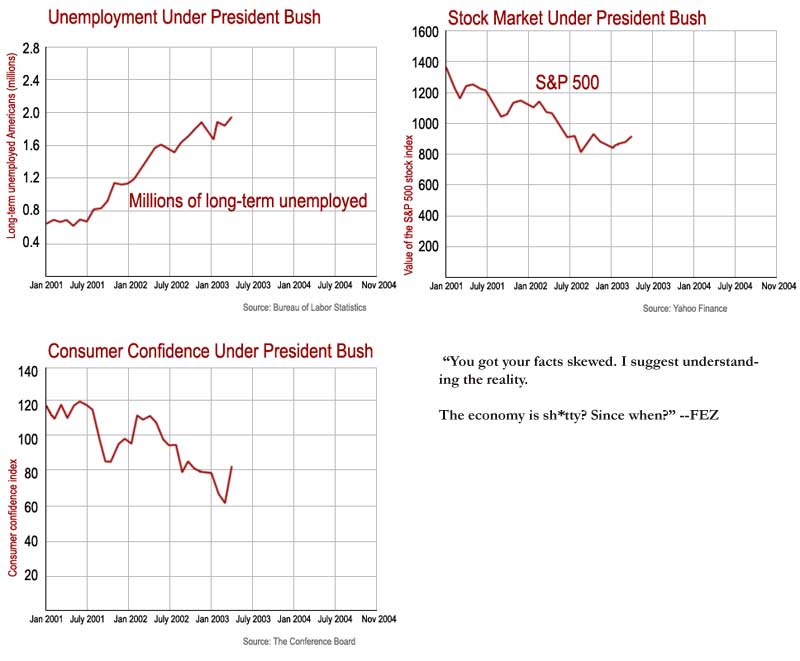
Economic growth, though positive, has not been sufficient to generate jobs and prevent unemployment from rising. In fact, there are now more than two million fewer private sector jobs than at the start of the current recession. Overcapacity, corporate scandals, and uncertainty have and will continue to weigh down the economy.
The tax cut plan proposed by President Bush is not the answer to these problems. Regardless of how one views the specifics of the Bush plan, there is wide agreement that its purpose is a permanent change in the tax structure and not the creation of jobs and growth in the near-term. The permanent dividend tax cut, in particular, is not credible as a short-term stimulus. As tax reform, the dividend tax cut is misdirected in that it targets individuals rather than corporations, is overly complex, and could be, but is not, part of a revenue-neutral tax reform effort.
Passing these tax cuts will worsen the long-term budget outlook, adding to the nation’s projected chronic deficits. This fiscal deterioration will reduce the capacity of the government to finance Social Security and Medicare benefits as well as investments in schools, health, infrastructure, and basic research. Moreover, the proposed tax cuts will generate further
inequalities in after-tax income.
To be effective, a stimulus plan should rely on immediate but temporary spending and tax measures to expand demand, and it should also rely on immediate but temporary incentives for investment. Such a stimulus plan would spur growth and jobs in the short term without exacerbating the long-term budget outlook. |
from the Economic Policy Institute... an organization comprised of people much smarter than Bush and his advisors.
quote:
George Akerlof*
UNIVERSITY OF CALIFORNIA-BERKELEY
Kenneth J. Arrow*
STANFORD UNIVERSITY
Peter Diamond
MASSACHUSETTS INSTITUTE OF TECHNOLOGY
Lawrence R. Klein*
UNIVERSITY OF PENNSYLVANIA
Daniel L. McFadden*
UNIVERSITY OF CALIFORNIA-BERKELEY
Lawrence Mishel
ECONOMIC POLICY INSTITUTE
Franco Modigliani*
MASSACHUSETTS INSTITUTE OF TECHNOLOGY
Paul A. Samuelson*
MASSACHUSETTS INSTITUTE OF TECHNOLOGY
Robert M. Solow*
MASSACHUSETTS INSTITUTE OF TECHNOLOGY
Joseph Stiglitz*
COLUMBIA UNIVERSITY
Laura D’Andrea Tyson
LONDON BUSINESS SCHOOL
Janet Yellen
UNIVERSITY OF CALIFORNIABERKELEY
Douglass C. North*
WASHINGTON UNIVERSITY
William F. Sharpe*
STANFORD UNIVERSITY |
My opinions on Bush's policy come from people much smarter than me. 
|
|
| |
|
| |
|
|
|
Sava
|
|
GO GO GO!
Mar 2001
time: 23:28
|
|
quote:
POLICY MEMORANDUM
SUBJECT: EPI comparison of the Daschle and Bush economic stimulus plans
FROM: Larry Mishel, EPI president
DATE: January 28, 2003
In a December 2002 Briefing Paper, Generating Jobs and Growth: An Economic Stimulus Plan for 2003, EPI identified five criteria for an effective stimulus plan. A comparison shows that the stimulus plan released by Senator Tom Daschle last week meets all five of these criteria, while President Bush’s plan fails on every count.
Criteria #1: A stimulus package should generate jobs and growth.
The Daschle plan would create more than a million jobs in the next year, three times as many as President Bush’s plan. It will also help the states protect jobs in education, police and fire protection, and other vital services. Unlike the Bush plan, which according to top econometric forecaster Economy.com will cost an estimated 750,000 jobs over 10 years, the Daschle plan will have no negative long-term effects.
Criteria #2: A stimulus package should be fiscally responsible.
The Daschle plan does not rob from future generations to provide large tax cuts for those who need them the least. It puts money into the economy now, when it’s needed most. In addition, the plan will take action against corporations that avoid paying their due in taxes by setting up special tax havens. By contrast, the Bush plan will cost $670 billion over 10 years.
Criteria #3: A stimulus plan should take effect quickly.
The Daschle plan puts $141 billion into the economy in 2003, compared to $50 billion in the Bush plan.
Criteria #4: A stimulus plan should be fair.
The Daschle plan puts money into the hands of middle-income working families who need it most and are most likely to spend it. Through $300 rebates for each adult in a family and $300 for each of the first two children, the plan would return $71 billion to families in 2003. In addition, the plan would extend federal unemployment insurance benefits for the one million individuals who exhausted their benefits in 2002. Given the increasingly unequal distribution of income in the United States, a stimulus plan that exacerbates this inequality is not acceptable. The Bush plan’s benefits disproportionately go to wealthy Americans who do not need extra cash and are more likely to save the money than to put it back into the economy.
Criteria #5: A stimulus package should target unmet needs.
The Daschle plan provides $40 billion to preserve vital state services, including $6 billion to ensure that every classroom has a qualified teacher and that vital services like after-school care and summer enrichment programs are available for the nation’s children. It also provides $4 billion for mass transit, highway, and airport infrastructure. The Bush plan adds no new funding for these purposes.
|
from http://www.epinet.org/content.cfm?id=1353
I agree with the Democrat plan.
|
|
| |
|
| |
All times are GMT. The time now is 05:28.
Apolyton Time is 00:28. |
top of page
|
| archivepost |
|
Forum Rules:
You may not post new threads
You may not post replies
You may not post attachments
You may not edit your posts
|
HTML code is ON
vB code is ON
Smilies are ON
[IMG] code is ON
|
|
|
|
|
|






 02-06-2003 02:21


 Attachment:




 The government is supposed to moderate the bussiness cycle so we don't end up with another great depression. Read Keynes and sober up, Fezzie.


 I am not too clear about this.. I am more familiar with my own country's politics to be honest.
 |
|