|

|
Guynemer
|
|
...do you believe they are legit, or do you believe they were planted?
It seems that the further along we go without finding these weapons that "could be launched within 45 minutes of a command," the more people are starting to think that the weapons were never there, and any find of weapons will be a Bush PR job.
Will it matter how many weapons are found? What type? If weapons aren't found until after the candidates are chosen next year, will all credibility be lost?
|
|
| |
|
| |
|
| |
|
| |
|
| |
|
|
|
Sava
|
 |
GO GO GO!
Mar 2001
time: 23:28
|
|
quote:
Originally posted by Fez
When it came to Iraq, all the weapons bought were either French or Russian. |
Don't take my word for it Fez. There are tons of people, smarter than myself, that know about the truth. Take the red pill and join us in the real world.
quote:
October 10, 2002
Helping Iraq Kill with Chemical Weapons:
The Relevance of Yesterday's US Hypocrisy Today
by ELSON E. BOLES
You may feel disgusted by the hypocrisy of US plans to make war on Iraq and sickened at the inevitable slaughter of thousands of people. But if you could only vaguely recall the details of how deep the hypocrisy goes, then read on.
The US not only helped arm Iraq with military equipment right up to the time of the Kuwait invasion in 1989, as did Germany, Britain, France, Russia and others, but also sold and helped Iraq to integrate chemical weapons into their US-provided battle plans while fighting Iran between 1985-1988.
According to a New York Times article in August, 2002, Col. Walter P. Lang, a senior defense intelligence officer at the time, explained that D.I.A. and C.I.A. officials "were desperate to make sure that Iraq did not lose" to Iran. "The use of gas on the battlefield by the Iraqis was not a matter of deep strategic concern," he said. One veteran said, that the Pentagon "wasn't so horrified by Iraq's use of gas." "It was just another way of killing people _ whether with a bullet or phosgene, it didn't make any difference."
Now consider just how deceptive the recent comments from the White House are. In late September spokesman Ari Fleischer said that British Prime Minister Blair's dossier of evidence is "frightening in terms of Iraq's intentions and abilities to acquire weapons." A few days later, while making his case against Saddam, President Bush said "He's used poison gas on his own people." Bush deceives because he hides the fact that US officials, including his father, had no qualms about helping Saddam gas Iranians. What is truly frightening are the US policies toward Iraq, the cover ups of those policies, and the US officials who personally profit in the millions of dollars from those policies. To whatever degree Saddam is a tyrant, he would not be that without the US government.
The question is not whether Saddam is willing to use chemical or other weapons of mass destruction again. The question is whether the US is currently selling and helping countries use weapons of mass destruction.
Details about Iraq killing Iranians with US-supplied chemical and biological weapons significantly deepens our understanding of the current hypocrisy. It began with "Iraq-gate" -- when US policy makers, financiers, arms-suppliers and makers, made massive profits from sales to Iraq of myriad chemical, biological, conventional weapons, and the equipment to make nuclear weapons. Reporter Russ Baker noted, for example, that, "on July 3, 1991, the Financial Times reported that a Florida company run by an Iraqi national had produced cyanide -- some of which went to Iraq for use in chemical weapons -- and had shipped it via a CIA contractor." This was just the tip of a mountain of scandals.
A major break in uncovering Iraqgate began with a riveting 1990 Nightline episode which revealed that top officials of the Reagan administration, the State Department, the Pentagon, C.I.A., and D.I.A., collectively engaged in a massive cover up of the USS Vincennes' whereabouts and actions when it shot down an Iranian airliner in 1987 killing over 200 civilians. The "massive cover up" Koppel explained, was designed to hide the US secret war against Iran, in which, among other actions, US Special Operations troops and Navy SEALS sunk half of Iran's navy while giving battle plans and logistical information to Iraqi ground forces in a coordinated offensive.
In continuing the probe, as Koppel explained in June, 1990, "It is becoming increasingly clear that George Bush [Sr.], operating largely behind the scenes throughout the 1980s, initiated and supported much of the financing, intelligence, and military help that built Saddam's Iraq into the aggressive power that the United States ultimately had to destroy."
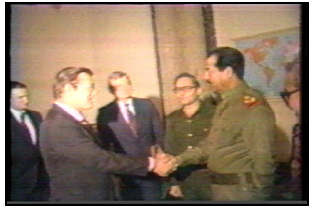
A PBS Frontline episode, "The Arming of Iraq" (1990) detailed much of the conventional and so-called "dual-use" weapons sold to Iraq. The public learned from other sources that at least since mid-1980s the US was selling chemical and biological material for weapons to Iraq and orchestrating private sales. These sales began soon after current Secretary of State, Donald Rumsfeld traveled to Baghdad in 1985 and met with Saddam Hussein as a private businessman on behalf of the Reagan administration. In the last major battle of the Iran-Iraq war, some 65,000 Iranians were killed, many by gas.
Investigators turned up new scandals, including the involvement of Banca Nazionale del Lavoro (BNL), the giant Italian bank, and many of the very same circles of arms suppliers, covert operators, and policy makers in and out of the US government and active in those roles for years. The National Security Council, CIA and other US agencies tacitly approved about $4 billion in unreported loans to Iraq through the giant Italian bank's Atlanta branch. Iraq, with the blessing and official approval of the US government, purchased computer controlled machine tools, computers, scientific instruments, special alloy steel and aluminum, chemicals, and other industrial goods for Iraq's missile, chemical, biological and nuclear weapons programs.
However, the early reports on BNL's activities and the startling revelations that the US government astonishingly knew that BNL was financing billions of dollars of purchases illegally, were rather comical in view of later revelations regarding who was involved. US government officials didn't just know and approve, but some were employees at BNL directly or indirectly. It was Representative Henry Gonzalez (D-Texas) who relentlessly brought key information into the Congressional Record (despite stern warnings by the State Department to stop his personal investigation for the sake of "national security").
Gonzalas revealed, for example, that Brent Scowcroft served as Vice Chairman of Kissinger Associates until being appointed as National Security Advisor to President Bush in January 1989. As Gonzalez reported, "Until October 4,1990, Mr. Scowcroft owned stock in approximately 40 U.S. corporations, many of which were doing busies in Iraq." Scowcroft's stock included that in Halliburton Oil, also doing business in Iraq at the time, which had also been run by current Vice President **** Cheney for a time. Recall that this year President George Bush Sr. faced suspicion of insider trading in relation to selling his stock in Halliburton. The companies that Scowcroft owned stock in, according to Gonzalez, "received more than one out of every eight U.S. export licenses for exports to Iraq. Several of the companies were also clients of Kissinger Associates while Mr. Scowcroft was Vice Chairman of that firm." Thus, Kissinger Associates helped US companies obtain US export licenses with BNL-finance so Iraq could purchase US weapons and materials for its weapons programs.
Many US business-men and officials made handsome profits. This included Henry Kissinger, the former Secretary of State under Richard Nixon, who was an employee of BNL while BNL was simultaneously a paying client of Kissinger Associates. Gonzalez reported that Mr. Alan Stoga, a Kissinger Associates executive, met in June 1989 Mr. Saddam Hussein in Baghdad. "Many Kissinger Associates clients received US export licenses for exports to Iraq. Several were also the beneficiaries of BNL loans to Iraq," said Mr. Gonzalez. Kissinger admitted that "it is possible that somebody may have advised a client on how to get a license."
Perhaps the most bizarre revelations about the involvement of former US officials concerned a Washington-based enterprise called "Global Research" which played a middleman role in selling uniforms to Iraq. It was run by, none other than Spiro Agnew (Nixon's former VP who resigned to avoid bribery and tax evasion charges), John Mitchell (Nixon's chief of staff and Watergate organizer), and Richard Nixon himself. In the mid-1980s, more than a decade after Watergate, Nixon wrote a cozy letter to former dictator and friend Nicolae Ceausescu to close the deal. Global Research, incidentally, swindled the Iraqis, who thought they were getting US-made uniforms for desert conditions. Instead they received, and discarded, the winter uniforms from Romania.
By late 1992, the sales of chemical and biological weapons were revealed. Congressional Records of Senator Riegle's investigation of the Gulf War Syndrome show that that the US government approved sales of large varieties of chemical and biological materials to Iraq. These included anthrax, components of mustard gas, botulinum toxins (which causes paralysis of the muscles involving swallowing and is often fatal), histoplasma capsulatum (which may cause pneumonia, enlargement of the liver and spleen, anemia, acute inflammatory skin disease marked by tender red nodules), and a host of other nasty chemicals materials.
To top it all off, there is the question as to whether Iraq's invasion of Kuwait was a set up. Evidence indicates that the US knew of Iraq's plans -- after all, the military and intelligence agencies of the two countries were working very closely. Newspaper reports about the infamous meeting between then-Ambassador Glaspie and Iraq officials, and a special ABC report in the series "A Line in the Sand," indicated that, although the US officials told Iraq that it disapproved, they indicated that the US would not interfere.
Bear in mind the attitude of the US policy makers not only regarding Iraq's use of gas against Iranians, but in general. Richard Armatige, then Asst. Sec. of Defense for International Security Affairs and now Deputy Secretary of State, said with a hint of pride in his voice that the US "was playing one wolf off another wolf" in pursuing our so-called national interest. This kind of cool machismo resembled the pride that Oliver North verbalized with a grin during the Iran-Contra hearings as "a right idea" with regard to using the Ayatollah's money to fund the Contras. The setting up of Iraq thus would be very consistent with the goals and the character of US foreign policy in the Middle East: to control the region's states either for US oil companies or as bargaining chips in deals with other strong countries, and to profit by selling massive quantities of weapons to states that will war with or deter those states that oppose US "interests."
The problem that Armatige refers to was the fact that by 1990, the US and allied arming of Iraq had given Iraq a decisive military edge over Iran, which upset the regional "balance." The thinking among the US hawks was Iraq's military needed to somehow be returned to its 1980 level. An invasion of Kuwait would enable the US to do that.
But initially many arms suppliers opposed the war on Iraq because they had been making huge profits from arms sales to Saddam's regime during the 1980s. Indeed, one US official interviewed expressed his disappointment with Iraq's invasion and the subsequent Gulf War because the relationship with Iraq could have continued to be "very profit...uh mutually profitable."
Bush Sr. and others expected that after the war, Saddam would capitulate to US designs on the region. With a heeled Saddam, the interests of arms suppliers, defense contractors, and the many US oil corporations could be renewed. Iraqi would have to re-arm itself and invest in oil drilling and processing facilities that were destroyed by US forces. And to pay for all that, Iraq would have to sell oil cheap, which served the interests both of the giant oil corporations and the American public who had begun buying GM SUVs en masse. It would be good for US business.
The invasion today is, above all, to renew US firm's access to Iraqi oil. As reported recently in the New York Times, former CIA director R. James Woolsey, who has been one of the leading advocates of forcing Hussein from power, argues that, "It's pretty straightforward, France and Russia have oil companies and interests in Iraq. They should be told that if they are of assistance in moving Iraq toward decent government, we'll do the best we can to ensure that the new government and American companies work closely with them. If they throw in their lot with Saddam, it will be difficult to the point of impossible to persuade the new Iraqi government to work with them."
His views are of course supported by the new Iraqi government-in-waiting. Faisal Qaragholi, the "petroleum engineer who directs the London office of the Iraqi National Congress (INC), an umbrella organization of opposition groups that is backed by the United States" says that "Our oil policies should be decided by a government in Iraq elected by the people." Ahmed Chalabi, the INC leader, put it more bluntly and sadi that he favored a U.S.-led consortium to develop Iraq's oil fields, which would replace the existing agreements that Iraq has with Russia and France. "American companies will have a big shot at Iraqi oil," Chalabi said.
Note also that Bush and company have a personal stake in unilateral action. According to Leroy Sievers and the Nightline Staff at ABC, "**** Cheney's Halliburton Co. had interests in Iraqi oil production after the [Gulf ] war."
Thus, following the Gulf War, Cheney, Bush Sr. and others didn't expect that Saddam would refuse to abide by US interests and join the so-called "family of nations." This is really what President Bush Jr meant when he said at a cabinet meeting on Sept. 24, 2002 that he intends "to hold Saddam Hussein to account for a decade of defiance."
There is no shock about any of this, nor of the sordid assortment of officials and individuals directly or indirectly involved -- from the infamous US-based international arms dealer Sarkis Songhanalian and former Gen. Secord, to Oliver North and Richard Nixon -- and many others. They had been part of covert US arms and drug deals and Mafia dating back decades. Iraqgate was in fact also part of Irangate, and both are about a shadow government that circumvents domestic and international laws in arming regimes and terrorist organizations to enhance the profits of US businessmen and corporations.
The public learned since the mid-1980s that the shadow government folks played all sides of various wars, and made curious business alliances. Profits were good, but there were also ideological reasons. While arming Iraq and putting proceeds into their pockets, the covert operators also armed Iran. Israel of course, had also been arming Iran since the Ayatollah came into power in order to counter Iraq. The US soon joined these operations after Regan came to power.
Oliver North, Bush Sr., Robert McFarlane, and Gen. Secord, and others purchased from the CIA spare parts for US-made weapons and more than two thousand TOW missiles, which the CIA had purchased at discount rates from the Pentagon. Secord and North sold the weapons and parts to Iran in exchange for cash and the release of US hostages in Lebanon.
In public, Ronnie Reagan repeatedly condemned negotiations with terrorists in principle and even stated on national TV that there had been no negotiations with terrorists. He went back on air a few months later and said that while he still didn't believe "in his heart" that the US had negotiated with terrorists, the facts told him "otherwise." He escaped impeachment because he "couldn't remember" signing detailed instructions for sales of weapons to Iran and for the diversion of money to the Contras.
Insiders considered these trades "business as usual." Former General Secord, for instance, unashamedly told Congressional investigators during the Iran-Contra hearings that his arms-dealing firm, the "Enterprise," which sold the TOWs to other brokers and then to Iran, was a legitimate profit-making business. And as we all know, at the other end of the deal, North channeled a portion of the proceeds from those sales through Swiss banks and to the terrorist Contras in Honduras. Their job was to overthrow the Sandinista regime that overthrew the brutal 43-year Somoza family dictatorship supported by the US.
Again, in legal terms, the scandal was not only that Reagan's administration circumvented the Boland Amendment which outlawed military support to the Contras, but also that the CIA had also mined the harbors of Nicaragua. When the US was taken to the International Court of Justice (ICJ) and convicted of violating international laws, President Reagan disregarded this conviction saying the ICJ had no jurisdiction over the United States.
Bush Jr. has stated the following reasons for invading Iraq, all of which are accurate except the last: (1) Iraq used chemical weapons, (2) Iraq tried to build nuclear weapons, and (3) the US tried to bring Iraq into the "family of nations" (said first by Bush Sr). He is correct that Iraq was willing to use chemical weapons and has been trying to build nuclear weapons for years. Of course, he just fails to mention that the US was willing to sell, and to help Iraq use, chemical weapons of mass destruction and that his friends profited handsomely in so doing. He also fails to note that today Hussein is not seen as an immediate threat by it's Arab neighbors, none of whom have called for his ouster, and that Iraq has only a shadow of the power it had in 1990. There is no evidence to support Bush or Blair's claims that Iraq has and is preparing to use chemical or biological weapons.
Lastly, what about Bush Jr.'s third contention, that the US had tried to bring Saddam into the "family of nations?" In view of the thousands upon thousands of women, children, and men butchered with US battle plans and arms, as well as arms from Europe, one could only characterize that family as being composed of unscrupulous, profiteering, vile accomplices to mass murder. Perhaps this is also a reason why the Bush administration opposes the formation of the World Court and needs US politicians and military personel exempt from international law.
from Elson E. Boles, an Assistant Professor of Sociology at Saginaw Valley State University University in Michigan.
|
|
|
| |
|
| |
|
|
|
Sava
|
|
GO GO GO!
Mar 2001
time: 23:28
|
|
quote:
How U.S. Arms and Technology Were Transferred to Iraq*
Ted Koppel - ABC News - Excerpt of Nightline Special Investigation
(Click here to see the full report.)
TED KOPPEL:
"In 1982, the United States gave the world a clear signal that relations with Iraq were improving. It dropped Iraq from its list of states that support terrorism and, around the world, a variety of interested parties watched, listened and drew their own conclusions...
"It wasn't just a tilt toward Iraq, it was an opening of the floodgates. At times, U.S. laws were violated. There was an official atmosphere that ranged from indifference to tolerance and sometimes even outright cooperation...
"The sheer quantity of technology, weapons and money that were transferred to Iraq over roughly the same period dwarfs anything that went to Iran. Remember, official U.S. policy was that no help should go to either side. In reality, the Reagan administration was split, some senior officials supporting Iran, others Iraq....
"But it's not a question of holding the Bush or Reagan administrations to account for having made mistakes in regard to their policies toward Iraq. The issue is how those policies were implemented. "As we've reported over the past few months, the Atlanta branch of an Italian bank, BNL, was able to funnel billions, some of it in U.S. credits, to Iraq's military procurement network. The U.S. government knew and turned a blind eye.
"Sophisticated military technology was illegally transferred from a major U.S. company in Lancaster, Pennsylvania to South Africa and Chile and, from there, on to Iraq. The Iraqi-born designer of a chemical weapons plant in Libya set up shop in Florida, producing and then shipping to Iraq chemical weapon components. The CIA, the FBI and other federal agencies were made aware of the operation and did nothing to prevent it. "During the 1980s and into the '90s, senior officials of both the Reagan and Bush administrations encouraged the privatization of foreign policy, certainly towards Iran and Iraq. The policy may have had merit, but they weren't willing or, in some instances, weren't successful in fighting it out on Capital Hill. So they found other ways. They made a mockery of the export control system, they found ways of encouraging foreign governments to do what our laws prohibited. They either knew or, if not, were guilty of the grossest incompetence, that U.S. companies were collaborating with foreign arms merchants in the illegal transfer of American technology that helped Saddam Hussein build his formidable arsenal." (Nightline Show #2690 - Sept. 13, 1991)
It is this same Iraqi arsenal that once again represents an existential threat both to Israel and the US. It is this same arsenal that Jonathan Pollard warned Israel about nearly 2 decades ago as the US covertly armed Iraq. In a recent interview, former Secretary of Defense Caspar Weinberger indicated that the Pollard case was not of major consequence, but that more was made of it than it was. [See Caspar's Ghost - NY Jewish Week - June 14, 2002]. This is a shocking admission from the man most responsible for securing the unprecedented life sentence that Pollard received.
In hindsight, it was clearly this secret US tilt towards Iraq and the covert build up of US arms and intelligence in Iraq that the Pollard affair threatened to reveal. It now becomes apparent why such energy and effort has been invested in burying Pollard alive and why that policy continues to this day as America again prepares for war against Iraq - an enemy armed to the teeth with American weapons, technology and intelligence.
|
the full report detailing the US's weapons support of Iraq can be found at http://www.jonathanpollard.org/1991/091391.htm
The Russians did give Iraq weapons Fez. Nobody is denying that. But you are denying the FACT that the US was the single greatest arms dealer to Saddam. The US remains the single greatest arms dealer in the world, BTW.
|
|
| |
|
|
|
Sava
|
|
GO GO GO!
Mar 2001
time: 23:28
|
|
quote:
U.S. And Iraq Go Way Back
NEW YORK, Dec. 31, 2002
Newly released documents show that U.S. officials, including Defense Secretary Donald Rumsfeld, played a leading role in building up Iraq's military in the 1980s when Iraq was using chemical weapons, a newspaper reports.
It was Rumsfeld, now defense secretary and then a special presidential envoy, whose December 1983 meeting with Saddam Hussein led to the normalization of ties between Washington and Baghdad, according to the Washington Post.
The cozy relationship was an effort to build a regional bulwark against America's enemies in Iran.
The newspaper says a review of a large tranche of government documents reveals that the administrations of President Reagan and the first President Bush both authorized providing Iraq with intelligence and logistical support, and okayed the sale of dual use items — those with military and civilian applications — that included chemicals and germs, even anthrax and bubonic plague.
Foreign affairs experts are split on whether the policy made sense given the different dynamics of an earlier era when the Soviet Union was still a player in the Middle East, when Iranian fundamentalism was unchecked by the current efforts toward reform, and when Saddam was already a valued friend of European U.S. allies like the French.
Vital American interests were also at stake. The U.S. assistance to Iraq came only after Iran gained the upper hand in their eight-year war, and looked poised to threaten the Persian Gulf states, Kuwait and even Saudi Arabia — key suppliers of oil to the United States.
Kenneth Pollack, a one-time CIA analyst and author of a current book advocating war with Iraq, told the Post, "It was a horrible mistake then, but we have got it right now. My fellow [CIA] analysts and I were warning at the time that Hussein was a very nasty character. We were constantly fighting the State Department."
But former U.S. ambassador to Baghdad David Newton contended in a Post interview, "Fundamentally, the policy was justified. We were concerned that Iraq should not lose the war with Iran, because that would have threatened Saudi Arabia and the Gulf. Our long-term hope was that Hussein's government would become less repressive and more responsible."
The U.S. removed Iraq from its list of states that sponsor terrorism in 1982, and as Iran made gains on the battlefield, the Reagan administration decided to pass intelligence to Iraq.
The policy to do this was captured in a November 1983 National Security Directive that is still classified, but apparently stated that U.S. policy was to do "whatever was necessary and legal" to stop Iran from winning.
At the same time, there were multiple reports Iraq was using chemical weapons to repulse the Iranian advance; one State Department official told Secretary of State George Shultz that Iraq was engaging in "almost daily use of (chemical weapons)" against Iranian troops.
This policy led to several Rumsfeld visits to Baghdad, as a private citizen working as a presidential envoy.
According to State Department report, at his first meeting with Saddam, Rumsfeld told Hussein the U.S. wanted a full resumption of relations. While the defense secretary has since said he warned Iraq about the use of chemical weapons, notes of the meeting do not show this. Rumseld apparently did mention the chemical weapons concern in a meeting with an aide to Saddam.
A 1995 affidavit by former National Security Agency official Howard Teicher, obtained by the Post, claimed that the U.S. "actively supported the Iraqi war effort by supplying the Iraqis with billions of dollars of credits, by providing military intelligence and advice to the Iraqis, and by closely monitoring third country arms sales to Iraq to make sure Iraq had the military weaponry required."
Teicher claimed that the CIA supplied Iraq with cluster bombs through a Chilean company. However, German and UK firms sold more weapons to Iraq than U.S. arms companies, the Post reports.
Congressional investigations after the Gulf War revealed that the Commerce Department had licensed sales of biological agents, including anthrax, and insecticides, which could be used in chemical weapons, to Iraq.
When Iraq used chemical weapons against the Kurds in 1987, there was anger in Congress and the White House. But a memo in 1988 from Assistant Secretary of State Richard W. Murphy stated that "The U.S.-Iraqi relationship is … important to our long-term political and economic objectives."
"We believe that economic sanctions will be useless or counterproductive to influence the Iraqis," the Post quoted the memo as saying. |
from http://www.cbsnews.com/stories/2002...ble534798.shtml
quote:
the administrations of President Reagan and the first President Bush both authorized providing Iraq with intelligence and logistical support, and okayed the sale of dual use items — those with military and civilian applications — that included chemicals and germs, even anthrax and bubonic plague. |
quote:
Congressional investigations after the Gulf War revealed that the Commerce Department had licensed sales of biological agents, including anthrax, and insecticides, which could be used in chemical weapons, to Iraq. |
quote:
a memo in 1988 from Assistant Secretary of State Richard W. Murphy stated that "The U.S.-Iraqi relationship is … important to our long-term political and economic objectives."
|
This is from CBSnews... not the Guardian, mind you. 
|
|
| |
|
|
|
Giancarlo
|
 |
Los Angeles
Apr 2000
time: 02:28
|
|
quote:
Originally posted by Sava
Sorry Fez, US government documents say otherwise.  |
You are so full fo ****.. I provide a source that provides the exact numbers on the Iraqi Airforce.. all of it is Russian and French, and you still deny it.
May I quote it again for your ignoring my quotations:
"Following Desert Fox, the UN Special Comission (UNSCOM) reported that the Iraq air force has tried to modify L-29 trainers and other fixed-wing types as UAVs which could carry chemical and biological warfare agents.
UNSCOM was responsible for cataloguing and removing Iraq's weapons of mass destruction capability.
Iraq is subject to an arms embargo which makes spares acquisition difficult, although rumors suggest some aid is flowing from Russia. Today's air force is spearheaded by Mirage F1EQa, MiG-21s and MiG-23s of various types with a few MiG-25s in support. Aircraft evacuated to Iran include MiG-23s, MiG-29s, Il-76s, Su-20/22s, Su-25s, Mirage F1EQs and one of the two Adnans.
It is likely that the entire Tu-16 Badger fleet was destroyed during the 1991 conflict. Remaining MiG-29s are apparently in long-term storage. "
|
|
| |
|
| |
|
| |
|
|
|
Edan
|
|
quote:
Originally posted by Sava
The Russians did give Iraq weapons Fez. Nobody is denying that. But you are denying the FACT that the US was the single greatest arms dealer to Saddam. |
I don't deny that the US supplied arms to Iraq, but that "fact" is simply false.
http://projects.sipri.se/armstrade/..._Imps_73-02.pdf
The USSR was, by far, the biggest arms dealer to Iraq by a wide margin, followed by France, China and Czechoslovakia.
|
|
| |
All times are GMT. The time now is 05:28.
Apolyton Time is 00:28. |
top of page
|
| archivepost |
|
Forum Rules:
You may not post new threads
You may not post replies
You may not post attachments
You may not edit your posts
|
HTML code is ON
vB code is ON
Smilies are ON
[IMG] code is ON
|
|
|
|
|
|






 14-06-2003 19:28


 Attachment:







 |
|