 |
| |
|

|
Arnelos
|
 |
of the Free World
Sep 2002
time: 00:31
|
|
quote:
Originally posted by Dominae
The alternative I proposed is just as time-consuming as what you did, and would IMO be more informative.
I'll try to this analysis myself when I return tonight.
(By the way, Arnelos, I'm not downplaying your contribuation here. All I'm saying is that some people are getting all worked up because of your "one in a million" result, which is not entirely accurate...it could be off by at least a few factors. Like I said, calculating the odds of a particular sequence of combats is not the same as calculating the joint probability of the evidence we've seen. My opinion is that your "credible" evidence is misleading.)
Dominae |
Now I think I see what your problem is. Normally, I would agree with you. My point is that because of the WAY in which I have calculated things here, that concern does not really apply. The reason is that I have calculated the chances of the level of success (defined as not dying) achieved by each GCA unit in all circumstances under each given scenario. I'll agree that that slightly fudges things because I'm not counting the potential last round of a horseman's combat should he have stayed in combat rather than retreated. Since he retreated, I'm calling his successful attempt to damage our Numidian Mercenary a "success" and calculating the chance of that success (or a greater one) and then multiplying it in with the rest.
Because of the way I'm defining success, therefore (success as GCA not losing a unit in any fight, which is the probability I'm really trying to get at), it is not necessary to do a joint look at all probabilities. Since EVERY single combat during GCA's turn is a GCA "victory", it's the equivalent of flipping ALL heads without ever flipping a single tails. If you flipped a mixsure of heads and tails, you'd need a more comprehensive method to figure out the exact probabilities of having had any number of combinations of doing better or worse than the given result.
However, when the given result IS the best result possible (because you flipped a heads every single time), that level of analysis is not necessary. In effect, flipping a heads 8 times in a row is a simple matter of 2^8 = 256. Done! no more math required.
That said, if you want to look at something different, like how many times GCA succeeding in KILLING AN APOLYTON UNIT as opposed to how many times they REFRAINED FROM LOSING A UNIT (which is what I looked at), you would certainly need to do a more indepth analysis of the probabilities involved, since you have (using hte analogy), a mixture of heads and tales.
Do see how my choice to look at GCA's lack of LOSING UNITS means that this is not necessary for what I was doing, however?
|
|
| |
|
|
|
MJW
|
|
MN,USA
Jul 2002
time: 23:31
|
|
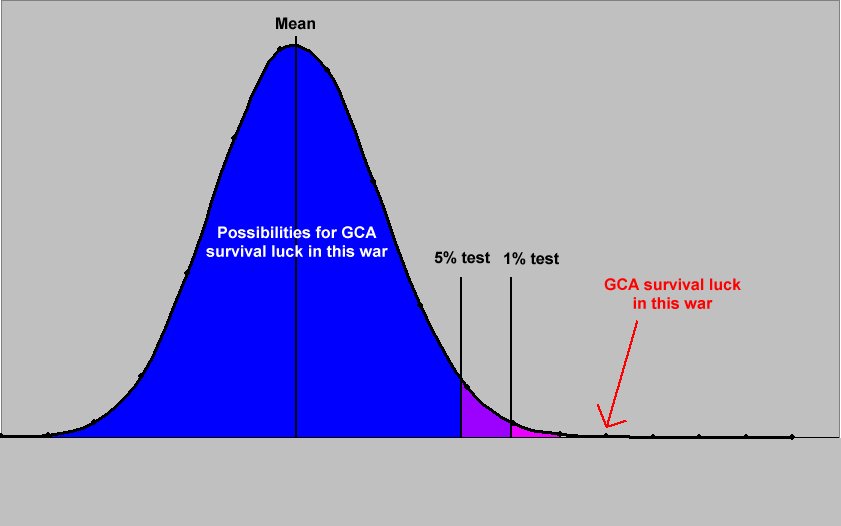
Just ran the numbers... by removing entirely from consideration the luck of GCA in retaining high hit points on some of their very lucky kills and additionally collectivizing all of the rolls together as suggested by Dominae (and considering the chance of this outcome AND ALL SUPERIOR OUTCOMES as a group), I come up with the following number:
~0.0209% (1 in ~4,760)
There's no WAY I'm posting the sheer amount of math that went into that number I built a spreadsheet for this purpose a long time ago and I've altered it for use with this, but it's rather user-unfriendly to anyone but me
I'll go try to jerry-rig a significance test for this case and see what the value for that is now... be back in a bit.
------------------------------------------------------------------------
I want to see it anyway. Please post it.
|
|
| |
|
|
|
wervdon
|
|
Well, i've been thinking about this today at work, and this is basically my thoughts:
I doubt seriously that we'll be able to prove that GCA is cheating, at least not to the point that anything is done about it. I also think that bowing out of the game will make us come off as sore losers, but that continuing in this war is semi-suicidal. Sure we may eventually win, but its not going to be the short type of war it should of been.
The only thing I think we can do about it is request (heck demand) that measures be put in place to help guarantee fair play in the future:
1) For the duration of the war, all saves (for us or GCA) should be sent directly to the UN and not the team.
2) During the actual turn chat (or however GCA does it), the UN should send an observer to play along. This observer should be given a basic turn orders summary before the start of the turn, only then will the save be given to the team. The observer's job will be to duplicate any moves that are taken while the turn is being played. The team is free to request any information from the save they wish before giving the turn orders summary (ie they can ask what losses they took, where the other sides visible units are, etc).
3) It'd be nice, but probally shot down, if the other team was allowed to have their own observer present listening only to the orders and battle results. (ie not in the teams private channel, but only being told in real time what battle related orders were being carried out).
Problems with this:
If they are determined they can still have several people playing the save in the background and instant messaging the results of battles to the leaders before they tell the observer what they do. Pre-made turn orders will help discourage this (heavy deviation for no obvious reason would be a red flag), but it would hopefully cut back a bit on their "luck".
|
|
| |
|
|
|
wervdon
|
|
-shrug- Probally so, and I'm just throwing it out there. Unfortunately, when it comes to the point that you can trust the people you are playing with it comes down to only four possibilities:
1) Take your ball and go home so to speak. ie) quit.
2) Take the knocks as they come. ie) Play on like its not happening, or whine and complain then play on like its not happening.
3) Complain and hope something gets done.
4) Putting insane measures in place like I proposed.
I personally vote against #2 at this point, and I don't think that anything would come of #3 which would leave us with the other 3 options. I do think we should try #3 first though.
I guess if/when nothing comes of complaining and no one has the will/energy to pursue #4 (and I think GCA would complain so much it wouldn't happen anyways), that we should go with #1 and just quit. Although it will to many make us look like sore losers.
|
|
| |
|
|
|
asleepathewheel
|
|
listening too long to one song
Mar 2002
time: 00:31
|
|
do we have a full list of the moves that will alter the seed?
|
|
| |
|
|
|
MrWhereItsAt
|
 |
New Year's Resolution: 2005 is the year of Where It's At - come get some.
Nov 2001
time: 17:31
|
|
Back now, and desperately trying to catch up.
The suspicions we have had until now are becoming more apparent with their recent successes, but there can be no positive proof of cheating. We think GCA may be somehow testing for the best outcomes and then playing these, and the odds seem to confirm our suspicions, however there is and can be no certainty in this.
I have not had more than the last 30 minutes to read on this issue, but my first feeling is that contacting Mongoose was the best thing to have done, but we can't stop the game over it yet. Delaying the sent save is perfectly fine - it is for times of uncertainty like this we have hours stored in the counter to spend.
With an attrition rate as we have seen so far, although GCA is winning some pretty unlikely battles, we are killing them almost as fast as they are killing us. If this comes down to sheer attrition, we are going to slaughter them, unless they are somehow adding units, which is inconceivable to me as to how they would implement this.
So, we are doing the right thing by letting the Admin know of our suspicions, but we shouldn't stop our tactics - reassemble the NMs and MIs and press on. We can easily have twice their offensive units, and in that case there is nothing that could save them from our counter-attacks.
|
|
| |
|
|
|
Dominae
|
|
quote:
Originally posted by Arnelos
However, when the given result IS the best result possible (because you flipped a heads every single time), that level of analysis is not necessary. In effect, flipping a heads 8 times in a row is a simple matter of 2^8 = 256. Done! no more math required.
|
Define:
H - when our unit scores a pip
T1 - when a GCA unit scores a pip but does not kill our unit
T2 - when a GCA unit scores a pip and kills our unit
Then the sequence you're talking about is does not look like T-T-T-T-T-T (like in your example), but something more like H-H-T1-T1-T2-H-T1-T1-H-T2-T1-H-H-H, etc. In other words, there's a bunch more going on that a simple sequence of "GCA always wins", because combat is random on the level of pip loss, not unit loss. Now think of how many possible strings of the second kind model the combat results we've seen so far: I think you'll agree with me that there are a great number of them, and these must all be summed together to get an accurate figure on how likely it was for GCA to do what they did.
Your second figure (1 in 4000) seems far more plausible to me...and I would not be surprised if it was again lowered by a another factor. Still that would be within 1% and that would be grounds enough to blow the whistle on GCA. So I'm not disagreeing with you, I just think that there's something wrong with how you're doing your analysis. Either that or there's something I'm really not understanding in your explanations.
Dominae
|
|
| |
|
|
|
MrWhereItsAt
|
|
New Year's Resolution: 2005 is the year of Where It's At - come get some.
Nov 2001
time: 17:31
|
|
Ah the difference between permutations and combinations....
Dom, I understand what you are getting at, but this will depend on how exactly the combat calculators used by Arn and others calculate victory odds: they may sum all permutations already. Apologies if the following is either obvious to those who have done this already.
Let us look at a Horseman attacking an NM (disregarding all terrain effects for the moment). For every attack we have an attack of 2 vs a defense of 3. Let us say we know the result - a dead NM and a Horse damaged from 4hp to 2hp. It is unimportant in which order the damage was done. I will show this.
Permutation 1: This is one possible permutation of results from the battle.
Horseman loses 1 hp, then another 1 hp, then
NM loses all 4 hp in a row.
The chance of this is 3/5*3/5 (the NM victories)*2/5*2/5*2/5*2/5 = 144/3125
Permutatio 2: Another possible permutation of results is this:
Horseman loses 1 hp, then
NM loses 2 hp in a row, then
Horseman loses 1 hp and then
NM loses the last 2 hp on a row.
The chance of this is 3/5*2/5*2/5*3/5*2/5*2/5 = 144/3125. This is the same probability as for the other order of results, and in fact you would find, for a given outcome with given starting hp values, ALL orders of hp loss are of the same probability. We can multiply the probability for one of these permutations by the number of permutations to get the chance of that particular result. The number of possible permutations is 10 (from listing all possible permutations). So, the chance for this particular result, REGARDLESS of the order of hp losses, is 10 x 144/3125 = 46.08%
I imagine this is what the calculation programs do (and I have checked that the civfanatics combat calculator does indeed some permutations like this), so all we need do is choose input hp amounts and resultant hp values and the chance of getting that particular result can be calculated including all possible other permutations of battle that lead to the same result.
Thus it is not necessary to have to do a calculation for every single possible permutation of battle hp losses, merely to calculate the one path and multiply the probability of this by a multiplier based on the number of possible paths. Since this is what the calculation program at least at CFC does, unless Arn has neglected this (which I don't think he has), then his results are as good as they can be. However I would like to hear from Arn on this when he is online again.
|
|
| |
|
|
|
Dominae
|
|
There are partial results from retreating Horsemen. These you must model exhaustively, because we have no access to them.
There are also results from Catapults, which for the same reason we must model exhaustively.
You cannot simply abstract away the "pip" level to obtain the "unit" level, I'm afraid.
Dominae
|
|
| |
|
|
|
MrWhereItsAt
|
|
New Year's Resolution: 2005 is the year of Where It's At - come get some.
Nov 2001
time: 17:31
|
|
It is true that there are the complications of Cats and retreats, so we can't get an absolute probability. However, we were told how many units were in Alga the turn before the attack, and from this + how many were left the turn we responded, we can get a more than fair estimation of what happened. If we look at the most favourable outcomes for us (a Horse or two lost attacking MIs), given the result that we know, we can get a probability for this "best" result, and anything that did happen was at least this unlikely. In fact, with Binomial tables (which I believe Arn may have used), once the initial estimations of what attacked what were made, then the calculations themselves would have been straightforward. We need just assume their Swords attacked NMs first and each of them had lost an hp (from Catapults) to calculate a good estimate of the best (for us) likely probability.
I doubt if figures as detailed as this would convince anyone from another team without considerable tutorials in exactly how they were obtained, but they help us decide how much we can put forward in terms of an argument for investigating possible cheating.
|
|
| |
|
| |
|
|
|
wervdon
|
|
quote:
but this will depend on how exactly the combat calculators used by Arn and others calculate victory odds |
If they are using the one on CFC's site then it does. I know this because I programmed my own and after finally getting the individual round/pip loss ratios right, my results agreed with theirs exactly.
My calculator works by creating a weighted tree graph at each battle round, going down the tree until all possible final outcomes are reached. Then multiplying the weights on each branch down to each outcome to get the individual chance of that series of results. Finally adding up the chances of each final branch with a result of the final outcome being looked for.
Short example:
quote:
+ Round 1 (chance = 1.0, Pips = 2,2)
+ / \
+ Loss (chance = .25, Pips = 1, 2) Win (Chance = .75, Pips = 2,1)
+ / \ / \
+L (.25, P = 0, 2) W (.75, P=1,1) L (.25, P=1,1) W (.75, P=2,0)
+ / \ / \
+ L (.25, P=0,1) W (.75, P=1,0) L (.25, P=0,1) W (.75, P=1,0)
|
Chance of Loss (add up all the P=0,X outcomes), multiplying weights as you work your way down the tree:
L = 1.0*.25*.25 + 1.0*.25*.75*.25 + 1.0*.75*.25*.25
L = .34375
In any case, I just wanted to point out that the CFC combat calculator does take into account all permutations on a unit vs unit level, and that I've checked these results.
Edit: Added the +'s to get the forum to stop taking out the leading spaces. Anyone know a better way to do that?
Edit: Or a way that actually works at all since that didnt :P
Last edited by wervdon on 17-10-2003 at 17:20
|
|
| |
|
| |
All times are GMT. The time now is 05:31.
Apolyton Time is 00:31. |
top of page
|
|
|
Forum Rules:
You may not post new threads
You may not post replies
You may not post attachments
You may not edit your posts
|
HTML code is ON
vB code is ON
Smilies are ON
[IMG] code is ON
|
|
|
|
|
|





 16-10-2003 22:46







 |
|