|
| |
|
| |
|

|
Mountain Sage
|
|
This is what happened during the Ancient Times:
Strategies and implementation:
1. Build the GLibrary. Maximize the second city and start a Palace pre-built. Research Writing (at 50 turns) and Philosophy (at 100%).
2. Expand and settle the whole continent. This time I went for a C-T-T-C.
3. Contact all civs and trade the techs around as to stay in the tech loop until the GLibrary.
As you see, nothing really new, but the implementation would be interesting.
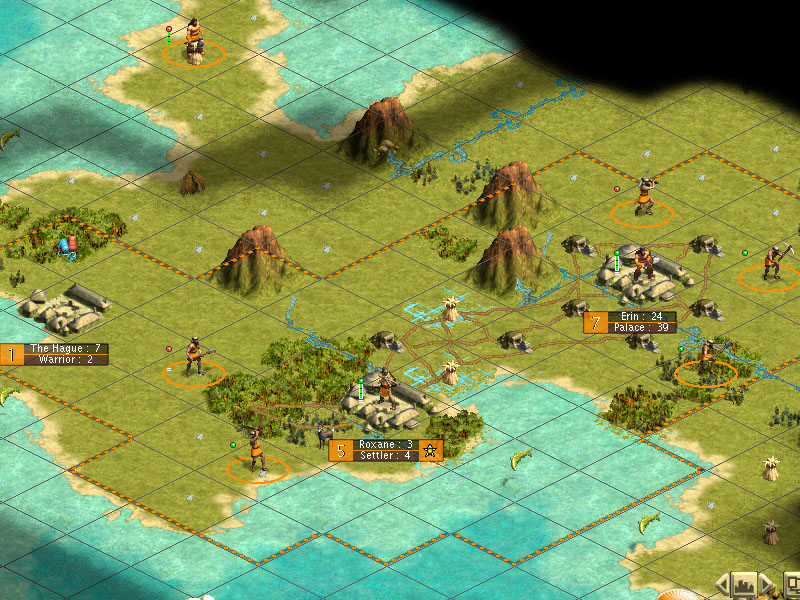
4000BC: I moved the Settler S-E (1) and started to irrigate the Wheat tile. The building order is: Warrior, Curragh, Warrior (both MP), Curragh, Settler.
3150BC: the second Curragh starts its Western Shore Trek. The Easter Shore Trek has rounded Cape Cold…
2900BC: the Western Curragh is ready for a bold sail in unknown waters. The Eastern Curragh found and island with more land ahead. The Settler is done, switched to a Granary.
2470BC: contacted Zululand. They have BW, The Wheel, WC, CB and we have only Alphabet to offer. I want to trade Alphabet as late as possible as to avoid their Writing-Map Making path and their Galleys-Settler combos.
The Western Curragh found a big island in he NW ans is heading towards more land.
Erin, my second city (Warrior, Warrior, Granary), was founded 9-9-9-x from Roxane (building a second Worker). Writing in 19 turns at 10%, 196 gold in the vaults, Lux at 20% (Roxane size 5).
2270BC: Roxane is building a couple of Archers. Once the hut W of it will be pooped, it might create problems. 3 Workers are around Erin to improve the landscape. Granary in 11 turns.
The Western Curragh found the Celts. Traded Aphabet for WC and CB (I will need temples when I’ll swith to 0% Lux at 100% research).
1990BC: discovered the Hittites. They already have the Alphabet plus BW, Masonry and The Wheel. Both cities (!) are building Temples. They are size 6 and 5 (1 Settler added). Writing in 7 turns.
1650BC: Philosophy in 29 turns but the Hittites discovered Writing 1 turn before me! That means that they started researching it with 1 turn advance upon me (I moved my Settler). If they do the same with Philosophy, I’m in trouble. Must find a solution soon.
All other civs discovered:
Zulus: + HBR and BW, - Alphabet
Japan: +BW, - Alphabet and Masonry
Mongols: +HBR and BW, - Writing
Egypt: + BW, HBR andPolytheism, - Alphabet
Arabia: + BW and HBR, - Writing
Hittites: + BW, - Mysticism
Celts: +BW, - Masonry and Writing.
I could get all the other techs by trading away Alphabet and Writing, but I don’t want to see those blo*dy Galleys around…
Palace pre-built in Erin, size 7, in 43 turns, Roxane is building a Worker and finally we are going to build our 3rd city near the spices. We even found the time to build a Warrior for scouting. We have 433 gold and are running at -8/turn, lux 0%, 2 entertainers in Erin, aargh!
1550BC: Philosophy in 20 turns. We are at war with the Hittites to slow their research.
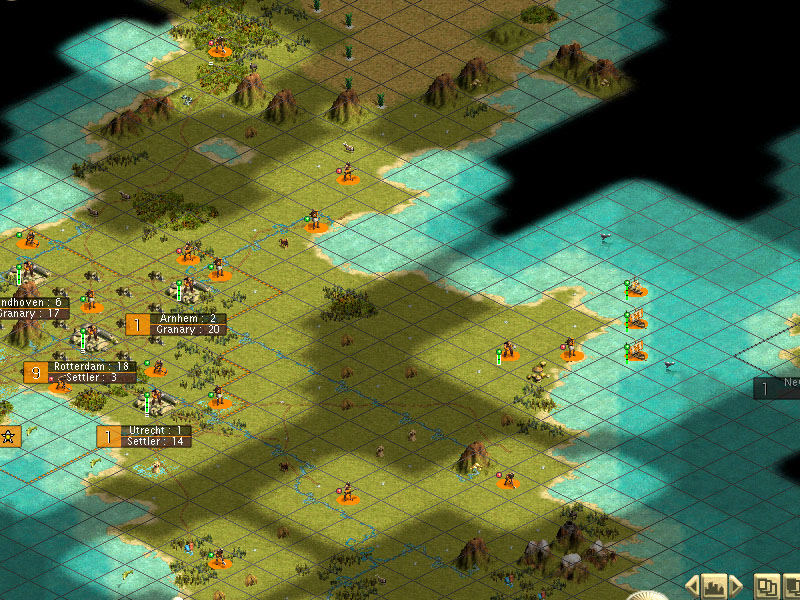
Traded Alphabet and some other minor techs to the Eastern States (the Hittites had it already) and some other techs to the NW States, but not Alphabet and Writing. Now we have 961 gold. Our 5 Workers are doing fine, time for some serious rexxing.
 Attachment: 1550bc.jpg Attachment: 1550bc.jpg
This has been downloaded 284 time(s).
|
|
| |
|
|
|
Mountain Sage
|
|
1050BC: got Philosophy first and with it Literature. The GLibrary in 22 turns. Erin is now at size 8, +10 net shields/turn. We have now 6 cities, the other civs having finished rexxing a thousand years before. But my island is big, almost too big. *sigh*
Research at 0%, 1’442 gold, +33/turn, lux at 0% (no difference for Erin if 0% or 60%).
The tech race:
Zulus: - Literature, Map Making and Polytheism
Japan: - Writing and Polytheism
Mongols: - Literature and Polytheism
Egypt: + Mathematics and Monarchy, - Literature.
Arabia: - Writing
Hittites: - Literature and Polytheism
Celts: - Philosophy, Literature, Map Making, HBR and Polytheism.
Wonders:
Egyptians: Pyramids and the Temple of Artemis
Mongols: Colossus
Japan: the Oracle
570BC: The GLibrary is completed. 2’536 gold +32/turn.
7 cities and 5 settlers on the road, 15 Workers. We discovered a bunch of empty big islands south. We failed to settle the chain of islands between us and the Zulus, but we blocked them with our 3 brave Galleys.
The tech race:
Zulus: + Mathematics, - Literature
Japan: + Philosophy, Map Making and Literature
Mongols: + Mathematics and CoL, - Literature
Egypt: ? at war with us, wanted Literature and we said no.
Arabia: + Literature and MM.
Hittites: + Mathematics, - Literature
Celts: - Philosophy, Literature, HBR and Polytheism
Wonders:
Egyptians: Pyramids, the Temple of Artemis, Hanging Gardens, The GLighthouse
Mongols: Colossus and Statue of Zeus
Japan: the Oracle
Hittites: Mausoleum of Mausollos
Attachment: 570bc.jpg
This has been downloaded 274 time(s).
|
|
| |
|
|
|
Mountain Sage
|
|
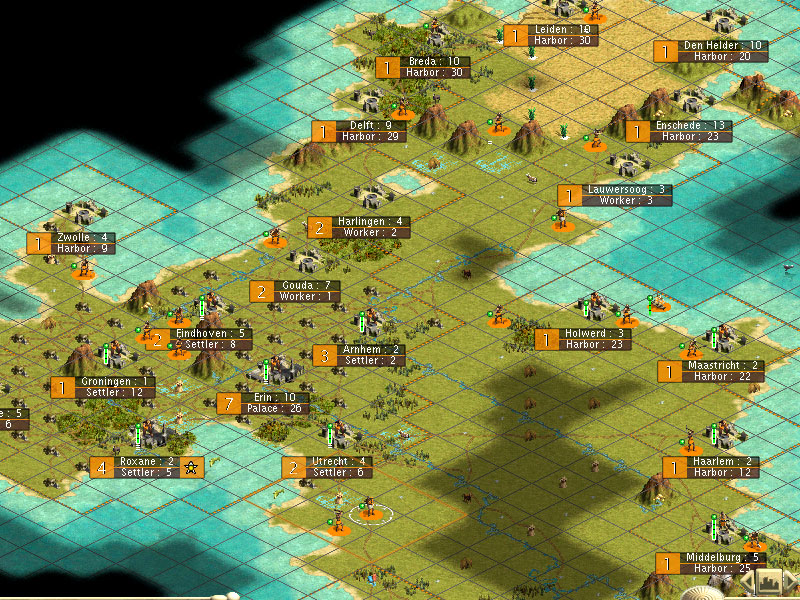
150BC: The Middle Ages
23 cities, 5 Settlers on the move, 22 Workers, 13 Warriors. We are still in Despotism, I am afraid to lose the land race if I can’t pump out settler for 9 turns.
4’451 gold +88/turn, lux 20%. We don’t have Settlers enough to try to settle the southern islands…
The tech race:
Zulus: + CoL, Literature, Currency
Japan: + Mathematics, Literature, the Republic, Monarchy
Mongols: parity
Egypt: + Monotheism, Feudalism, Chivalry (and others?)
Arabia: + Mathematics, CoL, Literature, Map Making
Hittites: + CoL and Monarchy
Celts: + Mathematics, Philosophy, Literature, CoL and Polytheism.
Wonders:
Egyptians: Pyramids, the Temple of Artemis, Hanging Gardens, The GLighthouse, the Great Wall. Building Knights Templar and Sun Tsu.
Mongols: Colossus and Statue of Zeus
Japan: the Oracle
Hittites: Mausoleum of Mausollos
Some comments:
The Land: this land is really beautiful, but it’s also too big. All my cities are churning out Settlers, Settlers and Settlers. The rexxing, however, is doing fine. With the Zulus cut off, I will manage to secure my borders and then settle inland. I failed to secure the two islands between the Zulus and us, so I gave a stepping stone away. I will also fail to secure the 3 southern islands…
Rexxing; was a C-T-T-C spacing wise? I dunno. On one hand, you have to build more Settlers, but since you get more cities with less corruption, these cities can contribute to the Settlers’ building. And more cities mean more military free units, and a bit of gold also…
The Techs: I am not sure the bid for the GLibrary was a clever one. This for two reasons. First of all, it bound my second best city to build ‘nothing’ for ages, when it could have pumped out a Settler every 5 turns. Secondly, I had to wait a very long time for a second civ to get Currency and allowing me to enter the Middle Ages. By now, Egypt is light-years away. At least we have tons of gold, but it will be impossible to get Leo….
The Palace/FP: the greatest problem I expect is where to build the Palace/FP. Roxane is not well-positioned. My idea is to build the FP in Erin and put the Palace in the south, around the 3 wheat. Te only problem is that the city is not founded yet and it will be a 1-shield city. Going to war with 13 warriors to get a GL is probably not a bright idea either…
Attachment: 150bc.jpg
This has been downloaded 264 time(s).
|
|
| |
|
|
|
Mountain Sage
|
|
Here is the save. I played it for a bit through the Middle Ages. I will post some screenshots and comments later on.
 Attachment: w, 150 bc.sav Attachment: w, 150 bc.sav
This has been downloaded 6 time(s).
|
|
| |
|
|
|
Mountain Sage
|
|
The Dutch, part 2.
It’s exactly the same world. In this alternate history, I will change 2 things: I will not go for the GLibrary and will use a 4 tiles city placement (C-T-T-T-C). Let’s find out how things will work out this time. Oh, don’t be upset if you are experiencing a feeling of ‘déjà vu’…
3100BC: a slight difference this time with the building queue, now it’s Warrior, Curragh, Worker, Warrior, Curragh, Curragh, Settler, Granary. Writing at 10% in 50 turns.
2900BC: my usual Western Curragh made it (again) to the big western island. Writing in 29 turns, 120 gold, Settler in 5 turns.
1910BC: Writing in 5 turns, 358 gold, 20% lux, ‘already’ 3 cities.
The Tech race:
Celts: + BW, - Alphabet
Hittites: + BW and HBR
Zulus: + BW, HBR, Mysticism
1625BC: still 3 cities, but 6 Workers. Philosophy in 24 turns, 410 gold at -6/turn. Lost a Curragh a while ago.
The tech race:
Celts: + BW and Masonry, - Alphabet
Japan: + BW, - Writing
Hittites: + BW and HBR
Zulus: + BW, HBR and Mysticism, - Writing
Arabia: + BW, Masonry and Mysticism, - Alphabet.
Time to trade Alphabet?
Wonders:
Egypt: Pyramids
Arabia: Oracle
Mongols: Colossus
1100BC: we got Philosophy and the Currency for free. We will wait for somebody to get CoL, buy it and will enter the Middle Ages. We have now 5 cities and 5 more Curraghs to block the Zulus. 794 gold, +23/turn.
The Tech race:
Celts: - 6 techs
Japan: - 4 techs
Mongols: - 5 techs
Egypt: parity
Arabia: - 4 techs
Zulus: - Currency and Construction
Hittites: - Mathematics and Philosophy
Wonders:
Egypt: Pyramids, Temple of Artemis
Arabia: Oracle
Mongols: Colossus
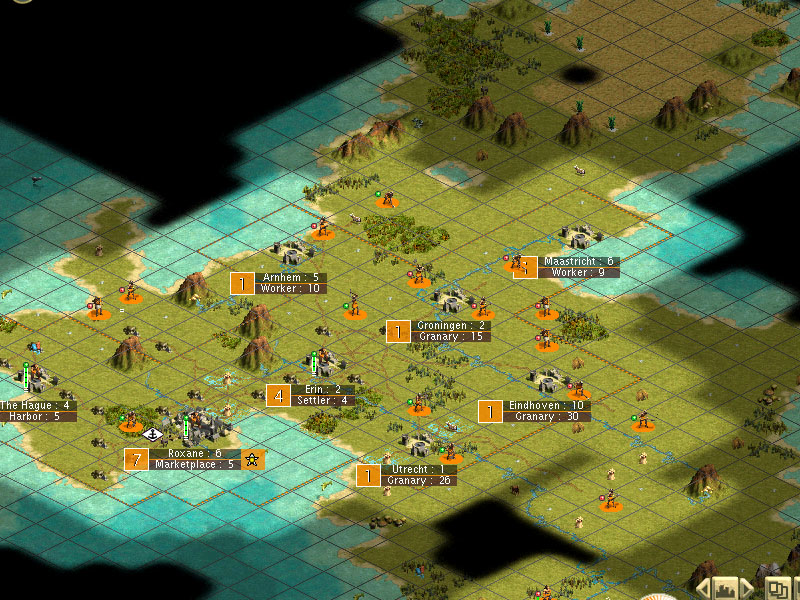
850BC: we entered the Middle Ages.
1496 gold, +41/turn, lux 10%, Engineering at 10% in 50 turns (max. speed). 8 cities.
The Tech race:
Celts: -6
Japan: -4
Mongols: -4
Egypt: + Monarchy, - CoL
Arabia: -4
Zulus: - CoL and Construction
Hittites: parity
Wonders:
Egypt: Pyramids, Temple of Artemis
Arabia: Oracle
Mongols: Colossus
Attachment: 850bcw2.jpg
This has been downloaded 254 time(s).
|
|
| |
|
|
|
Mountain Sage
|
|
Now, what’s the difference between the 2 games?
At this stage, not much. The rexxing is almost the same, as well as the tech race.
However, the GLibrary is NOT NECESSARY to stay in the tech race, at least up to this point.
Egypt is coming in very strong again, thanks to their Wonders, happiness (spices and gems) and fully equipped cities. And they are in Monarchy. It seemed that 30-50 turns in Monarchy instead of in Despotism makes a big difference. Should the ‘perfect’ civ for winning at Sid be seafaring and religious?
Oh, I almost forgot, in my first game, I had to wait for Currency, so I entered the MA in 150BC, now it's 850BC, just a few years difference... 
Attachment: w2, 850 bc.sav
This has been downloaded 1 time(s).
|
|
| |
|
|
|
nbarclay
|
 |
Huntsville, Alabama
Dec 1999
time: 23:35
|
|
Since Mountain Sage posted his early game, I'll go ahead and post mine. I wrote this log in excruciating detail as I played.
I actually replayed the first 34 turns or so after determining that trying to research Writing faster than 50 turns was hopeless. (If I'd been paying more attention and noticed that this was a large map, I wouldn't have tried.) But I followed the same move sequence on the replay aside from running the luxury slider at minimum instead of maximum. I also backed up a turn a time or two to correct micromanagement mistakes that I made because it's hard to keep track of micromanagement and write a detailed log at the same time.
I suspect that the level of detail I kept will bore casual readers. But I'll go ahead and post it anyhow in case anyone wants to make a deep enough study to find it useful.
---
4000 BC: Moved my settler “1”. That gave me a coastal river capital for extra commerce and kept me from having to worry about not having enough good tiles to work. (Moving “2” was tempting, but it would have left me without any known bonus grasslands until my borders expanded.)
3950 BC: Founded my capital and started irrigating my first wheat. Started work on a settler to found a city to take advantage of the second wheat as my first build; the game forest makes an early second worker a lot less important than it would normally be. (With how quickly I’ve gotten crowded having a neighbor on Deity, I doubt that I can afford the time for granaries on Sid if I have a neighbor on my island. And even without a neighbor, getting a second city taking advantage of the second wheat ASAP has definite advantages.) I work the game forest two turns and then switch to the wheat, thereby getting the most shields possible with 5-turn growth. (It only gets four food until it’s irrigated, but five after, so I can offset 3 food early with 5 food later for an average of four.)
3650 BC: My worker has finished irrigating and roading the first wheat and now moves to the second to irrigate and then road it. I want the wheat irrigated when my second city is founded.
3500 BC: Amsterdam is now size 3 and can finish its settler in one turn if I work a forest for an extra shield, thereby slowing down its growth, or two turns otherwise. Since I come out way ahead in shields in Amsterdam building the settler sooner, and founding my second city sooner will make up the turn of growth I lose in Amsterdam, I go ahead and finish the settler.
3450 BC: Amsterdam finishes its settler and starts a worker (since two pump-capable cities and one worker is a horrible imbalance). The city can work the game forest for two turns before going back to working the wheat. The settler starts moving “9”.
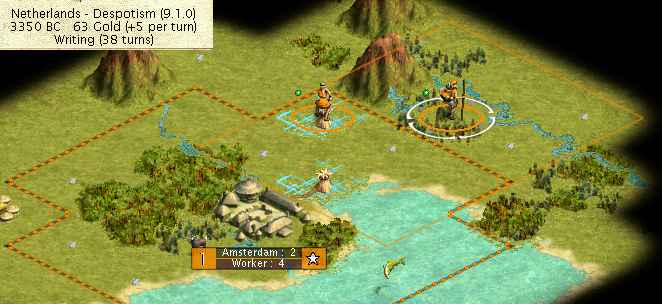
3350 BC: My settler has a decision to make. If he settles where he is, the capital will be very crowded because I’m also planning cities 7-7, 1-1-1, and probably 2-2-2-7 from the capital, and I give up the possibility of uncovering additional bonus grasslands for the new city to work. If I move 8, that is probably ideal for stretching out several cities along the river (always nice for an Agricultural civ), but it gives me only one known bonus grassland. Moving 9 gives the city two known bonus grasslands all to itself (at least for the time being) and a third it can share with the capital, plus the possibility of uncovering other interesting tiles. So that’s what I do. Unfortunately, all I uncover is ordinary, uninteresting regular grasslands.
Attachment: bc 3350 settler decision point.jpg
This has been downloaded 241 time(s).
|
|
| |
|
|
|
nbarclay
|
|
Huntsville, Alabama
Dec 1999
time: 23:35
|
|
3300 BC: Rotterdam is founded and starts work on a worker.
3250 BC: Amsterdam finishes a worker. Since fifteen turns have passed without any AI units showing up, and since this is Sid (meaning absurd numbers of AI units and settlers to find me), I start to think that we probably have the land mass all to ourselves. If so, I can afford to take my time building granaries in order to have a stronger REX in the long term. Accordingly, I start a granary in Amsterdam, with the thought in mind that I can switch to another settler if an AI does show up in the next few turns. My workers move onto the two bonus grasslands by Amsterdam. One worker will road the bonus grassland between the cities and then move on to the bonus grassland by Rotterdam, while the other will mine and road the one by Amsterdam and then mine the one in between.
3100 BC: Rotterdam grows, and its second laborer works one of the bonus grasslands by the river.
3000 BC: Rotterdam completes a worker and (since I still haven’t seen any trace of an AI neighbor) starts a granary. The worker moves 3, preparing to mine and then road.
2630 BC: With a road about to finish by Rotterdam, I figure out that I can drop the luxury slider back a notch and still get the extra happy face I need once the road is finished. The one gold I save that way probably won’t matter, but on Sid, I’m not taking any chances. 
2590 BC: My original worker finishes mining by Rotterdam and goes back to help finish the mine on the bonus grassland he roaded earlier.
2550 BC: Amsterdam finishes its granary and starts a settler. It moves a laborer from the shared bonus grassland to the fish tile, counting on growth to provide the additional shields that will be needed. Rotterdam is five turns from finishing its granary and four from growing, but it can get the granary a turn earlier by sacrificing growth. So I’ll be juggling laborers in Amsterdam and Rottedam a bit over the next few turns. All three workers are finished. One moves to the fur forest to chop it (trying to set up a third pump city), one to 8-7 from the capital (to give the city a mine to work) and one to 6 from Rotterdam (which needs more mines). During the AIs’ turns, I get word that the Zulus have finished the Colossus.
2550 BC: Rotterdam moves a laborer from its wheat to a forest for extra shields, while Amsterdam moves from the fish to the wheat to get extra food so its new laborer can keep working a forest.
2470 BC: I reverse the laborer change above.
2430 BC: Rotterdam moves back from wheat to forest in order to get the granary in one turn. Growth won’t come until two turns after the granary is finished, that’s the only alternative I can find to having the city grow and the granary finish the same turn. (I really, really wish I had another grassland with shield!) Amsterdam works both wheats, a mined bonus grassland, the game forest, a regular forest, and the fish.
2390 BC: Amsterdam completes a settler, which moves to Amsterdam 7-7, and starts another. Rotterdam finishes its granary and starts a settler. It’s going to take some juggling (and rather expensive use of the luxury slider), but an 8-8-6-8 shield pattern should be possible.
2350 BC: The Hague is founded and starts work on a granary.
2270 BC: Amsterdam completes its settler and starts a worker. (With Amsterdam and The Hague competing for tiles, I need more workers in the area.)
2230 BC: Rotterdam finishes its settler and starts a worker.
2190 BC: Amsterdam finishes a worker and starts another. One of the settlers spots a cow on the river southeast of Rotterdam. That’s four +5 food pump cities once I get enough granaries built! Now if the land mass is just large enough for me to get good use out of them. (I still haven’t built anything resembling a scouting unit. ) In the AIs’ turn, I get word that Egypt has completed the Pyramids, so I’m up against an AI in its GA.
2150 BC: Utrecht founded by the cows, and there is wheat just outside its borders. With proper positioning, that makes yet another pump city possible. Rotterdam finishes a worker and starts another one.
2070 BC: Groningen founded, and I learn about yet another river. Rotterdam completes a worker and starts a settler, which will be assisted by a chop. (Amsterdam is still cranking out workers.) The new city moves me up to sixth in GNP and Productivity, but I’m still last in Mfg. Goods.
1990 BC: In the AIs’ turns, I get word that the Arabs have completed the Oracle.
1910 BC: Rotterdam finishes a settler and starts a worker.
1790 BC: Eindhoven founded. GNP and Productivity are now in fifth place.
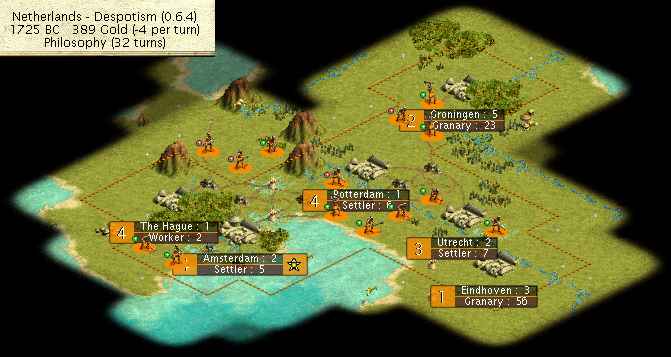
1750 BC: Utrecht completes a triple-chop-assisted granary and starts work on a settler. Rotterdam completes a granary and starts work on a settler that will be assisted by a chop.
1725 BC: The Hague completes its granary and starts a worker, allowing some shifting of tiles so Amsterdam can start building settlers again. From now on, Amsterdam should be able to function as a full-time 4-turn settler pump.
At that point in the game, I had just discovered Writing and had a choice to make. I could start researching Literature, or I could try to win the race to Philosophy. Unfortunately, with no military police and no luxuries hooked up yet, my research rate was unimpressive – 32 turns to Philosophy and 50 to Literature. On the other hand, AIs don’t make Philosophy a high priority, and unless I missed one, none has the right traits to start with Alphabet. With 389 gold in the bank, at least I didn’t have to worry about whether I could support deficit spending.
After thinking about it a while, I decided to try an experiment and see what would happen if I went for Philosophy. If I missed, I could then decide whether to go on from there or to back up to my 1725 BC save and go the other route. I wouldn’t take such a “what if” attitude in a competitive game, but under these circumstances, I found the possibility of winning the race to Philosophy on Sid too tempting to pass up.
Attachment: bc 1725 writing discovered.jpg
This has been downloaded 238 time(s).
|
|
| |
|
|
|
nbarclay
|
|
Huntsville, Alabama
Dec 1999
time: 23:35
|
|
1650 BC: Rotterdam completes a settler. Tiles are now prepared to a point where Rotterdam can build four-turn settlers without the help of a chop as long as Utrecht doesn’t compete with it too much. The Hague uses a scientist rather than push up the luxury slider civ-wide That means that as a worker pump, it will stay at size 4 not counting fraction-of-a-turn growth rather than oscillating 4/5.
1625 BC: Amsterdam and Utrecht finish settlers and start their next settlers, Utrecht’s to be assisted by a chop.
1600 BC: Arnhem founded, popping a hut that revealed maps.
1575 BC: Maastricht founded. A worker preparing to road the way to future city sites finds the silks northeast of the capital.
1525 BC: Haarlem founded, popping a hut to produce the Netherlands’ first warrior of the game. The Hague shifts from worker to settler production, and Utrecht from settler to worker production.
1475 BC: A border expansion pops barbs from the hut by the capital. The barbs go on to destroy the work done on settlers in Amsterdam and The Hague. (I should have diverted a settler to pop the hut building a city.)
1450 BC: Middleburg and Delft founded. I’m now fourth in GNP, fifth in Productivity, and seventh in Mfg. Goods (out of the basement for the first time in memory).
1425 BC: Breda founded by the silks. We are at fourth in GNP and Productivity and sixth in Mfg. Goods.
1350 BC: Leiden founded.
1325 BC: The first Dutch curraugh is finally completed.
1300 BC: Der Helder and Harlingen founded.
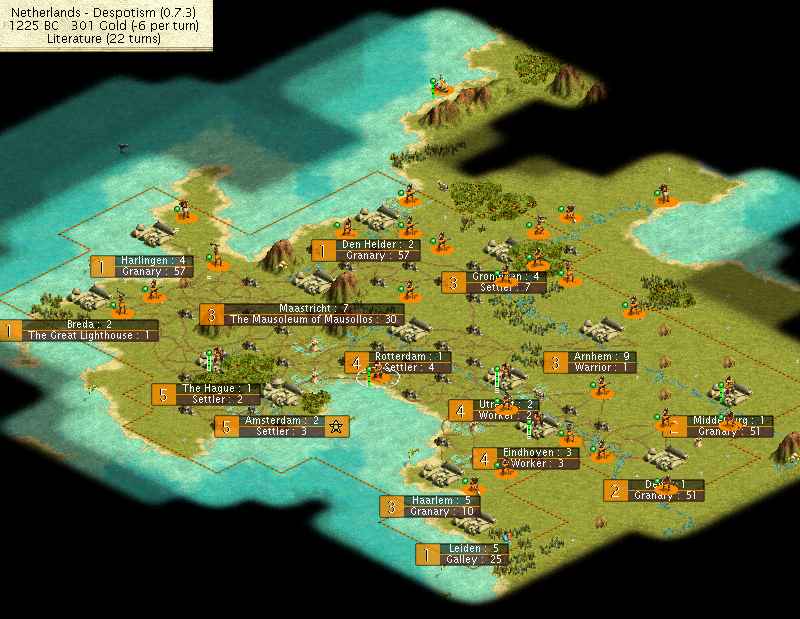
1225 BC: Jackpot! My Dutch are the first civ to get Philosophy. Better, we get a Scientific Great Leader!!! Since the Great Lighthouse has not been built yet, I take Map Making instead of Literature as my free tech and rush the Great Lighthouse. That’s a bit of a gamble since it could cause me to miss the Great Library, but depending on the map and which AI would get the Great Lighthouse otherwise, getting it myself instead of letting an AI get it could be a real game-breaker.
By the way, if I did things right, I snagged a copy of my autosave from the turn before I got the SGL. Thus, it would probably be possible to experiment with using the SGL in some other way (for example, to build the Great Library immediately).
Attachment: bc 1225 philosophy and sgl.jpg
This has been downloaded 230 time(s).
|
|
| |
|
|
|
nbarclay
|
|
Huntsville, Alabama
Dec 1999
time: 23:35
|
|
1200 BC: Lauwersoog founded. The Dutch are now second in Productivity, third in GNP, and sixth in Mfg. Goods. In the AIs’ turn, word arrives that the Arabs have completed the Temple of Artemis and that Egypt has completed the Great Wall (probably in a cascade). That indicates that I’m way behind the leading AIs in the tech race (aside from my branch lead in Philosophy if it still holds), but it reduces the danger of losing the Great Library to a wonder cascade.
1175 BC: Enschede founded.
1150 BC: Tilburg and Zwolle founded.
1100 BC: Gouda founded. My curraugh spots the Zulus’ borders but does not yet have contact.
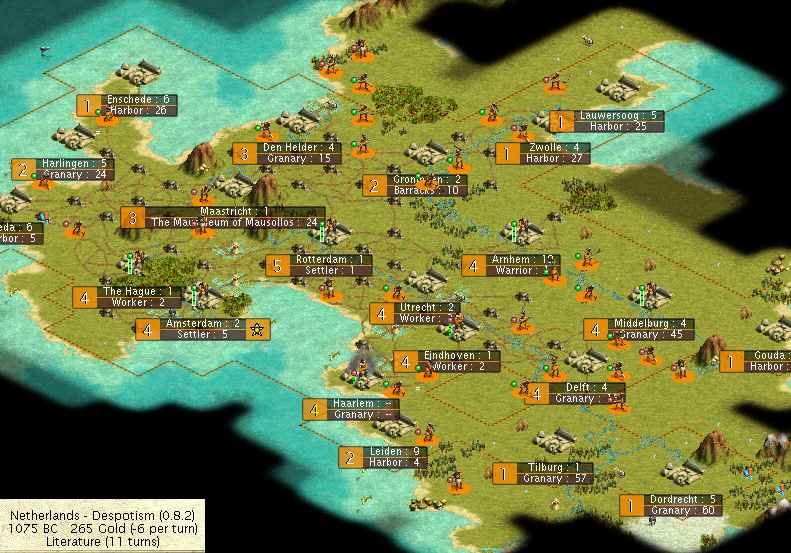
1075 BC: Dordrecht founded. We are now third in GNP, fourth in Mfg. Goods, and first in Productivity. Contact is established with the Zulus, who turn out to be a monster with ten percent of the total world area and sixteen percent of the population (versus my six and ten percent). They have all the techs we do, but do not have Code of Laws or Literature yet. We’ll probably have as much land as the Zulus when we finish REXing, so we may catch up eventually.
We’re now showing second in Literacy, implying that an AI may have Literature. With only 61 shields on my prebuild thus far it in what is now a relatively small town (Maastricht), I probably don’t have a chance if an AI starts it quickly in a high-production city. Still, I’ll give it my best shot, hoping that diverting three of my settler pumps to workers, adding workers to the city, and mining and roading a gold mountain beside the city can provide enough production.
Attachment: bc 1075 zulus met.jpg
This has been downloaded 233 time(s).
|
|
| |
|
|
|
nbarclay
|
|
Huntsville, Alabama
Dec 1999
time: 23:35
|
|
1050 BC: Leerdam founded.
1025 BC: Hilversum founded. We’re back down to fifth in Mfg. Goods and second in productivity but still third in GNP. (Corruption is ruining the more distant cities under Despotism, so the fact that the AIs are mostly finished REXing and we aren’t hurts in the short term.) We’re now showing first in Literacy again (about seven or eight turns from Literature), so I’m not quite sure what’s going on..
1000 BC: Roosendall founded. I’m now up to third in both GNP and Mfg. Goods (thanks in part to pumping up my Great Library city with a couple more workers), but still second in Productivity. I make contact with Egypt, which is even bigger than the Zulus with 11 percent of the world’s land area and a whopping 21 percent of its population. Egypt has neither Philosophy nor Map Making, and judging from what they’re willing to offer, they aren’t close to getting either. But F7 indicates that they are working on the Hanging Gardens, and if more than one civ is working on that wonder, there is a danger of a cascade to the Great Library.
950 BC: Holwerd founded. I’m now second in GNP and Productivity and third in Mfg. Goods. Adding two more workers takes Maastricht to size 10, forcing me to push the luxury slider up to 40 percent.
925 BC: North Lake and East Cove are founded; I’ve run out of names included in the game.
900 BC: Maastricht is boosted to size 12 with the addition of two more workers, and the luxury slider boosted to 50% to compensate. With a mine scheduled to complete this turn, it should stabilize at 22 gross and 18 net shields, which would put completion of the Great Library in about 14 or 15 turns. This is going to get very expensive if I miss!
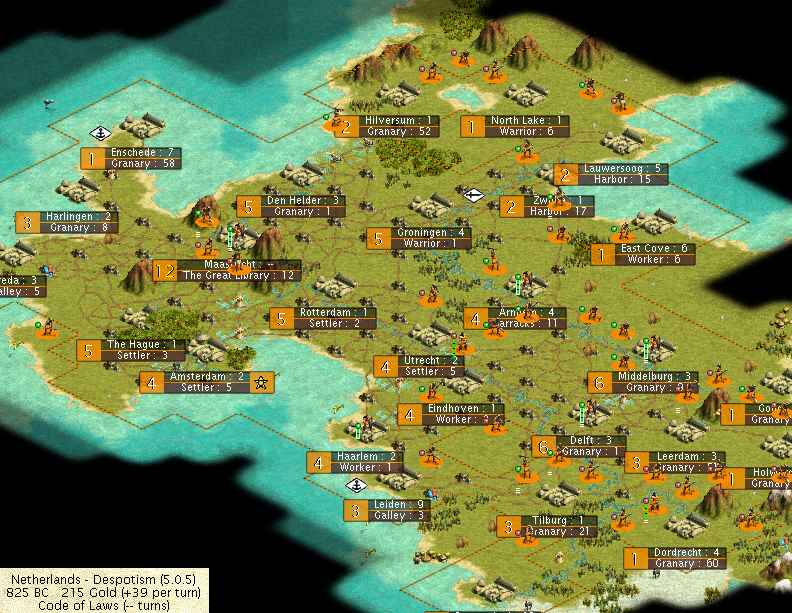
825 BC: The Dutch discover Literature and change the Forbidden Palace (originally Mausoleum of Mausollos) prebuild to the Great Library, which can be completed in twelve turns if an AI doesn’t build it first.
Attachment: bc 825 literature discovered.jpg
This has been downloaded 235 time(s).
|
|
| |
|
|
|
nbarclay
|
|
Huntsville, Alabama
Dec 1999
time: 23:35
|
|
800 BC: I switch a fourth pump city from workers to settlers. A sixth pump just went online after taking the better part of forever to build its granary, but two of the pumps can only handle workers due to corruption and a shortage of bonus grasslands. In the AIs’ turns, Egypt completes the Hanging Gardens and the Hittites the Mausoleum of Mausollos. If an AI was ready to cascade to the Great Library that turn, I’m in trouble. If not, I’ll get the Great Library.
750 BC: The first Dutch galley is ready at long last. A second will follow a turn later.
730 BC: Gold Mountain founded.
710 BC: West Point founded. I’m now second in Mfg. Goods, although that could possibly be a blip from someone’s changing to Monarchy. Egypt is way ahead of me, with a quarter of the world’s population and 13 percent of its land to my fifteen and eight percent). But a lot of that is because they finished REXing long ago and I’m still busy with my REX.
690 BC: Gametown founded. I find that as I’d feared, the founding of West Point disrupted the ranks of some other cities and ruined one of my worker pumps. (Concern about that possibility kept me from building it sooner.) I’ve about decided that once the Great Library is built, I’ll build down the size of Maastricht (which I’ll need to do to avoid starvation when I change governments anyhow) and do a free palace jump to around the middle of the continent. With my focus on REXing, my only improvement in Amsterdam is a granary anyhow.
670 BC: Sweet Valley founded amidst a few sugar tiles. I’m back down in third in Mfg. Goods.
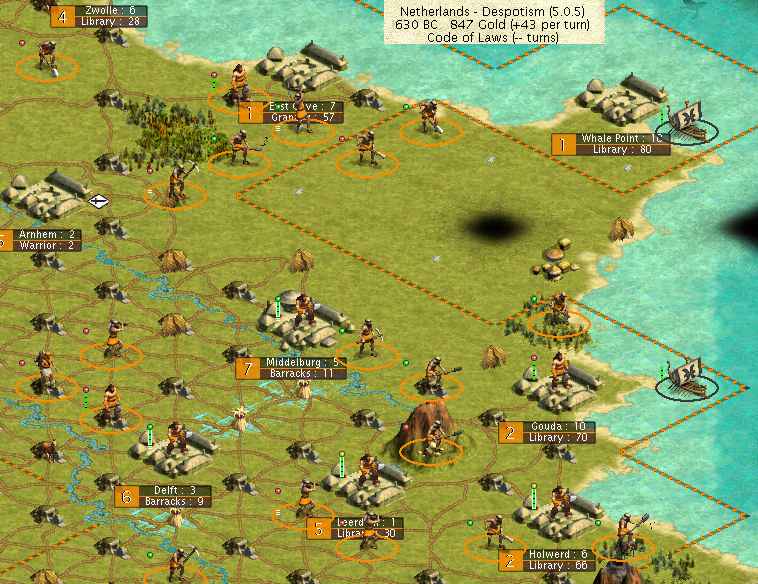
630 BC: Whale Point is founded. Two Zulu galleys appear off the east coast, pushing me into trading Literature to the Egyptians and Zulus to get the military techs through Iron Working and Horseback Riding. I also divert all of my pump cities except Amsterdam to build barracks. My only land forces thus far are fourteen warriors, mostly regular, originally built as MPs. So I really hope the Zulus are just trying to poach some city sites on my land mass rather than trying to start a war. The really annoying thing about the timing is that the Great Library is just three turns from complete. That would have let me get the techs without giving up Literature, although at least I got a bit over 200 gold as part of the deals.
Fortunately, I have two horse supplies already connected and an iron supply I can divert three workers to move to immediately and start roading. So I’ll be able to come up with some decent troops once I get my priorities switched.
---
And that's where I left off for the time being. I'll let you know what happens when I start playing again. I hope people don't mind if I want to play this out a bit farther before I start posting saves for others to experiment from.
Note that this image is from during the turn. I founded Whale Point (which I'll have to immediately abandon if the Zulus unload troops outside it) during the turn, and also moved a few warriors who had been on MP duty around and changed a bunch of build orders.
Attachment: bc 630 zulus off the coast.jpg
This has been downloaded 235 time(s).
|
|
| |
|
|
|
Mountain Sage
|
|
nbarclay,
I strongly believe that your better rexxing is due to the fact that you did not build any MP and curraghs at the beginning, and that you started settlers as soon as possible, without waiting for the city to reach size 4 (and having a 4-5 turns pump).
Of course, you did not build those 3 galleys or 5 curraghs to block the Zulus...
Any thoughts?
|
|
| |
|
|
|
lmtoops
|
 |
Dallas, Texas
Mar 2002
time: 23:35
|
|
quote:
Originally posted by nbarclay
1225 BC: Jackpot! My Dutch are the first civ to get Philosophy. Better, we get a Scientific Great Leader!!! Since the Great Lighthouse has not been built yet, I take Map Making instead of Literature as my free tech and rush the Great Lighthouse. |
Good move!  This was a bit of a gamble, but a worthy gamble. This was a bit of a gamble, but a worthy gamble.
I will be posting my experience, but not in such detail. In my case, I build the Gr. Library quite easily. I expected a race to the GL, but it never materialized. I guess the AI does not place much importance with the GL part of the tech tree. Also, there must not be much contact between the AI civs (minimal tech trading).
My point is (yes there is one  ), I think you will get the GL with no problem. So two early Wonders, is a huge accomplishment. ), I think you will get the GL with no problem. So two early Wonders, is a huge accomplishment.
|
|
| |
|
|
|
lmtoops
|
|
Dallas, Texas
Mar 2002
time: 23:35
|
|
quote:
Originally posted by Mountain Sage
nbarclay,
I strongly believe that your better rexxing is due to the fact that you did not build any MP and curraghs at the beginning, and that you started settlers as soon as possible, without waiting for the city to reach size 4 (and having a 4-5 turns pump).
Of course, you did not build those 3 galleys or 5 curraghs to block the Zulus...
Any thoughts? |
I did build warrior MP due to a fear of AI neighbors, which never materialized. Plus, when I determined the minimal lux. resources on our island, I need them for happiness.
If we shared the island with AI, I think an agressive AI (Zulu, Egypt) would have quickly declared war.
In my game, I did have a strange Zulu war...but I'll save that for my game post. I'll probably post my game experience tonight (ahh about 10 hrs from now).
|
|
| |
|
|
|
nbarclay
|
|
Huntsville, Alabama
Dec 1999
time: 23:35
|
|
quote:
Originally posted by Mountain Sage
nbarclay,
I strongly believe that your better rexxing is due to the fact that you did not build any MP and curraghs at the beginning, and that you started settlers as soon as possible, without waiting for the city to reach size 4 (and having a 4-5 turns pump).
Of course, you did not build those 3 galleys or 5 curraghs to block the Zulus...
Any thoughts? |
My early start on settlers and granaries was only part of the story. Chopping and irrigating the game forest by my capital gave me a settler/worker pump that you didn't have, and using three chops to help Utrecht get a granary online faster gave me a fourth +5 food pump city in 1750 BC (although it took the city just a little longer to grow enough to become a full-scale worker pump). Those extra pumps gave my early focus on settlers, workers, and granaries a powerful exponential effect. Indeed, comparing my game with your first attempt where you used a good potential pump city for a prebuild, I outnumbered you in pump cities four to one.
Your maneuver of blocking off the Zulus with curraughs was brilliant, and I would have saved myself a very serious headache if I'd thought of it. (With the Great Lighthouse, I didn't even know whether the Zulus could reach me because I took a route through mostly sea and ocean to find them.) But (and please take this as constructive criticism) you could have accomplished that without starting curraugh production nearly as early, and thus without slowing down your REX nearly as much.
One option would be to have Amsterdam start off as a settler/worker pump and then, once the settlers and workers for the other main pump cities are ready, shift to building a mix of 2-turn curraughs interspersed with 1-turn workers whenever it grows big enough. I'd also want a granary before curraugh production to get more of those 1-turn workers; the granary will be needed when the city goes back to settler/worker pump mode anyhow, so it's not wasted production. That would almost certainly provide enough curraughs in time, and the other settler/worker pump cities would still provide a very strong REX.
Another approach might be to add workers from settler/worker pump cities to a lower-production coastal city or two as a way of setting up productive shipyard cities relatively quickly. The problem is, for a settler/worker pump city, building a worker to add to another city costs as much time as building a curraugh. That leaves me a bit skeptical as to whether building workers to add to cities to build curraughs would really be more efficient than building curraughs directly. I'd have to conduct a more detailed analysis than I'm in a mood for at the moment to figure that out.
By the way, I assume you realize that your blockade only works as long as you give in to whatever demands the Zulus make. I doubt that the Zulus would start a war with an attack on a ship; AIs seem to like to have troops sitting right outside a city when they declare. But if a war starts over a rejected demand, ships become a perfectly legitimate target.
Nathan
|
|
| |
|
|
|
nbarclay
|
|
Huntsville, Alabama
Dec 1999
time: 23:35
|
|
quote:
Originally posted by lmtoops
I did build warrior MP due to a fear of AI neighbors, which never materialized. Plus, when I determined the minimal lux. resources on our island, I need them for happiness. |
My operating theory was that the increased risk of losing early if I didn't build MPs and an AI attacked me would be offset by the increased chance of winning if an AI left me alone long enough to build at least a few cities. Since my goal was to win, and I had no interest in just playing to survive as long as possible in a losing effort, going without an early military seemed like my best chance even if I had a neighbor.
Regarding the happiness function of MPs, I don't regard it as woth slowing down a REX significantly for. With 50-turn research, saving a notch or two on the luxury slider has no impact at all on research speed, and the impact on gold accumulation isn't all that big either. In contrast, REXing as quickly as possible means more and larger cities later on, and more and larger cities mean more income. Unless I'm afraid an AI will snatch a luxury away from me, I also prioritize high-growth cities over early access to luxuries for much the same reasons.
Nathan
|
|
| |
|
| |
|
| |
|
|
|
ErikM
|
|
quote:
Originally posted by nbarclay
Any idea what the peace terms would be likely to be like if I would capture or destroy a Zulu city and then make peace before anything much else happens? They'll certainly have a much bigger military than I do. On the levels I normally play, getting peace on even or favorable terms wouldn't be a problem under such circumstances. But since this is my first game on Sid, I don't know what to expect. |
It's the same thing. It seems that you need to pay more for peace if you do not have a positive war score - but it may be simply because they are relatively more powerful militarily on Sid than on Emp/Deity. Once you capture/destroy some of their cities, they will be willing to pay for peace even if they can kill you.
Another thing is that they will be less likely to part with their technology again, this is simply because tech is so much more expensive on Sid. OTOH, they will often have more money to pay due to bigger cities and income from tourist attraction wonders.
|
|
| |
|
| |
All times are GMT. The time now is 05:35.
Apolyton Time is 00:35. |
top of page
|
|
|
Forum Rules:
You may not post new threads
You may not post replies
You may not post attachments
You may not edit your posts
|
HTML code is ON
vB code is ON
Smilies are ON
[IMG] code is ON
|
|
|
|
|
|






 04-04-2004 11:20


 ?)
?)


 |
|