|
Flinx
|
 |
Toronto, ON CANADA
Nov 2001
time: 00:35
|
|
quote:
Originally posted by GeneralTacticus
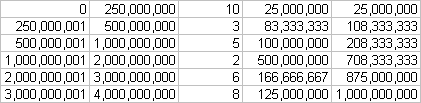
No, that's not it. The idea is that you divide the population up into segments of whatever, say 100 million. You then divide the first segment by, say, 2, the second one by 3, the third one by 4, etc. Thus someone with 100 million people would be considered to have 50 million, while someone with 200 million would be consider to have 83 million, someone with 400 million to have 108 million, etc.
EDIT: Now that I look at it, you almost had it, you just didn't express it very well. |
NS Pop |
Divisor |
Modified Pop |
100,000,000 |
2 |
50,000,000 |
200,000,000 |
3 |
83,333,333 |
300,000,000 |
4 |
108,333,333 |
400,000,000 |
5 |
128,333,333 |
500,000,000 |
6 |
145,000,000 |
600,000,000 |
7 |
159,285,714 |
700,000,000 |
8 |
171,785,714 |
800,000,000 |
9 |
182,896,825 |
900,000,000 |
10 |
192,896,825 |
1,000,000,000 |
11 |
201,987,734 |
1,100,000,000 |
12 |
210,321,068 |
1,200,000,000 |
13 |
218,013,376 |
1,300,000,000 |
14 |
225,156,233 |
1,400,000,000 |
15 |
231,822,899 |
1,500,000,000 |
16 |
238,072,899 |
1,600,000,000 |
17 |
243,955,252 |
1,700,000,000 |
18 |
249,510,808 |
1,800,000,000 |
19 |
254,773,966 |
1,900,000,000 |
20 |
259,773,966 |
2,000,000,000 |
21 |
264,535,870 |
2,100,000,000 |
22 |
269,081,325 |
2,200,000,000 |
23 |
273,429,151 |
2,300,000,000 |
24 |
277,595,818 |
2,400,000,000 |
25 |
281,595,818 |
2,500,000,000 |
26 |
285,441,972 |
2,600,000,000 |
27 |
289,145,675 |
2,700,000,000 |
28 |
292,717,104 |
2,800,000,000 |
29 |
296,165,380 |
2,900,000,000 |
30 |
299,498,713 |
3,000,000,000 |
31 |
302,724,520 |
3,100,000,000 |
32 |
305,849,520 |
3,200,000,000 |
33 |
308,879,823 |
3,300,000,000 |
34 |
311,820,999 |
3,400,000,000 |
35 |
314,678,142 |
3,500,000,000 |
36 |
317,455,920 |
3,600,000,000 |
37 |
320,158,622 |
3,700,000,000 |
38 |
322,790,201 |
3,800,000,000 |
39 |
325,354,304 |
3,900,000,000 |
40 |
327,854,304 |
4,000,000,000 |
41 |
330,293,328 |
|






 16-07-2004 10:50


 )
)


 Attachment:
  Question, Flinx: What is in each of those columns in your image? I presume the 10, 3, 5, 2, 6, 8 column contains the dividing factors?

 |
|