|
| |
|

|
molly bloom
|
 |
Lundenwic
Oct 2001
time: 15:35
|
|
quote:
Originally posted by MarkG
where is this quote from?
a page about some inscriptions for which there is no single image(yet there are terrible translations of them!) and who's author isn ex-mormon not-ex-gay (how's that for a suprise?)  |
The Herakles quote is taken from a Wikipedia article, itself extracted from 'Herakles in Trachis', part 143 of Vol. Two of Graves's Greek Myths, the sources given as being Diodorus Siculus, Probus, and Scholiast on Apollonius Rhodius.
As for your second statement, so what?
In any case, here's Robert Graves's from his 'Greek Myths', specifically 'The Madness of Herakles':
'....Many friends came to solace him in his distress; and, finally, when the passage of time had somewhat alleviated his pain, he placed himself at Eurystheus's disposal.
Some however, hold that it was not until his return from Tatarus that Herakles went mad and killed the children; that he killed Megara too; and that the Pythoness then told him:
'You shall no longer be called Palaemon! Phoebus Apollo names you Herakles, since from Hera you shall have undying fame among men!' -
as though he had done Hera a great service. Others say that Herakles was Eurystheus's lover, and performed the Twelve Labours for his gratification...'
Sources: Euripides's 'Herakles', Tzetzes 'On Lycophron' and Diotimus's 'Heraklea', as quoted by Athenaeus
Notes:
Herakles's homosexual relations with Hylas, Iolaus, and Eurystheus, and the accounts of his luxurious armour, are meant to justify Theban military custom. In the original myth, he will have loved Eurystheus's daughter, not Eurystheus himself.'
Robert Graves, 'The Greek Myths', Vol. II, Part 122, 'The Madness of Herakles' pp101-103
There's also Herakles's gifting of the city of Messene to Nestor, who 'he came to love more than Hylas and Iolaus', Nestor being the first to swear an oath by Herakles.
|
|
| |
|
|
|
Pax
|
|
Troy is a good movie. Brad Pitt is a good actor. Why is it that Shakespeare gets modified all the time and everyone is okay with that but any other adaptation gets reamed?
|
|
| |
|
|
|
Pax
|
|
Did anyone else see the movie as an antiwar movie.
|
|
| |
|
|
|
lord of the mark
|
 |
FUKCOV - Former United Kingdom Colony of Virginia
Dec 2000
time: 00:35
|
|
quote:
Originally posted by The Emperor Fabulous
I can't ever imagine a story being passed down these days like that. I mean, imagine if France walked into Britain and completely ransacked the entire country. It had been a country of brave warriors, some of the best of their time. Then only like 1,000 or so people survived, and went on to found the United States. Thus, the U.S. is created by a bunch of losers who got their asses whooped.
Somehow, I can't ever imagine that. We'd be ashamed to even suggest that we were descended from losers.
|
Lets see - Puritans fleeing Charles 1, whose fellow puritans in england saw their Commonwealth give in to a restored Stuart Monarchy. Check
Lots of impoverished, displaced Scots Irish. Check.
Highland Scots after Culloden. Check.
Unemployed Londoners coming as indentees. Check
Convicts. Check.
Mennonites and other Germans fleeing the chaos of Germany went it was the battleground for bigger powers. Check.
Refugees from the Irish Famine. Check.
Sicilians and South Italians, losers during the Risorgimentio, fleeing poverty. Check.
Jews. Check.
South Viet Namese. Check.
Yup, we WERE settled to a very consdierable extent by "losers". But losers who didnt give up, who had the courage to start over. Kinda reminds one of the Aeneid, no?
|
|
| |
|
|
|
molly bloom
|
|
Lundenwic
Oct 2001
time: 15:35
|
|
quote:
Originally posted by MarkG
who is Graves?
give me some url's to actual quotes from ancient greek writers(instead of a guy who says Heracles was bi according to anonymous "others" ) and then we can discuss |
Robert Graves:
http://www.kirjasto.sci.fi/rgraves.htm
Why on earth should I do your homework for you?
I don't see how Diodorus Siculus or Apollonius of Rhodes are 'anonymous' if they've been named as sources.
You strike me as being like the drowning Egyptian- up to his eyes in denial:
'The feature of Athenian sexual life that may appear most different from our arrangements is the practice of homosexual relationships between an adult male and an adolescent boy.
In the past this topic was rigorously avoided, due to the
operation of a specious syllogism: the Greeks are a good thing; homosexuality is a bad thing; therefore the Greeks could not have done it. These wretched evasions about 'the love that dare not speak its name' (Alfred Douglas) led to Mahaffy's book 'Social Life in Greece from Homer to Menander' (1874)
being withdrawn because it treated (and condemned) male homosexuality; they also led the Dean of a Cambridge college in E.M. Forster's novel 'Maurice' (published only in 1970) to tell a student who is translating from an unnamed Greek author:
'Omit: a reference to the unspeakable vice of the Greeks'.
Now we know better. A crucial moment was the
publication in 1978 of Sir Kenneth Dover's great book 'Greek Homosexuality', illustrated with pictures of vase-painting that leave no doubt about the reality of sexual relationships between Athenian men and adolescent boys.
A further important moment was the publication of Volumes 2 and 3 of Michel Foucault's 'History of Sexuality: The Uses of Pleasure' (1984) 'The Care of the Self' (1986). Foucault, who divorced sexuality from nature and regarded it as cultural production,
raised crucial issues:
(1) how is sexual experience constituted in a given
culture, i.e. what are the actual types of sexual activity?
(2) in what terms - terms of power or equality - is sexual experience constructed?
(3) how does sexual experience relate to other forms of
experience, to political, social, and economic experience?
(4) is sexual activity different for different members of
society, for men and women, for members of different social classes? '
http://www.soci.niu.edu/~phildept/Dye/AthenianSex.html
http://www.sas.upenn.edu/~ekondrat/...#ancientsources
Political, social and sexual power for the Ancient Greeks resided in the male body, more specifically, the free male adult body- everything and everyone else was subservient to it, be it their wives, the hetairai, or the adolescent boys (as personified by Hylus and Iolaus/Iolaos, both of whom are significantly shown to be younger than Herakles, or Ganymede, chosen by Zeus to be his cup bearer because of his beauty).
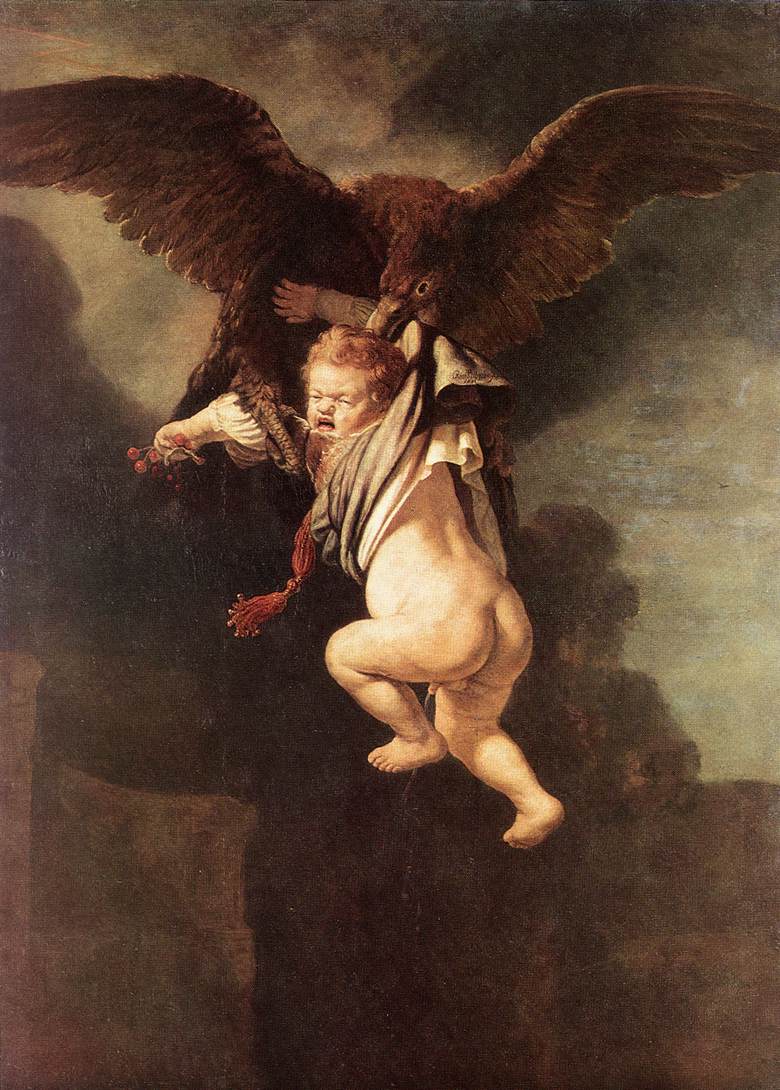
Exactly why you think Herakles can't be believed to have had same sex experiences, when the myth of his father Zeus and Ganymede is reasonably well known and depicted (Rembrandt's painting of the abducted boy, pissing himself in fright in mid-air), is a mystery to me.
http://en.wikipedia.org/wiki/Ganymede_(mythology)
 Attachment: ganymede.jpg Attachment: ganymede.jpg
This has been downloaded 91 time(s).
|
|
| |
|
|
|
molly bloom
|
|
Lundenwic
Oct 2001
time: 15:35
|
|
quote:
Originally posted by lord of the mark
Odd, Tipper Gore and Pat Robertson are both Southerners, and Dworkin is IIUC of eastern european Jewish descent. None descended from New England Calvinists.
Its amazing how America is villified for being the font of hedonistic culture, and at the SAME time is villified for puritanism. Villified for Rap music, AND villified for Tipper Gore.
Reminds me of how the Jews have been villified for being capitalists, and for being socialists. |
Not odd at all, given that theories of racial aristocracy that underpinned the Confederacy can be traced back to Protestant settlers in New England (not all of whom were Calvinists- some Puritans were, and some weren't, Calvinists).
It seems entirely natural to me that people vilify that which they disagree heartily with and consider to be dangerous- it is by no means the same people who vilify rap music on the one hand, and the antisex antifreedom movements exemplified by the likes of Robertson, Wildmon and Dworkin (whose Judaism, practising or not, has nothing to do with her 'Puritanism').
By the Eighteenth Century, in any case, Puritanism itself had given birth to two distinct (and to some extent) opposed, philosophies:
the evangelical, finger wagging browbeaters, and the rationalists and precursors of the Unitarians.
So one philosophy, or way of life, can ultimately engender both the A.CL.U. and libertarianism, Jerry Falwell and Tipper Gore.
Samuel Willard, minister of the Third Church in Boston, on reading an attack on the government of Masschusetts Bay, by the colony of Anabaptists in Charlestown:
(they had justified their congregation and colony by citing the example of the first settlers, claiming a similar flight from persecution into exile and safety)
'I perceive they are mistaken in the design of our first Planters, whose business was not Toleration; but were professed Enemies of it, and could leave the World professing they died no Libertines. Their business was to settle, and (as much as in them lay) secure Religion to Posterity, according to that way in which they believed was of God.'
Ne Sutor ultra Crepidam, Boston, 1681
|
|
| |
|
| |
|
|
|
molly bloom
|
|
Lundenwic
Oct 2001
time: 15:35
|
|
quote:
Originally posted by Imran Siddiqui
[
I must disagree greatly. The ideas of racial aristocracy were entrenched in the Anglican South well before they were united or even shared much correspondance with the Puritans up north. And IIRC, the Puritans were members of the Reformed Church (Calvinists) and that was the reason they were forced to leave England, who didn't tolerate that kind of stuff. |
And disagreeing, you would be greatly wrong.
The Puritans were originally of the Anglican communion, the Anglo-Catholic Church. What they objected to, were what they saw as the remnant aspects of Catholicism which were defiling the faith. Hence the 'purifying' in Puritanism.
Puritanism was, in origin, the movement within the Anglican Church that believed that the 'reforms' instituted by Henry VIII, Cranmer and Edward VI should be continued and the Church of England restored to the 'pure' state of the Church as established by Christ in the first century.
The Puritans who settled in New England were by no means even the most radical representatives of these beliefs, as the Diggers and Levellers in the English Commonwealth were to prove. Many Puritans insisted on their loyalty to the established institutions, and their patriotism was as great as that of any Englishman who had remained in England- the common enemies of the High Church Anglicans and the Puritan Anglicans were still the Papacy, Spain and to a lesser degree, the rising power of France.
http://www.seadinternational.com/harvest/radnor1.htm
As to Anglican origins of racism- you're barking up the wrong tree.
1609:
"by what right or war-rant can we enter into the land of these Savages, take away their right-full inheritance from them, and plant ourselves in their places, being unwronged or unprovoked by them?
By this right, evidently:
Samuel Purchas: "God in wisedome ... enriched the Savage Countries, that those riches might be attractive for Christian suters, which there may sowe spirituals and reape temporals."
Viginia, 1622:
'Our hands, which before were tied with gentleness and faire usage, are now set at liberty by the treacherous violence of the Savages so that We may now by right of Warre and law of Nations invade the Country, and destroy them who sought to destroy us .... Now their cleared grounds in all their villages, (which are situate in the fruitfullest places of the land) shall be inhabited by us, whereas heretofore the grubbing of woods caused us the greatest labour.'
Edward Waterhouse:
'[the Indians are]... by nature sloath-full and idle, vitious, melancholy, slovenly, of bad conditions, lyers, of small memory, of no constancy or trust…by nature of all people the most lying and most inconstant in the world, sottish and sodaine, never looking what dangers may happen afterwards, lesse capable then children of sixe or seaven years old, and less apt and ingenious ....'
Samuel Purchas, 1625 [describing Virginia's Indians]
"bad people, having little of Humanitie but shape, ignorant of Civilitie, of Arts, of Religion; more brutish then the beasts they hunt, more wild and unmanly then that unmanned wild Countrey which they range rather than inhabite; captivated also to Satans tyranny in foolish pieties, mad impieties, wicked idleness, busie and bloudy wickednesse .....
John Winthrop 's journal: [of the 1617 plague amongst the Indians]
[the Indians] "are neere all dead of the small Poxe, so the Lord hathe cleared our title to what we possess."
A remarkable contrast to the proselytising attitude of the Spanish.
In one engagement, 500 Pequot men, women, and children in Mystic Fort were burnt to death by Puritan forces:
" (God) ...had laughed at his Enemies ... making them as a fiery oven…Thus did the Lord judge among the Heathen, filling the Place [the fort] with dead bodies."
It's of interest that the Quakers, persecuted by the mainsteam Puritans, not only had a better opinion of the Indians, but signifcantly better dealings with them.
Robert Gray, A Good Speed to Virginia (London, 1609), in Wesley F. Craven, "Indian Policy in Early Virginia," William and Mary Quarterly, Third Series, I (1944) p. 65.
Samuel Purchas, Hakluytus Posthumus, or Purchas His Pilgrimes (20 vols.; Glasgow, 1905-1907), XIX, p. 232.
Edward Waterhouse, A Declaration of the State of the Colonie and Affaires in Virginia (London, 1622), in Susan M. Kingsbury, ed., The Records of the Virginia Company of London (4 vols.; Washington, D.C., 1906-1935), III, pp. 556-557.
Kingsbury, The Records of the Virginia Company of London, III, pp. 562-563.
John Mason, A Brief History of the Pequot War (Boston, 1736), in Alden T. Vaughan, New England Frontier: Puritans and Indians, 1620-1675 (Boston, 1965), p. 145.
William Penn, A Letter to the Free Society of Traders... (London, 1683), in Albert C. Myers, ed., Narratives of Early Pennsylvania, West New Jersey and Delaware (New York, 1912), pp. 230, 234.
In fact wasn't it in South Carolina (amongst the old original colonies) that interracial (black and white) marriage was last outlawed? The presence of fewer white women and proportionately more black women had led to a greater laissez faire 'acceptance' of interracial relationships in the more southerly colonies than in the more northern colonies.
The Puritans thus elaborated their superiority to the natives by several methods- their mission was a godly mission, ergo, it was God's will, as shown by his visiting pestilences upon the natives. The natives were not the same colour as the Puritans, nor were they as 'civilized' therefore they did not 'deserve' the land. They were barely human, or incapable of being civilized, therefore the sticky problem of having large numbers of Christianized natives taking up land that could be used by potential godly colonists, could also be solved.
These people considered themselves God's elect, establishing the New Jerusalem on earth- they didn't need 'scientific' racism.
|
|
| |
|
|
|
Imran Siddiqui

|
 |
The Potterverse
Jan 1970
time: 00:35
|
|
http://www.puritansermons.com/banner/hulse1.htm
quote:
During the pre-Reformation time grace and nature were separated. This is the concept of a two storey universe. Upstairs is spiritual and holy. Downstairs is sinful, fleshly and unholy. For example the clergy were forbidden to marry as though marriage were earthly and therefore sinful. Luther partly reformed this and brought grace alongside nature. For example he married an ex-nun, Katherine. John Calvin went further and taught that grace must permeate nature. The earthly must be sanctified by the heavenly. The Puritans went further still and taught in more detail than Calvin that biblical principles must be applied to every aspect of life. |
quote:
For instance John Bunyan was a Baptist firmly in the Puritan tradition just like Reformed Baptists today. We see how close the Reformed Baptists are to the Presbyterians (the children of John Calvin) when we compare the 1689, 2nd London Baptist Confession of Faith with the Westminster Confession. 28 out of 32 chapters are virtually the same. These Confessions of Faith represent the high water mark of Puritanism. The English Puritans followed Calvin's example in being involved in all aspects of life. |
quote:
Why are the Puritans effective in teaching Reformed theology whereas so many others fail? The answer is that the spiritual genius of the Puritans lay in their being men of prayer. |
quote:
The Puritan work ethic became famous. It is called the Protestant work ethic. |
('Protestant Work Ethic' actually standing for Calvinist - their believe system fits the idea of a Protestant Work Ethic the neatest)
http://www.puritansermons.com/aboutprt.htm
quote:
The texts of the Westminster Confession, Catechisms, and Summary of Saving Knowledge may be found at Reformed Theology Resources (CRTA) in their Historical Documents section. Some documents from the Congregational Churches are found there as well. |
http://www.gty.org/~phil/puritans.htm
quote:
The Puritans were English Reformers of the sixteenth and seventeenth centuries. They were frustrated by the slow progress of the Reformation in the Anglican Church. They left a legacy of theological writing that is unsurpassed in church history. Their doctrine tended to be Calvinistic and Presbyterian, and their finest writings were both polemic and devotional treatments of theology. |
Puritans were also big on predestination, which just wouldn't work in the Anglican Church.
--
Also racial aristocracy does seem to imply some internal aristocracy as well. If you mean that they believed in a layering of races, then just about every Christian religion believed that. If you talked about internal aristocracy, then it wouldn't apply to the Reformed Church, who considered all people in the church as equals.
|
|
| |
|
|
|
lord of the mark
|
|
FUKCOV - Former United Kingdom Colony of Virginia
Dec 2000
time: 00:35
|
|
quote:
Originally posted by molly bloom
Not odd at all, given that theories of racial aristocracy that underpinned the Confederacy can be traced back to Protestant settlers in New England (not all of whom were Calvinists- some Puritans were, and some weren't, Calvinists).
It seems entirely natural to me that people vilify that which they disagree heartily with and consider to be dangerous- it is by no means the same people who vilify rap music on the one hand, and the antisex antifreedom movements exemplified by the likes of Robertson, Wildmon and Dworkin (whose Judaism, practising or not, has nothing to do with her 'Puritanism').
By the Eighteenth Century, in any case, Puritanism itself had given birth to two distinct (and to some extent) opposed, philosophies:
the evangelical, finger wagging browbeaters, and the rationalists and precursors of the Unitarians.
So one philosophy, or way of life, can ultimately engender both the A.CL.U. and libertarianism, Jerry Falwell and Tipper Gore.
Samuel Willard, minister of the Third Church in Boston, on reading an attack on the government of Masschusetts Bay, by the colony of Anabaptists in Charlestown:
(they had justified their congregation and colony by citing the example of the first settlers, claiming a similar flight from persecution into exile and safety)
'I perceive they are mistaken in the design of our first Planters, whose business was not Toleration; but were professed Enemies of it, and could leave the World professing they died no Libertines. Their business was to settle, and (as much as in them lay) secure Religion to Posterity, according to that way in which they believed was of God.'
Ne Sutor ultra Crepidam, Boston, 1681 |
1. we were talking about censorship and puritanism, not racism. Really, its very hard to have an intelligble discussion when one keeps bringing up new subjects.
2. Yes, I know the people who complain about the rap music et al arent the same as the ones who complain about american puritanism et al. To some extent that applies to the analogy i make about antisemitic complaints as well. It does point, I think to some serious issues on the part of the complainers, and a hint of where some of it is coming from.
3. Tipper Gore - I think youve got that lady wrong - you're following a charictature of her. I would like to see the citation where she calls for CENSORSHIP of anything. You may not agree with warning labels for records, but comparing her to Pat Robertson doesnt make you look insightful.
4. Wow, you recognize that New England Congregationalism had different offshoots, including some profoundly liberal ones. Very good.
Now will you also recognize that some of the 'puritanism' of Southern USA Protestants goes back to widespread conversion to Methodism in the late 18thc and to Baptism in the early 19thc, and has little relationship to New England Congregationalism? And is not even entirely related to Calvinism?
Youre referring back to quotes from the 17th century. Not the most enlightened age anywhere. Shall we start with the Revocation of the Edict of Nantes, say?
Look, the Puritan establishment lost its elan after the Salem trials, and the Andros rebellion, and New England has been one of the most enlightened places on the planet since.
|
|
| |
|
|
|
Anita Blake
|
|
I really loved the movie. It stuck closer to the epic poem then I thought that it would. Great action scenes, and nice shots of Orlando Bloom and Brad Pitt of the girls. The guy who played Odyseuss was great. (He was the guy who played boromir in LOTR).
|
|
| |
|
|
|
molly bloom
|
|
Lundenwic
Oct 2001
time: 15:35
|
|
quote:
Originally posted by Imran Siddiqui
Also racial aristocracy does seem to imply some internal aristocracy as well. If you mean that they believed in a layering of races, then just about every Christian religion believed that. If you talked about internal aristocracy, then it wouldn't apply to the Reformed Church, who considered all people in the church as equals. |
Imran, your original statement was that: ‘if you recalled, the Puritans were members of the Reformed Church’ , by which you meant to imply that the Puritans were of the Calvinist confession.
Attempting to buttress this incorrect assertion by showing that they shared elements of theology or doctrine with Calvin isn’t proof that the Puritans, either as a whole, or even a majority of them, subscribed to Calvin’s ‘Institutes’.
If this were the case, then given the shared points of doctrine in Lutheranism, Calvinism, and Roman Catholicism, we should expect to see perhaps a time sharing agreement for the throne of St Peter operating, or that because both the Borgia Pope and Calvin believed in the Trinity, that somehow, Alexander was a Calvinist, and John Calvin a Cardinal in the Vatican.
As I said, the origins of the Puritan movement lay in the English Church in the 1560s- a time, by the way, when the doctrine of predestination also held sway amongst the bishops of the Anglican Church, so I shouldn’t hold on to that piece of straw to rescue you.
The points of difference between the Puritan tendency (who were never of one persuasion, nor of one prescribed set of doctrines, by the way, as debates between Congregationalist and Presbyterian Puritans would tell you) and the more High Church tendency (as would later be exemplified by Archbishop Laud in the reign of Charles I), seem at a distance of three centuries to be minimal to us, but to the protagonists in the struggle to either reform the English church or to maintain the status post -Marian counter reformation, would eventually loom so large as to lead to the breach between the colonizers in New England and the Established Church in old England.
What you’re doing, as far as I can tell, is squeezing together time, so that some of what Puritanism would become in America in the later 17th and 18th Century (in the 1740s, in the ‘Great Awakening’) is being imposed upon the early colonists.
It is true that some of the settlers were Calvinist, not simply in sympathy, but in communion- the colony in Plimouth (settled by the Pilgrims) later absorbed by Massachusetts Bay Colony, was avowedly Calvinist, but unlike Massachusetts, which had been settled by those who wished to 'purify' the Anglican Church in England, Plimouth consisted of separatists who had already broken with the Church of England, and had been living in the Calvinist United Provinces.
Frankly your assertion that the Puritans as a whole were Calvinists really rather begs the question, what on earth were they meant to be purifying? The water supply in Geneva, or the canals of Amsterdam?
I could at length, list the areas of doctrinal agreement between the mainstream Anglican Church and the more radical Puritan tendencies (which is not to say that the colonizers in America were even the most radical- those were still in England), but suffice to say, your assertion is incorrect- Calvin’s philosophy was rooted in anti-rationalism and Aristotelianism, whereas the Puritans (along with a great many more ‘mainstream’ Anglicans) looked to the logic of Petrus Ramus (the French Protestant convert, Pierre de la Ramee) and humanist anti-scholasticism, for the underpinning of their religious thought.
That some of the Puritans believed they were elect is self-evident, not simply from their sense of mission, and their desire to establish theocracies in the New World, but also their zeal to purge the Established Church of what they saw as Romish tendencies, but this was not of necessity rooted in a shared communion with Calvin, but rather in their approach to the Bible.
I’d suggest you read William Bradford’s ‘History of Plimouth Plantation’ and the journal of John Winthrop.
I’d also like to see some evidence for your assertion of hierarchies of races in the 17th Century, more specifically in the works of Roman Catholic and Anglican theorists. You’re getting ahead of yourself by about a century and a half there.
What vexed and preoccupied the social theorists of the day was how someone should know their place, what constituted the ‘natural’ order of things, which was obviously of paramount importance, when you had a butcher’s son become Archbishop of Canterbury, or the son of a bricklayer become court poet to James I and VI- or when you had yeomen and country gentry and city merchants, executing their sovereign.
'we were talking about censorship and puritanism, not racism. Really, its very hard to have an intelligble discussion when one keeps bringing up new subjects.'
L o T M
Oh, I'm sorry, I thought we were talking about things that America had been vilified for- one of which was racism.
If you look at what some of the Puritans thought of their black slaves, their behaviour, their 'bestial' nature, you are only a short step away from the labels of 'jungle' music and the comment in Coppola's 'Godfather', that the Mafia could sell drugs to the blacks because 'they had no souls'.
I'm not comparing Tipper Gore to or with, Pat Robertson. I'm including her along with him, which isn't the same thing.
I don't by the way, trace censorious attitudes in American theology or philosophies back to Calvin, since if you'd read my posts you would have seen that Imran is the one under the impression that the Puritans wre all Calvinists, not me.
I don't really see why you'd bring Louis XIV's suppression of the toleration of the Calvinist Huguenot Church in France in 1685 (!) into the discussion, when a much better example would have been the Puritan settlers' execution of four Quakers (one a woman) on Boston Common, or the banishment of Anne Hutchinson-
"...madmen acting according to their frantick passions are to be restrained with chaines, when they can not be restrained otherwise."
John Norton, The Heart of N-England Rent at the Blasphemies of the Present Generation, Cambridge, 1659
|
|
| |
|
| |
|
|
|
molly bloom
|
|
Lundenwic
Oct 2001
time: 15:35
|
|
quote:
Originally posted by MarkG
molly bloom,
i asked for quotes on heracles (not generally about homosexuality in ancient greece) being bi and you end up justifying
it as an assumption(!) with quotes about athenians |
Well I gave you quotes on Herakles, which you then protested came from an author you hadn't heard of, and were attributed to anonymous sources (they weren't). So I thought I'd set the myths of Herakles in a social context.
Since I'm unaware of what your objections to the possibility of Herakles having had same sex relations are based on, I'm therefore endeavouring to discover what you think makes Herakles having male lovers impossible, or unlikely- that male heroes didn't have male lovers, that male gods didn't have male lovers, that pre-Christian Greek societies condemned same sex relations between males ?
Let's try Theocritus, 'Idyll 13', dedicated to Hylas (one of Herakles's non-existent male lovers....):
"We are not the first mortals to see beauty in what is beautiful. No, even Amphitryon's bronze-hearted son [Herakles], who defeated the savage Nemean lion, loved a boy -charming Hylas, whose hair hung down in curls. And like a father with a dear son he taught him all the things which had made him a mighty man, and famous.
And they were inseparable, being together both day and night. That way the boy might grow the way he wanted him to, and being by his side attain the true measure of a man. When Jason sailed after the golden fleece, and all the nobles went with him invited from every city, to rich Iolkos he came too, the man of many labors, son of noble Alcmena.
And brave Hylas in the flower of youth went with him aboard the Argo, the strong-thwarted ship, to bear his arrows and to guard his bow."
Theocritus (ca 308-240 B.C.)
Born in Sicily in the late fourth century B.C., lived at the court of Ptolemy Philadelphus and in Syracuse, where he is said to have died around 240 B.C. Not notably Athenian....
Five of his thirty 'Idylls' deal with unrequited love between males.
How about Plutarch, in his 'Eroticus' :
"And as to the male lovers of Herakles, it is difficult to record them because of their number; but those who think that Iolaos was one of them do to this day worship and honor him, and make their loved ones swear fidelity at his tomb."
also,
"It is a tradition likewise that Iolaos, who assisted Herakles in his Labours and fought at his side, was beloved of him; and Aristotle observes that even in his time lovers pledged their faith at Iolaos' tomb."
and:
"it is not gentlemanly or urbane to make love to slave boys: such love is mere copulation, like the love of women."
The Thebans so admired Iolaos that they worshipped him together with Herakles, named their gymnasium after him, and in his honour, held their yearly contests, the Iolaeia.
So I've already mentioned the Spartans' devotion to the memory of a same sex coupling, and mentioned Graves's opinion that the Thebans justified their same sex relationships with their version of the Heraklean mythos.
I think we're starting to see a pattern emerging...
So, what are your objections to the notion of Herakles having male lovers?
Beyond, say, your gut feeling...
Robert Graves, The Greek Myths
Plutarch — 'Eroticus', par. 17 :
'The Peloppidas'
Bernard Sergent, Homosexuality in Greek Myth
Theocritus, 'Idyll 13' (fr. Bernard Sergent,
'Homosexuality in Greek Myth')
|
|
| |
|
|
|
molly bloom
|
|
Lundenwic
Oct 2001
time: 15:35
|
|
quote:
Originally posted by Imran Siddiqui
And IIRC, the Puritans were members of the Reformed Church (Calvinists) and that was the reason they were forced to leave England, who didn't tolerate that kind of stuff. |
'Under the weak archbishop Grindal, the puritan, or, as it was later called, the presbyterian, doctrine had been making great strides among the clergy of the Church of England. John Whitgift, long known as an uncompromising opponent of puritanism, was raised to the throne of Canterbury in 1583, only just in time to prevent the English reformation from following in the course already marked out by the Scottish (i.e., a Calvinist course). As it was, matters had gone so far that Whitgift found it necessary to adopt the most stringent measures, if the destinies of the church were to be taken out of puritan hands. The most important of these, from our present point of view, was the decree which he procured, in 1586, from the Star chamber, forbidding the publication of any book or pamphlet unless previously authorised by himself or the bishop of London, giving him full control over the Stationers’ company, empowering him to determine the number of printing presses in use, and, finally, reviving a previous law imposing the severest penalties on the printing of seditious or slanderous books. In this way, he hoped to stem the ever-rising tide of puritan pamphlets, and so to prevent the spread of doctrines which he considered heretical. The Marprelate tracts were the direct outcome of the feeling of indignation at his relentless policy of repression, and they appeared in defiance of the newly created censorship. Episcopacy, as an institution, had always been obnoxious to the puritans; it became doubly so now, as the political instrument of their persecution. Elizabeth, while sanctioning, and heartily approving of, Whitgift’s ecclesiastical policy, was well content to allow all the unpopularity resulting from it to light upon his shoulders; and the civil authorities, reluctant to persecute the puritans, withheld their support from the bishops, and so forced them to fall back upon the resources of their own prerogatives, and to strain these to the uttermost. Excuses may, therefore, be found for both sides. Defenders of the establishment were placed in an extremely difficult and disagreeable position, while puritans cannot be blamed for converting an attack on episcopacy in general into a diatribe against individual members of the episcopate. After ten years of struggle, so strong a reaction set in that parliament, formerly puritan in its sympathies, passed the famous anti-puritan statute of 1593, punishing those who attacked the ecclesiastical settlement with banishment or even death. The effect was magical. The violence of the puritans abated as suddenly as it had sprung up in 1583. '
http://www.bartleby.com/213/1701.html
http://history.wisc.edu/sommerville/361/361-17.htm;
'The Elizabethan religious settlement consisted of the Acts of Uniformity and Supremacy (1559), The Prayer Book of 1559, and the Thirty-nine Articles of 1563.
The Church of England retained various traditional forms of worship that some Protestants found offensive, in particular:
Clerical vestments - particularly the surplice (a white wide-sleeved gown worn to officiate in church services) and (to a lesser degree) the square cap (worn outdoors by ministers)
Kneeling to receive communion
Making the sign of the cross in baptism
Bowing at the name of "Jesus"
Using the wedding-ring in marriage services
Church bells
Some zealous Protestants wanted to purify the church of these "popish remnants"; these "puritans" became very important both in the Church of England and in the founding of English settlements in America.'
'During the 1570's a few London ministers kept the Presbyterian cause alive, but they had little chance of changing the English church as a whole.
Ironically, the puritan cause received a form of support from the new Archbishop of Canterbury, Edmund Grindal (?1519-83). Grindal (another Marian exile) saw Catholicism as the greatest threat to true religion.'
and
' Although the puritan cause had support in high quarters (Francis Walsingham and Robert Dudley, Earl of Leicester, for example), the gentry had little taste for a basically clericalist system that would undermine their rights of presentation and impropriation. The attempts made by Anthony Cope, Peter Wentworth and other radicals to introduce Presbyterianism through Parliamentary legislation failed miserably.'
'The failure of Presbyterian attempts to reshape the Church of England led to some puritans opting out altogether. These Separatists argued that the godly should leave the Church and set up their own pure assemblies to which only "saints" should be admitted and whose worship and doctrine would be purged of all "superstition".'
'Not all English puritans were Presbyterians. The moderate puritan tradition in the Church of England:
emphasized sermons (the preaching of God's word)
was extremely anti-papist (they saw the pope as the Antichrist foretold in the Book of Revelation)
disapproved of clerical vestments, traditional ceremonies, and stress on the efficacy of the sacraments (all - in their view - a hangover of popish superstition)
placed the doctrine of predestination at the centre of theology
insisted on strict observation of the Lord's Day (this sabbatarianism was especially important from the mid 1590's).'
http://88.1911encyclopedia.org/M/MA...CONTROVERSY.htm
|
|
| |
|
| |
|
| |
|
|
|
lord of the mark
|
|
FUKCOV - Former United Kingdom Colony of Virginia
Dec 2000
time: 00:35
|
|
quote:
Originally posted by molly bloom
.'
L o T M
Oh, I'm sorry, I thought we were talking about things that America had been vilified for- one of which was racism.
LOTM - we were talking about issues where america is villified from contradictory points of view. America may be villified for raciism, but it has that in common with most of the Western world.
If you look at what some of the Puritans thought of their black slaves, their behaviour, their 'bestial' nature, you are only a short step away from the labels of 'jungle' music and the comment in Coppola's 'Godfather', that the Mafia could sell drugs to the blacks because 'they had no souls'.
LOTM - Congo. Rhodesia. South West Africa. West Indies - English, French, Dutch. This was NO US monopoly.
I'm not comparing Tipper Gore to or with, Pat Robertson. I'm including her along with him, which isn't the same thing.
LOTM - whatever.
I don't by the way, trace censorious attitudes in American theology or philosophies back to Calvin, since if you'd read my posts you would have seen that Imran is the one under the impression that the Puritans wre all Calvinists, not me.
I don't really see why you'd bring Louis XIV's suppression of the toleration of the Calvinist Huguenot Church in France in 1685 (!) into the discussion, when a much better example would have been the Puritan settlers' execution of four Quakers (one a woman) on Boston Common, or the banishment of Anne Hutchinson-
LOTM - to show you that religious bigotry was WIDESPREAD in the Western World in the late 17th century, and that New England was not outside the norm at all. The edict of Nantes was the first thing that came to mind - Id have to do some more research on say, persecution of Quakers in England, of Amish in various parts of Germany,etc.
|
|
|
| |
|
|
|
LDiCesare
|
|
La Ferté sous Jouarre France
Jan 2001
time: 05:35
|
|
About Robert Graves: He's well-read, so his sources are probably true. Whatever he then says about them is much more doubtful, however. I confess not having read his Greek Myths, but The White Goddess was a bit far-fetched. I'd rather stick to serious modern mythologists like Dumezil.
I saw the movie. (For some reason, you can go to a cinema before 10 AM in Paris, but can't find a shop open...)
There's been some complaints here about not respecting the myth. I think the Iliad is thousands of times better than the movie, but there are many reasons why the movie couldn't be like the Iliad, and why, in a certain way, it follows the tradition of the Iliad very closely.
First, some people pointed out that war scenes were inaccurate. Sure, but they were still entertaining enough for me. I liked the way they emphasized Achilleus as being stronger than the other warriors. Now the Iliad is also totally inaccurate. What do the Achaeans do with their chariots in that story? The movie is not worse than the poem here.
Now, the poem restricted itslef to a very limited span of time, which gave it more strength. It was possible because people who heard it at the time knew many things about the back story: Not only who Achilleus, Hector, Odysseus were, but also the fates of Aias, Menelaos, Agamemnon, the greatness of Diomedes, etc. Today, people know several things about the war of Troy, but, ubfortunately, they wan all be quoted in a few words and names, without an etcaetera: Achilles'heel, Helen and Paris, the horse. Because the Greeks knew all their heroes, and each Greek city had a mythical hero who fought in Troy, Greeks expected all of the heroes to be talked about in the Iliad. Tosay, everyone expects the horse in a movie about Troy, which is in my opinion a mistake.
So the movie matches the expectations of people who know nothing about the Trojan war, while the Iliad matched expectations of people who knew something about the story.
Now what did I dislike in the movie?
SPOILERS!!!!
First, they changed the war into a war of a single man, Agamemnon. That's quite dumb in my opinion. There have been much better explanations about this war than that of the movie (read 'La Guerre de Troie n'aura pas lieu' -the Trojan war won't happen- by Giraudoux for instance). The war could have been explained as a war of people who wanted to sack a rich city, in addition to Helen's rescue, for instance, if you wanted to forget the classical reason, which was honour (the suitors of Helen having made an oath). Of cvourse, some of the Greeks, like Odysseus, didn't want to fight, but they went because otherwise they would have been known as being honourless. That and the threatening of Telemachos.
Next, some characters were dropped. Totally. The Gods. Why not, if you think they don't exist? It's a bit of a pity because the Iliad conveyed the message that men were the pawns of gods, but that gods themselves were subject to Fate. Next, Diomedes. The only man who fights and beats a goddess in the Iliad. His not fighting of Glaucos, friendship with Odysseus, all that, poof! These events are not essential to the Iliad, though, so you may omit them 'safely'. Cassandra. Never appears. Again, the notion of fate is removed from the movie. Other characters are changed beyond recognition. Ainaias was a prince, the son of a goddess, and he's seen for a half second when he leaves Troy, portrayed as an unknown trojan...
Last, the fate of characters. There are very interesting. All fighters die, except for Odysseus. But they couldn't kill him because Odysseus is known to have sailed back to Ithaca. Those who are known to survive die anyway. Aias doesn't commit suicide. Menelaos' fate is totally changed. So long for what Helen tells Telemachos in the Odyssey. Agamemnon leaves Klytemnestre without anyone to murder. Of course, Cassandra not being here doesn't help show Agamemnon as a human being, someone who is able to love... Paris isn't shown to die, although Glaucos is. Andromaque flees with Astyanax...
All in all, the 'lovers' survive, while the fighters die. That's the moral of the story. Even Achilleus chose to be a fighter before he would love so he made the choice to die knowingly. Diomedes, a perfect warrior, never wounded, able to fight the gods, and surviving the fight, doesn't appear in the story at all. Why?
The movie says there are two kinds of people: lovers and warriors. Menelaos is not shown as a lover, because it would demean Helen, thus he has to be a warrior, and has to die. Why can't we see a movie where Menelaos is shown as a lover whose wife has been kidnapped, and who will try to attack a city whose walls have been built by gods and prophetised never to be breached? Isn't that worth praising? thus he has to be a warrior, and has to die. Why can't we see a movie where Menelaos is shown as a lover whose wife has been kidnapped, and who will try to attack a city whose walls have been built by gods and prophetised never to be breached? Isn't that worth praising?
A bit of a pity. Only the events from Homer, the death of Hector, Priam talking to Achilleus, are really poignant.
|
|
| |
All times are GMT. The time now is 05:35.
Apolyton Time is 00:35. |
top of page
|
| archivepost |
|
Forum Rules:
You may not post new threads
You may not post replies
You may not post attachments
You may not edit your posts
|
HTML code is ON
vB code is ON
Smilies are ON
[IMG] code is ON
|
|
|
|
|
|






 18-05-2004 07:45








 |
|