|
| |
|

|
Ision
|
|
I have decided to do a review on each CIV. My intention is to encourage debate and hopefully to help others (and myself) in their game play.
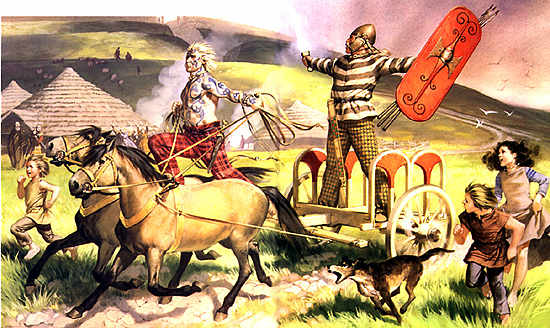
The Celts
The Roman historian Pliny wrote that after a 7-month siege of Rome itself, Brennus offered not to sack the city of Rome in exchange for 1000 pounds of gold. The Romans accepted these terms, but during the weighing of the gold accused Brennus of cheating with altered weights. It was then that Brennus uttered his famous response, “vae victis”. Playing as the Celts in Civ 3 will find you uttering the same words – and more than once!
Agricultural and Religious, the Celts in C3C are a formidable foe indeed. Here is a trait combo that truly shines at giving the player the flexibility to play either peaceful builder and/or aggressive warmonger with equal power. The agricultural bonus of 1 extra food in every base city square (for cities next to rivers only) gives the Celts that slight edge in early growth that can be so pivotal in maintaining pace with the early expansion of the AIs – and at times, even out expanding them! Add to this the ability to produce extra food from irrigated deserts and half priced aqueducts, and one can easily see how this trait has instantly supplanted Industrious as the CIVers favorite choice. Along with Agri, the Celts are Religious, which gives half-priced Temples and Cathedrals – the Celts are often able to pursue both a hard REX and some culture building from very early on – as well as having the religious luxury of minimal anarchy times during government changes. Lastly, as a water Civ (arch maps) the Celts make a nice average CIV, with their cheaper aqueducts and the always-useful higher growth rate – they are however, far stronger on Conts and Pang.
As a culture CIV the Celts can more than hold their own against the majority of the Civs in the game. From early on the synergy between the traits pay dividends to the culture player. Agri works on Religious by having faster city pop growth; in the early game this allows for the Celt player to rush build his half-priced temples a turn or two faster than usual. Conversely, these half-priced temples (and later cathedrals) allow the Celt to maximize his city shield production by adding happiness that lowers the number of necessary entertainers and/or military police while maintaining a decent science research rate. The net result over time is a series of culture buildings that are among the oldest and highest culture producing in the game. In combination with a minimal war strategy and a highly selective Wonder building program, the Celts can make for a strong Culture/Space Race Civ.
Normally this section of the review covers the warmongering power of a CIV. With the Celts however, this is impossible without first making reference to one of the most efficient UUs in the game – the Gallic Warrior. A 3-2-2 swordsman class unit that requires iron, at 40 shields the GW is THE most expensive military unit of the Ancient Age – and for good reason! Any cheaper and this unit would put the Celts completely over the top in power. In essence the GW is merely a swordsman with 1 extra movement point. But of all the weapons in CIV 3, ‘speed’ is the single most deadly. The 2 movement points of a non-horse unit that hits as hard as a swordsman gives the Celts a terrific and long lasting (strong until the advent of Gunpowder units) UU that is outclassed by very few.
While no slouch as a peaceful builder, it is at war that the Celt can be a truly magnificent CIV. The early game will often see the Celt player bee-lining to Iron Working and building warriors instead of spearman in preparation for an attempted mass upgrade to GWs in late Ancient Age. Yes do build as many warriors as possible – on average it simply is not as efficient to build 40-sheild GWs from scratch than to upgrade by commerce. Given a sufficient number of GWs, the Celt player can devour his closest neighbors in short order – thus sealing the games fate in the very first age! Unfortunately for the Celts, the 40-shield cost of the GW does not lend itself to easily amass a sizeable force of these beasts. This downside calls for meticulous planning by the Celt player along with a frugalness in gold spending that borders on the obsessive. With the Celts you need to save every single penny possible, consider lowering the research slider slightly (or even a ‘zero’ research gambit – buying and/or beating the techs out of your neighbors) and consider holding off on paying to open embassies with your neighbors – I cannot emphasize enough that if you want to get the most out of the GW you have to be a supreme TIGHTWAD in the early game. As a result the Celts often benefit from waiting until late in Ancient Age before going into full warmongering mode. That said, given a decent start and strong enough bank account, the Celts can propel themselves as an early warmonger and maintain that pace for the rest of the entire game. The despotic Golden Age for the warmongering Celts is not as bad as for most CIVs, the sheer power of the GW (like the Persian Immortal) mitigates the impact – nevertheless, it is preferable to be in Monarchy or Republic.
Summary: a solid well-rounded CIV that is efficient irrespective of the map type or player style. A top flight warmonger CIV and an efficient culture CIV with the built-in traits and a UU that lend themselves to an ease of play, the Celts are an excellent choice for newer players and experts alike - Overall a top end 2nd tier choice.
below is the link to my other CIV reviews:
|
|
| |
|
|
|
Ision
|
|
Building from scratch is not 'time efficent' at 40 shields and it would greatly hamper your REX - it would on average preclude you from massing GWs in suffucient numbers for a heavy late ancient rush. Naturally, you will also build some GWs as well (especially from a high shield barracks city) - so yes there will be a mixture.
Ision
|
|
| |
|
| |
|
|
|
Aqualung71
|
 |
Lord Desolator of the Desolation Row, C3CDG
Oct 2002
time: 12:36
|
|
quote:
Originally posted by bobbo008
"earlier Temples makes the Celts a daunting foe"
(that'll probably seem like a misquote, but i dont care)
so all of the religious civs will be daunting foes. you get two of six (or eight) special traits, and a not-so-great unique unit.
in my current game i'm bordering the aztecs and indians, and they're both doing the same thing, and i dont fear one over the other. one is green and one is grey, thats what they mean to me. if youre happy with the amount of variation between the civs, that i'm honestly happy for you. |
It is a misquote, since the faster government transition is the more important point. My statement was based on the fact that this smoother transition will enable you to produce the Celtic UU more quickly and in greater numbers due to higher shield production. As I said, the GS is an awesome unit that will quickly be able to run rings around your Indian and Aztec neighbours. If you don't feel the GS is a great UU then that's fine, but I don't think the majority of players would agree with you.
You should be able to grow more quickly than India since you are agricultural. And as long as you hold the Aztec Jag Warriors at bay in the early game, your quicker government switch will give you a production boost they won't be able to match for a while, during which time you can put your UU to good use to cripple them.
No other religious civs have a strong early UU to match the GS. So no, all religious civs are not the same. 
|
|
| |
|
|
|
Mr Justice
|
|
i think the only way that traits can seam similiar is if you DONT micromanage.
at the extreme edge of micromanagement where you actually monitor the citizens in a city to optomise production or growth or what ever takes ur fancy, this is where traits really stick out imo.
if you dont micromanage (and im not saying you should , its a personal choice) then most of the bonuses confered by traits will go unnoticed.
|
|
| |
|
|
|
Solomwi

|
 |
Don King of the Apolyton HLA Movement
Dec 2002
time: 23:36
|
|
I'll say this much, regardless of the stellar UU and the preferred method of gaining it, the Agricultural Celts combined with CxxC city spacing are uberpowerful. Playing on a huge map with 8 civs (continents, Monarch), this is the first time I've ever been able to keep the other continent AI's from plunking down settlements on the coasts of my continent, and I only had to off one settler team (whose owner is now polite to me  ) to do it. ) to do it.
I also noticed that I was able to come off 50 turn research and still turn a profit much earlier in the ancient era than usual. Because of an extended stay in Monarchy while all but clearing my continent of Egyptians and Arabs, it took a little longer to get tech parity, then pull ahead. I've got to think had I been able to get to and stay in Republic as quickly as I normally do, I'd have had the tech lead much earlier. But then I'd have also had Arabia and Egypt still to contend with.
Whether or not most of this effect was the city spacing, the Ag trait helped greatly in achieving that spacing and a rapid expansion rate.
Just an illustrative sidenote: I started between Arabia and Egypt, and expanded so quickly that they never met each other through exploration, despite sharing a landmass. I think I finally sold contact to one of them after I had known the other continent for quite a while. I'm thinking the Celts may be an ideal civ for the Arrian Deception.
|
|
| |
|
| |
|
|
|
skrobism
|
|
Thanks. Did you ever get around to all the civs?
|
|
| |
All times are GMT. The time now is 05:36.
Apolyton Time is 00:36. |
top of page
|
|
|
Forum Rules:
You may not post new threads
You may not post replies
You may not post attachments
You may not edit your posts
|
HTML code is ON
vB code is ON
Smilies are ON
[IMG] code is ON
|
|
|
|
|
|






 29-05-2004 00:53





 Attachment:





 |
|