|
| |
|
| |
|

|
foolish_icarus
|
 |
the thievery continues
Nov 2002
time: 21:37
|
|
July through December 1953
The Cold War
The Soviet naval presence in the Mediterranean has been removed. Under constant bombardment and just about out of fuel and supplies, a very few were able to sneak home, but most had to be beached or scuttled.
In the North Sea the fight is much closer, NATO has the edge and is gradually restricting Soviet zones of operation, but submarine attacks on Atlantic shipping still frequently happen.
Similarly the fighting goes on in the Pacific, but the Americans have forced a secure supply line to Japan and kept it open, but are still suffering losses.
With Naval and Air support regained, Japanese and American troops pushed back the Soviets in Hokkaido, and the Soviets had to withdraw from the island after getting pushed to the sea and split into pockets. But the Americans and Japanese suffered losses from the tough fighting and chemical munitions.
American and Canadian troops have counterattacked in Alaska, driving the Soviet forces back. Movement was slow during the winter and spring, but as soon as the weather warmed up and dried out the allies advanced a lot and now the Soviets hold on to only some of the Aleutian islands and the tip of the Alaskan peninsula. Their supply lines are tenuous, but intact, and if they choose not to withdraw, how long they hold out will come down to the morale of the Soviet troops.
The United States has landed a nuclear bomb right on Havana. US planes have conducted a successful bombing campaign on many remaining Cuban military installations, rendering their military nearly useless.
The U.S. has nuked 6 more Russian towns, 2 in the Soviet far east and 4 in the Russian west.
The Turks are regrouping and have sent troops to fight on the Bulgarian border and the Caucuses.
The DDR has joined the war on the Soviet side! Warsaw, Soviet, and East German divisions have joined in several regional campaigns.
All but the very western edge of Austria has fallen to the combined Warsaw armies, and a communist provisional government has already been set up. Some Austrians support the communist government, but a fledgling partisan force has also sprung up and is attempting to harass the occupying forces.
Warsaw troops have continued into Yugoslavia, where NATO and Soviet armies bash at each other. The fighting is fierce in northern Yugoslavia. Both sides are locked in a crucial battle to cut of the other’s supply lines: The Soviets control the land approach, NATO the sea.
The Greek military is fighting hard, but the Soviets continue to advance and it appears the Greeks really can’t hold out any longer. Turkish movements have put pressure on Soviets troop reinforcements to Greece, but even with current numbers Greece will soon be overrun.
The Americans and Warsaw both continue to use chemical weapons on the battlefield, but somewhat more sparingly than before.
The tactical situation in Europe has been greatly affected by the fact that the Warsaw, Soviet, and German militaries have completely withdrawn their airforces. Badly outnumbered, they decided to regroup their air forces and in the meantime they shoot at anything in the sky. AA guns constantly fire in the deadly duel between earth and sky. High altitude NATO bombers have the advantage here, being rarely reached by surface-launched missiles, but Warsaw AA has effectively prevented close air support for NATO ground troops on most battlefields.
Soviet armor defeats most personal anti-tank weapons, so NATO planes take every opportunity they can to get tank-kills. Warsaw has no way to prevent NATO from bombing out bridges, so armored advancements have been considerably slowed. So, we come to Germany…
With unreliable artillery and armored support, Warsaw infantry has had to slog through well supported enemy positions to make advances. They simply cannot get too far ahead of their AA guns, which have to be slowly floated across rivers in rafts, lest they be vulnerable to devastating airstrikes.
The Warsaw force has mounted a major offensive towards Hamburg, and Warsaw divisions now stand just beyond the outskirts of the city, gathering together enough of their scattered armor to mount an assault, while NATO bombards them with artillery and bombs. Further to the south, Warsaw has made some gains in West Germany.
NATO has inflicted significant losses on the Warsaw ground forces by tactically withdrawing and letting the air force make repeated assaults on troops and armor, but this has in turn cost NATO some of their precious advantage in airplanes.
East Germany
The East Germans are preparing themselves for war by retooling their factories and putting usable civilian equipment into military and support use. Some of the arms and equipment seized from NATO, particularly from West Berlin, has gone to the East German military, who are putting it into use fairly effectively.
Finland
The Finns are being dutifully quiet and unobtrusive. If we can’t see you, you can’t see us.
USA
America has started a draft and called up WWII vets. Women are taking on a huge range of noncombat, support, and industrial duties to free up more men for combat. The shipyards are busy, resources are being rationed, and those not fighting or working are working for the government to treat the affected people and regions in Florida.
The US military is getting relatively cheap oil from Iran.
USSR
The nuclear death toll is exceeding the Soviets’ capacity to care for the injured. Internal production and supply lines are being negatively affected.
Dissent has spiked in the USSR. Minority groups, hard-pressed collective farm workers, and civilians in the border SSR countries are becoming discontented enough to mutter angrily and in some cases even assassinate minor party officials and sabotage Soviet offices. The Soviet secret police has responded as usual, harshly crushing dissent, but the dissatisfaction isn’t going away.
Egypt
Egypt, Syria, Iraq, Jordan, and Lebanon have formed a defensive alliance purely for the purpose of stopping a nuclear attack on their states, and have organized their somewhat outdated air forces into defensive basing and patrol sites and are making the most of their numbers by jointly patrolling airspace.
Groups in Egypt have put pressure on the government for years to engage in democratization; after staunchly refusing to succumb to the “shrill cries of these fringe groups”, the King himself has initiated democratic reforms. By resolutely setting his own pace the King, now a President, has retained a lot of power within the government and his appearance of strength and wisdom has earned him a lot of support amongst most of the population. If things continue well, the President may not see any decrease in his effective influence.
Egypt’s state education and health systems are the best in the Arab world, and are rapidly approaching Western standards due to generous funding and an emphasis on virtuous study and achievement.
Egypt’s other state programs are not as efficient, suffering from some administrative bloat and local corruption. But many people are finding employment in government sponsored programs.
Most other Arab countries are following Egypt’s lead in donating relief supplies, workers, and funds to Turkey. Several states have abstained, not wanting to interfere in what they consider to be war matters.
Arab political and public opinion is still largely opposed to the existence of the state of Israel. In fact, people are getting rather riled up by what they consider to be Egypt’s unnatural favoritism and support of Israel. A dangerous balance exists, and while most states seem to be addressing the Israel problem by simply pretending it doesn’t exist, none have yet come anywhere near matching the Egyptian government’s recognition of the country.
The economic conference really hasn’t gone anywhere. Most states can agree to internal regulation, but they are pretty much already operating at lowest prices to attract buyers.
Mexico
The Mexican government has been reestablished. This government has declared its neutrality and is working on consolidating it control over local affairs and setting up new administrative structures.
Cuba
Bad place to be.
Yugoslavia
Invaded.
Britain
Evacuations, treatment of sick and wounded continues. Britain introduces a military draft and calls up all WWII vets for service. Pretty much every single African and Asian colony is asking for immediate independence upon the conclusion of the war in exchange for their support.
Korea
Israeli troops arrived in Korea to support the insurgents, but then China stepped in. China’s army is sweeping down the peninsula, forcing the insurgents to flee or surrender, and Israeli forces have not yet engaged Chinese troops are fairing well in providing support in the south, but there is no way they will be able to fight the Chinese once they arrive.
Other News
The European’s colonies are demanding independence if they are to be expected to support their colonizers in the war.
The Japanese have amended their constitution and are building a military, preparing to exact vengeance against the USSR.
Edited for better spacing
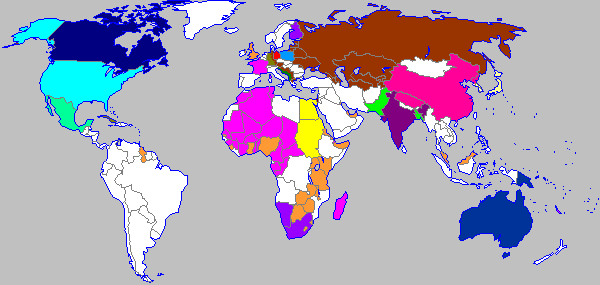
 Attachment: cold war 1953 ii.gif Attachment: cold war 1953 ii.gif
This has been downloaded 88 time(s).
Last edited by foolish_icarus on 20-11-2004 at 06:25
|
|
| |
|
|
|
Easthaven I
|
|
I'd like to jump in. Any open nations need a ruler?
|
|
| |
|
|
|
Easthaven I
|
|
I'll take Australia, thank you.
|
|
| |
|
|
|
Pave
|
 |
Celebrating Macedonia, the country north to FOPOG
Dec 2002
time: 07:37
|
|
Finland welcomes scientists
The finnish goverment has decided to found the International Science Center (ISC) in Jyväskylä. It's meant to be the center of peaceful researching in the war shattered Europe. Goverment funds the most of the expenses, but other countries are free and almost expected to sponsor.
Paasikivi: "A hope of peace".
President Paasikivi respects the efforts made by both USSR and USA. He also hopes, that the peace negotiations doesn't generate new conflicts, like happened in WW2 and WW3. "And of course, Finland is willing to send peace keepers to stabilize condition after war.
Already waiting for presidental elections
Even the elections are held in 1955, there is a small atmesphere going on. It is quite sure, that Paasikivi doesn'tgo for a third term. Some have speculated, that either Prime minister Kekkonen (center) or Socialist democratic party leader Fagerholm is the next president.
Orders:
Start the designing ofthe ISC
Improve school system and modernize school buildings.
If Egypt needs, send engieneers and builders to build the Dam.
Last edited by Pave on 27-11-2004 at 23:10
|
|
| |
All times are GMT. The time now is 05:37.
Apolyton Time is 00:37. |
top of page
|
|
|
Forum Rules:
You may not post new threads
You may not post replies
You may not post attachments
You may not edit your posts
|
HTML code is ON
vB code is ON
Smilies are ON
[IMG] code is ON
|
|
|
|
|
|







 15-11-2004 08:20






 Sheep, you belong in an institute. You destroyed the Austrian military. How many people do you think are left? And the people who are left, how many would want to fight for the people who killed their sons/brothers/friends/family?

 |
|