|

|
Natalinasmpf
|
|
quote:
IIRC, it's a thunking layer, not an emulator. |
Even Cygwin says it uses posix-layer emulation.
Basically, the XP kernel will never detect the multiple programs running inside Cygwin.
|
|
| |
|
|
|
Natalinasmpf
|
|
quote:
POSIX layer? What's a POSIX layer? |
http://en.wikipedia.org/wiki/Posix
Apocalypse, just use HTTP redirect...
quote:
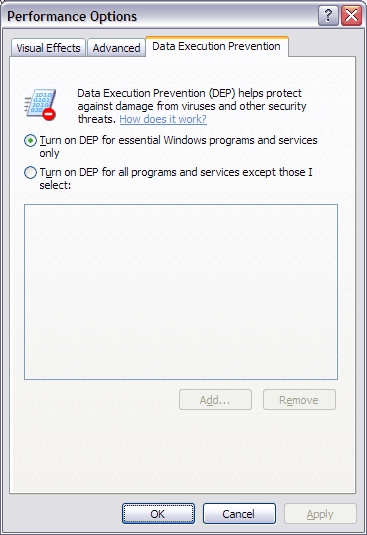
Further, by default, DEP only affects Windows System components, as per this screenshot: |
Pardon my ignorance, but wouldn't that mean it would prevent the critical components from running?
(Anyway, does it lookout for the program name/PID/etc. being executed, or the actual code patterns itself?)
|
|
| |
|
|
|
Fve Crathva
|
|
quote:
Originally posted by Apocalypse
But my school's IT department sucks and the shut down P2P...our theory is that they just want to download more porn. |
Yeah, some Bittorrent trackers don't allow you to use those P2P ports, because some networks limit bandwidth over them (or shut them off). You get an error message if you don't change the port range. I use 40000-40004.
SP
|
|
| |
|
|
|
Fve Crathva
|
|
Presumably, a POSIX layer would be something that implements the POSIX interface for an OS that doesn't have a native one.
SP
|
|
| |
|
| |
|
|
|
DRoseDARs

|
 |
"My god, it's full of peas..."
Jul 2002
time: 21:34
|
|
http://story.news.yahoo.com/news?tm..._pcworld/117452
Security Flaws Found in SP2
Wed Aug 18,12:00 PM ET
Paul Roberts, IDG News Service
Security researchers inspecting a new update to Microsoft's Windows XP (news - web sites) found two software flaws that could allow virus writers and malicious hackers to sidestep new security features in the operating system.
German Internet security portal Heise Security published a security bulletin, dated August 13, describing two holes in the Windows XP Service Pack 2 and warning users about running programs from untrusted Internet sites.
The flaws could allow virus writers to circumvent the security feature and write worms that spread on XP SP2 systems, according to the bulletin. However, the researcher who discovered the holes says he does not consider the flaws to be serious and he still recommends installing SP2.
Microsoft released XP SP2 to its customers shortly after completing work on the massive software update on August 6. SP2 contains a number of new security features, including an improved version of Windows Internet Connection Firewall, now named the Windows Firewall, a new, user-friendly interface for managing security settings and improved features for detecting and blocking malicious content downloaded from Web sites.
Identifying the Flaws
Heise Security Editor and Chief Jurgen Schmidt and his colleagues discovered the holes in an XP SP2 feature that marks files downloaded using the Internet Explorer Web browser or saved from e-mail messages using the Outlook Express e-mail client with a "Zone Identifier" or "ZoneID," according to Schmidt.
The ZoneID records the Internet Explorer security zone from which the file originated. Internet Explorer security zones assign different levels of security permission to different sources of files and data. For example, Web sites and files downloaded from the Internet are considered less secure than those obtained from a local area network the computer is connected to, or from the local computer hard drive.
XP SP2 saves ZoneIDs in a text file on the local computer. That file is linked to the downloaded file and used to issue pop-up warnings when Windows users attempt to open files from a dangerous source. However, certain Windows features allow users to open files without receiving a warning, Heise Security found.
For example, users can open files using text commands issued through the Windows command prompt, a standard Windows feature, without being warned about the risk associated with opening the file.
Second Bug
A second bug exploits what Schmidt called a "programming error" in XP SP2 that fails to update the ZoneID information cached for immediate use when files are renamed. That could allow malicious hackers or viruses to get around the user warnings, at least temporarily, by renaming a malicious file that would otherwise generate a warning, he says.
Neither security hole could be exploited by a remote attacker, and both require Windows users to take actions, such as opening the Windows command shell, or renaming files to overwrite other files on Windows, he says.
However, a flaw such as the failure to update cached ZoneID information could cause problems as third-party software programs try to take advantage of XP SP2, he says.
Microsoft was informed of the holes on August 12. The Microsoft Security Response Center responded to the report, saying that the issues raised were not in conflict with "the design goals of the new protections," and that it did not consider the holes serious enough to warrant a patch or workaround, Schmidt says.
A Microsoft spokesperson could not confirm or deny that the company issued a statement to Heise Security.
Many security experts agree that XP SP2 improves Windows security, especially by deploying a desktop firewall by default that blocks all but common Internet traffic to and from Windows XP machines. However, the hunt for holes in XP SP2 began as soon as the software update was released. Some security researchers predict that hackers will discover ways to circumvent many of the XP SP2 features, even writing worms and viruses that target machines running the updated operating system.
"SP2 is not going to be the end of all viruses. Users have to be aware of the fact, that the new security features of SP2 are not catch-all solutions," Schmidt says.
*********
Just so it's clear: Nothing can replace buying an anti-virus program, installing anti-spyware software, and practicing safe-surf. 
Edit: I meant to bold that, not italicize it.
Last edited by DRoseDARs on 19-08-2004 at 09:19
|
|
| |
|
|
|
Urban Ranger

|
|
Apolyton Duke of Off-Topic
|
|
quote:
Originally posted by Asher
This is expected. I still don't get why certain people don't understand that Windows is a much bigger target, and hence more people try to break it, than other major desktop OSes. |
quote:
In early May, stories were written saying that Microsoft would make this upgrade available to all XP users, both licensed and unlicensed. To me, this was a very smart move on Microsoft's part. Think about all the ways it benefits Microsoft. One, its licensed users are more secure. Two, its licensed users are happier. Three, worms that attack Microsoft products are less virulent, which means Microsoft doesn't look as bad in the press. Microsoft wins, Microsoft's customers win, the Internet wins. It's the kind of marketing move that businessmen write best-selling books about.
Sadly, the press was wrong. Soon after, Microsoft said the initial comments were wrong, and that SP2 would not run on pirated copies of XP. Those copies would not be upgradeable, and would remain insecure. Only legal copies of the software could be secured.
This is the wrong decision, for all the same reasons that the opposite decision was the correct one.
Of course, Microsoft is within its rights to deny service to those who have pirated its products. It makes sense for them to make sure performance or feature upgrades do not run on pirated software. They want to deny people who haven't paid for Microsoft products the benefit of them, and entice them to become licensed users. But security upgrades are different. Microsoft is harming its licensed users by denying security to its unlicensed users. |
link
quote:
Some of our recommendations are easier to implement than others, but if Microsoft is serious about security and wants to take a true leadership position, they can't shirk any of them. Some of our changes are easier to verify than others, but it is our goal that all of them be independently measurable. In the end, the pronouncements and press releases don't mean a thing. In security, what matters are results. |
Judging Microsoft
Sadly, Microsoft hasn't made much progress in any of these areas.
|
|
| |
|
|
|
Natalinasmpf
|
|
quote:
This is expected. I still don't get why certain people don't understand that Windows is a much bigger target, and hence more people try to break it, than other major desktop OSes.
|
But the threat distribution isn't proportional.
|
|
| |
All times are GMT. The time now is 05:34.
Apolyton Time is 00:34. |
top of page
|
| archivepost |
|
Forum Rules:
You may not post new threads
You may not post replies
You may not post attachments
You may not edit your posts
|
HTML code is ON
vB code is ON
Smilies are ON
[IMG] code is ON
|
|
|
|
|
|






 15-08-2004 00:32








 Attachment:


 |
|