|
| |
|

|
Lincoln
|
|
quote:
Originally posted by DRoseDARs
So, because Kerry won 3 purple hearts but DIDN'T have limbs blown off nor was he captured and tortured by enemy forces, he's a 'crybaby'? Did these young men bleed enough or are they crybabys too? Someone better do a sweep of surviving veterens, from WW2 up to current conflicts, to revoke medals since losing 3 of your 4 limbs or being held prisoner for years still isn't enough to prevent questioning of one's patriotism and commitment to protecting this country. Just ask Max Cleland and John McCain. |
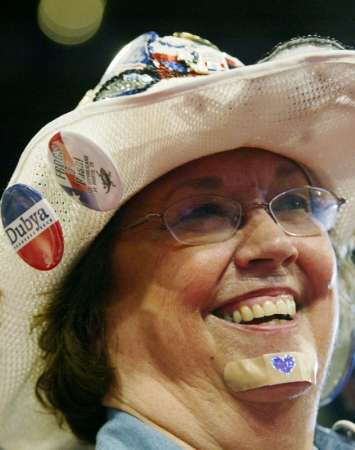
Spoken like a true Clintonesk Democrat! Where do you people learn to twist words so well? What does Kerry's whining about opposing opinions being aired (to counter his own propaganda machine) have to do with 'blown off limbs"? Please tell us the connection. I am sure thee must be one (and try not to redefine words in your answer if at all possible). Or does Kerry's bandaid wounds somehow compare with those who have lost limbs for the same medal?
|
|
| |
|
|
|
Kontiki
|
|
Canada
Aug 2001
time: 00:35
|
|
quote:
Originally posted by Ned
Arrian, you people who bash Bush have no appreciation for one of the great presidents in our history. |
Oh that's so going in my sig. Thanks Ned!
|
|
| |
|
|
|
Ned
|
 |
of Aptos, CA
Oct 1999
time: 21:35
|
|
quote:
Originally posted by Kontiki
Oh that's so going in my sig. Thanks Ned! |
\
You know, Kontiki, guys like you would also think that Polk was a bad president. To most historians, Polk ranks among the top ten if not the top five presidents in terms of benefit to the US. But most liberal historians simply skip over Polk. Why? It is quite obvious, in my view. Liberals all appear to think alike: presidents who stand up for America and will use war, if necessary, are not to be applauded in any manner whatsoever.
Bush has done more for America and the world than most presidents. He finally is acting to transform the world's most backward and violent areas into democracies. Without freedom, these areas will forever be breeding grounds of hate, fanaticism and terror.
I also think favorably back to Jefferson who took on the Barbary Pirates rather than pay ransome like the Europeans. His actions were the beginning of the end of piracy in the Mediterranean.
Bush is a great president and will be treated very favorably by historians. Put that in you sig, because it is true.
|
|
| |
|
|
|
Kontiki
|
|
Canada
Aug 2001
time: 00:35
|
|
Nor has reality, but that's why we all get such a kick out of reading Ned's comments. Although I think he's ruffling a few feathers in the Russian subway attack thread claiming that most Europeans, along with people who attend Berkley, are anti-Semites who won't be happy until all the Jews are killed. Oh, and that Hitler's views on the Jews were pretty mainstream in Europe.
|
|
| |
|
|
|
Barinthus
|
 |
A Magical Moment...
Jan 2004
time: 21:35
|
|
Seems relevant to this thread....
So instead of making a seperate one, I'm putting it in here.
quote:
Ex-Viet Cong Soldier Recalls Swift Boats
Tue Aug 31, 1:46 PM ET
By MARGIE MASON, Associated Press Writer
ON THE BAY HAP RIVER, Vietnam - The 50-foot Swift boats were easy targets as they plowed through the waterways of the Mekong Delta in packs of three or four, making big waves and thunderous noise when approaching. Former Viet Cong soldier Duong Hoang Sinh remembers them well — the one time he tangled with three Swift boats, the Americans killed all of the insurgents in his unit except for two.
"It was very fierce fighting," said Sinh, 52, who lost his left eye during the war and still has shrapnel embedded in his arm. "Each side tried to eliminate the other."
Sinh and John Kerry, the U.S. Democratic presidential nominee, were fighting along the Dong Cung canal around roughly the same time 35 years ago in early 1969, experiencing the intensity of war along these muddy waters, but from opposite sides.
Although Sinh had never heard of Kerry, he has a strong opinion about the debate surrounding the candidate's Vietnam War record as a U.S. Navy (news - web sites) Swift boat commander: Kerry must have had guts to troll the Mekong Delta's spider web of rivers and narrow canals knowing that Viet Cong like himself were waiting to pick him off.
"Kerry served in Vietnam and he was awarded the medal for his bravery," Sinh said. "He deserves the medal."
The memories of the Swift boat battles in these waters are now being sharply scrutinized under the divisive lens of the U.S. presidential election, where Kerry's actions under fire have been disputed by a group of veterans.
As a Navy lieutenant, Kerry commanded two Swift boat units, PCF-44 and PCF-94, in Vietnam in late 1968 and early 1969. He was awarded three Purple Hearts, a Silver Star and a Bronze Star.
Kerry's actions in several of those instances — including a March 13, 1969 incident when he rescued U.S. Army Special Forces Lt. Jim Rassmann under enemy fire; a February 28, 1969 incident when he chased and killed a Viet Cong fighter; and a December 1968 incident when he was wounded — have been challenged in a series of television ads aired by the group Swift Boat Veterans for Truth.
They claim he did not come under heavy enemy fire as his medal citations state. But other veterans of the "brown water navy" who witnessed the fighting, along with Navy documents from that time, have backed Kerry's version of events.
The Associated Press took a boat tour along the same rivers and canals of the Mekong Delta that served as a battleground for Kerry. The people who live here now have worked hard to put the fighting behind them, but the memories persist.
When Kerry and Sinh plied these muddy waterways, mangroves grew thick on both sides of the Bay Hap River, forming a bushy shield of impenetrable green. It was perfect cover for Viet Cong guerillas who laid waiting to ambush the clunky U.S. Swift boats.
Sinh recalled one morning in February 1969 when he and six other insurgents watched silently from their hiding spot in the thick forest that grew along the banks of the Dong Cung canal, about 7.5 kilometers, or 4.7 miles, off the Bay Hap River in Vietnam's southernmost province of Ca Mau.
When the U.S. Navy boats rumbled into view, the Viet Cong were in for a shock as the Americans began firing on them. Sinh recalled his comrade got off one good shot from a B-40 rocket launcher, blasting a hole in the side of one vessel. But it wasn't enough. The Americans charged, unloading a hail of bullets, and Sinh realized this was not a fight his unit could win.
"We got more fire from the American soldiers after that. We tried to fight back, but decided to flee," he said.
He believes the Americans must have had intelligence about the planned ambush that day because the three U.S. boats fired first. Five of his comrades died, including his buddy who fired the crippling blast. Sinh escaped by fleeing into the dense forest.
He said it was the first and last time he fired at Swift boats along the waterways where he grew up. Not long after, he was sent away from his family in Dong Cung village to fight elsewhere, which is why he remembers the date so well. His village was renamed Tran Thoi after the war.
To Sinh and those who still live along the Mekong Delta, the controversy over Kerry's tour of duty in Vietnam is dumbfounding. Since the war ended in 1975, they have reveled in peace and more recently, economic growth.
"I think it's American politics," said Nguyen Van Khoai, 61, a former Viet Cong soldier who attacked American troops along the water but never fought directly against the Swift boats. "On any side, a soldier who made an outstanding feat is given a medal — but maybe some people try to think otherwise."
The area that once crawled with Viet Cong has changed. The thick mangrove forests that lined both sides of the Bay Hap River, Dong Cung canal and other tributaries are mostly gone. Some canals just wide enough for the U.S. Navy boats to pass through are double in size today.
Many more thatch houses are perched on stilts along the water's edge and small speed boats now zoom past. Shrimp farms litter the landscape where forests once grew, and the names of many wartime canals and villages have been changed.
Cai Nuoc village where Kerry put in on March 13, 1969 — the day for which he was awarded his third Purple Heart and a Bronze Star for rescuing Rassmann — has ballooned into a district. Cafes abound along the water here as well as shops selling a wide variety of wares, including shiny bathroom tile. A thriving floating market also bustles where mounds of ripe rambutan, pomelo and bananas form a rainbow of color.
But much also remains the same. The water is still dotted with children splashing and men checking fishing nets attached to crude sticks poking out of the river. The smell of diesel fuel and smoke is in the air and stinging downpours still come in the afternoon.
Many of the residents here in the Mekong Delta have never heard of Kerry. They do, however, remember the Swift boats and the Americans who roared by aboard them.
"I was very scared when I heard the American boats coming up the canal, so I had to hide in my back yard," said Phu Thi Nguyet, 60, who has lived along the Dong Cung canal since 1960.
For those who have followed the debate, the Kerry controversy is confusing.
"It's very strange in a way. It's just a small thing, but they have made it into a big deal," said Lam The Hung, 42, a native of Cai Nuoc village who now serves as a provincial official in Ca Mau. "The fact that one soldier rescued another — that happened thousands of times among the Vietnamese, so I don't understand."
Hung said he's also puzzled by the uproar over Kerry's decision to join the anti-war movement upon returning home. He said Kerry's actions proved he learned a lot during his time in Vietnam and that he wanted to keep other Americans from dying here.
"When they went home, they knew the nature of the war and the people here were innocent and they knew it was nonsense to wage war here," said Hung, whose two older brothers joined the Viet Cong and laid mines in the rivers where the Swift boats operated.
And while Kerry may be worried about veterans' support in America, Sinh said he would vote any day for his former enemy over President Bush (news - web sites). In the veteran's opinion, Kerry's experience along these rivers fighting Viet Cong might keep him from sending other young Americans to invade countries.
"He knew the suffering and how much misery it brought to the people of Vietnam — he knew the cruelty of war," Sinh said. "So, I don't think he would go to war again if he's elected." |
|
|
| |
|
|
|
Lincoln
|
|
VIETCONG FOR KERRY 2004!
|
|
| |
|
|
|
Lincoln
|
|
Osama, I think, was one of the foreign leaders that promised to work more closely with Kerry if he is elected. Apparently he agrees with Kerry that Bush has divided the world and squandered the good will that America was shown just after 9/11. I think Osama has promised not to execute anymore hostages if Kerry promises to wage a more sensitive war and consult France before anymore invasions.
|
|
| |
|
|
|
molly bloom
|
 |
Lundenwic
Oct 2001
time: 15:35
|
|
quote:
Originally posted by Ned
I also think favorably back to Jefferson who took on the Barbary Pirates rather than pay ransome like the Europeans. His actions were the beginning of the end of piracy in the Mediterranean.
Bush is a great president and will be treated very favorably by historians. Put that in you sig, because it is true. |
The second statement has as much truth as the first- which is to say, not much.
You'll note that although Jefferson didn't want to pay ransom, Congress did. And that although the Americans fought the first Barbary War over the issue, it didn't settle the issue of the ransom.
'In many ways, the First Barbary War did not meet its implicit goals. It did not, in fact, end America's position of tributary to the Barbary pirates. In fact, part of the treaty of 1805 was an agreement to pay ransom for sailors taken hostage by Algiers—part of the reason it took so long for the Senate to ratify. The Barbary states emerged relatively unscathed. For them, the First Barbary War was one in a series of punitive wars that signalled their weakened status and foreshadowed eventual colonization by France, starting in the 1830s. '
http://www.nationmaster.com/encyclopedia/Tripolitan-War
And that in fact it was Europeans (an Anglo-Dutch fleet) who brought the Algerian corsairs' piratical activities to an end with a sustained barrage of Algiers.
Still it has the virture of having the same relationship to reality as your version of Viet Namese and Cambodian history I suppose, and your 'intriguing' account of how American presidential office is supposedly based on the Roman emperor's.
Now I know you've had presidents who were related, even a son and a father, but that doesn't mean the position is hereditary, does it? Even though there have been something like eleven descendants of Ulster Protestants to have been president.
And tell me- other than perhaps Reagan, how many presidents have been deified in their lifetime, or were acclaimed as president by the army, or bought the pres- o.k., skip the last part.
|
|
| |
|
| |
All times are GMT. The time now is 05:35.
Apolyton Time is 00:35. |
top of page
|
| archivepost |
|
Forum Rules:
You may not post new threads
You may not post replies
You may not post attachments
You may not edit your posts
|
HTML code is ON
vB code is ON
Smilies are ON
[IMG] code is ON
|
|
|
|
|
|






 31-08-2004 18:58


 hi there, Fez!

 Attachment:


 linky linky!
 Of course, they're soldiers, not politicians (well, except the one guy).


 |
|