|
Who will win?
This poll is closed. |
| Bush |
   |
86 |
49.43% |
| Kerry |
   |
88 |
50.57% |
| Total: |
174 voters |
100% |
|
| |
|

|
Ramo
|
 |
Austin, Texas, USA
Oct 1999
time: 23:21
|
|
quote:
That's much different than saying the other person has a 'slight edge' though, isn't it? |
You didn't say that you were talking about a spread in the opposite direction.  As I said, I don't necessarily trust the polls, I'm just going with my gut. As I said, I don't necessarily trust the polls, I'm just going with my gut.
Coburn is the batshit crazyiest of 'em all, so undecideds will break against him.
quote:
And yet the latest grouping of recent polls show Bunning with an average of 10 point lead.
The Bluegrass poll may have him only at +6, but the SurveyUSA poll (taken during the same time) has him at +15!
|
Look at the trends. I think SUSA showed a pretty good trend for Mongiardo as well. Internal polls show him even closer (a point behind). Basically, Bunning's campaign is a total joke, and he's going to have a tough time holding onto his seat.
quote:
And yet, the latest Rasmussen poll gives Thune a +3. And McLaughlin gives him a +4. KELO-TV is giving Dasche a +2. If there is implosion the polls aren't showing it. |
There's a time lag between campaign events, and for them to be reflected in the polls.
Last edited by Ramo on 27-10-2004 at 22:07
|
|
| |
|
|
|
OzzyKP
|
 |
Rockville, MD
Oct 1999
time: 00:21
|
|
Great article about some of the possabilities that await us.
If Electoral College Fails, House Decides
http://story.news.yahoo.com/news?tm...he_house_s_pick
quote:
WASHINGTON - One near-certainty in this election of many uncertainties is that if the Electoral College can't pick a winner, George W. Bush will stay in the White House. That's because the House of Representatives is and will probably remain in Republican hands.
The 12th Amendment, adopted in 1804 after the House took seven days in 1801 to break a tie and make Thomas Jefferson president, states that when there's no electoral vote majority, the House elects the president and the Senate the vice president.
In the 200 years since, what are called contingent elections have happened only twice: in 1825, when the House chose John Quincy Adams over Andrew Jackson after an election fragmented by third-party candidates, and in 1837, when the Senate settled a disputed vice-presidential race.
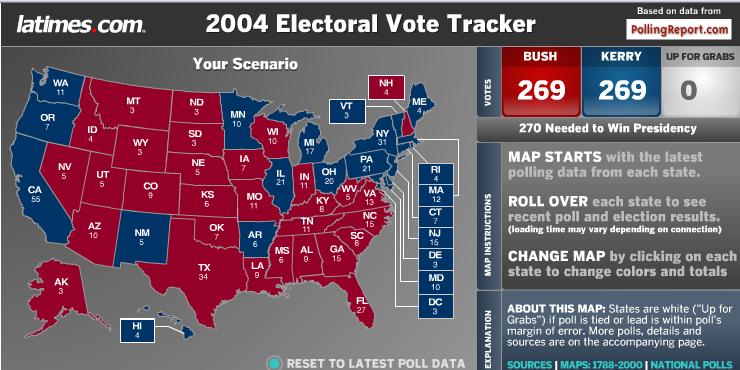
The odds are still good that Bush or John Kerry will secure 270 electoral votes, out of 538 cast, when the House and Senate meet in joint session on Jan. 6, 2005, to officially tally the results.
But in the muddled 2000 election Bush edged Al Gore by 271-266, and there are several scenarios that could keep either candidate from reaching 270 this time.
If that happens, there's little question that the House would choose Bush. The newly elected House would do the voting, and the makeup of that body is not expected to change much from now. Republicans hold 227 of the 435 seats and, more importantly, have a majority in 30 state delegations.
The 12th Amendment specifies that each state gets one vote in a contingent election. Most assume that lawmakers will vote with their party, meaning that Florida, with Republicans currently holding 17 of 24 seats, and Ohio, with 12 of 18 seats held by Republicans, would probably go to Bush regardless of the popular vote.
"The pressures would simply be enormous to vote your party allegiance," said Rep. David Price, D-N.C., who has pushed for changes in the election system.
The prospects would be no brighter for Kerry if lawmakers were to vote in line with their states. In 2000, even though Gore captured more popular votes, Bush carried 30 states.
With Ralph Nader's support hovering around 1 percent, there's no chance this time of a third-party candidate preventing anyone from getting a majority.
But it is possible that the electors will split 269-269 when they meet in their states on Dec. 13 to register their votes. Also possible is a "faithless" elector confounding the process by either withholding a vote or voting for someone else.
Electoral College electors are loyalists chosen by their party and rarely — only eight times since 1948 — stray from the chosen candidate. But this time every vote counts, and already one West Virginia Republican elector has suggested he might not vote for Bush.
The biggest concern is a repeat of 2000 when the outcome hinged on the protracted legal battle over the winner in Florida. This time, both parties have thousands of lawyers watching for voter irregularities and ready to file legal challenges in states where the outcome may be in doubt.
The Congressional Research Service issued reports in January 2001 and again last September educating members on the intricacies of the electoral college system. The latest analysis pointed out the importance of a Colorado referendum that would divide the state's electors proportionally, depending on the vote count, rather than the winner-take-all system used by almost every state.
Lawsuits would be likely if proportional allocation appeared to reverse the nationwide results, the CRS said, "and might lead to a prolonged and bitter dispute, such as occurred following the 2000 election."
Price, hoping to avoid what could be multiple Florida-like situations, last month introduced legislation that would give states with contested elections an extra three weeks, until Jan. 3, to conduct recounts before state electors have to meet to certify results. But the bill isn't going anywhere this year even though disputes over such issues as new registrants and provisional ballots are waiting to happen.
"There's a higher level of suspicion and vigilance this time," Price said.
There's still one more scenario that can't be totally discounted. If Democrats pick up two Senate seats next Tuesday, they will regain control of the Senate when lawmakers convene on Jan. 6.
Without a clear Electoral College winner on that day, the country could end up with President Bush, re-elected by the House, being joined by a new Senate-picked vice president, John Edwards. |
|
|
| |
|
|
|
Guynemer
|
|
Oh, it's been interesting.
What it is now is ****ing intolerable.
Just one week. One week until there are no more political ads on TV and radio.
Sure, the election will go on for another month, but at least the ads will be done.
|
|
| |
|
| |
|
|
|
Ramo
|
|
Austin, Texas, USA
Oct 1999
time: 23:21
|
|
quote:
I don't think that hurts him at all. I think people know what he was talking about. And its Oklahoma. |
The scary thing is that, most likely that wasn't a misstatement at all, and the people of Oklahoma will know this. This is a man who has been calling for the death penalty for abortion doctors, been ragging on the Cherokee, warned of "rampant lesbianism" in OK schools where supposedly girls can only go into the bathroom one at a time, etc., etc. mind you. This is just one statement in a long history of batshit crazy Coburn positions this campaign.
And Okies may be funny looking, but still generally aren't racists.
quote:
Zogby recently predicted a Bush victory, so I guess Ramo has to change his opinion now. |
Well, I'd certainly put more credence in that prediction over Gallup's, if he acutally said that (and I don't think he has). But some of us have the capacity to be think independently of pollsters, even if you don't.
Zogby's tracking polls, like any other, rely on small samples, leading to large margins of error, and don't rely on pivotal factors (cell phones, GOTV, etc.); and in any case, the pro-Bush trends there, as in the rest of the tracking polls, have reversed.
Last edited by Ramo on 28-10-2004 at 16:07
|
|
| |
|
|
|
Pax
|
|
quote:
Originally posted by Ogie Oglethorpe
I'm surprised Bush isn't winning in a landslide. Conservatives are optimists and libs are pessimists. |
The very nature of liberalism is to be optimistic and the very nature of conservatism is skepticism.
|
|
| |
|
|
|
Drachasor
|
|
My prediction now is that Kerry will win with over 300 Electoral Votes, carrying both Florida and Ohio.
The boost he should get from undecided voters and people that aren't counted properly in the polls should be enough to give him the victory in both of those states, imho.
-Drachasor
|
|
| |
|
|
|
Drachasor
|
|
quote:
Originally posted by MrWhereItsAt
Bush will win, because opinions are so close to evenly split, and the US is a conservative nation. Not so much in that Conservative Presidents are the default, but in that the incumbent, provided he hasn't destroyed the nation utterly, will get a boost simply by being the incumbent. |
The incumbant president basically never gets a boost beyond what the polling data indicates. At best Bush will get a 1% boost, at best.
Kerry will likely get a 2-4% boost however, which is enough to win a number of battleground States.
Based on how this sort of thing has played out in the past anyhow (and there is no reason to think it won't work the same way again).
-Drachasor
|
|
| |
|
|
|
Drachasor
|
|
Interestingly, the Gallup poll has stopped indicating the percentage of Democrats and Republicans in the population of its polls.
This seems new to the last week or two.
-Drachasor
|
|
| |
All times are GMT. The time now is 05:21.
Apolyton Time is 00:21. |
top of page
|
| archivepost |
|
Forum Rules:
You may not post new threads
You may not post replies
You may not post attachments
You may not edit your posts
|
HTML code is ON
vB code is ON
Smilies are ON
[IMG] code is ON
|
|
|
|
|
|







 27-10-2004 21:30









 Attachment:
  |
|