|

|
Comrade Tassadar
|
|
If 30 foot tidal waves hit Japan?
|
|
| |
|
|
|
DanS
|
 |
Kickball Capital of the World
Jan 1970
time: 00:17
|
|
Damn.
quote:
It Seemed Like a Scene From the Bible
By Michael Dobbs
Washington Post Staff Writer
Monday, December 27, 2004; Page A01
WELIGAMA, Sri Lanka, Dec. 26 -- Disaster struck with no warning out of a faultlessly clear blue sky.
I was taking my morning swim around the island that my brother Geoffrey, a businessman, had bought on a whim a decade ago and turned into a tropical paradise 200 yards from one of the world's most beautiful beaches.
People look at debris in Madras, India, one of several areas hit by a massive tidal waves that slammed into several countries in Southeast Asia on Sunday. (AP)
I was a quarter way around the island when I heard my brother shouting at me, "Come back! Come back! There's something strange happening with the sea." He was swimming behind me, but closer to the shore.
I couldn't understand what the fuss was about. All seemed peaceful. There was barely a ripple in the sea. My brother's house rests on a rock 60 feet above the level of the sea.
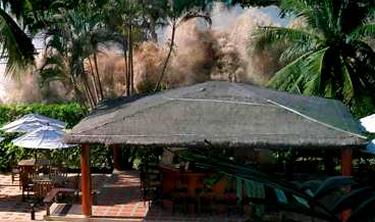
Then I noticed that the water around me was rising, climbing up the rock walls of the island with astonishing speed. The vast circle of golden sand around Weligama Bay was disappearing rapidly, and the water had reached the level of the coastal road, fringed with palm trees.
As I swam to shore, my mind was momentarily befuddled by two conflicting impressions -- the idyllic blue sky and the rapidly rising waters.
In less than a minute, the water level had risen at least 15 feet, but the sea remained calm, with barely a wave in sight.
Within minutes, the beach and the area behind it had become an inland sea that rushed over the road and poured into the flimsy houses on the other side. The speed with which it all happened seemed like a scene from the Bible, a natural phenomenon unlike anything I had experienced.
As the waters rose at an incredible rate, I half expected to catch sight of Noah's Ark.
Instead of the ark, I grabbed a wooden catamaran that the local people used as a fishing boat. My brother jumped on the boat next to me. We bobbed up and down on the catamaran as the water rushed past us into the village beyond the road.
After a few minutes, the water stopped rising, and I felt it was safe to swim to the shore. What I did not realize was that the floodwaters would recede as quickly and dramatically as they had risen.
All of a sudden, I found myself being swept out to sea with startling speed. Although I am a fairly strong swimmer, I was unable to withstand the current. The fishing boats around me had been torn from their moorings, and were bobbing up and down furiously.
For the first time, I felt afraid, powerless to prevent myself from being washed out to sea.
I swam in the direction of a loose catamaran, grabbed the hull and pulled myself to safety. My weight must have slowed the boat down, and soon I was stranded on the sand.
As the water rushed out of the bay, I scrambled onto the main road. Screams were coming from the houses beyond the road, many of which were still half full of water that had trapped the inhabitants inside. Villagers were walking, stunned, along the road, unable to comprehend what had taken place.
I was worried about my wife, who was on the beach when I went for my swim. I eventually found her walking along the road, dazed but happy to be alive. She had been trying to wade back to our island when the water carried her across the road and into someone's back yard. At one point she was underwater, struggling for breath. She finally grabbed onto a rope and climbed into a tree, escaping the waters that raged beneath her.
Our children were still asleep when the tsunami struck at 9:15. They woke up to find the bay practically drained of water and their parents walking back across the narrow channel to safety.
The waves raged around the island for the rest of the day, alternately rising and receding.
It took us many hours to realize the scale of the disaster, because we could see only the tiny part in front of us. The road from Weligama to Galle was cut in many places. The coastal road was littered with carcasses of boats, dogs and even a few dead sharks. Helicopters flew overhead and loudspeaker vans warned residents to leave low-lying areas for fear of more tsunamis.
My brothers' little island, called Tapbrobane after the ancient name of Sri Lanka, was largely intact, although a piece of our gate ended up on the seashore half a mile away. The water rose about 20 feet toward the house.
We have no water and no electricity and are cut off from the rest of Sri Lanka. It is impossible to buy food. We are existing on cold ham and turkey sandwiches, leftovers from Christmas dinner.
The holiday that we planned and dreamed about for many months is in ruins. We feel fortunate -- fortunate to be alive. |
|
|
| |
|
| |
|
|
|
chegitz guevara
|
 |
Ft. Lauderdale, FL Communist Party of Apolyton
Jun 2000
time: 00:17
|
|
quote:
Originally posted by VJ
I've never heard of the place before... just how can you guys over here remember the exact location of every single place around the globe?  |
When I was a little kid I wanted to grow up to be a vulcanologist. Sadly, I'm asthmatic, and cannot go anywhere near an active or dormant volcano because the gasses will affect me worse than others. Kraaktoa is a famous vacano whose erruption in the 19th Century killed more than 10,000 people with tsunamis. This one is worse.
Krakatoa explodes catastropically every 150 years or so, and is believed to be responsible for both the world wide economic collapse in 530AD and the Black Death. It's more massive explosions put massive quantities of dust in the air, which cools off the planet and disrupts both crop production and lowers the temperature to the point where the plague bacillus begins to block the gut of the flea, which then gorges itself on rat blood, which passes the disease on to the rat, which kills the rat, sending the flea in seach of new sources of blood, us. We're due for another major explosion in about thirty years.
|
|
| |
|
|
|
Chemical Ollie
|
 |
Bored of this board
Jan 2002
time: 06:17
|
|
800 Swedish tourists unaccounted for, in Thailand alone. Most of them probably just lost their phone in the water or something, but at least 20 are confirmed dead.
>20 000 and counting. 11 000 on Sri Lanka alone.
Last edited by Chemical Ollie on 27-12-2004 at 15:41
|
|
| |
|
|
|
Giancarlo
|
 |
Los Angeles
Apr 2000
time: 02:17
|
|
The death toll is now 19,930.
http://story.news.yahoo.com/news?tm...esia_earthquake
Edit: It could be far past 22,000 now... because one police chief for one region reported losses in his area:
"On the remote Car Nicobar island south of India, Police Chief S.B. Deol told New Delhi Television he had reports "that maybe 3,000 people are dead." If confirmed, that would raise the death toll past 22,900."
Last edited by Giancarlo on 27-12-2004 at 15:50
|
|
| |
All times are GMT. The time now is 05:17.
Apolyton Time is 00:17. |
top of page
|
| archivepost |
|
Forum Rules:
You may not post new threads
You may not post replies
You may not post attachments
You may not edit your posts
|
HTML code is ON
vB code is ON
Smilies are ON
[IMG] code is ON
|
|
|
|
|
|







 27-12-2004 07:18


 .
. 




 Attachment:


 |
|