|
| |
|

|
Drogue
|
 |
Omnipresent conscience
Oct 2002
time: 05:28
|
|
quote:
Originally posted by Kidicious
Why are you talking about a shutdown situation? Because there is not producer surplus obviously in a sutdown situation. In a normal situation there is a demonstratable producer surplus. |
Because of the shutdown condition, there isn't a producer surplus under perfect competition, as stated. There is no supply curve below the price. Look at any micro textbook, under perfect competition.
Or just try here: http://econserv2.bess.tcd.ie/fotoole/SF15.ppt (click until you get to producer surplus).
Producer surplus is the amount a seller is paid, minus the total variable cost of production. Or dividing by quantity, price - average variable cost. This in the long run, economic profit = producer surplus. And in PC, there is no economic profit in the long run. Simple.
Thus, in a competative market, there is no surplus to be appropriated to the worker, nor to the capitalist.
quote:
Originally posted by Kidicious
You're the one with the strawman, which is why I didn't understand what you were saying. How could I be expected to understand what you are saying when it isn't relevant. It's human nature to ignore irrelevencies. |
No, you kept saying that I said price = value, which I didn't. I haven't strawmaned anything, as I've never assumed what you believed. What was irrelevant?
|
|
| |
|
|
|
Flubber
|
|
With a view of the Rockies
Aug 2000
time: 22:28
|
|
quote:
Originally posted by Kidicious
But walking up the mountain to see the view is an economic behaviour. You are claiming that it isn't because it doesn't involve exchange. Economic behavior does not have to involve exchange although it can involve exchange. |
Hmmm can you read?? I actually pointed out that the view COULD be viewed in terms of exchange. In fact I went on to say that pretty much everything a person values could be viewed in terms of exchange, even if we are talking the love of one person versus another . . .
and I repeat my question . . . what does it matter?
You cam plump and primp the various theroetical models all day long and use 5000 different definitions of "value" . . . we can go around for a while on the number of angels that can dance on the head of a pin too . . .
But whats your point??
Any person can see that when a "thing" is created by a "worker" in "capitalism" using machinery provided by the "owner", the worker is not generally paid the full monetary price obtained for the item as compensation. The worker may be paid something more than the "price" of what they produced but that can only be temporary or the business will be losing money and fail. So the norm is that the worker is paid something less than the price of what they produce. The reality is that there are probably major operating costs for electricity, fuel, maintenance and rent plus the wages of many preceding and succeeding wokers in the production process such that its probably not even possible to accurately proportion out the monetary price of what a worker produced. As for the owner . .. if the price for the aggregate of goods exceeds the costs , they make a profit--- NOBODY HAS to pay it to them and it is not guaranteed. It is the possibility of this profit that entices the owner to make their equipment and machinery available.
Now you say value is utility and cannot be measured. Fine . . . continue you exercise in academic self-congratulation if you wish but it has no relevance to how business works. Businesses care about the PRICE they can obtain for their goods and they care about the PRICE they have to pay for labour. Most workers don't give a rats ass if their work is useful as long as the conditions are good and they are paid fairly. Businesses don't CARE about Marshall and snicker at Marx.
I do admire your persistence in arguing in circles though. You would spend another thousand posts trying to convince all comers about some obscure point about "value". But to society, you and the views you espouse don't even rise to the level of relevance. A "worker" in Calgary is far too busy choosing from among the literally hundreds of available jobs to be in the slightest bit interested ... I don't think it enters his mind that he would be "exploited" in the 30 dollar an hour job but not if he took the government job at 20m dollars an hour.
Kid I find it fun to sometimes debate you to see how many ways you can contradict yourself. Its also amusing that everyone else EXCEPT YOURSELF doesn't understand pretty much anything. Heck I think Drogue was pretty much quoting mainstream econ text verbatim . . . Plus its amusing to see how often you try to change your position to adopt the position of another while claiming they disagree with you. Our go around on "cost of risk" was a perfect example of this. Your interchange with Kontiki and myself showed how woefully inadequate your knowledge is with respect to how business decisions are made. You may have decent knowledge of academia and theoretical models ( mine is admittedly scanty mainly because I don't care unless it impacts how things actually work)but you show very little real world know how.
Oh and I will continue to show up in these threads . . . if just to inject some reality into the theory--
|
|
| |
|
|
|
Flubber
|
|
With a view of the Rockies
Aug 2000
time: 22:28
|
|
quote:
Originally posted by Drogue
No, you kept saying that I said price = value, which I didn't. I haven't strawmaned anything, as I've never assumed what you believed. What was irrelevant? |
Drogue
Kid defines as irrelevent any pointed statement or question that incisively cuts his arguments to shreds. he has to do this if there isn't some sub-portion he can quote out of context or if enough posts have not gone by that he can adopt a portion of what you stated and ask you why you can't see the obvious.
|
|
| |
|
|
|
Kidicious
|
 |
Diety of Kidiverse
Mar 2003
time: 21:28
|
|
quote:
Originally posted by Drogue
Because of the shutdown condition, there isn't a producer surplus under perfect competition, as stated.
|
I know there isn't a producer surplus under perfect competition in the shutdown situation. In other situations there is.
quote:
Producer surplus is the amount a seller is paid, minus the total variable cost of production.
|
Yes
quote:
This in the long run, economic profit = producer surplus. And in PC, there is no economic profit in the long run. Simple.
|
It's not only complicated. It's incoherent, because producer surplus is revenue minus total variable cost, as you have stated. The logical conclusion of what you are saying is that total revenue is equal to total variable cost.
quote:
No, you kept saying that I said price = value, which I didn't. I haven't strawmaned anything, as I've never assumed what you believed. What was irrelevant? |
You disagreed with me when I said that value was utility. Now you say it isn't price either. So what is it?
|
|
| |
|
|
|
Drogue
|
|
Omnipresent conscience
Oct 2002
time: 05:28
|
|
quote:
Originally posted by Kidicious
I know there isn't a producer surplus under perfect competition in the shutdown situation. In other situations there is. |
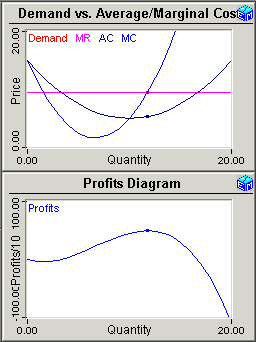
No, because of the shutdown condition, there will never be a PS in the long run under PC. In the long run, price cannot rise above minimum AC, otherwise economic profit is made, and thus it's not PC. Because of shutdown it can't fall below AC. Therefore the only points of possible production are 0 and min AC. Neither of which has a producer surplus. Thus there is no producer surplus in the long run under perfect competition. Please read a textbook, or even look at the link I provided, that shows exactly that.
quote:
Originally posted by Kidicious
It's not only complicated. It's incoherent, because producer surplus is revenue minus total variable cost, as you have stated. The logical conclusion of what you are saying is that total revenue is equal to total variable cost. |
Exactly! If you make 0 economic profit, total revenue must equal total cost. That's the definition of PC in the long run. It's simple. In perfect competition in the long run there is no economic profit, no producer surplus, price = marginal cost = average cost.
quote:
Originally posted by Kidicious
You disagreed with me when I said that value was utility. Now you say it isn't price either. So what is it? |
As I've said 3 times, willingness-to-pay. The amount someone is willing to pay for something is the value of that good to them. That's why I said you strawmaned me, as this is what I've been arguing all along. Value is what it's worth to someone, what they're willing to pay for it, which is a function of utility, but is not exactly equal to it. All the examples I've given have shown this.
|
|
| |
|
|
|
Drogue
|
|
Omnipresent conscience
Oct 2002
time: 05:28
|
|
quote:
Originally posted by Kidicious
Good. I'm glad you see that. Neither are they paid for the full value of the goods produced, which is the utility value of the good. |
Value is a subjective thing, are you talking about the full value to the consumer or the full value to the company? The company would value it at what it can sell it for, ie. marginal revenue. The consumer at their willingness-to-pay. I think what I mean by willingness-to-pay is what you mean by utility, as given the presumption of a rational consumer, maximising utility, revealed preference would show that they'd choose the set of goods that had the highest value, which would be the ones with the greatest consumer surplus. Thus price+consumer surplus = value = willingness to pay, and could also = utility, if you wanted it to.
So if you consider utility to be value, of course the worker isn't given the full value of what is produced, since that's more than the firm gets, so the firm would be paying the worker more than it received for the product.
|
|
| |
|
|
|
Kidicious
|
|
Diety of Kidiverse
Mar 2003
time: 21:28
|
|
quote:
Originally posted by Drogue
Value is a subjective thing, are you talking about the full value to the consumer or the full value to the company? The company would value it at what it can sell it for, ie. marginal revenue. The consumer at their willingness-to-pay. I think what I mean by willingness-to-pay is what you mean by utility, as given the presumption of a rational consumer, maximising utility, revealed preference would show that they'd choose the set of goods that had the highest value, which would be the ones with the greatest consumer surplus. Thus price+consumer surplus = value = willingness to pay, and could also = utility, if you wanted it to.
|
Willingness to pay is dependent on income, so I wouldn't say that it's exactly utility, but generally you get the idea. Utility = value. We seem to agree on that.
quote:
So if you consider utility to be value, of course the worker isn't given the full value of what is produced, since that's more than the firm gets, so the firm would be paying the worker more than it received for the product. |
I'm not against exchange for exchange value in the market per se, but such a system benefits those with more income, and not those who work. My whole argument is that some benefit from the system more than others, and others work in the system more than others. In a fair system work would be rewarded equally with benefits.
|
|
| |
|
|
|
Kidicious
|
|
Diety of Kidiverse
Mar 2003
time: 21:28
|
|
quote:
Originally posted by Drogue
No, because of the shutdown condition, there will never be a PS in the long run under PC. In the long run, price cannot rise above minimum AC, otherwise economic profit is made, and thus it's not PC. Because of shutdown it can't fall below AC. Therefore the only points of possible production are 0 and min AC. Neither of which has a producer surplus. Thus there is no producer surplus in the long run under perfect competition. Please read a textbook, or even look at the link I provided, that shows exactly that.
|
Of course you can have a price that is higher than average costs. That's the very definition of profit. Price = average costs is the shutdown situation. Price is greater than AC is a profit situation.
And I'm not familiar with the information at that website. I got my degree 10 years ago, and that information was not presented to me. Still, the information is incoherent. I can't even begin to tell you how it does not make sense.
quote:
Exactly! If you make 0 economic profit, total revenue must equal total cost. That's the definition of PC in the long run. It's simple. In perfect competition in the long run there is no economic profit, no producer surplus, price = marginal cost = average cost.
|
If TR = TC there is no profit at all, let alone economic profit. Normal profit is the profit made in a theoretical PC economy. Economic profit is that made by firms with some pricing power.
quote:
As I've said 3 times, willingness-to-pay. The amount someone is willing to pay for something is the value of that good to them. That's why I said you strawmaned me, as this is what I've been arguing all along. Value is what it's worth to someone, what they're willing to pay for it, which is a function of utility, but is not exactly equal to it. All the examples I've given have shown this. |
Willingness to pay is basically utility, but I would say the difference has to do with diminishing marginal utility.
|
|
| |
All times are GMT. The time now is 05:28.
Apolyton Time is 00:28. |
top of page
|
|
|
Forum Rules:
You may not post new threads
You may not post replies
You may not post attachments
You may not edit your posts
|
HTML code is ON
vB code is ON
Smilies are ON
[IMG] code is ON
|
|
|
|
|
|





 01-02-2005 22:08


 Attachment:
 |
|