|
| |
|

|
Lawrence of Arabia
|
 |
of the Gulag Archipelago
Apr 2001
time: 06:32
|
|
quote:
Putting up the barricades
Apr 25th 2005
From The Economist Global Agenda
America's Congress is taking a harsher line on trade, particularly with China. The Bush administration is also getting into the act, with the treasury secretary and even the newly nominated trade representative talking tough. Is America turning protectionist?
THESE are not happy times for the dwindling band of free-traders in Washington, DC. Trade sceptics are on the move on two fronts: raising the barricades against the Chinese and refusing to lower them for the Central Americans.
Politicians blame China and its fixed exchange-rate regime for America's trade deficit. But Congress is also sceptical about the Central American Free Trade Agreement. Although CAFTA is small beans in economic terms, failure to get it through would spell ill for any global trade deal at the World Trade Organisation (WTO).
China-bashing has captured the headlines. On April 6th, 67 senators voted against dumping a bill proposed by Charles Schumer, a Democrat from New York, that would impose a 27.5% tariff on all goods from China unless Beijing adjusted its currency—which is fixed to the dollar at an artificially low exchange rate—within six months. Not only is the legislation utterly against WTO rules, it would cause havoc for the American economy. But Mr Schumer has been promised a vote by July, and his bill may well pass the Senate.
The Schumer bill's success, which has surprised even its sponsor, is accelerating other measures. Two more senators, Susan Collins and Evan Bayh, are touting the Stopping Overseas Subsidies Act, which would allow American firms to get countervailing duties to make up for Chinese subsidies, including a subsidised exchange rate. China is not currently subject to America's anti-subsidy law as it is deemed a “non-market economy” (which makes it easier for American firms to file anti-dumping cases against it). But declaring China a market economy for the purposes of subsidies, and a non-market economy for the purposes of anti-dumping, is against WTO rules.
Nobody in Congress, alas, seems to care about breaking WTO rules. The aim is to be seen to be bashing China loudly. Mr Bayh is holding up the confirmation of Rob Portman, the Ohio congressman whom George Bush has nominated for US trade representative, until his bill is voted on. Meanwhile, in the House of Representatives, Duncan Hunter, a conservative Republican, and Tim Ryan, a Democrat, have cooked up a law that allows American companies to use “exchange-rate manipulation” as a reason for demanding protection under America's trade laws. And the Congressional China Currency Action Coalition has filed a Section 301 petition asking the Bush administration to file a formal case to the WTO complaining about the yuan.
In the 1980s, a rising trade deficit—at that time with Japan—fuelled protectionist pressure in Congress. Ronald Reagan introduced the notorious “voluntary export restraints” on Japanese steel and cars. The Reagan team also abandoned its laisser-faire attitude to currency markets and, through the Plaza Agreement, engineered a sharp drop in the dollar.
The current bout of China-bashing is not a replay of the 1980s. Back then, large American firms, particularly the Detroit car giants, led the clamour for protection. Now big business, which relies heavily on Chinese inputs, is quieter. The shouting comes from smaller American suppliers. And even the noisier business groups, such as the National Association of Manufacturers, are relatively nuanced. Though the NAM wants Beijing to revalue the yuan, it does not support the Schumer bill.
Less encouragingly, the political and economic risks are bigger this time round. In the 1980s Japan, for all its faults, was always viewed as a democratic ally in Asia. By contrast, China is now seen as a nasty communist regime and a dangerous rival. In the mid-1980s, America's current-account deficit was smaller, 3.5% of GDP in 1985 compared with 6.3% today, and its debt stock lower. Today, America is the world's biggest debtor, with China as an important creditor. A sharp reversal in China's appetite for American Treasury bonds could send interest rates soaring.
This might come sooner rather than later, according to Alan Greenspan, the chairman of the Federal Reserve. In testimony before the Senate budget committee last week, he stated that the Chinese government’s massive exchange-rate interventions were causing growing imbalances in the domestic economy that will force China to abandon its currency peg. Over the weekend, the head of China's central bank also gave a speech indicating that the yuan could be revalued in the near future (though he blamed international pressure, rather than internal imbalances). Once this happens, the People's Bank of China can stop stockpiling dollar reserves—meaning its demand for American government securities will also dry up. Critics wonder if Congress, which has made little effort to curb America’s soaring budget deficits, has quite thought things through.
For now, the Bush administration seems to be trying to muddle along. It has increased its rhetoric about the need for China to fix its exchange rate. It said this at the G7 meeting of finance ministers on April 16th, and, when the Treasury issues its twice-yearly report on currencies later this month, it is likely to come close to calling China a “currency manipulator”—a term last applied to Beijing in 1994. Even Mr Portman, an ardent free-trader, sounded a harsh note on China during an appearance before the Senate finance committee on April 21st. Saying that the Chinese “do not always play by the rules”, he promised to take a firmer stance than his predecessor, Robert Zoellick. This seems to have garnered approval on both sides of the aisle—though not from Mr Bayh, who said that words were no substitute for action.
The Bush team hopes to keep this sort of grandstanding to a minimum. But the China-bashing in Congress presents a danger. At worst, this frenzy could result in a series of illegal (in WTO terms at least) protectionist bills becoming law. Even if things do not get that far, the China effect will complicate an already tough struggle to get CAFTA through.
Aside from a handful of passionate free-traders, Democrats are solidly opposed to the Central American trade deal, thanks largely to a massive lobbying campaign by the unions. The unions believe (correctly) that if CAFTA is defeated, Mr Bush's trade agenda will lie in tatters. In the face of determined union opposition, Mr Bush is already having trouble persuading many Democrats. Alarmist news about imports from China makes this task much harder.
Another set of CAFTA sceptics—the textile lobby—ought to be brought on board by fears of China. The Central American agreement is in part a way of staving off Chinese textile imports, which have surged since the quota regime ended this January. Without CAFTA, Central America's textile industry is likely to be decimated by Chinese competition. With the special duty-free access that CAFTA grants, Central American textile firms—and the American companies that supply them with material—may survive.
The Bush team is busy making this argument to textile groups. But the opposition against free trade of any sort in hard-hit textile states like the Carolinas is considerable (see article). The White House is thus getting more overt with its bribes, such as its decision to consider safeguard quotas against Chinese imports for several textile products. (The European Union said on April 22nd that it is mulling similar restrictions.)
Another powerful southern lobby, the sugar industry, is proving even harder to placate. Outrageous import quotas keep the domestic price of sugar at double that of the world price. CAFTA would allow more imports in from Central American countries, but still less than 2% of US sugar production. For the sugar lobby—and the 15 or so Republican politicians who follow its bidding—that is still too much.
The betting is that, with enough presidential involvement and vote-buying, Mr Bush may get CAFTA through in the next couple of months. Until he does, there will be little appetite in the White House to give the China-bashing in Congress the cold shoulder that it deserves. |
--------
on the net at www.economist.com
--------
well well well, it looks like Bush is once again, not the free trader that the economist and many people thought he was. Is China wrong with its peg? sure it is. But are we better off if China takes away all our manufacturing jobs? yep, we sure are. Not only that, it will remove a section of our society from being protectionist, making everyone else better off.
these senators are, as usual, just cutting their own throats. more protectionism means a slower growing economy, higher unemployment, and sooner or later they will lose their jobs in the US senate.
then we've got CAFTA, a bill that must be passed. but again, it seems that its one or the other. I dont understand how bush can have everyone in the republican party in lock step for iraq, but cant get them together for free trade. I guess the republican party isnt the party of open markets, but of big business, who dont necessairly want open markets.
remember Zombiereagan? the ardent free trader? remember how he slapped quotas on Bangladesh in the 80s when they became a huge textile exporting counry? why cant anyone stick up to their principles? maybe the power over international trade should be taken away from the US legislature and the executive. Create the USITB (US international trade bureau,) composed of qualified economists (PhDs only, etc) similar in experience level as the Fed. Have the top guy nominated by the Prez, have a board who votes on US trade policy, like the board of governors in the Fed reserve.
----------
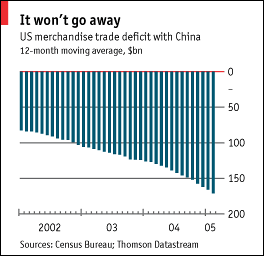
The graph shows US textile current account deficit over the years with China
 Attachment: cga744.gif Attachment: cga744.gif
This has been downloaded 150 time(s).
|
|
| |
|
| |
|
|
|
Lawrence of Arabia
|
|
of the Gulag Archipelago
Apr 2001
time: 06:32
|
|
quote:
As for why it's okay for us to tell others what to do, I never said it was. Given, however, that the only time the SC has ever ordered anyone around it was because it was trying to stop agression.
|
yeah, I guess youre right on this point.
did you know that if the world wants to destroy america, all what they have to do is close their borders to our stuff. its what happened in the great depression. but they dont even have to do it illegally, since we're about to do it illegally, and by WTO rules, they can retaliate by closing their borders to our stuff, hurting our EXPORT industry. protectionism might save the import industry, but it kills our export industry and our consumers. is that really what the people or the poor want? you want them to pay more for everything right?
did you also know that real wages go UP when there is more trade. isnt that what the trade unions have been moaning about for years. blah blah blah real wages have gone down waah wahhhh. you want higher real wages? then allow more imports.
|
|
| |
|
|
|
Imran Siddiqui

|
 |
The Potterverse
Jan 1970
time: 00:32
|
|
quote:
well well well, it looks like Bush is once again, not the free trader that the economist and many people thought he was. Is China wrong with its peg? sure it is. But are we better off if China takes away all our manufacturing jobs? yep, we sure are. Not only that, it will remove a section of our society from being protectionist, making everyone else better off. |
Indeed. This is horrible news. This protectionist fervor is going to bite us on the ass. After all, protectionism during the Great Depression made that particular downturn quite nasty for the world. If we want to have good growth, we have to embrace free trade, not just talk about it and then go the other way.
This China demonization, leading to protectionist measures, is just utterly dumb. If we tariff them, they'll retaliate against us, and that's quite a big market we'll be depriving our businesses from.
|
|
| |
|
|
|
Spiffor
|
 |
CPA - Evil Clone brigade
Nov 2001
time: 06:32
|
|
quote:
Originally posted by Lawrence of Arabia
and why would you want to raise tariffs? is JP Raffarin feeling the pressure from the snake Sarkozy? |
I don't know.
It's possible that the gov't is scrapping whatever it can, in order to hinder the steady rise of unemployment a little bit. (which is the only rational explanation I found as to why we push for the end of the weapon embargo on China).
It's possible that it is simply EU policy, and that I got it confused for a French initiative (hard to say what comes from French diplomacy and what comes from the EU). There is still a very real textile industry in the EU, and the Chinese textile industry is a real threat to it. It's not mere statistics, it's hunderd of thousands of jobs, EU-wide. You may look at this for an overview of the EU textile industry in 2003 (in French)
OTOH, I have no idea whether Sarkozy has anything to do with protectionnist policies. Actually, I thought he would be more of a free-trader than the old gaullist guard, who believe the neoliberal ideology (like any self-respecting rightwinger), but who retain a fondness for State intervention. I think Sarkozy would be much less fond of interventionism, considering that he wasn't in politics back when France was a mixed economy.
|
|
| |
|
|
|
Lawrence of Arabia
|
|
of the Gulag Archipelago
Apr 2001
time: 06:32
|
|
interesting stuff spiff. in 2003, the EU's imports of textiles, as a percentage from China, check in at less then 10%. whats all the huff about? the most interesting pages are 10 and 11, where we can see costs of production increasing, and where they discuss reasons for the fall in demand abroad (unfavorable exchange rates, bad economy, people by less, lower prices, relocation of businesses to china)
whatas interesting is that investment in textiles has gone down over the last two years (-11.7% and -7%) it seems that even the private sector knows that europe is becoming uncompetitive.
btw, where did you get this from?
Last edited by Lawrence of Arabia on 27-04-2005 at 07:11
|
|
| |
|
| |
|
|
|
Verto
|
|
"Of all the enemies to public liberty, war is, perhaps, the most to be dreaded, because it comprises and develops the germ of every other. War is the parent of armies; from these proceed debt and taxes and armies are the known instruments for bringing the many under the domination of the few. In war, too, the discretionary power of the Executive is extended; its influence in dealing out offices, honors, and emoluments is multiplied; and all the means of seducing the minds, are added to those of subduing the force, of the people...
[There is also an] inequality of fortunes, and the opportunities of fraud, growing out of a state of war, and....degeneracy of manners and morals....No nation could preserve its freedom in the midst of continual warfare." -- James Madison
|
|
| |
All times are GMT. The time now is 05:32.
Apolyton Time is 00:32. |
top of page
|
|
|
Forum Rules:
You may not post new threads
You may not post replies
You may not post attachments
You may not edit your posts
|
HTML code is ON
vB code is ON
Smilies are ON
[IMG] code is ON
|
|
|
|
|
|





 27-04-2005 03:21









 |
|