|

|
ormuzd
|
|
Inka - agricultural and industrious
they have the best scouting unit IMO thus making them expansionistic too
Additionally they are coloured in beautiful pink
|
|
| |
|
|
|
Modo44
|
 |
in western Poland
Jul 2004
time: 06:18
|
|
The Inca are Agricultural+Expansionistic. Their Chasqui Scout is expansive for a scout, which makes them worse at using the Expansionist trait. Which needs some luck to work out anyway.
Agricultural+Industrious means the Maya. They have the Javelin Thrower - a Slave-producing unit. Incredible power in the early REX.
EDIT: If SGLs are on, the Sumerians (Agricultural+Scientific) are an interesting choice. Cheap Libraries go very well with an extremely cheap defensive unit.
Last edited by Modo44 on 01-05-2005 at 22:38
|
|
| |
|
|
|
Paddy the Scot

|
 |
Hordeland
Mar 2001
time: 14:18
|
|
I put forward the Persians
--------------------------------------------
Industrious
workers complete tasks faster
centre square produces an extra shied once hit "City" and "Metro"
Scientific
Libraries etc cheaper to produce
Nation receives a free tech at the start of each era 
--------------------------------------------
The Persians start with Masonry & Bronze Working, which allows instant research to start on Iron Working tech, thus allowing the discovery of Iron as soon as possible. This then allows for the apporpriate infrastructure to be built in that area, thus allowing Unique Unit.
With UU the ancient Golden Age can be enabled, and although this has a bad reputation in many areas of Poly, it is still a bonus, and used shrewdly, would allow the nation to grow and conqueor quickly
--------------------------------------------
Immortals - 4/2/1 (instead of swordsman 3/2/1)
Advances needed - Iron Working
Resources - Iron
Cost - 30 shields
--------------------------------------------
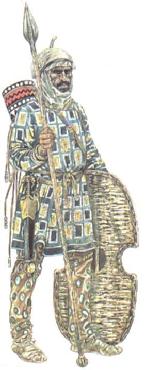
In his description of the battle of Thermopylae (480 BCE), the Greek researcher Herodotus mentions a Persian elite corps which he calls the Ten Thousand or the Athanatoi, the 'Immortals'. He describes them as
a body of picked Persians under the leadership of Hydarnes, the son of Hydarnes. This corps was known as the Immortals, because it was invariably kept up to strength; if a man was killed or fell sick, the vacancy he left was at once filled, so that the total strength of the corps was never less -and never more- than ten thousand.
Of all the troops in Persian army, the native Persians were not only the best but also the most magnificently equipped; their dress and armor I have mentioned already, but I should add that every man glittered with the gold which he carried about his person in unlimited quantity. They were accompanied, moreover, by covered carriages full of their women and servants, all elaborately fitted out. Special food, separate from that of the rest of the army, was brought along for them on dromedaries and mules. (Histories 7.83; tr. Aubrey de Selincourt)
As he indicates, Herodotus has already mentioned the Persian equipment:
The dress of these troops consisted of the tiara, or soft felt cap, embroidered tunic with sleeves, a coat of mail looking like the scales of a fish, and trousers; for arms they carried light wicker shields, quivers slung below them, short spears, powerful bows with cane arrows, and short swords swinging from belts beside the right thigh. (Histories 7.61; tr. Aubrey de Selincourt)
We also learn from Herodotus that this elite corps played an important during the Battle of Thermopylae. The Greeks had blocked a narrow road along the coast and prevented the Persians from invading Greece. However, the Immortals made a detour and were able to attack the Greeks in the rear. They are also mentioned during the second year of the war, in 479 BCE, when they remain in Greece in the army of the Persian commander Mardonius.
The big problem with this elite corps is that they are unknown from other sources. (There are, of course, other Greek and Latin texts that mention the Immortals, but they have taken this name for the Persian elite troops from Herodotus and simply mean: the royal guard.) There is ample evidence from Persia -e.g., the Persepolis fortification tablets- but it does not mention a corps of Immortals. Probably, Herodotus' informant has confused the name Anûšiya ('companions') with Anauša ('Immortals').
The historians of Alexander the Great mention another elite regiment, which they call the Apple Bearers. Their spears had a small metal counterweight to balance the heavy point. Because this counterweight resembled an apple, they received their remarkable surname. Several scholars believe they are identical to the Immortals.
article by Jona Lendering ©
--------------------------------------------
- Running Bear Productions
 Attachment: persian immortals.jpg Attachment: persian immortals.jpg
This has been downloaded 112 time(s).
|
|
| |
|
| |
|
| |
|
| |
|
|
|
Donovan Zoi
|
|
Things must be going well! We are already discussing the next game...... 
Take it from a former Maya(CFC), we most likely won't get full enslavement benefits from the Mayan Javilineer due to our starting distance from other civs. With five civs in the semi-final game, we were only able to enslave some barbs and very few rival units.
With six civs (and slightly closer range), we would probably be best served by a mid-AA unit, like the ones offered by the Celts or the Carthaginans. These units are unveiled right about the time when land disputes may begin.
For the record, my favorite traits are Religious and Seafaring, but I also like Agricultural. Therefore I am leaning toward the Celts.
My Top 3:
Celts: Awesome traits and a mobile attack UU. Religious trait keeps us from postponing crucial government switches during wartime, and allows us to culturally claim our land via Temples.
Byzantines: The Dromon! We rule the seas in the early game and can build cheap Libraries(cheap culture here, too!). Seafaring trait allows us to meet opponents first, giving us a diplomatic advantage.
Carthage: Early-game survival is ensured, plus the workers can enhance the land quickly. Minimal cheap builds, though. With the Numidian Mercenary, we may be able to claim disputed land by staging them a bit beyond our current borders. Seafaring diplo advantage exists here too.
|
|
| |
|
| |
All times are GMT. The time now is 05:18.
Apolyton Time is 00:18. |
top of page
|
|
|
Forum Rules:
You may not post new threads
You may not post replies
You may not post attachments
You may not edit your posts
|
HTML code is ON
vB code is ON
Smilies are ON
[IMG] code is ON
|
|
|
|
|
|






 01-05-2005 21:54


 allowing more than 1 point to be put forward
  and as to names... not sure I remember the default names surviving in a dg









 |
|