|
| |
|

|
Kidicious
|
 |
Diety of Kidiverse
Mar 2003
time: 21:20
|
|
quote:
Originally posted by Velociryx
I dunno, Ag...haven't seen a decent argument yet, from team red.
|
quote:
Well if anyone else wants to discuss the actual theories of Marxism instead of Vel's exploits in capitalism here's a good website to base our dicsussion on.
Historical Materialism
This is what Historical Materialism is. Social existence determines man's consciousness, not the other way around.
quote:
Historical Materialism is the application of Marxist science to historical development. The fundamental proposition of historical materialism can be summed up in a sentence: "it is not the consciousness of men that determines their existence, but, on the contrary, their social existence that determines their consciousness." (Marx, in the Preface to A Contribution to the Critique of Political Economy.)
Society goes through stages of development where production relationships change. People's consciousness is determined by these various production relationships.
quote:
To each stage in the development of the productive forces corresponds a certain set of production relations. Production relation means the way people organise themselves to gain their daily bread. Production relations are thus the skeleton of every form of society. They provide the conditions of social existence that determine human consciousness.
This one is for Che. "Necessary labor" is that which the workers recieve compensation. It is mutually exclusive with "surplus labor," which is that which the workers are not compensated for. Every worker in the capitalist system does both "necessary" and "surplus" labor. It's not either or, and it's black and white.
quote:
Thus the worker's daily work is divided into "necessary labour" and "surplus labour''. The worker performs "necessary labour'' during that part of the day spent in producing value which, when sold, will cover the cost of the wages. The worker performs "surplus labour'' during the remainder of the working day, producing value which, when sold, will cover the rent, interest and profit which goes to the capitalist class.
The working class is not like the peasant class. The peasant class does not have the cohesion that the working class does, and are not capable of revolution. Neither do the have a cohesive bond with the working class.
quote:
The working class is unlike any other exploited class in history. We have seen how the three-sided class struggle within slave society necessarily led to the "common ruin of the contending classes". We have seen how the feudal peasantry were for hundreds of years incapable of formulating a coherent revolutionary alternative to the system that exploited them.
So feudal societies are not ready for communism. They must completely go through the stage of capitalism.
Marx predicted that capitalism will progress until a certain point has been reached, and that communism was not possible before that point. Communism can not occur before the process of capitalism is complete, just like the other stages of development could not occur before the stages before it were complete.
quote:
/Nor is the modern working class left to vegetate at a modest but constant standard of living. Insecurity is a condition of their existence.
Capitalism has produced many wonders inconceivable hitherto. It has also produced social disasters inconceivable under previous forms of society - crises taking the form of overproduction.
In pre-capitalist societies, the subsistence of the toilers was only interrupted by famine - physical shortage of necessities. Primitive people's minds may well have been clogged with all sorts of superstition, but the spectacle of people starving, while sitting idly in front of the tools necessary to make the things they need, is a unique product of our society.
Capitalism is social production. It is social in two ways. Firstly, it ties the whole world up into one economic unit through the world market, a worldwide division of labour. Everybody is dependent on everyone else for the things they need.
Again. Social existence determines man's consciousness, not the other way around. |
That's THE argument. That's Marxism. Debate it or don't.
|
|
| |
|
|
|
Velociryx
|
 |
of Candle'Bre
Apr 1999
time: 05:20
|
|
 You people are fantastic! You people are fantastic!
You provide an impractical scheme for social improvement (which, btw, if you bothered to look UP the definition of the word utopia, you'd discover resting comfortably on the page), and then cry "strawman" when I call it what it is.
In fact, I've noted that the reds have gotten so touchy and thin skinned that "strawman" has become almost akin to "mercy" - any time you want to concede, that's fine by me. You have no historical basis to believe your theories will work any better than they have in the past, no one seriously believes that the industrialized world will VOTE the reds into power, and all you have to show for all the talk is a lot of sci-fi dreams and a bad track record. Given that, I don't blame you for being overly defensive.
So....call it quits....
-=Vel=-
As to "THE" debate (all caps makes it sound soooo important!)...100% tripe, pure and simple. Substituting the main definition that most folks MEAN when they speak of human consciousness for the definition that points to social consciousness/awareness, and then pretending that the latter leads to the former is a) cheesy, and b) fairly typical of Marxist doubletalk.
In short, nothing to debate.
|
|
| |
|
|
|
Velociryx
|
|
of Candle'Bre
Apr 1999
time: 05:20
|
|
If you want to believe that Vel, then fine. You aren't doing yourself any favours. I'd happily debate communism with you if you would actually debate properly instead of repeating the same disputed points over and over again.
Not doing myself any favors? Why not? By rejecting an ideology that's got a losing track record, or by not trusting this generation's red-gurus that it'll magically be different.
To quote a popular movie icon, "sorry kid, I don't believe in fairy tales." And I don't believe I'm hurting myself for not doing so. If you think so, rather than just trolling out insubstantial statements, perhaps you'll go out on a limb at some point and tell me why...
then you have no argument.
Dead wrong. My argument is that Marx is really good at bait and switch, and even better at creating his own internal logic, which works just fine till you take it off of the paper and put it into practice in the real world.
Society and production methodologies have no more to do with the state of human consciousness than phlegm globs do, and at least phlegm globs are marginally more interesting than Marx.
To borrow a quote from Ag, If you want to believe that, then fine. You aren't doing yourself any favours though....
-=Vel=-
|
|
| |
|
|
|
Sandman
|
 |
Sinister Penguin
Aug 2001
time: 05:20
|
|
quote:
You provide an impractical scheme for social improvement (which, btw, if you bothered to look UP the definition of the word utopia, you'd discover resting comfortably on the page), and then cry "strawman" when I call it what it is. |
Before, you thought that utopia meant economic paradise:
"Inasmuch as communism itself is a utopian society where everyone magically has plenty."
It doesn't say that at dictionary.com, does it? It emphasises the social aspects.
1. An ideally perfect place, especially in its social, political, and moral aspects.
2. An impractical, idealistic scheme for social and political reform.
The second meaning, nearly the opposite of the first, has only come about because people like yourself have used the first meaning in a strawman-creating manner. You had no idea of the second meaning before you glanced at dictionary.com, as evidenced by your earlier attempt at a definition.
|
|
| |
|
|
|
Velociryx
|
|
of Candle'Bre
Apr 1999
time: 05:20
|
|
I see you believe in infinity also. The number of markets is finite, and the number of workers will decrease before the year 2050. It really only takes one contraint. The other factors have to make up for the contraints. Maybe you think the rate of technological development will increase, but I don't. It's likely to decrease, although there probabaly will always be some development.
Define the upper limit of the imagination. Can you?
Nope....no one can.
Same with the number of markets, which rely on human ingenuity for their creation.
Innovation is occuring more rapidly now than at any point in human history, and it shows signs of continued excelleration, not deceleration, but if you wish to arbitrarily believe that innovation will suddenly slow to a crawl, there's certainly nothing stopping you from adopting that belief (although this is another case-in-point of wishing doesn't make it so....now you have another excuse to cry "strawman" if you desire...
Sandman: For the record, I didn't go to dictionary.com, but thanks for bearing it out for me...I appreciate that.
You are aware, I presume, that many words carry more than one meaning?
The beauty of debating you folks is that you take every word the opposition says literally, but when we try to do the same with you...Oh my ever-living Lord, out come the crying towels.
In any case, since you seem to require it, I shall explain fully. Will that make you happy?
Yes. Communism is an ideology steeped in the notion of plenty for everyone and of COMMUNAL (or state, which they'll tell you amounts to the same thing) ownership. This implies a number of things, best summed up by the phrase "each according to his ability, and each according to his needs" Which is the mantra for many, if not most communists here.
The phrase in and of itself IS utopic in the good sense of the word. There is simply no escaping it (rather like there's no esacping that Marx is an idiot, although some here will no doubt disagree).
However, for the rest of us, who see your social plans as just so much flim-flam, the "other" definition certainly holds true.
Get it? Or was that still too complex? (mutters under breath about the delightful double standard that team red seems to desire to hold the discussion under)
-=Vel=-
|
|
| |
|
|
|
Velociryx
|
|
of Candle'Bre
Apr 1999
time: 05:20
|
|
I wasn't refering to your imaginary world.
Ha ha....nice attempt at a dodge, too.
Actually by "markets" I was refering to places to sell goods and services which are currently produced. This is reaching constraint rapidly with globalization. After globalization has run its course there is sure to be problems.
Well then, this is a bit incomplete, don't you imagine? I mean, a market is more than just a place to sell stuff, but should also include the people needed to manufacture the stuff sold, transportation folks, advertising....in short, both the production AND consumption side that create a market, in addition to its physical location. By solely focusing on the physical location, its true that it helps to support your position, but is also disengenuous in the extreme, dontchathink?
It doesn't matter how fast the rate is increasing right now. The rate will increase and decrease. You can't count on a constant or constantly increasing rate of relevent technological innovation.
History is about the only guide we HAVE. I recognize that this is not a guide that communists are particularly FOND of using (on account of the...shall we say...spotty track record?)...however, in the absence of anything else, what would you PROPOSE that we use? Magic 8-ball??
-=Vel=-
|
|
| |
|
|
|
Kidicious
|
|
Diety of Kidiverse
Mar 2003
time: 21:20
|
|
quote:
Originally posted by Velociryx
I wasn't refering to your imaginary world.
Ha ha....nice attempt at a dodge, too.
|
No attempt made. People come up with ideas for products all the time. That doesn't mean that they are good ideas. Corporations are paying more and more for product development and marketing and starting to get diminishing returns. These ideas are getting expensive, especially when they are bad ideas like New Coke.
quote:
Actually by "markets" I was refering to places to sell goods and services which are currently produced. This is reaching constraint rapidly with globalization. After globalization has run its course there is sure to be problems.
Well then, this is a bit incomplete, don't you imagine? I mean, a market is more than just a place to sell stuff, but should also include the people needed to manufacture the stuff sold, transportation folks, advertising....in short, both the production AND consumption side that create a market, in addition to its physical location. By solely focusing on the physical location, its true that it helps to support your position, but is also disengenuous in the extreme, dontchathink?
|
I'm not sure what you are getting at. Of course the workers are part of the market. The market in the domestic economy is already saturated though. That's one reason why globalization is increasing profits. The other reason is the increased exploitation of workers.
quote:
It doesn't matter how fast the rate is increasing right now. The rate will increase and decrease. You can't count on a constant or constantly increasing rate of relevent technological innovation.
History is about the only guide we HAVE. I recognize that this is not a guide that communists are particularly FOND of using (on account of the...shall we say...spotty track record?)...however, in the absence of anything else, what would you PROPOSE that we use? Magic 8-ball??
|
Ok, what was the rate of successful product development during the Great Depression?
|
|
| |
|
|
|
Velociryx
|
|
of Candle'Bre
Apr 1999
time: 05:20
|
|
No attempt made. People come up with ideas for products all the time. That doesn't mean that they are good ideas. Corporations are paying more and more for product development and marketing and starting to get diminishing returns. These ideas are getting expensive, especially when they are bad ideas like New Coke.
 Something we agree on! THAT rocked, Kid! Something we agree on! THAT rocked, Kid!
I agree that ideas can be varying degrees of successful, but I have seen no evidence that there are "fewer ideas" out there, or that they're coming at a slower pace. Do you have a source, or just sorta....winging it?
I'm not sure what you are getting at. Of course the workers are part of the market. The market in the domestic economy is already saturated though. That's one reason why globalization is increasing profits. The other reason is the increased exploitation of workers.
What I'm getting at is that what you said initially (Actually by "markets" I was refering to places to sell goods and services which are currently produced.) isn't what you said just now (which is a re-phrasing of what I pointed out). Nor is there any particular evidence that the "domestic market" is saturated. Signs that this were true would be a dramatic slowdown of new construction of market-devices here (new car dealerships, malls, ext...) but this is not what is occuring. Again....do you have a source, or just using it cos it sounds good and supports your position?
Ok, what was the rate of successful product development during the Great Depression?
I have no idea, nor do I consider it to be important. Everyone who studies economics knows that an economy is a cyclical beast, and during the bad times, innovation can be expected to drop.
This in no way changes the fact that the general trend, over time, has been a dramatic increase in innovation, nor does it offer even a shred of evidence that the rate of innovation has reached a peak and is on the verge of decline.
-=Vel=-
EDIT: Note that despite more than one opportunity to do so, I did NOT weep into my crying towel and cry "strawman!"....something that a few others on Kid's side of the fence ought to take a closer look at....unless they just enjoy looking like pansy girlymen...
|
|
| |
|
|
|
Kidicious
|
|
Diety of Kidiverse
Mar 2003
time: 21:20
|
|
quote:
Originally posted by Velociryx
No attempt made. People come up with ideas for products all the time. That doesn't mean that they are good ideas. Corporations are paying more and more for product development and marketing and starting to get diminishing returns. These ideas are getting expensive, especially when they are bad ideas like New Coke.
Something we agree on! THAT rocked, Kid!
I agree that ideas can be varying degrees of successful, but I have seen no evidence that there are "fewer ideas" out there, or that they're coming at a slower pace. Do you have a source, or just sorta....winging it?
|
R&D as a percentage of GDP
That breaks it down between industry and govt. There was a tremendous increase in R&D after WWII. That peaked in 1964, and has decreased quite a bit. Industry R&D has increased steadily since the 40s. It's now almost 2% of GDP. As far as successful product development I don't know about that, but it stands that industry R&D is earning diminishing returns to GDP.
quote:
I'm not sure what you are getting at. Of course the workers are part of the market. The market in the domestic economy is already saturated though. That's one reason why globalization is increasing profits. The other reason is the increased exploitation of workers.
What I'm getting at is that what you said initially (Actually by "markets" I was refering to places to sell goods and services which are currently produced.) isn't what you said just now (which is a re-phrasing of what I pointed out). Nor is there any particular evidence that the "domestic market" is saturated. Signs that this were true would be a dramatic slowdown of new construction of market-devices here (new car dealerships, malls, ext...) but this is not what is occuring. Again....do you have a source, or just using it cos it sounds good and supports your position?
|
Well the savings rate is less than 1%. If you want to get into the US market you are going to have to replace some other product or service that people consume. That requires substantial product differentiation, which is expensive. In contrast, selling TVs to a country that where most people have never seen TV isn't so hard so long as they have income.
quote:
Ok, what was the rate of successful product development during the Great Depression?
I have no idea, nor do I consider it to be important. Everyone who studies economics knows that an economy is a cyclical beast, and during the bad times, innovation can be expected to drop.
|
You reinforce my point. Innovation may very well decline when world population declines because of declining profits. Profits are needed for R&D, and product development.
quote:
This in no way changes the fact that the general trend, over time, has been a dramatic increase in innovation, nor does it offer even a shred of evidence that the rate of innovation has reached a peak and is on the verge of decline.
|
I haven't disputed either of those things. It's tough to get away from "strawman" strategy isn't it.
I don't know what the rate of innovation will be in the future. Know one can know that. But technological innovation is only one of the possible constraints to profit.
|
|
| |
|
|
|
Velociryx
|
|
of Candle'Bre
Apr 1999
time: 05:20
|
|
R&D as a percentage of GDP
Are we looking at the same chart? Cos the chart that the link you provided points to a big spike in the sixties, followed by a dip, and a more gradual increasing. One dip with the overall trend of increasing....I'm not really sure how this reinforces your point, but okies...
Well the savings rate is less than 1%. If you want to get into the US market you are going to have to replace some other product or service that people consume. That requires substantial product differentiation, which is expensive. In contrast, selling TVs to a country that where most people have never seen TV isn't so hard so long as they have income.
The industrialized world IS the place where new products hit first. It is false to assume that the market is "saturated here" every new gizmo that comes along gets shipped to here, Europe, and Japan first.
Sometimes those products replace other products, and sometimes not. (example: I have a game cube...I also have a PC (four, actually)...the game cube's invention in no way replaced the PC....they're similar but different enough to warrant the purchase of both).
Overall: Disagree, with no strong evidence on your part to disprove. Next item.
quote:
Ok, what was the rate of successful product development during the Great Depression?
I have no idea, nor do I consider it to be important. Everyone who studies economics knows that an economy is a cyclical beast, and during the bad times, innovation can be expected to drop.
You reinforce my point. Innovation may very well decline when world population declines because of declining profits. Profits are needed for R&D, and product development.
Bait and switch. Changing topics to avoid the issue. We were not talking about world population, we were talking about the cyclic nature of the economy. If world population suddenly begins to decline, the pie would shrink (causing an economic contraction) but its cyclical nature would continue. This came out of left field and I can't quite fathom why....except that you wanted to make it look like...you scored a point somehow? 
And finally...the last:
quote:
Vel: This in no way changes the fact that the general trend, over time, has been a dramatic increase in innovation, nor does it offer even a shred of evidence that the rate of innovation has reached a peak and is on the verge of decline.
Kid: I haven't disputed either of those things. It's tough to get away from "strawman" strategy isn't it.
I'm sorry...is this: Maybe you think the rate of technological development will increase, but I don't. It's likely to decrease, although there probabaly will always be some development. not what you said?
I'm not sure how many different ways there are to interpret that statement, but it sure sounds like you're referring to an overall probable decrease.....or to put another way...strawman my arse.... 
-=Vel=-
|
|
| |
|
|
|
Worthingtons
|
|
Pride Park,Derby
Jan 2002
time: 05:20
|
|
Sorry to Join this debate late,
I think Communism is a system whereby the work system tries to be more 'fair' on those with less ability. Unfortunatly it can also punish those who excel just with workrate due to lack of incentives. It tends to result in a 'brain drain'. I think the current Capitalst model we have works ok although the wealth gap is appauling given much is inherited.
I think a system that appraises , in some non-monetary way, those making a good contribution and seeks to encourage those struggling to use thier ability best, would be sucessful. Insulating people from Poverty must remain an important objective. In a world where most nations around us are capitalist a Caring socialist envoronment can be the best hope for the communists?
|
|
| |
|
|
|
Kidicious
|
|
Diety of Kidiverse
Mar 2003
time: 21:20
|
|
quote:
Originally posted by Velociryx
R&D as a percentage of GDP
Are we looking at the same chart? Cos the chart that the link you provided points to a big spike in the sixties, followed by a dip, and a more gradual increasing. One dip with the overall trend of increasing....I'm not really sure how this reinforces your point, but okies...
|
R&D as a % of GDP can not increase indefinitely. Furthermore, R&D functions as a way to differentiate products and maintain monopoly power. Increases in R&D expenditures need to be paid for somehow. Either wages need to decrease, or prices need to increase. Neither of those things can continue indefinitely, ceterus parabus.
quote:
Well the savings rate is less than 1%. If you want to get into the US market you are going to have to replace some other product or service that people consume. That requires substantial product differentiation, which is expensive. In contrast, selling TVs to a country that where most people have never seen TV isn't so hard so long as they have income.
The industrialized world IS the place where new products hit first. It is false to assume that the market is "saturated here" every new gizmo that comes along gets shipped to here, Europe, and Japan first.
|
That has nothing to do with the constraint of finding new markets. You're talking about product development, another different possible constraint.
quote:
Sometimes those products replace other products, and sometimes not. (example: I have a game cube...I also have a PC (four, actually)...the game cube's invention in no way replaced the PC....they're similar but different enough to warrant the purchase of both).
|
The point is that there is a limit to how many game cubes that you will buy. It's called the law of diminishing utility. New and different products must be marketed to increase profits. Even with new products much of the profit is offset by the declining profits or the producers of the product being replaced.
quote:
quote:
Ok, what was the rate of successful product development during the Great Depression?
I have no idea, nor do I consider it to be important. Everyone who studies economics knows that an economy is a cyclical beast, and during the bad times, innovation can be expected to drop.
You reinforce my point. Innovation may very well decline when world population declines because of declining profits. Profits are needed for R&D, and product development.
Bait and switch. Changing topics to avoid the issue. We were not talking about world population, we were talking about the cyclic nature of the economy. If world population suddenly begins to decline, the pie would shrink (causing an economic contraction) but its cyclical nature would continue. This came out of left field and I can't quite fathom why....except that you wanted to make it look like...you scored a point somehow?
|
We are absolutely talking about world population. That's one of the constraints to profit. It's got nothing to do with cycles. Population decrease is permanent. Do you have a theory of perpetual population increase?
quote:
And finally...the last:
quote:
Vel: This in no way changes the fact that the general trend, over time, has been a dramatic increase in innovation, nor does it offer even a shred of evidence that the rate of innovation has reached a peak and is on the verge of decline.
Kid: I haven't disputed either of those things. It's tough to get away from "strawman" strategy isn't it.
I'm sorry...is this: Maybe you think the rate of technological development will increase, but I don't. It's likely to decrease, although there probabaly will always be some development. not what you said?
I'm not sure how many different ways there are to interpret that statement, but it sure sounds like you're referring to an overall probable decrease.....or to put another way...strawman my arse....
|
I said that I don't think that technological development would increase at a faster rate. "Think" clearly implies that I don't claim to know, as you seem to claim to know that it will.
|
|
| |
|
|
|
Velociryx
|
|
of Candle'Bre
Apr 1999
time: 05:20
|
|
Welcome to the party, Worthingtons! Mayhaps you can be the newest whipping boy for the reds...I've nearly exhausted my supply of time here, although I'm sure they'll not shed any tears when I've gone...
Thanks for the link, Mr. Fun! I'll definitely check it out!
R&D as a % of GDP can not increase indefinitely
No....really?
But then, GDP can continue to increase ad infinitum, ceterus parabus.
(I can use latin too! WhoooHoo!) meaning that as a % of GDP, R&D doesn't HAVE to keep rising to ultimately be greater in (inflation adjusted) dollars. Amazing how that works!
Conclusion: You give me a graph which shows a HUGE, nearly continuous upswing, and point to the singular downward spike to "prove" your point.
Unsuccessfully, I might add.
Next item.
The point is that there is a limit to how many game cubes that you will buy. It's called the law of diminishing utility. New and different products must be marketed to increase profits. Even with new products much of the profit is offset by the declining profits or the producers of the product being replaced.
Entirely incorrect. Go back and review the conversation and you will discover that the key point being discussed HERE was market saturation in the US of A, rendering it difficult for new competitors to gain entry.
Conclusion: Bait and Switch...Kid loses focus and the point.
Next item.
We are absolutely talking about world population. That's one of the constraints to profit. It's got nothing to do with cycles. Population decrease is permanent. Do you have a theory of perpetual population increase?
Let's see then...I have some historical numbers to go by. Numbers that suggest that, at present, the world is experiencing VAST population growth.
At some point, we can expect it to level off, whereupon it would, if that happens, go through cyclical contractions akin to what the economy goes through now.
It's also entirely possible that continuing technological advances will push the "maximum upper limit" of population that the earth can support to new heights, as our ingenuity (and the savvy use of CAPITAL) allows us to do such things as build cities on the sea (Buckminster Fuller, circa 1030's), or under it, or on the moon, or on Mars, or.....
And with each new frontier, we open up whole new vistas of resources, and further increase the potential population threshold.
So...if you're asking do I believe that population growth could continue to rise forever....my answer would be that it's too soon to tell, but that the current trend is straight up, and that shows no signs of stopping.
Using history as a guide and all.
I said that I don't think that technological development would increase at a faster rate. "Think" clearly implies that I don't claim to know, as you seem to claim to know that it will.
Wiggle, wiggle, widdle worm! "It (technological innovation) will likely decrease." And you wonder why no one wants to debate in this fashion with you?! Great mother of God but it's a waste of time.
-=Vel=-
EDIT: And another fine example of that stellar internal logic. Here we have a Wikidpedia entry talking about "constraints"...and not even constraints, just "possible constraints" and suddenly, because Marx said it, it's taken into the lore of the debate as cannon. Irrefutable fact, cos you know, I read it on the 'net AND Marx said so, so of course it MUST be true.
Jesus....
Last edited by Velociryx on 26-05-2005 at 06:45
|
|
| |
|
|
|
Kidicious
|
|
Diety of Kidiverse
Mar 2003
time: 21:20
|
|
quote:
Originally posted by Velociryx
R&D as a % of GDP can not increase indefinitely
No....really?
But then, GDP can continue to increase ad infinitum, ceterus parabus.
(I can use latin too! WhoooHoo!) meaning that as a % of GDP, R&D doesn't HAVE to keep rising to ultimately be greater in (inflation adjusted) dollars. Amazing how that works!
|
Are you playing stupid or are you actually that stupid? If R&D is the driving force of GDP growth, you get diminishing returns from it, and it can't increase as a percentage of GDP then there is no growth in GDP.
quote:
Conclusion: You give me a graph which shows a HUGE, nearly continuous upswing, and point to the singular downward spike to "prove" your point.
|
I showed you a graph that shows that non-govt spending on R&D has continually increased, which supports my point. It can not continue to increase. At some point it must stop. That's a constraint to profit.
quote:
The point is that there is a limit to how many game cubes that you will buy. It's called the law of diminishing utility. New and different products must be marketed to increase profits. Even with new products much of the profit is offset by the declining profits or the producers of the product being replaced.
Entirely incorrect. Go back and review the conversation and you will discover that the key point being discussed HERE was market saturation in the US of A, rendering it difficult for new competitors to gain entry.
|
Your understanding of economics seems to be limited to that which supports your worldview. You have no capability of understanding it further. It's no wonder you use such pitiful debate strategies.
quote:
We are absolutely talking about world population. That's one of the constraints to profit. It's got nothing to do with cycles. Population decrease is permanent. Do you have a theory of perpetual population increase?
Let's see then...I have some historical numbers to go by. Numbers that suggest that, at present, the world is experiencing VAST population growth.
At some point, we can expect it to level off, whereupon it would, if that happens, go through cyclical contractions akin to what the economy goes through now.
It's also entirely possible that continuing technological advances will push the "maximum upper limit" of population that the earth can support to new heights, as our ingenuity (and the savvy use of CAPITAL) allows us to do such things as build cities on the sea (Buckminster Fuller, circa 1030's), or under it, or on the moon, or on Mars, or.....
And with each new frontier, we open up whole new vistas of resources, and further increase the potential population threshold.
So...if you're asking do I believe that population growth could continue to rise forever....my answer would be that it's too soon to tell, but that the current trend is straight up, and that shows no signs of stopping.
|
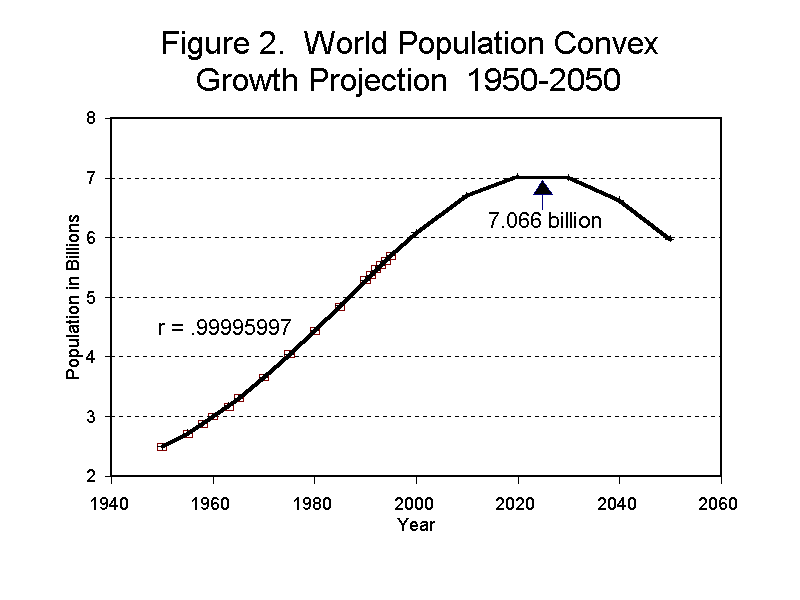
What in God's name are you talking about? Did you just make all this crap up just now? Source please. I'm attaching an graph of the world demographic projections accepted by every population expert that I know of. The peak date may vary, according to experts, but the trend does not.
 Attachment: f2proj.gif Attachment: f2proj.gif
This has been downloaded 26 time(s).
|
|
| |
|
|
|
Ell_man
|
|
Am I the only one who finds it funny that Kidicious asks for a source on Velociryx's conjectures then posts a graph with his very informative source being "every population expert that I know of"?
Concerning the possibility that economic growth will stop at one point, I personally believe that's false. There's always scarcity- people will never be completely satisfied with what they have. There will always be people who argue someone has too much and others have too little. People will always want more. I don't mean more in an evil materialistic way either. You want more leisure time, fullfilling relationships and other non- material goods too.
|
|
| |
|
|
|
Sandman
|
|
Sinister Penguin
Aug 2001
time: 05:20
|
|
quote:
Yes. Communism is an ideology steeped in the notion of plenty for everyone and of COMMUNAL (or state, which they'll tell you amounts to the same thing) ownership. This implies a number of things, best summed up by the phrase "each according to his ability, and each according to his needs" Which is the mantra for many, if not most communists here. |
Ok, communists. Is 'for each according to his ability, to each according to his needs' your 'mantra'?
quote:
It's also entirely possible that continuing technological advances will push the "maximum upper limit" of population that the earth can support to new heights, as our ingenuity (and the savvy use of CAPITAL) allows us to do such things as build cities on the sea (Buckminster Fuller, circa 1030's), or under it, or on the moon, or on Mars, or.... |
If you're willing to entertain such notions, then perhaps you should be more careful when you're calling the communists on their sci-fi visions.
|
|
| |
|
|
|
Velociryx
|
|
of Candle'Bre
Apr 1999
time: 05:20
|
|
On my way to work, and I'll likely not be able to get back to the 'net for a couple weeks, minimum, so now I suspect you'll be crowing about your spectacular "victory" *shakes head laughing*
We can get an outsider (someone who didn't participate in the debate) to score it, but I think it will not end well for team red...I'm game if you are tho!)
And to these latest snotty little comments:
If you're willing to entertain such notions, then perhaps you should be more careful when you're calling the communists on their sci-fi visions.
Given that the technology exists RIGHT NOW to do most of the stuff on my list...yeah, I'd say that puts it a bit closer to reality than replicator technology. Sorry...didn't mean to disturb your communist wet dream. Now back to our regularly scheduled programming....
Am I the only one who finds it funny that Kidicious asks for a source on Velociryx's conjectures then posts a graph with his very informative source being "every population expert that I know of"?
Noticed that too, and had a good chuckle. Also note that I even AGREED that it was likely "at some point" that population would level off (which is essentially what the graph showed). The whole "population decrease is permanent" statement was pure rediculous....as if technology won't expand, thus raising the cap, or people will suddenly forget how to have kids...uh huh. But, it supports commie fantasy land, so of course, it's devoured as eagerly as that crusty old blowhard, Marx.
If R&D is the driving force of GDP growth, you get diminishing returns from it, and it can't increase as a percentage of GDP then there is no growth in GDP.
Ahhh...yes, IF R&D (defined as the formal research conducted BY corporations/government) is the sole force that increases GDP, you would be right. Since it's not (there's private inventors, whose work is not counted in R&D studies, there's market maturation, spinoff products requiring no r&d to develop, etc., etc., etc....), you're full of spoiled communist stew, as usual.
Your understanding of economics seems to be limited to that which supports your worldview. You have no capability of understanding it further. It's no wonder you use such pitiful debate strategies.
Notice here how when he didn't like my answer, rather than enlightening me and the good readers of this thread, he simply provided a "filler" answer which was generally disparaging, making himself look like the wise old teacher, and me the stumbling buffoon, and then skittered AWAY from the topic to avoid having to give particulars? Typical of team red. You'll see this basic move often. Study it well!
What in God's name are you talking about? Did you just make all this crap up just now? Source please. I'm attaching an graph of the world demographic projections accepted by every population expert that I know of. The peak date may vary, according to experts, but the trend does not.
Interesting that the graph you posted does not dispute what I said...namely, that at some point (I, like the "various experts" you cited, do not know exactly WHEN the peak will occur) but I SAID At some point, we can expect it to level off which is what the graph shows. Not my fault that the graph stops recording its predictions shortly after the drop, but I went a bit further and predicted that once said peak is reached, population would become cyclic, hovering near the peak, sometimes contracting, sometimes expanding. This is rather different from Kid's "population decrease is permanent" nonsense, but then, I've come to expect regular doses of nonsense from yonder side of the ideological fence.
Enjoyed it...and now you've got your sandbox back. Hopefully, someone from the Capitalist side will step in and pick up the slack, so this doesn't turn into another CCJ thread (Communist Circle Jerk...you know, where everyone sits in slack-jawed awe, admiring Marx, and the wonders of communism, taking turns extolling its virtues, etc., etc., etc)...most probably, you'll be in kinder, gentler hands, so those tender egos won't be at such risk.
I'll be back when I can...busy busy busy, what with all my economic slaves to tend to...
-=Vel=-
|
|
| |
All times are GMT. The time now is 05:20.
Apolyton Time is 00:20. |
top of page
|
|
|
Forum Rules:
You may not post new threads
You may not post replies
You may not post attachments
You may not edit your posts
|
HTML code is ON
vB code is ON
Smilies are ON
[IMG] code is ON
|
|
|
|
|
|





 26-05-2005 00:36





 |
|