|
| |
|

|
Timexwatch
|
 |
Columbia Heights, Washington D.C.
Jul 1999
time: 00:23
|
|
quote:
French Reject Europe's First Constitution
By JOHN LEICESTER
The Associated Press
Sunday, May 29, 2005; 5:01 PM
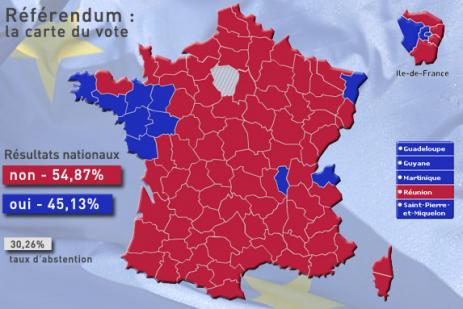
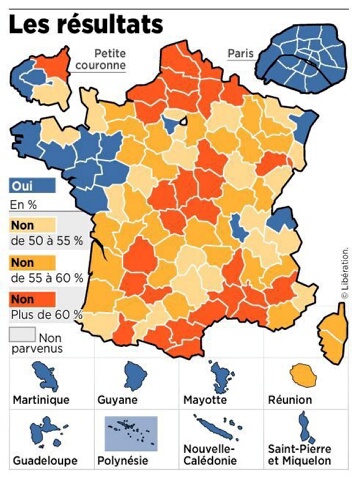
PARIS -- French voters rejected the European Union's first constitution Sunday, President Jacques Chirac said _ a stinging repudiation of his leadership and the ambitious, decades-long effort to further unite the continent.
Chirac, who urged voters to approve the charter, announced the result in a brief, televised address. He said the process of ratifying the treaty would continue in other EU countries.
"France has expressed itself democratically," Chirac said. "It is your sovereign decision, and I take note."
Earlier, the Interior Ministry said that with about 83 percent of the votes counted, the referendum was rejected by 57.26 percent of voters. It was supported by 42.74 percent.
All 25 EU members must ratify the text for it to take effect as planned by Nov. 1, 2006 _ and nine already have done so. The Dutch vote Wednesday, with polls showing opposition to the constitution there running at about 60 percent.
France's rejection could set the continent's plans back by years. The nation was a primary architect of European unity.
"There is no more constitution," leading opponent Philippe de Villiers said. "It is necessary to reconstruct Europe on other foundations that don't currently exist."
De Villiers called on Chirac to resign _ something the French leader had said he would not do _ and called for parliament to be dissolved.
"Tonight we face a major political crisis," he said.
Extreme-right leader Jean-Marie Le Pen, who campaigned vigorously for the constitution's defeat, also called for Chirac's resignation.
Chirac "wanted to gamble ... and he has lost," Le Pen said.
The rejection could kill any hopes Chirac may have had for a third term. His approval ratings have plunged to 39 percent in recent weeks, and there was widespread speculation a "no" vote would prompt him to fire unpopular Prime Minister Jean-Pierre Raffarin.
European leaders negotiated the treaty in October in Rome. EU officials said before the vote that even if France rejected the treaty, efforts to ratify it in other countries would proceed.
On Friday, the constitution's main architect, former French President Valery Giscard d'Estaing, said countries that reject the treaty will be asked to vote again. |
Does this mean that the French are getting the current constitution, whether they like it or not? Or does anyone think that the E.U. will have the courage to start over and make the constitution stronger and more 'desireable'?
I for one highly doubt that a renegotiation will take place any time soon. It seems that many of the elite see this as a done deal that'll be approved one way or another.....
|
|
| |
|
|
|
BlackCat
|
|
quote:
Originally posted by duke o' york
Well it would appear that the Non had better spin than the Oui. Let's face it, there's probably about eight people in the whole of France who read the whole thing (despite everyone getting a free copy from the government delivered to their door).
I haven't read it either, but I bloody plan to if Mr Tony Blair ever gets round to inviting us to vote on it. (We'll reject it too by the way, I'll tell you that now without having read it, or without anyone having read it). |
Not according to my local news. The french bookshops has apparently sold a lot of books about the subject, both the raw text and different analysis of it.
|
|
| |
|
|
|
Jon Miller
|
|
is this going to be another one of those things where people are asked to vote on it again and again until they get tired of voting and vote yes?
Jon Miller
|
|
| |
|
|
|
Spiffor
|
 |
CPA - Evil Clone brigade
Nov 2001
time: 06:23
|
|
Maybe I can help understand the situation.
The refendum's aftermath, as usual, was full of crappy politicians trying to explain that their party was the winner, that they have the right interpretation. However, there are some polls that actually depict the public's behaviour:
From abroad, or from the international press (which, in Europe, is mostly constitution friendly), it is tempting to believe in facile myths. These polls debunk it quite well.
1st myth: The Non vote was all about domestic issues. False.
The three main reasons among the non voters were (several possible answers)
- you're unhappy with the current socio-economic situation in France: 52%
- the constitution is economically too liberal [European meaning] 40%
- It will allow to renegociate a better treaty: 39%
In France, the political establishment and their pro-Oui friends in the press are quickly tempted to paint the Non voters with a broad brush, that they only cared about domestic policies, and not one notch about Europe. This is false. Despite the very prevalent charicature, one half of the non voters didn't express any socio-ecoonmic discontent in their vote. This half's vote was fully motivted by European issues.
So, the Non vote was not entirely about domestic economic matters. Was it about domestic political matters? Did the French want to overthrow Chirac and his cronies? Again, no.
The statement "it is the opportunity to oppose the government of Jacques Chirac" is the one that was the least supported by the non voters (24%). The "blind opposition" vote wasn't entirely unexistent, but it was nothing as close as what our Oui politicians want to believe.
2nd Myth: The French didn't bother to evaluate the constitution. False.
48% of the polled evaluate the constitution as "very bad" or "rather bad". OTOH, 41% evaluate it as "very good" or "rather good". Only 11% of the polled have no opinion on the issue.
If you don't take the "no opinion" into account, you have 54% of the polled that are disfavourable to the con, while 46% are favourable. It is very close from the eventual result.
3rd Myth (that will mostly be heard abroad IMO): This referendum shows that the French are anti-European. False.
A whooping 72% of the French population are "very favourable" or "rather favourable" to continue the European construction. Only 23% are opposed to it.
|
|
| |
|
|
|
Spiffor
|
|
CPA - Evil Clone brigade
Nov 2001
time: 06:23
|
|
quote:
Originally posted by CapTVK
So it was the fascist and communists that won the day. |
The ones who made the Non a reality weren't the fascists or Commies. If the fascists and Commies had been the only ones to vote non, you'd have about 35% non and 65% oui.
The difference was made by the moderate left. A few months ago, nobody expected the supporters of the moderate left to vote for the Non (actually, before some center-left politicians started to publicly oppose the constitution, the debate was pretty much dead, and 60% of the population supported the con).
The center-left voters have actually formulated an opinion only after the debated kicked off among their politicians. This is why the trend has been precisely inversed between the pre-campaign and the post-campaign vote:
When the Socialist party (centre-left) had its internal referendum on the party's stance about the constitution, 60% of the members voted Oui. Now, 56% of the socialist voters have voted Non. Overall, 63% of the supporters of parliamentary left parties voted Non.
Last edited by Spiffor on 30-05-2005 at 06:25
|
|
| |
|
|
|
Spiffor
|
|
CPA - Evil Clone brigade
Nov 2001
time: 06:23
|
|
quote:
Originally posted by Shi Huangdi
So domestically in France, who do you think are the biggest winners and losers as a result of this treaty? |
Personally, I think the biggest winner is Laurent Fabius. He is the archetype of the spineless manipulative centre-left elitist, But he's the only one of his kind to have lobbied for the Non. There were other Socialists for the Non, but they're not the same kind, as they're actual social-democrats with ideas. Actually, the victory of the Non can be largely imputed to Fabius, because he's the one who opened the can of worms (a mainstream debate  ). Since the Socialist Party is utterly divided, and since the party's leadership has been considerably weakend, Fabius may well be the one who ends up leader of the party, which will be very good for him in the 2007 presidential election. ). Since the Socialist Party is utterly divided, and since the party's leadership has been considerably weakend, Fabius may well be the one who ends up leader of the party, which will be very good for him in the 2007 presidential election.
quote:
It seems clear Chirac and his party are obviously the losers and it seems like this has to be a pretty big credibility hit? |
This is definitely a credibility hit for Chirac abroad, but I don't think Chirac's credibility can further sink in the French opinion (well, I'm extremely biased  ). ).
quote:
Do you think Sarkozy will now be in a better position against Chirac to lead the right? |
Nicolas Sarkozy definitely benefits from it. He wasn't nearly as vocal as Chirac during the campaign, and he made a move as soon as the results were broadcasted. It's likely that the last remnants of Chirac supporters will now back Sarkozy, because he's frankly the last guy in the right that still appeals to the masses.
quote:
Are the Socialists likely to go into disarray since they were so split over ratification? |
I don't know at all. There will be much reorganisation in the Socialist party, that's for sure. However, the party holds on a very solid ground: no matter the ideological differences between the members, the Socialist Party is a fantastic way to come to power, as long as it's united. If the Socialists splinter, they'll lose their ability to win seats, which is the one thing they cannot tolerate.
quote:
And how about the anti-EU Communists and National Front, will this booster either of them? |
I think the Commies have scored an important success on which to capitalize. As a party, the Communist Party was the only one to call for a left-wing No during the official campaign (other far left parties were too small to take part to the official campaing). The Commies were the main organizers of the left-wing Non synergy, though Fabius didn't take part into it.
The Commies might be up to something to create other broad alliances with parties that are serious with leftwingness in the future (the alliance with the whole Socialist party was very bad for the Commies, but there is a common understanding with the leftiest of the Socialists).
The fascists have certainly scored something (they're actually seen among the big winners by the popular opinion), but I don't really know. The campaign was much less about national soveriegnty than the 1992 one, which is the item the fascists push on the agenda. Overall, I would say this referendum brings little more to the fascists than any other relative electoral success. But I'm really no specialist on that bunch.
|
|
| |
All times are GMT. The time now is 05:23.
Apolyton Time is 00:23. |
top of page
|
|
|
Forum Rules:
You may not post new threads
You may not post replies
You may not post attachments
You may not edit your posts
|
HTML code is ON
vB code is ON
Smilies are ON
[IMG] code is ON
|
|
|
|
|
|





 30-05-2005 02:15








 Britain is pro-freetrade but France (seeing the 55% massive turnout) obviously isn´t.




 to this great humiliation of Jacques Chirac.


 Attachment:
  |
|