|
| |
|

|
Colon
|
 |
Antwerp, Colon's Chocolate Canard Country
Jan 1970
time: 06:18
|
|
quote:
The Japanese government is, for some reason, convinced that construction projects are the way to end their rather lengthy recession. That it hasn't worked yet does nothing to stop them from trying, like most government projects. |
There are good reasons to suspect the Japanese is trying to support the stock market using funds from its govt pensions funds. Of the 1,9 trillion Yen it received last year it invested 1,3tr in Japanese shares while it had a negative return of 17% on those investments. (worse than the topix drop of 16% and worse than the positive returns it receives on foreign investments)
Squandering pension money like that, it's getting ever more disgusting...
Last edited by Colon on 02-08-2002 at 18:39
|
|
| |
|
|
|
DanS
|
 |
Kickball Capital of the World
Jan 1970
time: 00:18
|
|
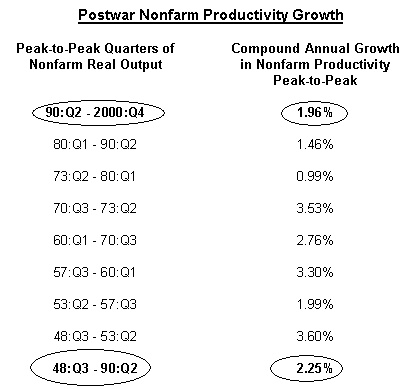
The (adjusted) returns on the last business cycle are starting to roll in. Kasriel has a good, short look at comparable productivity during expansion periods...
http://www.northerntrust.com/librar.../us/020819.html
I think he's looking at this cup half empty. 2% productivity growth per annum for a 10 year stretch is good, IMO, especially compared to our experience 1973-1990 and the decade-long employment and population boom.
Looking back, 1960-73 was an amazing period. To me, it isn't even real in a sense. I was born in '73 and am a child of the oil shocks. 2% productivity growth rate felt very good and the change seemed very fast. I can only imagine what a nearly 3.5% growth rate would be like.
 Attachment: 020819_01.gif Attachment: 020819_01.gif
This has been downloaded 47 time(s).
Last edited by DanS on 20-08-2002 at 21:54
|
|
| |
|
|
|
DanS
|
|
Kickball Capital of the World
Jan 1970
time: 00:18
|
|
Anecdotal evidence suggests that productivity growth due to information technology has a ways to run.
My brother-in-law is a machinest at Meritor, which builds custom heavy axels and we have been having a running discussion--mainly him telling me how things are run at the plant (yeh, you've got to believe you're interested at family gatherings to make it through  ). About 3 or 4 years ago, they moved to a just-in-time model, which he just hates. He says the assembly line is always being held up because they don't have one or another small and cheap part. ). About 3 or 4 years ago, they moved to a just-in-time model, which he just hates. He says the assembly line is always being held up because they don't have one or another small and cheap part.
Also, he uses a terminal to track what he does, which automates the stocking process from the back office. He complains that often it doesn't work like it should, and that he has to call the back office anyway to make sure he's stocked. He does admit that it's nice when it does work. If he uses 4 bolts of a specific type, then 4 bolts are re-ordered automatically.
Of course, I try to explain to him that from management's POV, him using this system, even if faulty and inconsistent, is amazingly good--a huge step forward in management control. But it's a tough sell, considering that he doesn't see it. He just sees an idled line because of a nut that costs $1 is not in stock.
This reminds me a lot of the 80s and 90s, when the advent of complicated spreadsheets allowed financial engineering on a mass scale.
The other day, my secretary told me about how her first job was in a corporate accounting department, where they did spreadsheet calculations using a typewriter and 9 copies using carbon paper.  In the 80s, they moved to Lotus, etc., which was kludgy. Then the 90s brought the blue screen of death. Now, I run spreadsheets doing at least a million calculations without a second thought. In the 80s, they moved to Lotus, etc., which was kludgy. Then the 90s brought the blue screen of death. Now, I run spreadsheets doing at least a million calculations without a second thought.
|
|
| |
|
|
|
el freako
|
 |
Bristol, European Union
Oct 1999
time: 05:18
|
|
quote:
Originally posted by DanS
I think he's looking at this cup half empty. 2% productivity growth per annum for a 10 year stretch is good, IMO, especially compared to our experience 1973-1990 and the decade-long employment and population boom.
|
What employment boom?
The US's employment rate has been static or falling since 1990 after rising very strongly during the 1970's and 1980's.
If the employment growth had continued then GDP growth in the period 1990-2000 would have been higher than in the period 1970-1990, however it was exactly the same (3.2% in each case)
So the increase in productivity growth has been completely offset by a reduction in employment growth.
Even the underlying trend in growth hasn't improved - if you take the rise in productivity* and rise in the workforce over a cycle to be equivalent to the underlying growth rate then it was 3.1% in 1973-79, 2.9% in 1979-90 (the average for 1973-90 is 3.0%) and 3.0% in 1990-2000
*I am using GDP per man-year as I have no data for hours going back to 1973
BTW what does everyone think of the large budget deficits that the US is now racking up (over 3% of GDP in the first half of 2002)?
Last edited by el freako on 21-08-2002 at 18:53
|
|
| |
|
|
|
DanS
|
|
Kickball Capital of the World
Jan 1970
time: 00:18
|
|
Hey, where's my cigar??!! 
Aren't little kids cute? Once you hit 25, you're over the hill though. 
"What employment boom?"
The one that provided jobs to all of those immigrants.
"*I am using GDP per man-year as I have no data for hours going back to 1973"
I saw those numbers a couple of days ago. In the States, still holding steady at roughly 1,800-1,900 hours per annum, IIRC. In Europe, slides to (very) roughly 1,400 hours, depending on country.
"BTW what does everyone think of the large budget deficits that the US is now racking up (over 3% of GDP in the first half of 2002)?"
How do you figure these numbers? By my calculation, it's well under 2%.
http://www.fms.treas.gov/mts/mts0602.txt
Jan -- 43.7B
Feb -- (76.1B)
Mar -- (64.3B)
Apr -- 67.2B
May -- (80.6B)
Jun -- 29.1B
Total deficit = $81B / $5,000 x 100% = 1.62%
This squares with the numbers provided by FT, which probably prompted your post...
http://search.ft.com/search/article...id=020820005916
But by and large, I think these numbers suck. There is no fiscal discipline in this town nowadays.
|
|
| |
|
|
|
el freako
|
|
Bristol, European Union
Oct 1999
time: 05:18
|
|
quote:
Originally posted by DanS
"What employment boom?"
The one that provided jobs to all of those immigrants.
|
If it was a boom comparable to those in the 1970's and 1980's then you would have seen a rise in the US's employment rate (employed/working age population) similar to those times - what happened was stagnation.
If employing all those immigrants was so important then why has the US's activity rate been falling for over a decade?
quote:
Originally posted by DanS
"*I am using GDP per man-year as I have no data for hours going back to 1973"
I saw those numbers a couple of days ago. In the States, still holding steady at roughly 1,800-1,900 hours per annum, IIRC. In Europe, slides to (very) roughly 1,400 hours, depending on country.
|
You couldn't PM me either a link or the data could you?
I'd love to get hold of an average annual hours series going back to 1973!
Pretty please 
quote:
Originally posted by DanS
"BTW what does everyone think of the large budget deficits that the US is now racking up (over 3% of GDP in the first half of 2002)?"
How do you figure these numbers? By my calculation, it's well under 2%.
|
Actually I got that data from the BEA national accounts release (Table 3.1, line 24 'net lending'), this was a $300bn deficit in the first quarter and a $340bn one in the second (actually I estimated one figure to achieve this, it was line 3 'Corporate profits tax accruals', I estimated this at $200bn - slightly above the average for the last four quarters - when the preliminary estimate of GDP is out next thursday we'll see how far out I am)
**edit**
looking at the new data it was $212bn so I was out by $6bn in the following estimate - or 0.1% of GDP
**edit**
The average figure of a $320bn deficit (at annual rate) is 3.1% of the $10,340bn (again, at an annual rate) GDP for the period.
The figures you are referring to seem to be only for the federal government, not all federal+state+government corporations etc.
My reason for choosing this measure of budget balance is (as usual) that is is the most internationally comparable figure. It reached a peak of $165bn surplus in Q1 2000 (1.7% of GDP), since then it has deteriorated by around 5% of GDP (or $10bn a week at today's prices
Last edited by el freako on 07-09-2002 at 00:25
|
|
| |
|
| |
All times are GMT. The time now is 05:18.
Apolyton Time is 00:18. |
top of page
|
| archivepost |
|
Forum Rules:
You may not post new threads
You may not post replies
You may not post attachments
You may not edit your posts
|
HTML code is ON
vB code is ON
Smilies are ON
[IMG] code is ON
|
|
|
|
|
|





 02-08-2002 18:32


 Attachment:
  |
|