|

|
Lefty Scaevola
|
 |
San Antonio TX USA
Oct 2000
time: 23:22
|
|
I would not worry about, like the rest of the crooked goverments, they are just going to give the treaty requirments lip service.
Last edited by Lefty Scaevola on 05-09-2002 at 02:33
|
|
| |
|
|
|
blackice
|
 |
Canada where else...
Sep 2000
time: 00:22
|
|
Fez Uh huh. 
The statistic that combines energy and economic statistics is called "energy intensity" -- the amount of energy consumed per unit of economic output. More goods and services produced using less energy means lower, thus better, energy intensity.
So if you produce a product with less energy=cost how can that be a loss? The oil industry will just have to continue to find cheaper ways to make it work. This is not new they have been working at ways to make it cheaper thus more profits for some time now.
The problem is the solutions in part have been pollution causing ones. Now it's time they did it with some respect of man kind.
In fact then you could produce more products for the same intensity.
Seems this is the thinking in China, should be every where.
Any rate try this link:
http://www.nrdc.org/globalWarming/achinagg.asp
Many more echo this one.
http://www.infoexport.gc.ca/docs/cn_chhktap02-5f-e.htm
Guangdong Province, the economic engine of South China, is spending 2.5% of its GDP on environmental protection, launching the Clear Water Program and the Blue Sky Program to improve quality of life in the province. It also offers many incentives to promote participation of the private sector. Beijing, as host of the 2008 Olympics, has promised a massive infrastructure program and a cleaner environment, with a focus on cleaner air. Under current plans, prior to 2008, water treatment rate will reach 90%, safe garbage disposal will reach 98% and the usage of natural gas will increase 4 or 5 times over 2000 levels. Shanghai, as commercial centre of China, is also spending increasing amounts of money on environmental protection with the objective of having an environment consistent with its aspirations of being an international financial centre.
You would think having the relationship with Chinese provinces like the Klein government has. They would know all this and would have acted a lot sooner to stay competative.
Last edited by blackice on 05-09-2002 at 02:17
|
|
| |
|
|
|
Tingkai
|
|
To find the Northwest Passage
Aug 2001
time: 13:22
|
|
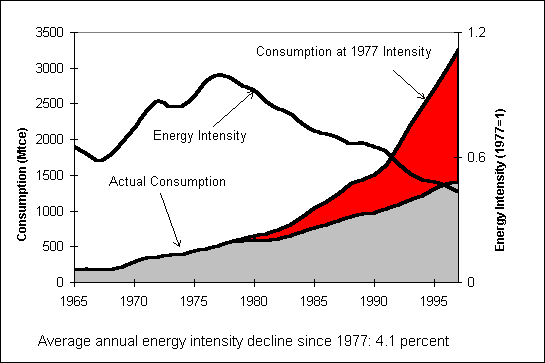
China uses a lot of coal, but its use of coal is becoming more efficient.
The following is from http://www.pnl.gov/china/aboutcen.htm
One promising aspect of China's energy development related to the environment has been in energy efficiency. On average, energy intensity, a measure of energy consumed per unit of economic output, has dropped by over 4 percent each year since 1977. Without this reduction, China would now be consuming twice as much energy as it actually does. The graph below shows that energy consumption in 1998 would have been over 3000 million tons of coal equivalent (Mtce), compared to the actual level of about 1400 Mtce, if intensity remained constant at the 1980 level.
 Attachment: chinaconserv1.gif Attachment: chinaconserv1.gif
This has been downloaded 20 time(s).
|
|
| |
|
|
|
Tingkai
|
|
To find the Northwest Passage
Aug 2001
time: 13:22
|
|
Also, from the World Bank:
"Average air quality in China has stabilized or improved since the mid-1980s in monitored cities, especially large ones - the same period during which China has experienced both rapid economic growth and increased openness to trade and investment."
http://www1.worldbank.org/economicp...ation/ag04.html
EDIT: However, new forms of air pollution are rising as other forms of pollution decrease. One major problem facing China is the increasing number of motor vehicles.
Last edited by Tingkai on 05-09-2002 at 07:14
|
|
| |
|
| |
|
|
|
Asher
|
 |
Calgary, Alberta
Nov 1999
time: 22:22
|
|
quote:
Originally posted by blackice
Interesting point and covered earlier, Canada will be bound by the agreement to with draw hold back all and any subsities etc. etc. to the non comforming party. I may point out that is quite a lot of money the feds pump into the Alberta economy for oil alone. |
The net contribution is negative for Alberta. If the feds stop giving us back a percentage of the huge figure we pump into the federal government, what's to stop us from giving the feds that money in the first place? 
Alberta puts in more than we get, everyone knows that, so if the Feds can't play games by withholding funding because it will only bite them in the ass.
quote:
Besides realisticaly less energy comsumption per unit means more profits. |
Which is why there already is movements towards cleaner energy. Perhaps you didn't hear about how Enmax allows users to use wind power to power their homes (6000 homes in Calgary use wind power), about how Calgary Transit's LRT is completely 100% emission free with wind power, stuff like that?
quote:
He looks like the fool he is. Opec will be producing it cheaper and Alberta will lose market shares. |
That's right, with the government forcing unrealistic standards on Canada, OPEC will be producing alot cheaper and Alberta will lose market shares. Thanks for agreeing.
The only way to curb to 1990 levels is to cut production. The easiest way to do that is for the government to increase cost substantially...
quote:
Another point if we are reducing why not sign it? Seems to me extentions are allowed so what's the beef? |
Because it's a completely unrealistic idea. Stuff like Alberta experienced enormous growth from 1990, cutting back to 1990 levels will only be accomplished by shutting down production substantially.
Current estimates have pegged Alberta losing 40,000 jobs from it and $5B/year, where are Ottawa's studies on it? That's right, they're not important for them to study...
|
|
| |
|
|
|
blackice
|
|
Canada where else...
Sep 2000
time: 00:22
|
|
quote:
The net contribution is negative for Alberta. |
One rebutal at a time I'll go slow....Remember some information is older but if you like I can update it for you.
Or you could do the right thing and look it up for yourself? Bottom line the picture is bigger than you think. Oh and this will annoy you Asher, sorry but I have to respond with all the information which means a long post.
FEEDING THE DINOSAURS: Billions in govt. handouts going to wealthy oil companies
While the federal Liberal government cuts $7 billion this year from health, education and social assistance, it continues to lavish multi-billion-dollar subsidies on the major oil companies which are destroying wildneress areas and polluting the environment with acid rain, smog and greenhouse gases.
The extremely profitable oil industry generated $56.8 billion in revenue in 1994, yet received more than $743 million in direct federal grants, as well as another $1.2 billion in tax breaks. Among the grants were $171.6 for the Hibernia offshore megaproject near Newfoundland, $11.1 million for Nova Scotia offshore projects, $26 million for a pipeline to Montreal, and $30 million for research on hydrocarbon supply and fuels technology.
Government staff support for the oil industry totalled $229.4 million in 1995, spread over three programs within the Department of Natural Resources: economic analysis, marketing to the United States, and maintaining frontier reserves offshore and in the North.
The largest category of handouts to the oil companies, however, is hidden in the federal tax system. The oil companies have a vast array of tax breaks and loopholes to draw from--so many that in 1994 they were able to reduce their $56.8 billion in revenue to a mere $4 billion in taxable income and to just $1.2 billion in actual federal income tax paid.
Now the oil industry is pressing the federal and Alberta governments for yet more handouts. Eric Newell, chief ececutive officer of Syncrude--a consortium owned by Exxon, Shell, Gulf, and other big oil firms--has already convinced Alberta Premier Ralph Klein to essentially eliminate royalties for tar sands production--a perk worth $2.1 billion over the next eight years. (The tar sands are a huge oil reserve in northeastern Alberta.)
Newell is also demanding from Ottawa--and is likely to get--an extension of the tax breaks available to the mining industry to the tar sands industry. These new tax breaks would be worth about $702 million over the next eight years, according to an Informetrica study.
The exploitation of the tar sands comes at a staggering environmental cost. The complex process involved in converting the tar sands bitumen to synthetic crude oil involves mining from enormous open pits gouged from Alberta's boreal forest. It also requires vast amounts of energy. Roads, pipelines and other infrastructure further damage the wilderness.
The environmental group Greenpeace says that, far from giving the oil industry more handouts, the federal government should eliminate all the present energy subsidies.
"There are three good reasons for stopping these handouts," says Kevin Jardine, a Greenpeace campaigner. "First, energy subsidies take money away from social programs. It's scandalous that the Chretien government is slashing $7 billion from social spending and forcing the closure of schools and hospitals, while continuing to subsidize the immensely profitable oil industry.
"Second, energy subsidies cause unemployment. The oil industry is one of the least labour-intensive industries in Canada. A million dollars spent on oil production generates only seven new jobs, whereas the same amount spent in any other area of the economy would produce at least three times as many jobs. By diverting money into the job-poor oil industry, the government is contributing to higher unemployment elsewhere in the economy.
"Third, energy subsidies cause environmental damage. They enable the oil industry to exploit reserves that would otherwise be left untouched. These reserves are often in remote, environmentally-sensitive wilderness areas far from public scrutiny; or else they require forms of processing that pollute the air, water and soil. The production of synthetic crude oil, for example, produces 10 times more carbon dioxide (the main climate-warming greenhouse gas), 12 times more sulphur dioxide (the main cause of acid rain), and three times more nitrogen oxides (the main cause of smog) than the production of ordinary fuel oil."
The Commons Standing Committee on the Environment and Sustainable Development warned last December that "federal assistance seems to be biased towards the conventional polluting energy industry."
And Jim McNeill, one of Canada's most renowned environmentalists and a lead author of the influential Brundtland Commission Report, Our Common Future, has also called for the termination of all federal handouts to the oil industry. He says that these billions of dollars could more constructively be diverted into encouraging the development of more efficient and renewable forms of energy which would reduce greenhouse gas emissions and save billions of dollars.
There was no sign in Paul Martin's recent budget, however, that this advice will ever be heeded by his government.
Taken from The CCPA Monitor, May 1996.
Articles from The CCPA Monitor
|
|
| |
All times are GMT. The time now is 05:22.
Apolyton Time is 00:22. |
top of page
|
| archivepost |
|
Forum Rules:
You may not post new threads
You may not post replies
You may not post attachments
You may not edit your posts
|
HTML code is ON
vB code is ON
Smilies are ON
[IMG] code is ON
|
|
|
|
|
|





 04-09-2002 16:16





 |
|