|
| |
|
| |
|
| |
|

|
Exile
|
 |
of the Benighted Realms
Sep 2000
time: 23:16
|
|
Leonidas;
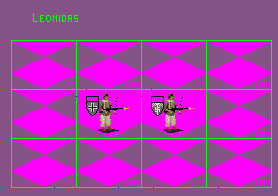
I spotted your units gif for an upcoming Afrika Korps campaign. Some general comments below, but here are some specific comments about units; The Afrika Korps uniform, as fairline has mentioned, was much lighter in shade AND so were all the DAK vehicles. Their paint scheme was much lighter than even the British desert paint schemes. Photos I've seen of Luftwaffe fighter and bomber units also were painted light colors and had a camo scheme as well. Your artillery units need to be completely reconsidered. Take a look at the German 150 or 105 mm howitzers--those should be the models you use. The British used the 25 pounder gun/howitzer and the 5.5 inch gun/howitzer. The American army in North Africa used primarily the tried-and-true 105 mm howitzer (we made a LOT of these, lol.) While there were 2 or 3 divisions of Australians (2nd and 7th, IIRC), there were more Indian infantry divisions in the desert than any other commonwealth troops. There were also at least 2 South African infantry divisions and two South African armored/mechanized reconaissance units. By FAR the bulk of transport, for both commonwealth and axis forces was the truck/lorry, and both sides used a rather motley collection of vehicles from both sides--lots of captured equipment. After the breakout battle by Rommel at El Ageila, ALL units, Italian included, were motorized/mechanized. The idea that foot infantry could operate successfully in the desert was abandoned after Graziani's utter rout in '40 south of Mersa Matruh; 150,000 foot troops were rounded up by a relatively paltry force of Brits; elements of the 7 Armored and 4th Indian divisions--probably less than 15,000 men and 300 total vehicles, not counting the trucks/lorries. (Historical note; rather surprisingly, this 10-1 ratio is almost exactly what Fuller had suggested during the interwar period when asked to comment on the effectiveness of mobile to foot troops.)
Now for some general comments; The Western desert campaign is actually a very good use of what the Civ2 program has to offer. While the mobile battles in Cyrenaica and Egypt were exemplary from a tactical point of view, the campaign was conditioned, if not governed, by what was happening in the Mediterranean Sea. The importance of Malta, the concentration of Luftwaffe resources in southern Italy and Sicily, and the sea battles fought between the Italian and British naval units had tremendous effect on who was winning in the desert. When the Royal Navy could fight a convoy through the Med, the commonwealth forces could go on the offensive. When the axis could suppress the RAF units on Malta, Rommel would have enough troops, equipment, and, most importantly, PETROL to go over to the offensive on his part. The campaign was fought on land, sea, and air--a great setup for a scenario designer.
I can suggest a few books; Panzer Battles by Von Mellenthin. Great stuff by a staff officer who was there and gives superb details on strategic information that only those overseeing the campaign could offer.
Ballantine Books' Africa Corps. Could be difficult to find nowadays, but I have a copy around here somewhere. Very nice maps of every important battle, and the writing is in a neat, summary form--you don't have to wade through a lot of extraneous material to get to the heart of it. A HUGE number of photos, though in black and white, sadly. Even so, the wealth of photos does provide a solid look at what kind of vehicles, artillery, aircraft, and uniforms were in use by the various participants.
This response is kind of late, but . . . better late than never. 
|
|
| |
|
| |
|
|
|
fairline
|
 |
of the wing
Sep 2002
time: 05:16
|
|
quote:
Originally posted by Exile
... While there were 2 or 3 divisions of Australians (2nd and 7th, IIRC), there were more Indian infantry divisions in the desert than any other commonwealth troops. There were also at least 2 South African infantry divisions and two South African armored/mechanized reconaissance units.
|
The N. Africa campaign really was a Commonwealth/Empire effort. As Exile says there were Aussies, Indians, S. Africans as well as the elite 2nd New Zealand Division and Scottish and English divisions. The Australians pulled out to defend Australia after Pearl Harbor, although to maintain the cosmopolitan flavour their place was taken by Polish and Free French units.
quote:
By FAR the bulk of transport, for both commonwealth and axis forces was the truck/lorry, and both sides used a rather motley collection of vehicles from both sides--lots of captured equipment. After the breakout battle by Rommel at El Ageila, ALL units, Italian included, were motorized/mechanized.
|
Not entirely true - the Italians suffered a chronic lack of motorised transport throughout the war in the desert, although a much larger proportion of their divisions were armoured/mechanised after the disaster during Operation Compass. After El Alamein, Rommel skidaddled with the DAK and some of the Italian Armour, leaving the hapless Italian infantry to their fate.
You are absolutely right about the crucial nature of motorised units in the desert, though and your analysis of the importance of the Mediterranean supply line is spot on.
BTW, just to be fair to the Aussies the 6th Australian Division replaced the 4th Indian Division for much of the Operation Compass campaign, the latter having been transferred to fight in Abbysinia, IIRC.
|
|
| |
|
| |
|
| |
|
|
|
Leonidas
|
|
quote:
Originally posted by Exile
Leonidas;
I spotted your units gif for an upcoming Afrika Korps campaign. Some general comments below, but here are some specific comments about units; The Afrika Korps uniform, as fairline has mentioned, was much lighter in shade AND so were all the DAK vehicles. Their paint scheme was much lighter than even the British desert paint schemes. Photos I've seen of Luftwaffe fighter and bomber units also were painted light colors and had a camo scheme as well. Your artillery units need to be completely reconsidered. Take a look at the German 150 or 105 mm howitzers--those should be the models you use. The British used the 25 pounder gun/howitzer and the 5.5 inch gun/howitzer. The American army in North Africa used primarily the tried-and-true 105 mm howitzer (we made a LOT of these, lol.) While there were 2 or 3 divisions of Australians (2nd and 7th, IIRC), there were more Indian infantry divisions in the desert than any other commonwealth troops. There were also at least 2 South African infantry divisions and two South African armored/mechanized reconaissance units. By FAR the bulk of transport, for both commonwealth and axis forces was the truck/lorry, and both sides used a rather motley collection of vehicles from both sides--lots of captured equipment. After the breakout battle by Rommel at El Ageila, ALL units, Italian included, were motorized/mechanized. The idea that foot infantry could operate successfully in the desert was abandoned after Graziani's utter rout in '40 south of Mersa Matruh; 150,000 foot troops were rounded up by a relatively paltry force of Brits; elements of the 7 Armored and 4th Indian divisions--probably less than 15,000 men and 300 total vehicles, not counting the trucks/lorries. (Historical note; rather surprisingly, this 10-1 ratio is almost exactly what Fuller had suggested during the interwar period when asked to comment on the effectiveness of mobile to foot troops.)
Now for some general comments; The Western desert campaign is actually a very good use of what the Civ2 program has to offer. While the mobile battles in Cyrenaica and Egypt were exemplary from a tactical point of view, the campaign was conditioned, if not governed, by what was happening in the Mediterranean Sea. The importance of Malta, the concentration of Luftwaffe resources in southern Italy and Sicily, and the sea battles fought between the Italian and British naval units had tremendous effect on who was winning in the desert. When the Royal Navy could fight a convoy through the Med, the commonwealth forces could go on the offensive. When the axis could suppress the RAF units on Malta, Rommel would have enough troops, equipment, and, most importantly, PETROL to go over to the offensive on his part. The campaign was fought on land, sea, and air--a great setup for a scenario designer.
I can suggest a few books; Panzer Battles by Von Mellenthin. Great stuff by a staff officer who was there and gives superb details on strategic information that only those overseeing the campaign could offer.
Ballantine Books' Africa Corps. Could be difficult to find nowadays, but I have a copy around here somewhere. Very nice maps of every important battle, and the writing is in a neat, summary form--you don't have to wade through a lot of extraneous material to get to the heart of it. A HUGE number of photos, though in black and white, sadly. Even so, the wealth of photos does provide a solid look at what kind of vehicles, artillery, aircraft, and uniforms were in use by the various participants.
This response is kind of late, but . . . better late than never. |
To Exile and everyone:
Thanks for the input and ideas.
This Afrika Korps scenario is going to be a major up-date and revision of J. Petroskis's old "Afrika Korps" scenario.
Sadly, I had to choose the grey German armour scheme because at the moment there are no current desert units.
Perhaps some kind soul could create a complete set of desert camo German armour.
Although I do graphics, I am currently using MS paint, which is slow and can be difficult to do units properly.
I will look into other arty, but I basically chose arty that would stand out - it is after all a Civ2 scenario, and things will need to be abstracted. But I want to be as historical as possible.
As to gameplay. This scenario will only be playable as the Axis. This way, I will tweak the scenario to give the player a real run for his money. Rommel didn't have it easy, and neither will the player.
There will be a lot to do in this scenario. It will cover ALL of the Middle East, Southern Italy, Malta, and Greece.
There are a variety of things the Axis commander (you) can do. Here are just some of the strategies to consider:
1) Malta - it will be a thorn in your side. As long as Malta exists, Axis supplies will be curtailed and supplies from the UK will get through to Alexandria.
If the Axis takes Malta, then Allied supply efforts will be cut, and they will have to rely on convoy through the Suez, which will be at the mercy of U-boats.
But taking Malta will not be easy. Is the Italian Navy up to the challenge? Do you risk your surface fleet in a risky gamble to take Malta?
While Malta holds out, the Allies will receive 6-8 reinforcements (of armour and infantry) PER TURN. Compare this to the Axis reinforcements of just two armoured units per turn.
2) North Africa - Will the Italians be strong enough to take the offensive early in North Africa? Should they attack quickly, or wait for the Afrika Korps to show up in Tunisia? You are the overall theatre commander, so the decision is up to you 
3) The Afrika Korps - this is the elite German formation led by Field Marshal Erwin Rommel. They are all veterans and will consist of infantry, Panzer Grenadiers, as well as armoured formations. Utilize their offensive abilities well. They will arrive as reinforcements in Tunisia. They will serve as the major backbone in your offensive.
4) Greece - this area could open up an opportunity for the Italians and German units to score some territory and experience. Plus, it allows you more cities with which to build units. Without Malta, the ONLY way German and Italian air units can make it to North Africa, will be to secure some Greek territory, which will place Axis airfields in North Africa within flying distance. Plus, the German units left over from the Yugoslavia and Greece invasions may be of some assistance to you if you can get them to North Africa to help in the offensive.
The question is: How tough will it be to conquer Greece? Is the territory you gain worth the time, trouble and forces you will devote to this "sideshow"?
5) The Italians start with a substantial navy and ground forces. Plus ALL southern Italy can churn out units. However, these ground units are generally inferior to the British units, and to be of any use, they must be transported across the Mediterranean, subject to British Navy interference.
6) A victory for the Axis means taking Alexandria and the Suez. But it will be a long road to travel. Every turn that passes, means the British only get stronger 
Well, this should give you some idea of what I have been up to
Thanks again for everyone's individual interest and comments.
Cheers!
Last edited by Leonidas on 18-11-2003 at 13:59
|
|
| |
|
| |
|
|
|
Exile
|
|
of the Benighted Realms
Sep 2000
time: 23:16
|
|
Gareth,
About the Italian formations;
As I understand it, the Italian infantry divisions that were operating in the Western desert after Rommel's arrival actually were motorized units. IIRC, Trento, Pavia, Brescia, Bologna, and maybe 1 or 2 more.
However . . .
Their transports were often mobilized to conduct resupply operations. When the front advanced hundreds of miles/kilometers in very short periods of time, it was discovered that the necessary supply apparatus was insufficient. The Italian infantry units would then be stripped of their intrinsic transport. Because they were often utilized as holding-the-front troops, Rommel felt that they could spare their transport rather than pull trucks/lorries away from the more potent armored/Panzer formations. Also, the SAS was constantly raiding the over-stretched supply lines, the RAF was also hitting it whenever possible with interdiction missions, the destruction of transport units in transit from Europe was a constant condition, and finally, the maintenance problems created by the desert envionment all placed limits on the number of vehicles available for moving supplies from the available ports to the front. THIS was why Tobruk was so damn important--when the axis units could use it as their primary port, the Italians could have their transport back. On paper the Italian formations were motorized. In practice, they often found themselves on foot. When you stop and really examine the distances involved in some of the advances and retreats, it becomes apparent that ONLY motorized transport could get these troops from one battlefield to the next.
Try marching from Tripoli to Alexandria.
|
|
| |
|
| |
|
| |
All times are GMT. The time now is 05:16.
Apolyton Time is 00:16. |
top of page
|
|
|
Forum Rules:
You may not post new threads
You may not post replies
You may not post attachments
You may not edit your posts
|
HTML code is ON
vB code is ON
Smilies are ON
[IMG] code is ON
|
|
|
|
|
|






 16-11-2003 20:27




 Attachment:




 |
|