|

|
Andrew1999
|
|
quote:
Originally posted by Mad Bomber
What are you talking about, The Shuttle has been used for crew replacement since the inception of the ISS, and the station was designed around the use of the STS and Progress delivery systems. |
The other shuttles were used for the ISS. Columbia was much heavier than the other three.
There seems to be some disagreement among the papers I've looked at. Yesterday it was imposssible, today it was just in the wrong orbit with no docking ring.
|
|
| |
|
|
|
Andrew1999
|
|
quote:
Hollywood-style rescue mission ‘implausible, but not by much’
BY MARCIA DUNN THE ASSOCIATED PRESS
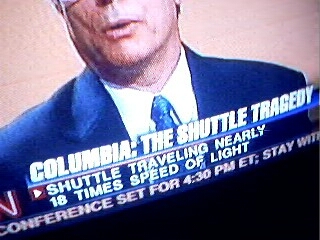
CAPE CANAVERAL, Fla. — If liftoff damage to Columbia’s thermal tiles caused the disaster, was the crew doomed from the very start?
Or could NASA have saved all or some of the seven astronauts by trying some Hollywood-style heroics — a potentially suicidal spacewalk, perhaps, or a rescue mission by another shuttle?
Some of the ideas suggested would have been highly impractical, dangerous and perhaps futile.
The shuttle does not carry spare tiles, and the National Aeronautics and Space Administration insists that the crew had nothing on board to use to repair or replace missing or broken ones. In any case, the space agency believed at the time that the tile damage was nothing to worry about and thus nothing worth risking a life over.
Still, as James Oberg, a former shuttle flight controller and author who has been bombarded by Armageddon-type rescue ideas by e-mail, said Sunday, "They may be implausible, but not by much." He added, "There’s always the question of miracles."
FOAM STRUCK LEFT WING
NASA knew from the second day of Columbia’s 16-day research mission that a piece of the insulating foam on the external fuel tank peeled off just after liftoff, struck the left wing, and possibly ripped off some of the tiles that keep the ship from burning up when it re-enters the earth’s atmosphere.
A frame-by-frame analysis of launch video and film clearly showed a clump of something streaking away from Columbia 80 seconds into the flight.
Engineers spent days analyzing the situation and saw no reason for concern. Leroy Cain, the flight director in charge of Columbia’s Jan. 16 launch and Saturday’s descent from orbit, assured reporters as much Friday.
Hours after the disaster, shuttle program manager Ron Dittemore acknowledged that NASA might have erred and that wing damage on launch day might have contributed to or even caused Columbia to disintegrate on re-entry.
"It’s one of the areas we’re looking at first, early, to make sure that the investigative team is concentrating on that theory or that set of facts as we are starting to unfold," NASA Administrator Sean O’Keefe said Sunday.
Dittemore himself said, "My thoughts are on what we missed, what I missed, to allow this to happen."
Some facts remain:
NASA did not try to examine Columbia’s left wing with high-powered telescopes on the ground, 180 miles below, or with spy satellites. The last time NASA tried that, to check Discovery’s drag-chute compartment during John Glenn’s shuttle flight in 1998, the pictures proved of little use, Dittemore said. Besides, he said, "there was zero we could have done about it."
Similarly, NASA did not ask the crew of the international space station to use its cameras to examine the wing when the two ships passed within a few hundred miles of each other several times over the past two weeks.
NASA did not consider a spacewalk by the crew to inspect the left wing. The astronauts have neither training nor equipment to repair tile damage anywhere on the shuttle, least of all on a relatively inaccessible area like the underside of a wing, Dittemore said.
Could NASA have sent another shuttle to rescue Columbia’s five men and two women?
In theory, yes.
Normally, it takes four months to prepare a shuttle for launch. But in a crisis, shuttle managers say, they perhaps could put together a launch in less than a week if all testing were thrown out the window and a shuttle were already on the pad.
Columbia had enough fuel and supplies to remain in orbit until Wednesday, and the astronauts could have scrimped to stay up another few days beyond that. With shuttle Atlantis ready to be moved to its pad, it theoretically could have been rushed into service, and Columbia’s astronauts could have climbed aboard in a series of spacewalks. If Atlantis flew with the minimum crew of two, it could have accommodated seven more astronauts.
Could Columbia’s astronauts have abandoned ship and climbed aboard the international space station?
Because Columbia was in an entirely different orbit from the space station, it lacked enough fuel to fly to the orbiting outpost. Even if the shuttle could have limped there, it could not have docked. Columbia had no docking ring, since it was never meant to go there. So the shuttle astronauts would have had to float over in space suits to get there.
NO TILE-REPAIR KIT
Could Columbia’s astronauts have gone out on a spacewalk to inspect and perhaps repair their own ship?
That assumes that the astronauts could have rigged up something, Apollo 13-style, to replace the missing tiles. But there was nothing on board, according to Dittemore and others. Back in the early shuttle days, NASA considered a tile-patching kit that was essentially a caulking gun, but the gunk undermined the performance of the tiles and never flew.
|
|
|
| |
|
| |
|
| |
|
|
|
Az
|
 |
MACEDONIA - It's the name of the sovereign country to the north of Greece
Apr 2000
time: 07:25
|
|
quote:
With the frenzy of speculation about the piece of ice or piece of foam insulation from the ET, one thing that hasn't been mentioned at all is the possibility that there was no significant damage from that event at all, and that Columbia was hit by something else at the time it started it's roll reversal and descent maneuver.
A micrometeorite encounter is a known risk, and so is the possibility of hitting space junk from thousands of dead objects in progressibely decaying orbits. We've had at least two known cases of satellites being killed by junk collisions, and have no ability to consistently track space junk smaller than 10cm in diameter.
The telescope footage taken by the Cal Tech astronomer showed that some object was already detached and moving with the Columbia, separate from the flash where another object (possibly an ablatement tile) detached. If the damage had been fatal from the outset (by the launch collision), I don't think it's real likely that Columbia would have successfully executed the roll reversal in the first place.
|
two questions about space junk:
1) How are small part created? after all, a satellite, even when it malfunctions, is still staying intact?
2)why not just crash the sattelites into the atmosphere and burn them, when they go offline?
|
|
| |
|
|
|
MichaeltheGreat

|
|
Apolyton Grand Executioner
|
 |
mooning the house that Ruth built.
Oct 1999
time: 21:25
|
|
Small parts are created in a lot of ways - structural degredation from radiation, temperature differentials and micrometeorite collisions is the normal wear and tear way.
Another one is shear stress from the occasional satellite that doesn't deploy correctly or stabilize, so starts spinning uncontrollably and increasing stresses on things like joints for deploying solar panels.
Satellites can have stuff knocked loose or broken from the stress of launch, and that stuff gets deployed when the satellite does.
Also, large objects (Mir, Salyut, Skylab, and rocket booster stages) that reenter and burn up tend to break apart, and some small debris gets deflected upward (atmospheric bounce) back into orbit.
Accidents also contribute some - for example, problem with the solar panel arm not deploying on the original Skylab, and the French had a collision between a dead satellite and a military commsat, that broke pieces off of both.
There's several thousand pieces of junk > 10cm in size, tens of thousands in the 1-10 cm range, and likely millions in the < 1 cm range, down to microscopic particles.
Even though the junk would be a lot less massive than the ice or foam insulation from the ET, it could be moving at virtually any speed or angle, so the relative force of a collision with a piece of space junk or a micrometeorite would be higher.
Crashing satellites and burning them is done (now) with some satellites, depending on their orbital position, but is still not reliable - they could still have bounce problems with some pieces being separated and kicked back up, and you have a problem with trying to do something with an old satellite at the end of it's useful life. Do you take something in a relatively stable, out of the way orbit, and try to maneuver it into the atmosphere (passing through more crowded orbits, including those used in manned flight activities), not knowing if or how long it's maneuver systems (if any) will work? Sometimes it's been done successfully, other times it's done and hasn't worked. Sometimes, it's safer for several centuries to leave something where it is.
The earliest satellites had no really useful maneuvering systems, and/or uplinks can be impossible to achieve.
Yet another problem occurs with the percentage of satellites that just spontaneously die and don't respond.
Right now, the only thing that can be done is tracking those objects large enough to be tracked, and mapping the orbits that those pieces lie in or will soon be transitting through.
|
|
| |
|
|
|
Zylka
|
|
quote:
Originally posted by Willem
I really, really hope you're joking here! |
You don't get out much, do you?
|
|
| |
All times are GMT. The time now is 05:25.
Apolyton Time is 00:25. |
top of page
|
| archivepost |
|
Forum Rules:
You may not post new threads
You may not post replies
You may not post attachments
You may not edit your posts
|
HTML code is ON
vB code is ON
Smilies are ON
[IMG] code is ON
|
|
|
|
|
|






 03-02-2003 18:45


 , its going to be intresting as what they are going to do , build a new shuttle like they did after the Challenger , or go for a new project , .....


 Attachment:


 |
|