|
| |
|

|
Bloody Monk

|
 |
austin, tx
May 2001
time: 23:26
|
|
@rjm
Yes, it is a LIFO order, last in, first out.
Having a newer city to fill the beaker box to trigger an advance, after many deliveries, early in the processing allows for a second advance in that turn from the SSC contribution. If the SSC is your first city, then any excess over that needed to trigger the second advance is lost. If your SSC is further down the list, those extra beakers, and the beakers contributed by, in this example, the first and second cities, get carried over toward the next advance.
Possibly, you are not thinking big enough. It sounds like you are focusing on the second advance in a turn, whereas, I am planning to get the third--if not his time, then sooner. Whatever, I have found it more efficient not to have the first city be the SSC.
I am glad you found the log informative and instructive. It was my hope that others might catch the bug, so to speak. So I tried to describe the "why" behind the moves. The focus and mindset needed in an early landing is different from the usual gameplay and I tried to show that. I hope you are enjoying playing the Early Landing Game.
Monk
|
|
| |
|
|
|
Bloody Monk
|
|
austin, tx
May 2001
time: 23:26
|
|
On Rush buying
One thing I didn't mention is my philosopy on using your gold to speed the build process. In the early part of the game there isn't enough gold around to matter; but, after deliveries start, I try to build things quickly.
Either, fill-out-the-row buying; or one turn and buy the rest, line by line, the second turn; or, in the case of the SSC, a hard rush buying in one turn (start by buying a barracks for 160, then switching to dip, 25g, and switching to settler, 25g, and letting the 10+ shields in the SSC finish the build.)
I follow the plan SG(2) described previously for white goods. Improvements should be started one turn and paid in full the next, where possible. When gold is abundant, use it.
The general rule is, "Gold in the bank represents TIME lost." Early Landing is above all about Time.
Monk
|
|
| |
|
|
|
Bloody Monk
|
|
austin, tx
May 2001
time: 23:26
|
|
Hello Slow,
1) Bribing the camel was a gamble. I didn't want the slot to be taken ( by an Aztec delivery) and me not receive the bonus, especially the beakers. Allowing it to deliver for the Aztec would have stolen a supply slot from me. Just about any commodity would deliver with enough gold to pay for itself; at least, that was my hope.
2) That may work in a regular game, but in an Early Landing game, you need to get explorations going quickly. Also, too many cities can slow you down. The game was won handily by Solo with ONLY nine cities total. While you are sleazing 8 cities, he has raced ahead. This style of play revolves around the idea, " Do less and accomplish more."
3) I didn't want them to have an option about going to a Monarchy. Making sure they became a Republic, now, was the aim.
4) Others have used this convention. I am sorry it caused some confusion for you. Coming immediately (without a space) after the commodity, (d) means demanded, while (xd) means not demanded.
5) I waited too late to start the offshore colonies and decided to go with two beside each other. This way they could work from the same boat when sending out their freights. Another possible site could have been the land south of and across the Aztec Sea, as the boats going to Aztlan could have continued on to that site w/out much delay. The thought of danger did not enter my mind. You have to assume some risk--from Barbs--where ever you build.
Hope this makes things more clear, SlowT.
Monk
|
|
| |
|
|
|
solo
|
|
Lowell, MA USA
Jan 2001
time: 05:26
|
|
Monk,
quote:
The game was won handily by Solo with |
Whoa!!! There's still another week, because I extended the deadline. Many talented players are still lurking out there.
I enjoyed reading your log which gave me a few new ideas. I am getting the impression you want to win the next game, and welcome the challenge!
I don't want to hear any more lame excuses like "I was sick", either!
|
|
| |
|
|
|
Bloody Monk
|
|
austin, tx
May 2001
time: 23:26
|
|
Hey Solo,
I did mean, "won the game." Someone else may yet win the challenge, but, you did have a Landing.
I'm guessing that, "the dog ate my hard drive," won't fly either.
Seriously, I will play again; but my typing, especially from notes, really sucks, and I can't see spending four days composing a log again. It's a burn-out.
Monk
|
|
| |
|
|
|
solo
|
|
Lowell, MA USA
Jan 2001
time: 05:26
|
|
Monk,
Reconstructing a log from saves is a real pain. I write my own down on paper while playing just to make sure this record won't evaporate in cyberspace. Typing it up later is a chore, though, and the game might have been perfected if there had been an option to "keep a written log." Such a feature could have been easily implemented.
|
|
| |
|
|
|
SlowThinker
|
|
homeless, Praha, Czech Republic
Jan 2000
time: 06:26
|
|
quote:
Originally posted by Bloody Monk
Seriously, I will play again; but my typing, especially from notes, really sucks, and I can't see spending four days composing a log again. |
I found out the only way is to write the log carefully when playing.
|
|
| |
|
|
|
SlowThinker
|
|
homeless, Praha, Czech Republic
Jan 2000
time: 06:26
|
|
Monk,
1. I suppose the attachment must work.
2. You can load a WordPad text in Word, then save it as a html. The html source code may be posted in Apolyton forums, but you have to delete (or better replace by spaces) all end-of-line markers. So rename the html as txt, then load again in Word as a plain text, then 'find and replace' end-of-line markers by spaces (I have made a Word macro for this purpose, so that I only need to press Ctrl-F12).
|
|
| |
|
| |
|
|
|
Bloody Monk
|
|
austin, tx
May 2001
time: 23:26
|
|
Solo,
It is my hope that you are planning to discuss the various aspects of Trade in your "White Paper" on Early Landing. The previous posts dealing with Wonder Bread, unblocking of slots are very helpful, especially the examples. The three recent threads you and Samson collaborated to create had so much vital intelligence, but they are also somewhat hard to follow. And the math parts stump me completely.
What is a Remainder??, for instance. Using the wildcard formula for example, I don't get anything like the 0-16 result the table suggests. Perhaps an example using the SSC coord's of this game (18,12) would help. That is, if you have the time.
The reason I think this info belongs in an Early Landing discussion is placement of colonies, since there are so few of them. If one could determine which tiles would give the best supply back to the SSC, it could make a huge difference in the final outcome.
Hope you don't mind my 2cents being floated about.
Monk
|
|
| |
|
|
|
solo
|
|
Lowell, MA USA
Jan 2001
time: 05:26
|
|
Monk,
I agree that the calculations can be a bit daunting, especially if you want to figure out all supplies and demands, since each individual commodity has to be calculated. When I was working with Samson on this, by checking his formulas, I would have the answers right in front of me, and was just trying to verify his formulas, but often came up with something different due to slight errors here or there. It's very tricky.
However, wildcards are quite straightforward and easy to do, as long as you know the meaning of the remainder function.
First of all, a remainder is what is left if a number does not divide evenly into another. For example, 4/2= 2 with no remainder, since 2x2 = 4. You could also call this a zero remainder. 5/2 = 2 also, in integer math, but this does not come out even, since 2 x 2 = 4. The remainder is found by subtracting 4 from 5, so in this case the remainder is 1. 8/3 = 2, and this time the remainder is 2, which can be found be multiplying 2x3 and getting 6, which when subtracted from 8 equals 2.
Now when you divide with a calulator , you'll get real number as a result. For example, 8/3 = 2.6666666
The .66666 is the remainder expressed as a fraction. We can convert it to an integer by multiplying it by 3.
3 x .66666 = 1.99999, which is closest to 2, so 2 ends up as the remainder. Since you'll probably want to use a calulator, it's easiest to do it like this:
Step 1 8/3 = 2.66666
Step 2 2.66666 - 2 = .666666 (all we want is the remainder)
Step 3 .66666 x 3 = 1.99999, which we round up to 2
All three steps can be done without having to punch in all the digits of the remainder, if you do it like this.
Now for the SSC in our game at coordinates (18,12):
Let's do the first wildcards, before 32 techs are known.
Supply = (18x13 + 12x7)/14
= (234 + 84)/14
= 318/14 = 22.71
remainder of 22.71 = 22.71 - 22 = .71 x 14 = 10 silver
Demand = (18x3 + 12x5)/14
= (54 + 60)/14
= 114/14 = 8.14
remainder of 8.14 = 8.14 - 8 = .14 x 14 = 2 beads
Now let's do it after 32 techs are known. Notice that 318 and 114 are used again, and only have to be figured out once:
Supply = 318/9 = 35.33
remainder of 35.33 = 35.33 - 35 = .33 x 9 = 3
add 5 to 3 to get the commodity # which is 8 wine
Demand = 114/9 = 12.66
remainder of 12.66 = 12.66 - 12 = .66 x 9 = 6
add 5 to 6 to get 11 spice
That's all there is to figuring wildcards.
Trade is my favorite subject, and is getting its own chapter in my little guide, but I haven't gotten to it yet.
|
|
| |
|
|
|
Bloody Monk
|
|
austin, tx
May 2001
time: 23:26
|
|
Solo,
Gee whiz!! That's a great example. And now it is clear how these formulas work.
I had two problems. It was not clear how to convert the decimal remainder to a whole number (eg, X14). And I miss-used the coordinates; a process I still do not understand.
The way I see it the Civ expression (18, 12) represents (V, H); whereas, you are using (H, V). Since the "18" row goes from top to bottom, I thought it was a Vertical expression, rather than Horizontal. Same with the "12" going east-west representing Horizontal, rather than Vertical. I guess I just don't "see" it the same way and that basic definitional problem caused big problems for me. But I am certainly willing to adapt for the sake of following these formulas.
Thanks much.
Monk
|
|
| |
|
|
|
solo
|
|
Lowell, MA USA
Jan 2001
time: 05:26
|
|
Monk,
Wait until you start trying to figure out Eastern and Western hemispheres! Many of the commodity calculations would have been easier for me to follow if there had been a few examples. It's a good thing that I usually get enough info from wildcards to suit my purposes when playing a game.
|
|
| |
|
|
|
solo
|
|
Lowell, MA USA
Jan 2001
time: 05:26
|
|
Monk,
Colony wildcards are a factor, but the main qualities I look for in a colony are:
1) Strategic locations that facilitate quick freight deliveries to good AI trading partners. Distance (lack or too much of it) from home is a major factor.
2) Good sites that grow quickly and that have good specials. I look less for shields and more for food and trade.
If many sites qualify, then I pick the ones with better wildcards.
Wildcards are more of a factor when comparing AI cities for inciting revolts, such as Isandlhwara, in this game.
For AI trading partners, the main reason I have for checking demand wildcards is to see if the new ones coming at 32 techs will be more useful than the old ones. Then I gift techs accordingly.
Earlier in the game, all you have is old wildcards, and you can just click on AI cities to see what they are, since they almost always are present as the middle commodity.
During that part of the game, I'll keep track of cycle turns to make sure demanded commodities can be delivered in time, but sometimes when I have something I'd like to deliver and can not find any demand, I'll go into more detail, looking for an AI city where I might be able to trigger it by delivering something else first.
|
|
| |
|
| |
|
|
|
solo
|
|
Lowell, MA USA
Jan 2001
time: 05:26
|
|
I think it's more of a coincidence. Computers use base 2, and multiples of it such as 4,8,16,32, etc. 16 is two bytes, a very common word size. Notice there are also 16 commodities, and 16 of a lot of other things, too.
|
|
| |
|
|
|
solo
|
|
Lowell, MA USA
Jan 2001
time: 05:26
|
|
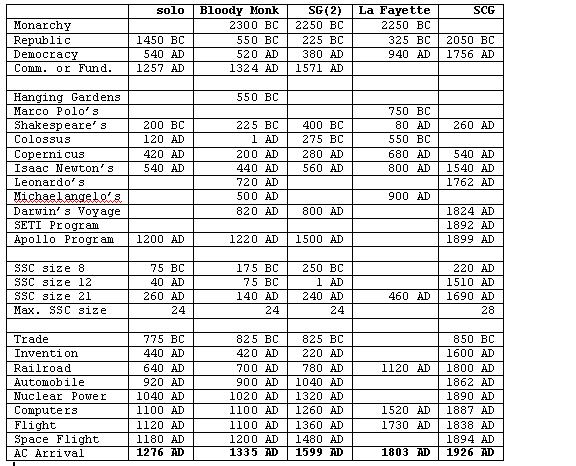
On the 16th I plan to post a table summarizing the results for this game.
It could be that everyone planning to post a log for this game has already done so, and since I know that some are anxious to start playing the next game I might as well start a thread for it today along with the start.
|
|
| |
|
|
|
solo
|
|
Lowell, MA USA
Jan 2001
time: 05:26
|
|
Here's the table summarizing this game. Thanks to all who participated.
 Attachment: chart.jpg Attachment: chart.jpg
This has been downloaded 58 time(s).
|
|
| |
All times are GMT. The time now is 05:26.
Apolyton Time is 00:26. |
top of page
|
| archivepost |
|
Forum Rules:
You may not post new threads
You may not post replies
You may not post attachments
You may not edit your posts
|
HTML code is ON
vB code is ON
Smilies are ON
[IMG] code is ON
|
|
|
|
|
|






 09-03-2003 12:27


 What's that?
 . other html text can be inserted as desired

 ) Are there any thoughts on a second game?

 |
|