|
| |
|

|
Ned
|
 |
of Aptos, CA
Oct 1999
time: 21:26
|
|
quote:
Originally posted by Seeker
Actually, from what I can understand, the US/SK plan for dealing with the large mass of artillery is to use a big integrated system they've had for a while that works like this:
-very accurate radar tracks data on incoming shells
-computers calaculate the exact position of the origin using this data (fast)
-rocket artillery goes to this destination
This is part of an integrated system that the SKs and USA forces train very hard to make work quickly and reliably. It can turn the balance of artillery superiority faster than flying around trying to find artillery firing pits.
The North lacks the sophisticated radar, computers, and 'integrated systems' necessary to pull off something like this so they basically can't fight a sustained war.
Unfortunately, the NKs do have enough artillery to just 'brute force' this system for possibly quite a few weeks, especially if they use some tactics like sacrificing their artillery in sections to get maximum use, or if their spies are accurate enough to find a good chunk of the mobile rocket artillery launchers.
Even if they just fire where they are targeted now (seoul) and then get totally blown away by the response within a few days, they still have enough to level Seoul, which is the area where I and 47% of the population live. |
This is not acceptable at all -- especially in the face of their outrageous belligerence.
Rather than simply talk of NK nuke disarmament, we need to talk about removing that artillery and reducing forces. I don't know how the South can have any discussions with the North about appeasement so long as they remain poised to decimate Seoul.
|
|
| |
|
|
|
Andrew1999
|
|
If they are launching cruise missiles they probably don't need escorts since they will be hundreds of miles away from Korea. They can probably take off from Guam, launch, and land without ever leaving US airspace.
|
|
| |
|
| |
|
|
|
panag
|
 |
MY WORDS ARE BACKED WITH BIO-CHEMICAL WEAPONS
Oct 2000
time: 07:26
|
|
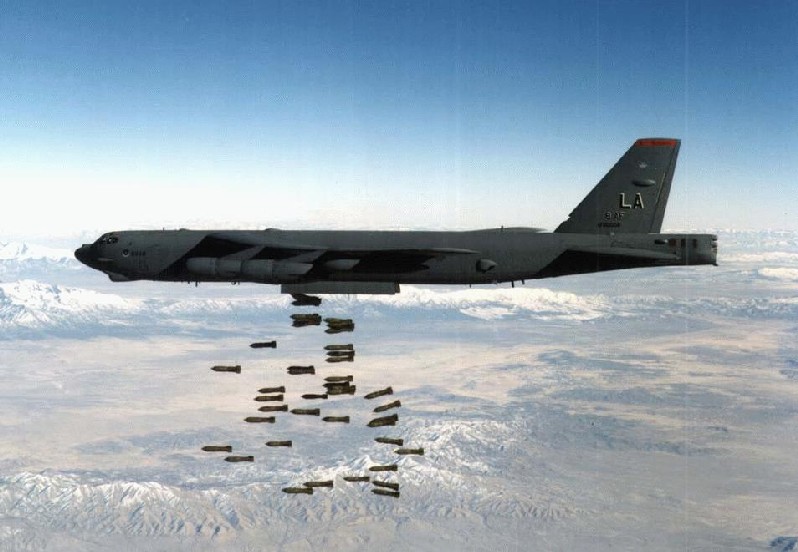
The B-52H BUFF [Big Ugly Fat Fellow] is the primary nuclear roled bomber in the USAF inventory. It provides the only Air Launch Cruise Missile carriage in the USAF. The B-52H also provides theater CINCs with a long range strike capability. The bomber is capable of flying at high subsonic speeds at altitudes up to 50,000 feet (15,166.6 meters). It can carry nuclear or conventional ordnance with worldwide precision navigation capability.
The aircraft's flexibility was evident during the Vietnam War and, again, in Operation Desert Storm. B-52s struck wide-area troop concentrations, fixed installations and bunkers, and decimated the morale of Iraq's Republican Guard. The Gulf War involved the longest strike mission in the history of aerial warfare when B-52s took off from Barksdale Air Force Base, La., launched conventional air launched cruise missiles and returned to Barksdale -- a 35-hour, non-stop combat mission.
A total of 744 B-52s were built with the last, a B-52H, delivered in October 1962. Only the H model is still in the Air Force inventory and all are assigned to Air Combat Command. The first of 102 B-52H's was delivered to Strategic Air Command in May 1961. The H model can carry up to 20 air launched cruise missiles. In addition, it can carry the conventional cruise missile which was launched from B-52G models during Desert Storm.
Barksdale AFB, LA and Minot AFB, ND serves as B-52 Main Operating Bases (MOB). Training missions are flown from both MOBs. Barksdale AFB and Minot AFB normally supports 57 and 36 aircraft respectively on-station.
Features
In a conventional conflict, the B-52H can perform air interdiction, offensive counter-air and maritime operations. During Desert Storm, B-52s delivered 40 percent of all the weapons dropped by coalition forces. It is highly effective when used for ocean surveillance, and can assist the U.S. Navy in anti-ship and mine-laying operations. Two B-52s, in two hours, can monitor 140,000 square miles (364,000 square kilometers) of ocean surface.
Starting in 1989, an on-going modification incorporates the global positioning system, heavy stores adaptor beams for carrying 2,000 pound munitions and additional smart weapons capability. All aircraft are being modified to carry the AGM-142 Raptor missile and AGM-84 Harpoon anti-ship missile.
The B-52H was designed for nuclear standoff, but it now has the conventional warfare mission role with the retirement of the B-52G’s. The B-52 can carry different kinds of external pylons under its wings.
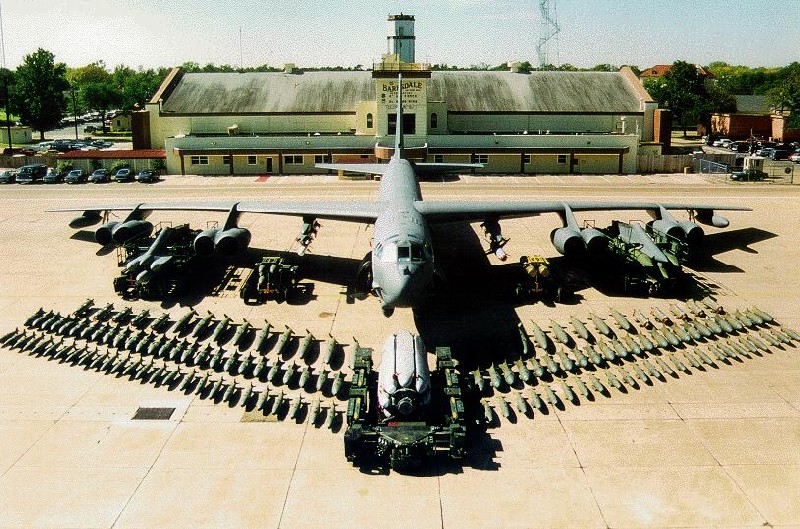
The AGM-28 pylon can carry lighter weapons like the MK-82 and can carry 12 weapons on each pylon, for a total of 24 external weapons. With the carriage of 27 internal weapons, the total is 51.
Heavy Stores Adaptor Beam [HSAB] external pylon can carry heavier weapons rated up to 2000 lbs. However, each HSAB can carry only 9 weapons which decreases the total carry to 45 (18 external).
A third type pylon is used for carrying ALCMs/CALCMs/ACMs.
So the B-52 can carry a maximum of either 51 or 45 munitions, depending on which pylon is mounted under the wings. However, the AGM-28 pylon is no longer used, so the B-52 currently carries on HSABs, limiting the external load to 18 bombs, or a total of 45 bombs.
The use of aerial refueling gives the B-52 a range limited only by crew endurance. It has an unrefueled combat range in excess of 8,800 miles (14,080 kilometers).
All B-52s are equipped with an electro-optical viewing system that uses platinum silicide forward-looking infrared and high resolution low-light-level television sensors to augment the targeting, battle assessment, flight safety and terrain-avoidance system, thus further improving its combat ability and low-level flight capability.
Pilots wear night vision goggles (NVGs) to enhance their night visual, low-level terrain-following operations. Night vision goggles provide greater safety during night operations by increasing the pilot's ability to visually clear terrain and avoid enemy radar.
Current B-52H crew size is five. Pilot and co-pilot are side by side on the upper flight deck, along with the electronic warfare officer (EWO), seated behind the pilot facing aft.
hi ,
try to get one , those babies fly at more then 50 000 feet , .....
have a nice day
|
|
| |
|
|
|
panag
|
|
MY WORDS ARE BACKED WITH BIO-CHEMICAL WEAPONS
Oct 2000
time: 07:26
|
|
USAF Fact Sheet
B-52 Stratofortress
Mission
Air Combat Command's B-52 is a long-range, heavy bomber that can perform a variety of missions. The bomber is capable of flying at high subsonic speeds at altitudes up to 50,000 feet (15,166.6 meters). It can carry nuclear or precision guided conventional ordnance with worldwide precision navigation capability.
Features
In a conventional conflict, the B-52 can perform strategic attack, air interdiction, offensive counter-air and maritime operations. During Desert Storm, B-52s delivered 40 percent of all the weapons dropped by coalition forces. It is highly effective when used for ocean surveillance, and can assist the U.S. Navy in anti-ship and mine-laying operations. Two B-52s, in two hours, can monitor 140,000 square miles (364,000 square kilometers) of ocean surface.
All B-52s are equipped with an electro-optical viewing system that uses platinum silicide forward-looking infrared and high resolution low-light-level television sensors to augment targeting, battle assessment, and flight safety, thus further improving its combat ability and low-level flight capability.
Pilots wear night vision goggles (NVGs) to enhance their vision during night operations. Night vision goggles provide greater safety during night operations by increasing the pilot's ability to visually clear terrain, avoid enemy radar and see other aircraft in a covert/lights-out environment.
Starting in 1989, on-going modifications incorporates the global positioning system, heavy stores adapter beams for carrying 2,000 pound munitions, and a full array of advance weapons currently under development.
The use of aerial refueling gives the B-52 a range limited only by crew endurance. It has an unrefueled combat range in excess of 8,800 miles (14,080 kilometers).
The aircraft's flexibility was evident in Operation Desert Storm and again during Operations Allied Force. B-52s struck wide-area troop concentrations, fixed installations and bunkers, and decimated the morale of Iraq's Republican Guard. The Gulf War involved the longest strike mission in the history of aerial warfare when B-52s took off from Barksdale Air Force Base, La., launched conventional air launched cruise missiles and returned to Barksdale -- a 35-hour, non-stop combat mission. During Operation Allied Force, B-52s opened the conflict with conventional cruise missile attacks and then transitioned to delivering general purpose bombs and cluster bomb units on Serbian army positions and staging areas.
Background
For more than 40 years B-52 Stratofortresses have been the backbone of the manned strategic bomber force for the United States. The B-52 is capable of dropping or launching the widest array of weapons in the U.S. inventory. This includes gravity bombs, cluster bombs, precision guided missiles and joint direct attack munitions. Updated with modern technology the B-52 will be capable of delivering the full complement of joint developed weapons and will continue into the 21st century as an important element of our nation's defenses. Current engineering analyses show the B-52's life span to extend beyond the year 2045.
The B-52A first flew in 1954, and the B model entered service in 1955. A total of 744 B-52s were built with the last, a B-52H, delivered in October 1962. Only the H model is still in the Air Force inventory and is assigned to Air Combat Command and the Air Force Reserves.
The first of 102 B-52H's was delivered to Strategic Air Command in May 1961. The H model can carry up to 20 air launched cruise missiles. In addition, it can carry the conventional cruise missile that was launched in several contingencies during the 1990s, starting with Operation Desert Storm and culminating with Operation Allied Force.
General Characteristics
Primary Function: Heavy bomber
Contractor: Boeing Military Airplane Co.
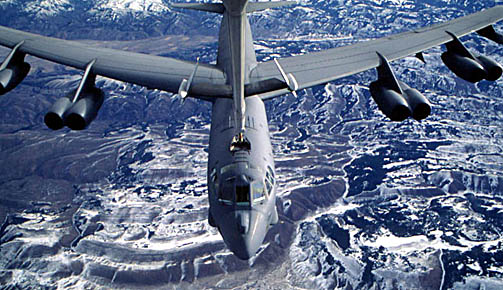
Power plant: Eight Pratt & Whitney engines TF33-P-3/103 turbofan
Thrust: Each engine up to 17,000 pounds
Length: 159 feet, 4 inches (48.5 meters)
Height: 40 feet, 8 inches (12.4 meters)
Wingspan: 185 feet (56.4 meters)
Speed: 650 miles per hour (Mach 0.86)
Ceiling: 50,000 feet (15,151.5 meters)
Weight: Approximately 185,000 pounds empty (83,250 kilograms)
Maximum Takeoff Weight: 488,000 pounds (219,600 kilograms)
Range: Unrefueled 8,800 miles (7,652 nautical miles)
Armament: Approximately 70,000 pounds (31,500 kilograms) mixed ordnance -- bombs, mines and missiles. (Modified to carry air-launched cruise missiles, Harpoon anti-ship and Have Nap missiles.)
Crew: Five (aircraft commander, pilot, radar navigator, navigator and electronic warfare officer)
Accommodations: Six ejection seats
Unit Cost: $53.4 million (fiscal 98 constant dollars)
Date Deployed: February 1955
Inventory: Active force, 85; ANG, 0; Reserve, 9
Current as of March 2001
 Attachment: b_52.jpg Attachment: b_52.jpg
This has been downloaded 40 time(s).
|
|
| |
All times are GMT. The time now is 05:26.
Apolyton Time is 00:26. |
top of page
|
| archivepost |
|
Forum Rules:
You may not post new threads
You may not post replies
You may not post attachments
You may not edit your posts
|
HTML code is ON
vB code is ON
Smilies are ON
[IMG] code is ON
|
|
|
|
|
|






 04-03-2003 16:22








 |
|
 |
|