|
| |
|
| |
|

|
Ned
|
 |
of Aptos, CA
Oct 1999
time: 21:26
|
|
quote:
Originally posted by panag
hi ,
no so easy , .....
tv and radio are not present in the north , unlike in the DDR , .....
its a totalirian regime inwhere people die like , not to mention about the killings , .....
you just cant compare it with something we know in our culture , .....
a couple years ago people who went there showed video tapes of empty roads , poverty , etc , ....
and all that the nk commie party does is building rice bunkers , wmd's , etc , ..... they use the people as slaves , .....
just send in the troops , that shall be easier , .....
have a nice day |
What if the President of SK publicly offered every officer of general rank who participates in a coup $5 million?
If nothing happened, raise it to $10 million.
Then to $20 million.
At some point, North Korea is toast.
|
|
| |
|
|
|
panag
|
 |
MY WORDS ARE BACKED WITH BIO-CHEMICAL WEAPONS
Oct 2000
time: 07:26
|
|
quote:
Originally posted by Ned
What if the President of SK publicly offered every officer of general rank who participates in a coup $5 million?
If nothing happened, raise it to $10 million.
Then to $20 million.
At some point, North Korea is toast. |
hi ,
one general is one general , ..... what is needed is the million fold of people , .....
like the east germans the day the wall came down , .....
ones you get those , its just a matter of time , and its bye-bye for the commies , .....
while the people are starving , ......
Grain Storage Facilities
Dig tunnels deep,
store rice everywhere!
North Korea has built reserve rice storage facilities with the target of storing at least one million tons of grain or grain supply sufficient for 170 days national consumption. As of the end of 1995 North Korea had grain storage facilites capable of storing at least 1.42 million tons of grain. Reserved grains are divided into three categories -- for exclusive military use, military and civilian use, and civilian use:
grain for exclusive military use are managed by the Grain Department under the General Logistical Bureau of the Military of the People's Armed Forces;
grain for military and civilian use managed by the Logistical Mobilization General Bureau, which is in charge of managing war supplies;
grain for civilians use are managed by the Ministry of Food Administration
There are a total of 248 grain storage facilities for reserved grains for military use in North Korea, with approximately 1.2 million ton of grain in these storage facilities. The location and capacity of food storage facilities that have been identified include:
37 areas, including Yangdok and Yonggang County in South Pyongan Province, for 217,000 tonn
39 areas, including Kusong City and Pakchon County in North Pyongan Province, for 200,000 tons
28 areas, including Hamju and Yonggwang County in South Hamgyong Province, for 149,000 tons
13 areas, including Yongsong District in Pyongyang, for 69,000 tons.
Beginning in 1987 North Korea built three different types of grain storage facilities -- tunnel-type, silo- type, and half-submerged -- to store war reserve grain for military use. Part of the grain is also kept in open storage areas. The types of North Korean war reserve grain maintenance and storage facilities are as follows:
Half-submerged storage: This is the most basic of storage facilities. A half-submerged storage facility is made of cement concrete and is 14 meters wide, 60 meters long and four meters high. Half-submerged storage facilities are reportedly located in 68 areas, including Yangdok and Sukchon of South Pyongan Province.
Tunnel-type storage facilities: There is one tunnel- type storage facility in Oktol Valley in Yonggang County, South Pyongan Province. There is a rice mill inside the tunnel. A railway is linked to the tunnel entrance. The storage capacity is 100,000 tonnes, all of which is for military use.
Silo-type storage: A silo-type storage facility is cylindrical. Ten cylindrical silos form one silo-type storage faciliy. They are above-ground facilities. They are located in four different areas, including Yangdok and Kaechon in South Pyongan Province.
Open storage type: Rice is stored temporarily in open areas to reduce the moisture level from 15-17 percent at harvest time to 13 percent. They stack rice bags, cover them with straw, and leave them in open storage areas in mountainous areas, inlcuding Tongchon in Kangwon Province and Yongsong District in Pyongyang.
Of the total 73 grain storage facilities located in remote mountain areas which are under the control of the Ministry of People's Armed Forces, North Korea built new half-submerged type grain storage facility at 60 grain storage areas. The construction of these new half-submerged type grain storage facilities began at the end of 1995, when foreign relief goods from international organizations and western countries were sent to North Korea right after floods damage crops. The construction of these grain storage facilities aroused suspicions that the 150,000 tons of rice provided to North Korea by the ROK Government and the 500,000 tons of rice provided by the Japanese Government were diverted for military purposes.
have a nice day
|
|
| |
|
|
|
panag
|
|
MY WORDS ARE BACKED WITH BIO-CHEMICAL WEAPONS
Oct 2000
time: 07:26
|
|
quote:
Originally posted by Seeker
But what about Seoul Panag??
I can practically spit over the border from where I am, along with 47% of the population.
Do you really want to risk letting us fall into Kims hands?
Do you really think firepower and mines will be able to stop the waves Kim can unleash before they cut us off?
You do know that they would level this city before they would give up.
I think Korean unification can wait for peaceful means. The SK military should be used only as a defensive guarantee. |
hi ,
thats why military action should be used , ...... peacefull means , well those commies in the north are getting weaker and they are becoming "outdated" , ...... sooner or later they shall see they have nothing to loose and try to invade the ROSK , thats why the south should strike first , ....
leveling Seoul , .... well that shall be the day , one more reason to use a preemtive strike , ....
have a nice day
|
|
| |
|
|
|
panag
|
|
MY WORDS ARE BACKED WITH BIO-CHEMICAL WEAPONS
Oct 2000
time: 07:26
|
|
quote:
Originally posted by Q Cubed
with a massive force-shield.
meaning, it won't happen.
any attack on skorea has to go through seoul; the mountains in the east prevent much fast movement, and is far to easily defended.
meaning you have to go through a major city. which would also be easily defended.
why do you think nkorea has so many artillery emplacements near seoul? because in the event of any armed conflict, the easiest, and probably the only way, of "capturing" seoul would be to level it entirely.
any pre-emptive strike will result in the destruction of seoul.
i don't like that so much. |
hi ,
actually in a pure military operation one would go around seoul and concentrate on military targets , ....
example , 1940 the battle of britain air campaign , the germans where doing a good job in bombing airfields , factories , military targets , etc , ..... so far so good , then all of a sudden they start to bomb civilian targets , results , the brits can re-arm and strike back , winning the war , ....
and who would want to be responsable for such a large population centre , ..... the north cant even feed its own people , ... let alone the whole south , ....
if they nuke seoul they are going to get some nukes back , the chinese shall do it it the US of a shall not do it , .....
have a nice day
|
|
| |
|
|
|
ranskaldan
|
 |
Beijing ~ Singapore ~ Toronto ~ All hail to the new Rome
Sep 2001
time: 00:26
|
|
quote:
Originally posted by panag
if they nuke seoul they are going to get some nukes back , the chinese shall do it it the US of a shall not do it , ..... |
You bet. 
quote:
hi ,
actually in a pure military operation one would go around seoul and concentrate on military targets , ....
example , 1940 the battle of britain air campaign , the germans where doing a good job in bombing airfields , factories , military targets , etc , ..... so far so good , then all of a sudden they start to bomb civilian targets , results , the brits can re-arm and strike back , winning the war , .... |
Mmm, but isn't this whole situation about NK disintegrating one day and trying to go out with a bang? If that's the case, then they would want to cause as big a bang as possible.
|
|
| |
|
|
|
Q Cubed
|
 |
t3h y3ll0w p3ril
Apr 1999
time: 23:26
|
|
panag:
quote:
hi ,
actually in a pure military operation one would go around seoul and concentrate on military targets , ....
example , 1940 the battle of britain air campaign , the germans where doing a good job in bombing airfields , factories , military targets , etc , ..... so far so good , then all of a sudden they start to bomb civilian targets , results , the brits can re-arm and strike back , winning the war , ....
and who would want to be responsable for such a large population centre , ..... the north cant even feed its own people , ... let alone the whole south , ....
if they nuke seoul they are going to get some nukes back , the chinese shall do it it the US of a shall not do it , .....
have a nice day |
north korean military doctrine for the past 50 years has been reunification of the peninsula by any means necessary.
naturally, this would involve capturing seoul, the heart of south korea, by any means necessary.
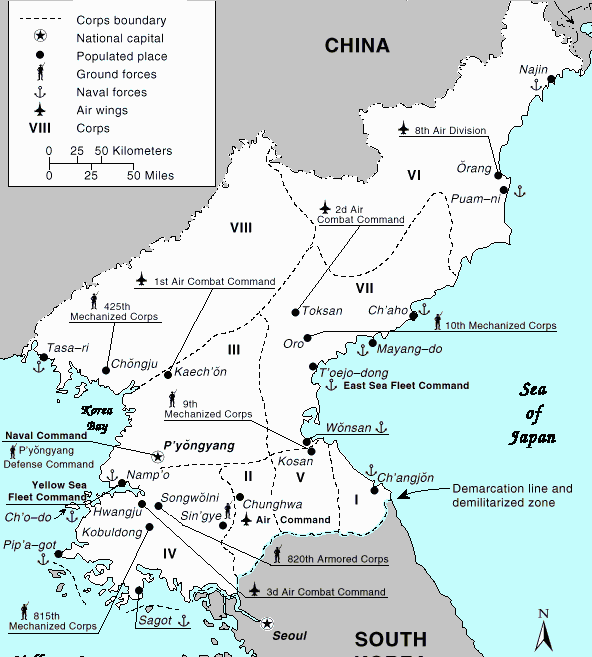
south korea, being a metropolis, is insanely well defended: boulevards are lined with defensive points, highways with tank traps, and the like; to capture seoul using troops would be an insane and idiotic proposition. thus, to capture it, one must level it.
north korea has therefore placed a large number; indeed, a good portion of their forward-reaching artillery, within range of seoul. thus, in the opening moments of any armed confrontation, north korea would begin firing at what is a) the financial center of skorea; b) the technological center of skorea; c) the military center of skorea; d) the industrial center of skorea; e) the cultural center of skorea; f) the governmental center of skorea.
because seoul is the financial, military, governmental, and industrial center, it is going to be an objective of the north korean army. seoul is therefore a pure military target.
i highly doubt that nkorea would want to nuke skorea; nuclear weapons and other wmds are immaterial to the amount of conventional ordinance that nkorea could pour on skorea. surgical strikes will not prevent this, unless you manage to take out virtually all of the AA batteries, all of the troop emplacements, all of the missile bases, all of the artillery emplacements, and all of the radar installations.
no surgical strike could do all of that.
it is a false analogy to compare the battle of britain, which was an AIR campaign, to any armed conflict on the korean peninsula. for one, much of nkorea's military hardware is focused on the army; their airforce is technologically at least two generations behind, and their navy is relatively negligible. any combat in skorea will be predominantly land, because a) the terrain is extremely mountainous; b) air power, although clearly on the american side, will not add too much to the military's efforts on land; c) naval power is also negligible, because nkorea is so secretive that it will be difficult to target anything extremely accurately.
there is no doubt that skorea would eventually win a war; their reserves are comparable to nkorea's (iirc, around 4mill), better trained and equipped. this doesn't mean that seoul and any other major skorean city will be ignored, however. my bets are that if nkorea attacks, seoul will have much rebuilding to do; taejon and taegu, if they get that far, will be leveled as well. many other major cities in between, such as ch'ongju and suwon for instance, will not be spared.
|
|
| |
|
|
|
Q Cubed
|
|
t3h y3ll0w p3ril
Apr 1999
time: 23:26
|
|
let me also say this:
there are two main ways into south korea that don't go through mountain. one is in the east, along the back of the taebaek mountains. because it is sandwiched between the mountains and the sea, and that very little is there until you get far south (p'ohang (steel center), ulsan (industrial center), and pusan (industrial, commercial, shipping center)), it's very unlikely that the vast majority of the nkorean army will head that way. indeed, if it did, it would also fail miserably; the narrowness of the passage would be a defender's dream.
the other way is through seoul. that is where the major korean highway, connecting seoul in the NW to Pusan in the SE ends. this highway, naturally, goes straight through seoul and a good portion of the rest of flat korea. in fact, there are no other major paths from the north to the south between the neutral zones.
panag, fact is, any military confrontation between the two koreas will result in much of seoul being destroyed, no matter how "purely military" or "precision strike" driven it might be.
also, it's ROK: "republic of korea". not ROSK, which i assume you mean "republic of south korea". there is no ROSK.
it's always been ROK. north korea's official abbreviation is DPRK, or "democratic people's republic of korea".
much like how west and east germany were not "Democratic People's Republic of East Germany" or "Federal Republic of West Germany", but rather "DPR Germany" and "Federal Republic of Germany".
|
|
| |
All times are GMT. The time now is 05:26.
Apolyton Time is 00:26. |
top of page
|
| archivepost |
|
Forum Rules:
You may not post new threads
You may not post replies
You may not post attachments
You may not edit your posts
|
HTML code is ON
vB code is ON
Smilies are ON
[IMG] code is ON
|
|
|
|
|
|






 01-03-2003 03:39


 Pro-Israel does not mean All-Jewish:

 Attachment:


 |
|