|
| |
|

|
jim panse
|
 |
Anvilvania
Oct 2002
time: 06:26
|
|
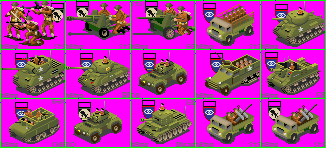
1st row: Infantry Bn, RFA Regt (25pdr; I´m still searching a better graphic for that unit), 6pdr AT Regt, Lorried Infantry Bn, Sherman V;
2nd row: Achilles AT Comp, Sherman VC Comp, Arm. Car Regiment, Mot. Infantry Bn, RFA Regt (Sexton);
3rd row: MG Bn (Bren Carrier), Recce Regt, Arm. Recce Regt (Cromwell), Lt AA Regt (Bofors on Bedford Trucks), Lt AA Regt.
What do you think? 
 Attachment: xxx corps troops.gif Attachment: xxx corps troops.gif
This has been downloaded 120 time(s).
|
|
| |
|
|
|
fairline
|
 |
of the wing
Sep 2002
time: 05:26
|
|
You've got me into sad bstard wargamer mode here Jim. One more thing: there should be 2-3 times as many Sherman Vs as VC (each troop of 4 tanks had 1 firefly and 3 75mm Shermans in '44), so if you are using Squadrons rather than regiments as the civ scale for tank units then you should have 9 squadrons of shermans in the Gds Amd Division. Of these, 2-3 should be Fireflies and 6-7 75-mm Shermans.
While I'm going off on one, it's worth noting that the 17-pdr fitted to the firefly was a much better AT gun than either the 88 in the Tiger VIE or the Panther's 75, but wasn't as good with AP rounds as either these or the standard Sherman. You could simulate this by giving the fireflies the same attack (or slightly lower than) a standard Sherman but give them the pikeman bonus against movement =2 units. Obviously, defence-wise they need to be lower than the German tanks.
In answer to your question abi=out the Stuart light tanks: leave 'em out. The Yanks had separate light battalions intheir armd divisions whereas the Brits used them only for the recce platoons (not troops!) of each armoured regiment. By this stage of the war many of them had their turrets removed and fought as scout cars('Stuart Kangeroos') as their guns were ineffectual against most German armour
Last edited by fairline on 09-07-2003 at 22:01
|
|
| |
|
|
|
fairline
|
|
of the wing
Sep 2002
time: 05:26
|
|
You may doubt it Pericles, but it's true. Look what you've done now, you've made me move seamlessly from geeky wargamer to geeky engineer...
OK, lots of tests were done by the allies and Germans both during and after the war with AT guns and target vehicles. There are a lot of factors which effect the penetration ability of AT rounds, but for sake of argument the main ones are armour quality and slope from the trajectory of the round, ammunition type (ballistic properties and material of the 'cap'), the distance of the target from the gun and the muzzle velocity of the gun. Are you still awake there at the back?
Anyhow.. if you take a level playing field of a distance from gun to target of 1000m and an armour slope of 30° you get the following results for late war guns (if you're even slightly interested):
British:
17-pdr standard ammo-------120-130mm of armour
(apc or apcbc ) penetrated
17-pdr special ammo(apds)--190-230mm
77mm apcbc --------------------100-110mm
77mm apds----------------------150-160mm
6-pdr apcbc----------------------75-80mm
6-pdr apds-----------------------120-145mm
75mm apcbc---------------------60-65mm
75mm M61 ammo---------------75-90mm
The 17-pdr was fitted to the Firefly, the '77mm' to the Comet and the 75mm was used in Shermans, Churchills and Cromwells. As you can see, Firefly was pretty much twice as good as the standard Sherman.
I wonder if anyone's still reading this? Anyway:
Germans:
75mm L/70 std ammo-----------100-120mm
special ammo-------150mm
88mm L/56 std ammo-----------90-110mm
special ammo-------140mm
75mm L/48 std ammo-----------80-100mm
The 75 L/70 was the Panther gun, the 88 L/56 the Tiger VIE and the 75mm L/48 late-model Pz IVs and StuGs. A factor with the german guns was that the special ammo requires tungsten for the ballistic caps which was non-existent by late '44, so only the standard results apply.
The real monster guns were the JagdPanther (88 L/71) and JagdTiger (128mm) guns:
128mm L/55 std ammo---------145mm
special-------------245mm
88mm L/71 std ammo-----------140-160mm
special------------190mm
As for the Russians, they started the war with the best AT gun but by 1944 were left trailing with their 2 main guns, the 76.2 fitted to mid-war T-34s and the 85mm of the later KVs and T-34s (50mm and 100mm armour penetration respectively). The American 75mm was much the same as the British, their 76mm was comparable with the results of the 6-pdr and the 90mm of the Pershing was similar to the 17-pdr.
The only person sad enough to have read this far has to be FMK, if he's still out there 
|
|
| |
|
| |
|
|
|
fairline
|
|
of the wing
Sep 2002
time: 05:26
|
|
quote:
Originally posted by Palaiologos
But what is that special apds ammo for the Firefly?
It allows penetration almost as a Jagtiger.
|
apds stands for 'armour piercing discarding sabot' or sabot for short. Modern AT rounds are derived from this Brit invention, but they are tipped with depleted Uranium rather than tungsten  I won't bore you with the details of what sabot is but it effectively allows the round to travel much faster through the air. Every Firefly tank had 5 or 10 sabot rounds which they saved for Panthers and Tigers, allowing virtual certainty of a kill if they fired first and hit the target. Trouble was they were sat in a Sherman, so every round the Germans got on target was also a kill. The down-side of apds is it's slightly less accurate than non-discarding rounds I won't bore you with the details of what sabot is but it effectively allows the round to travel much faster through the air. Every Firefly tank had 5 or 10 sabot rounds which they saved for Panthers and Tigers, allowing virtual certainty of a kill if they fired first and hit the target. Trouble was they were sat in a Sherman, so every round the Germans got on target was also a kill. The down-side of apds is it's slightly less accurate than non-discarding rounds
quote:
How many milimeters(that is what mm stands for right? ) is the 17pdr? ) is the 17pdr?
|
If you mean gun calibre, then 76.2mm (3 inches)
quote:
And perhaps these numbers are good in theory but not on the field.
|
What holds in theory also holds in the field, in this case. Obviously the ranges and apparent armour slope vary enormously in practice, but the 17-pdr was still a better anti-tank gun than the Panther or Tiger VIE guns. The Germans new it too, and would always fire on Fireflies first, leaving the ineffectual 75mm Shermans for later. The Firefly may have had the better gun, but on balance the Panther was a much better tank. It's gun was able to penetrate any Sherman at decent distances and its thick, well-sloped armour made it impervious to standard Shermans at anything above point blank range. Same holds for the Tiger, but more so in terms of it's side and rear armour.
quote:
And anyway these numbers come from a brit. |
Shame on you I wouldn't let my nationality alter the facts
|
|
| |
|
|
|
fairline
|
|
of the wing
Sep 2002
time: 05:26
|
|
Jim, just read your OOB and I think the post about British UK unit nomenclature was confusing. This may clarify, giving the equivalents for tanks, infantry and artillery:
Tanks: Infantry: Artillery:
Brigade = Brigade = Brigade
Regiment = Battalion = Regiment
Squadron = Company = Battery
Troop = Platoon = Troop
Don't ask why it had to be this confusing, it's just a British thing, OK?
So, if you are using a scale of 1 civ unit = 1 (US) company, the equivalent british units are:
1 Company of infantry (4 rifle companies + support company in a battalion, 3 battalions in a Brigade)
1 Squadron of tanks (3 sqns in a regiment, 3 regiments in a brigade)
1 battery of artillery - this includes Achilles, AA, AT and RFA (4 batteries in a regiment, 2 regiments in a armoured division, 3 regiments in an infantry division)
Last edited by fairline on 10-07-2003 at 05:30
|
|
| |
|
| |
All times are GMT. The time now is 05:26.
Apolyton Time is 00:26. |
top of page
|
| archivepost |
|
Forum Rules:
You may not post new threads
You may not post replies
You may not post attachments
You may not edit your posts
|
HTML code is ON
vB code is ON
Smilies are ON
[IMG] code is ON
|
|
|
|
|
|





 04-07-2003 16:47


 Attachment:





 Attachment:

 |
|