|
| |
|
| |
|

|
nbarclay
|
 |
Huntsville, Alabama
Dec 1999
time: 23:28
|
|
I didn't even think of a blockade. The frigates' main jobs are (1) to escort galleons and (2) to clobber any ships that happen to wander into their area. (I wouldn't have built quite so many if I'd realized how high the number was getting.)
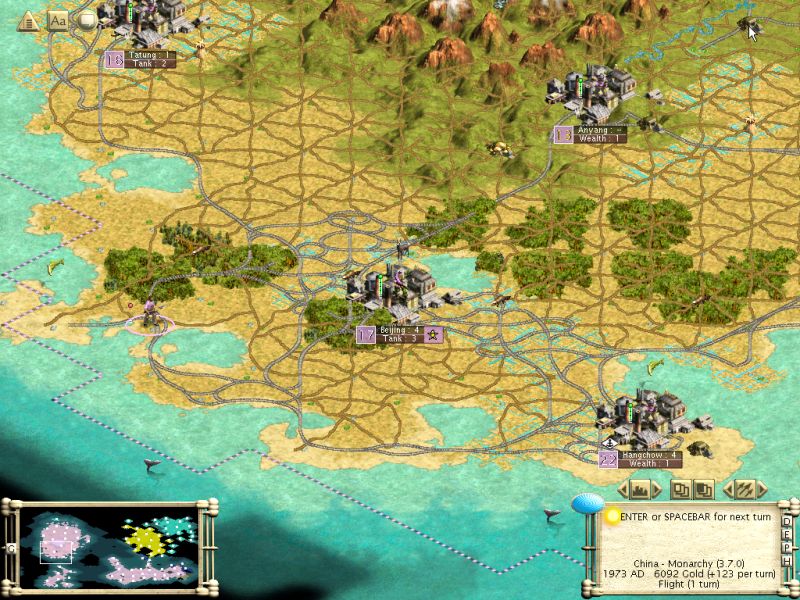
Having America end up with the Theory of Evolution has worked out pretty well for me after all. With its free techs from ToE, America's been able to siphon off massive amounts of gold from the other civs. With Communsim, they have nothing to spend it on (especially since they seem to have sent all their obsolete units to attack me long ago, judging by their almost total lack of guerillas). So guess who's ending up with all that gold?  I must have gotten close to 10,000 gold looting captured American cities since the war started. I must have gotten close to 10,000 gold looting captured American cities since the war started.  America still has just over 4500 gold, and they're running a surplus of a little over 250 gpt (as indicated by what they could afford to pay for a peace treaty if I were willing to negotiate). America still has just over 4500 gold, and they're running a surplus of a little over 250 gpt (as indicated by what they could afford to pay for a peace treaty if I were willing to negotiate).
Right now America is down to two cities (assuming there aren't others hidden in the black areas), one on their home continent and one (now their capital) just north of mine. I moved my own capital to Miami, just across the channel from Egypt, partly because it's a good place to start work on a second core (at least until Egypt gets bombers  ) and partly to reduce the risk of culture flips. ) and partly to reduce the risk of culture flips.
Regarding the tech pace, there's good news and bad news. The good news is that I still haven't seen any oil-powered ships. The bad news is that radar towers have been popping up lately (although India seems to be lagging behind in that regard). I have Refining and am about to start Steel, but Scientific Method is as far as I've gotten on the bottom of the tree. With my gold from America, I should be able to keep up a four-turn pace for the next several techs even if I go after expensive ones, so my prospects for catching up in the tech race are starting to look good. It's too early to be sure, but I think I'm actually going to win this thing.
|
|
| |
|
|
|
Dominae
|
|
I'm pretty sure you've got it, Nathan. Finish them!
|
|
| |
|
| |
|
| |
|
|
|
cumi
|
 |
Austria
Jul 2002
time: 06:28
|
|
quote:
Originally posted by Arrian
cumi,
Yeah, that's the discovery that convinced me to throw in the towel. I feel your pain.
Dominae,
Woah, freaky avatar! The eyes! Ahhh!
Nathan,
Lookin' good, man, keep us informed.
-Arrian |
I was in about AD1500: the part of coast that wasn't destroyed, was under stady bombardment. I could count about 10 Ironclads and 20 frigatts. No coal, no saltpeper. Although I could catch up in the tech race, my best unit was rider (I was concentrating on "builder" techs, like economy, physics etc. The AI was attacking with cavalry. When the AI dropped in the first time a horde of Riflemans, I quit. BTW, I made a huge mistake (I think): I switched to Monarchy very very late, at about 1000AD. I simply forgot to make a revolution...
BTW, in what goverment form are you playing?
I throwed in the towel and restarted the scenario at the easyest level. I am not very proud of that... Normally, I am playing on Regent level and I can win without any problems. But, these AU games seems like to be too big challenges for me...
Now I am going to kick out every civ from the game !!!
|
|
| |
|
|
|
Dominae
|
|
quote:
Originally posted by cumi
1. I would like to ask you or open a small discussion about the city placement. I saw screenshots from Dominae, where he used 2-3 tile spacing (I did it so too). But NorMe and vmxa1 used about 20 tile city placement.
|
I used quite tight city-spacing in the core because I was hard-pressed to defend against the Romans for a while. I could probably have benefitted from using temporary camps instead of full-fledged cities, as the necessary later-game Builder mode was very expensive for me, what with all improvements in all core cities (apart from Coliseums). I spread my cities futher apart up North around my Forbidden Palace, but with the conquest of the English island I'm quite sure I was suffering from some annoying Corruption. Something to improve on in the next game.
I'm not quite sure what vmxa1 was doing in the screenshot just above. Care to comment, vmxa1?
quote:
2. Where did you built your FP?
|
I know Arrian, Nathan and I have indicated where we've placed our FPs, if you read our reports. It's hard to describe without a screenshot!
quote:
3. How many cities did you founded? I don't think, that it's possible to fill the whole continent with cities and to stay at low corruption.
|
Lots. I'm not quite sure anymore. Let's just say I had 3-spacing around my core, then 4- or 5-spacing everywhere else. That should give you an idea of the number of cities I had compared to yours.
quote:
4. And finally, I would like to know the history of the form of your goverments.
|
Despotism
Anarchy
Monarchy
Dominae
|
|
| |
|
|
|
Dominae
|
|
Yes, but...1) his tile improvements are way behind for the 20th century, 2) if his capital or Forbidden Palace is on the home continent, he is better off to put more cities there than somewhere else, due to distance-from-capital Corruption. My guess is that he relocated his Palace and is using Irrigation and Specialists in the areas visible in the screenshot. Still, it looks weird.
vmxa1?
Dominae
|
|
| |
|
|
|
vmxa1
|
 |
Oviedo, Fl
Nov 2001
time: 21:28
|
|
quote:
Originally posted by cumi
1. I would like to ask you or open a small discussion about the city placement. I saw screenshots from Dominae, where he used 2-3 tile spacing (I did it so too). But NorMe and vmxa1 used about 20 tile city placement.
Any comments or explanations on that?
2. Where did you built your FP? In one of my screenshots (page 8 - Here the link ) you can see, where did I put it...
3. How many cities did you founded? I don't think, that it's possible to fill the whole continent with cities and to stay at low corruption.
4. And finally, I would like to know the history of the form of your goverments.
cumi |
I went with the max optimal placement, because I wanted to cover the circumference of the island. I wamted this quickly so I could defend any incursions.
I figured I needed to have as few cities as I could to manage that. The problem came later when it was hard to get enough workers to RR. I also wanted to prevent barbs from rampaging on me. This was done by cover the land and early two roving archers sacking any camps. This worked great.
FP I stuck in Samalanca or what ever the former capitol of Iroq was. This was great for the mainland, but sucked for any other lands. I was winning so easily that I did not bother to palace jump. Mainly because England was too small and India and Babs was too late to care.
Cities, I don't know, not that many.
I switched once to Monarch very late 170AD, I just could not afford to do it sooner.
|
|
| |
|
|
|
vmxa1
|
|
Oviedo, Fl
Nov 2001
time: 21:28
|
|
"I'm not quite sure what vmxa1 was doing in the screenshot just above. Care to comment, vmxa1?"
That was just a final look at the mini map the turn before I won.
Last edited by vmxa1 on 10-06-2003 at 21:29
|
|
| |
|
|
|
vmxa1
|
|
Oviedo, Fl
Nov 2001
time: 21:28
|
|
quote:
Originally posted by Dominae
Yes, but...1) his tile improvements are way behind for the 20th century, 2) if his capital or Forbidden Palace is on the home continent, he is better off to put more cities there than somewhere else, due to distance-from-capital Corruption. My guess is that he relocated his Palace and is using Irrigation and Specialists in the areas visible in the screenshot. Still, it looks weird.
vmxa1?
Dominae |
It was just my fear of incursion and pollution. I spending so much effort to get out ships and troops, that I did not have enough workers to do the job.
I have workers mainly getting roads up on all tiles. This is so I could get to any spot that needed defending or later to clean pollution.
Incursions did not occur, but pollution did. I then put the workers on RR building.
By this time it was clear that the AI could not do anything to bother me in my homeland or England.
They were sending all troops against me in India/Babs island.
I was sending a steady stream of units over there to hold any captured cities.
I captured very few workers and all were on the Indian island. Well, I did get some from England and left them there. I managed to rail that island completely.
I could have put up a few more cities on my island, but I just did not see any need to make more work for myself.
They would get to a new unit the same time I would get to the next generation of troops.
IOW they started sending infantry as I was making tanks. I wonder how the heck India ever got that tech or could afford to make any and Hammy was in nearly as bad of shape.
|
|
| |
|
| |
|
|
|
Catt
|
 |
California - SF Bay Area
May 2002
time: 21:28
|
|
I finally started. Standard rules, dropped down to Monarch, playing the Germans. Lots of screenies to come later.
For now, an interim report. I've never played Total War, and probably over-built units in the early game, losing out on REXing opportunities. Found Rome first (or they found me). My archer attack on Rome was disastrous -- I lost 8 archers in the attack and counter-attack without taking Rome  That was a serious blow. Soon thereafter Legions started appearing. Found the Iroquois, MWs come not too long after. My early research was the Wheel and IW - surprise, no iron or horses . Survived the Roman and Iroq golden ages, and gradually made progress, eventually taking Rome and Caesar's iron supply. Big early game mistake - lack of a good military road network to the front. That was a serious blow. Soon thereafter Legions started appearing. Found the Iroquois, MWs come not too long after. My early research was the Wheel and IW - surprise, no iron or horses . Survived the Roman and Iroq golden ages, and gradually made progress, eventually taking Rome and Caesar's iron supply. Big early game mistake - lack of a good military road network to the front.
I didn't trade gpt for techs. My understanding of Total War is that this tactic is "out of market" or unusual. Nonetheless, it wouldn't have netted me much since I didn't have a good gpt opportunity. And I agree that AU is a free for all - nothing wrong with having used the gpt trick; I just didn't do it.
I hoped for the GL, but wasn't counting or planning on it. I hoped to secure a decent position without it and thought it might be interesting to play the scenario without it. I changed my mind at about 500 BC and tried for it, hard. With a leader waiting and 3 turns to the discovery of Literature, England got it first.
I've made it to the point that I have a decent world map, and control of my continent (although I don't own it - there remain a few Iroq and Roman tundra cities, but it's just a matter of time). I'm so far behind I'm not thinking of ToE and Hoover's - I'm looking ahead to Modern Armor. I'll have Chivalry in a turn or two; the overseas powers have already built Magellan's and Smith's, working on Shakespeare's. I figure I'm almost an age behind. If I can avoid a cultural or diplo loss, and I can handle the landings to come, I hope to survive. But I suspect I've lost the game.
Screenies and a more detailed AAR to come in the next few days. For now, a bit more beer and a bit more civ.
Good AAR's so far  alexman - add me to the list of those saying you're a smidgen evil. alexman - add me to the list of those saying you're a smidgen evil.  Rome, on a hill, with iron . . . Rome, on a hill, with iron . . .
Catt
|
|
| |
|
|
|
Catt
|
|
California - SF Bay Area
May 2002
time: 21:28
|
|
I believe I've lost. I control my continent, but am suffering through 20+ bombard attacks from frigates and ironclads each turn (which, while painful, is also tremendously monotonous). I am dealing with landing parties adequately, but am a long ways away from any sort of invasion. The lack of saltpeter means no frigates, cannons, or cavalry. I am still 6 techs from the industrial age, and numerous civs are building Universal Suffrage - it is only a matter time before infantry start showing up (haven't seen riflemen yet). With no effective bombard defense, I suspect I'm in for a long, slow, painful collapse. I'm going to play on for now, and will work on a more complete AAR with lessons learned and key points / events in the game.
Catt
|
|
| |
|
|
|
Catt
|
|
California - SF Bay Area
May 2002
time: 21:28
|
|
I selected Germany -- with warfare from the get go, I believed that archers and spears would be helpful; cheap barracks would be welcome; militaristic would mean quick promotions - potentially particularly helpful with the early builds pre-barracks (reg to veteran easily); I wanted the scientific trait for cheap science improvements.
I stepped down to Monarch from Emperor after hearing all the chatter about how tough the scenario was. I played standard rules.
I had never played Total War before, but planned to start with limited exploration. I wanted to scout out a few city sites and hopefully find a few barbs, but I didn't want to meet my foes until I was ready. I settled in the start spot on the furs - there wasn't a real attractive start spot within one move, and I didn;t want to waste any time. I decided to build archers for the first 3 or 4 builds -- I considered a granary or a barracks, but, not knowing how close an enemy might be, I wanted several attackers right off the bat. After a few early archers, I built a barracks and then a settler.
The start was actually pretty bleak in retrospect, although it looked OK at the beginning. The Industrial trait would have "improved" the start considerably, but even with a non-industriuos civ, I felt that we had a decent location. Early huts were all barbs - actually not bad considering I wanted upgrades (and got them!).
I set research on the Wheel at 90% or 100%, wanting to find horses quickly. Even though the high research only moved science from 1 gold to 2, and reduced the build from 40 turns to something like 36 turns, I figured that as Berlin grew (I wouldn't be pumping settlers as often as a normal game) the research time would drop considerably. The Germans discovered The Wheel in 2630 BC and set research on Iron Working at 10%.
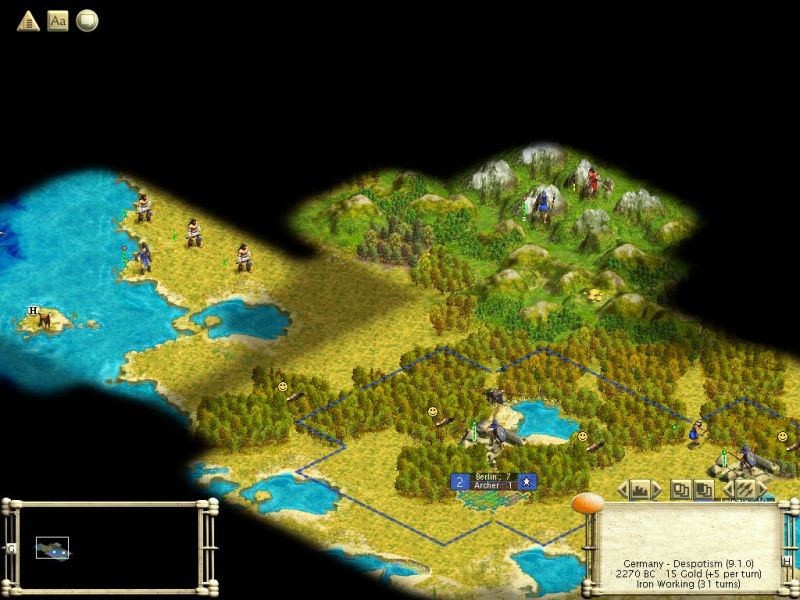
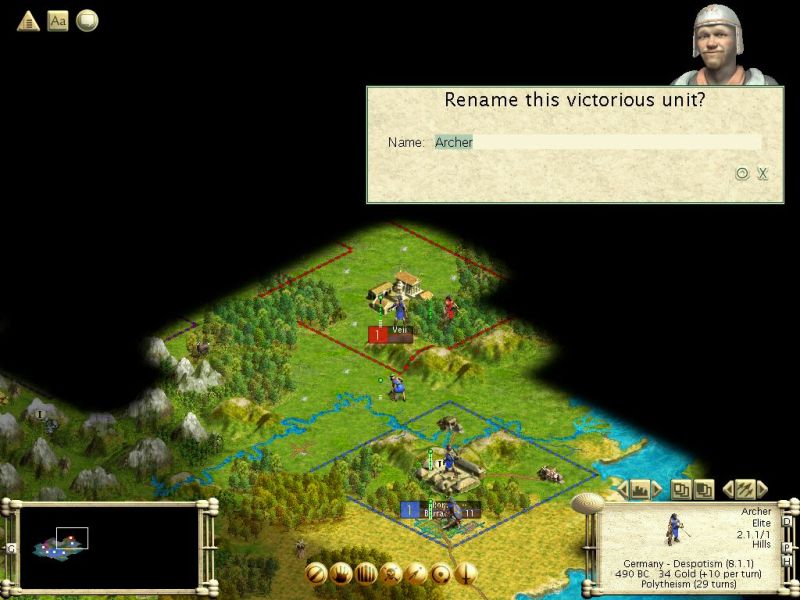
In 2270 BC, A German harrassment force looking for victims came across our first foreign foe -- a wounded Roman archer, out hunting barbs was spotted in the mountains north of Berlin. Here's the screenshot.
 Attachment: 2270 - first contact.jpg Attachment: 2270 - first contact.jpg
This has been downloaded 138 time(s).
|
|
| |
|
|
|
Catt
|
|
California - SF Bay Area
May 2002
time: 21:28
|
|
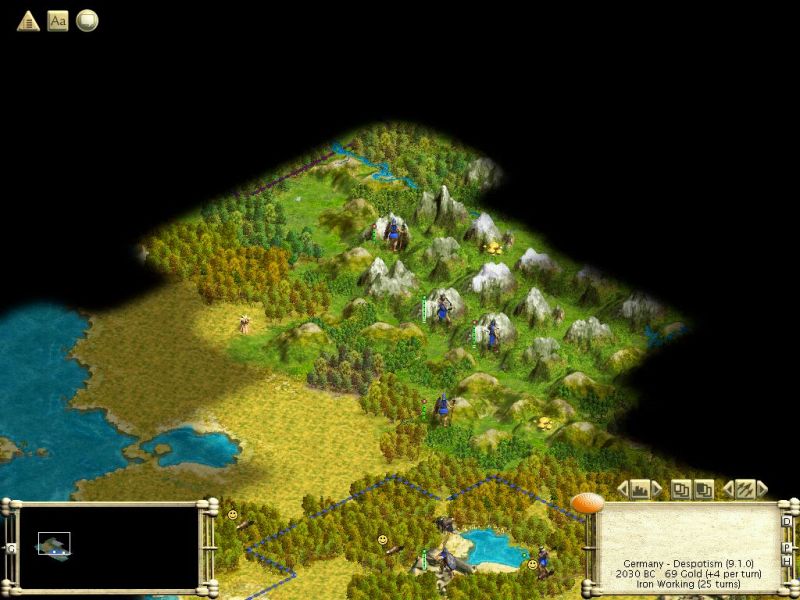
Soon, the red borders of Rome came into view. A strike force of 8 archers (2 elites!) and one spearman was assembled and marched to Rome's gates. The spearman was reduced to one HP by a Roman archer, but held the defenses. When the time came to attack, all 8 German archers let fly their arrows. The carnage was horrible. In a huge setback for Germany, Rome remained defiant. Three spearmen were defending, backed by an archer and a warrior or two. At the conclusion of the assault, several wounded archers and the wounded spearman remained standing -- but a Roman counterattack quickly destroyed the survivors. The assault on Rome was a complete disaster.
The failure at Rome was a tremendous blow. The Germans would spend the next 1000 years reassembling an attack force, all the while fending off the occassional Roman interloper. To add insult to injury, we had made contact with the Iroquois and faced a two front war.
Around 600 BC, a second assault force had maneuvered to a point just outside Rome. The Roman's had managed to train a few Legions, and Bismarck was certain that second failure would mean death. This second force was about the same composition as the first ill-fated army and was facing better trained troops, but taking Rome was a must -- to turn back then would mean death.
Attachment: 2nd assault on rome.jpg
This has been downloaded 133 time(s).
|
|
| |
|
|
|
Catt
|
|
California - SF Bay Area
May 2002
time: 21:28
|
|
German scientists were researching towards Monarchy, hoping for a fast escape from Despotism. In retrospect, probably a mistake. Bismarck had been unable to trade for Alphabet with Rome before war erupted -- the high cost of a large, early, standing army and the efforts at researching the Wheel meant that Bismarck didn't have enough gold to purchase Alphabet (with The Wheel thrown in for good measure). Nonetheless, a more focused effort towards Literature and the Great Library would have likely been the better play.
With Rome secured, Germany began training swordsmen (more accurately, Germany began mass-producing warriors until Rome was connected via road and upgrades became available). The first Great Leader formed an army -- the Germans had neither a wonder available nor a wonder-enabling technology just over the horizon. The army was filled with newly trained swordsmen.
Unfortunately, Iroquois mounted warriors quickly appeared -- with both Rome and the Iroquois enjoying golden ages, the German forces had their hands full defneding the fatherland and the newly-acquired territories.
English galleys soon appeared off the German southern coast. After trading maps with England, Elizabeth too felt the sting of Bismarck's war declaration.
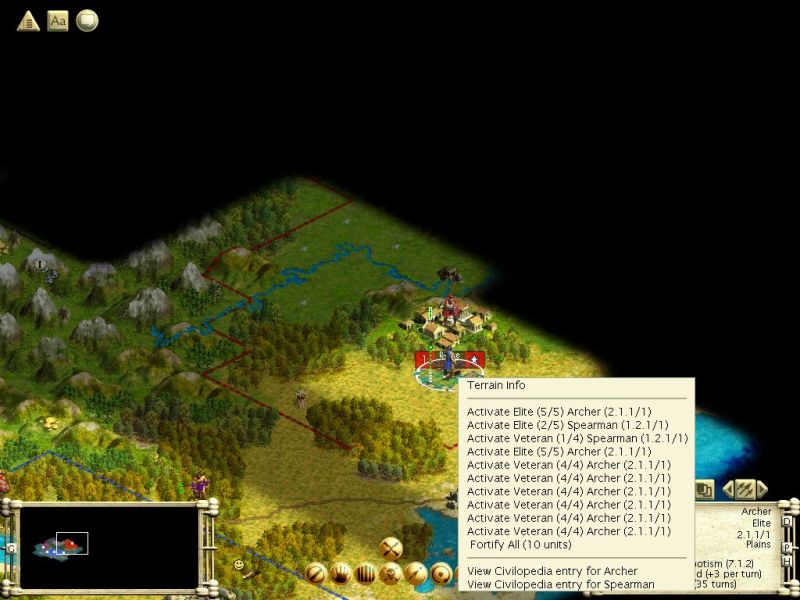
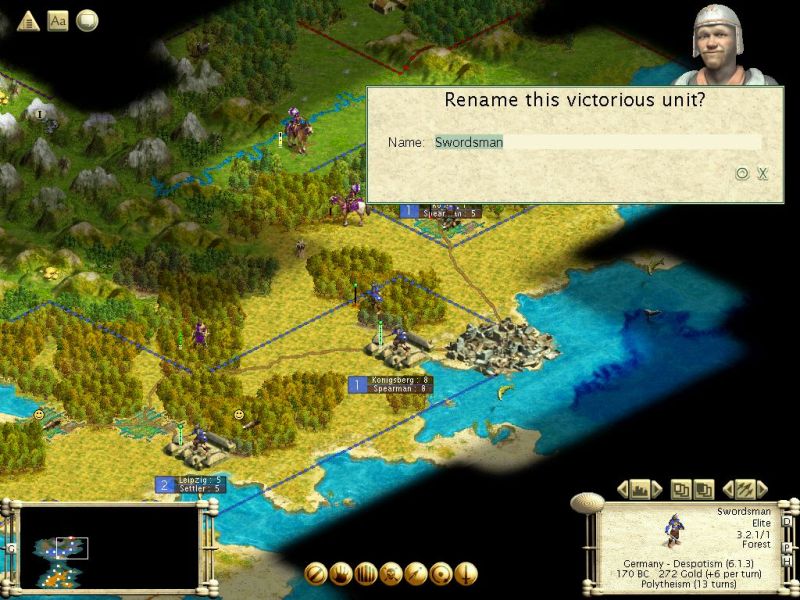
A swordsman on defense against Iroquois troops generated Germany's second great leader. The Heroic Epic was completed immediately thereafter.
Attachment: second leader.jpg
This has been downloaded 125 time(s).
|
|
| |
|
|
|
Catt
|
|
California - SF Bay Area
May 2002
time: 21:28
|
|
The next 800 or so years were a constant struggle. As Iroquois raiding parties slowed (golden age ended), the Germans made slow but steady advances against both the Iroquois and the last remnants of Rome. Every so often English troops were sacrificed for Germany's glory. But Bismarck was slow to settle te available land. Without horses, Germany lacked military mobility, and forces were stretched thin enough that sending weakly-defended settler parties out into the open plains where monted warriors could strike was to dangerous.
After discovering Polytheism, Bismarck decided that the Great Library would be very important -- he had previously decided that it wouldn;t be necessary, but the facts on the ground called for reappraisal. Both the Iroquois and the English were extending their technological lead over Germany, and a strange race that called themselves the Babylonians had built several wonders, or so the travelers told. Hiawatha did manage to build the Pyramids, which meant they would be controlled by Germany eventually. With a leader waiting and 3 turns from the discovery of Lierature, Bismarck learned that London had completed the Great Library. The poor German leader could do nothing -- he couldn't even form an army due to the small number of German cities.
Several Great Leaders later, Bismarck was still directing a "lazy war" -- picking off enemy units at will, fishing for leaders and focusing on building the German empire. Military production slowed, and libraries were being built in all German cities. A forbidden palace was constructed in the center of the continent, south and slightly west of Salamanca. Even with a large portion of income directed towards research, a decent FP-Palace axis, and a focus on city growth and improvement, the long German stay in Despotism and the limitations of Monarchy meant that Germany fell far behind the unknown overseas rivals.
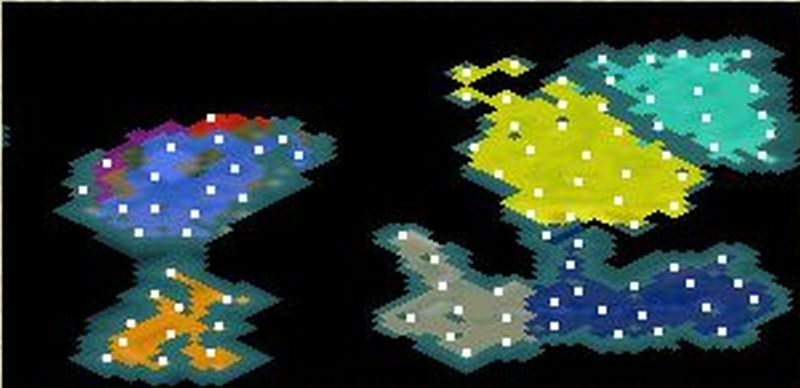
In approximately 900 AD, Germany suddenly made contact with 4 previously unknown civs. Territory maps were purchased, several technologies were purchased, and war was declared. A look at the known world indicated that Germany was facing formiddible opponents.
Attachment: minimap at 900 ad.jpg
This has been downloaded 122 time(s).
|
|
| |
|
| |
All times are GMT. The time now is 05:28.
Apolyton Time is 00:28. |
top of page
|
|
|
Forum Rules:
You may not post new threads
You may not post replies
You may not post attachments
You may not edit your posts
|
HTML code is ON
vB code is ON
Smilies are ON
[IMG] code is ON
|
|
|
|
|
|






 09-06-2003 18:49


 No matter how experienced my Galleys where, Lizzie's were Kickin




 |
|