 |
| |
|
| |
|

|
Paddy the Scot

|
 |
Hordeland
Mar 2001
time: 14:33
|
|
Thanks My Mistake, way too much Caffine last night... 
Please note that I have edited these two initial posts so that the first post becomes our workdesk...  Here is what the initial post said... Here is what the initial post said...
In my campaign speech I promised to be a good publican. Well as any good publican will admit, you are only as good as the service that you offer. And good service comes from having a good team.
I am actively seeking a deputy to assist in the Ministry.
The constitution asked that the Minister of the Interior:
1. One Citizen shall be appointed as Minister of the Interior.
2. The Minister of the Interior advises on the movement and usage of all workers and settlers.
3. The Minister of the Interior advises on the Science and Luxury Sliders, the treasury, and the direction of science research.
4. The Minister of the Interior advises on the management of all city citizens.
5. The Minister of the Interior may draw boundaries and regions within the nation and appoint governors over those regions.
6. The Minister of the Interior advises on the management of all city build queues, including the rushing of projects.
7. The Minister of the Interior may create or alter any system for naming all cities, provinces, geographic features, and so forth.
If you would like to contribute to this effort, please do not hesitate to contact me via PM, or leave a post below.
The following are some of my thinking on these matters, which may help you decide if you would like to join me in this endeavour.
My philosophy towards work force management (which area do you emphasize) is to first off build a good road structure, so to get a road to our first major resource that we will work. Then if needed either irrigate or mine that resource. I believe that roads are important, like the glue that holds the civilization together. They are great for the economy and for getting the troops to and from locations.
A typical order of building improvements is to start with the granary, then temple (yes the pub!), then barracks, usually I am looking to build a marketplace next. This process is altered if we have masonry, or get masonry very quickly. If masonry available, I like to get one city quickly positioned where it will make a lot of shields, and devote that city to building the pyramids. Under this plan I like to have at least one other city that is for mass production of settlers and workers.
I prefer Rapid expansion with certain considerations, position of neighbours, resources, and land availability. Depending on environment, resources, neighbours, land availability, rapid expansion is the best. With this there should be a minimum of two core cities, on that is allowed to grow, and grow big. As with the above mentioned Pyramid scheme, this city should be in a place where it can produce a great deal of shields, making this a great place to rapidly put units together when they may suddenly be required. The other, once again produces settlers and workers.
A lot of the initial planning will take place in the time before we actually know our location.
Last edited by Paddy the Scot on 25-02-2004 at 07:19
|
|
| |
|
| |
|
| |
|
| |
|
|
|
E_T
|
 |
Orlando, Florida
Mar 2001
time: 00:33
|
|
This table shows the times for the number of workers to finish a task. For instance, If we are Non-Industrious and have 1 worker and 1 slave doing something, this is equil to having 3 slaves doing the same thing. So, if we were to have these 2 road a flatland tile (6-3-2-2-2-1), they would take 2 turns to complete. This same Combo would take 4 turns to road a forrest (12-6-4-3-3-2-2-2-2-2-2-1).
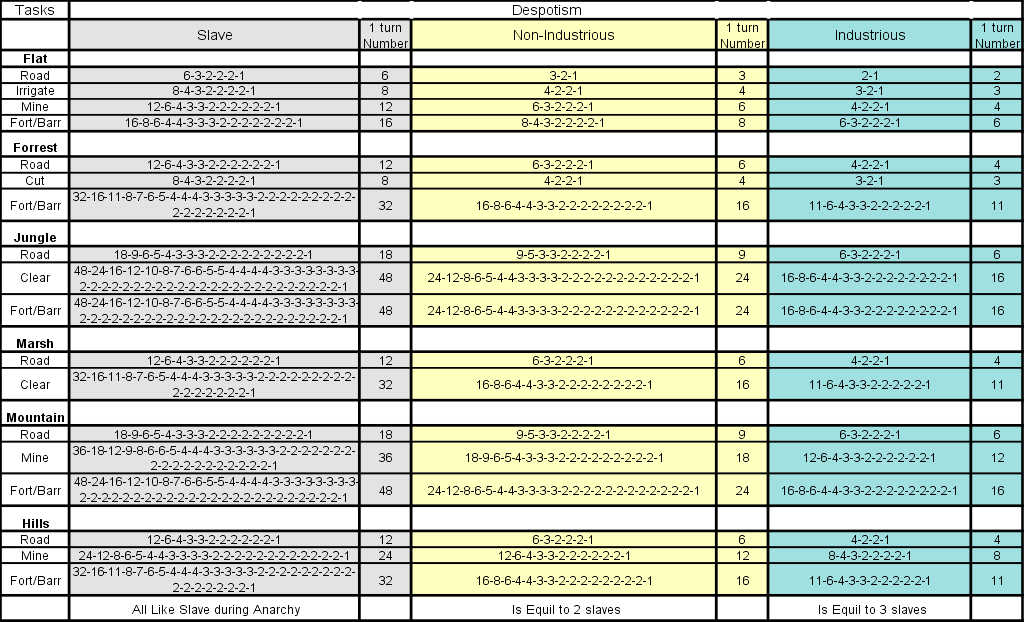
Now, when it comes to planning ahead for your workers, it's important to realize how to use stacks properly. Say we are Non-Industrious and we want to utilize a group of workers to complete a long term task, in the shortest amount of time. Just for instance, Jungle clearing (24-12-8-6-5-4-4-3-3-3-3-2-2-2-2-2-2-2-2-2-2-2-2-1), you could use 2, 3 & 4 workers and they would stay in sync. If you were to use 5 workers, to get done faster but when that task is done, you will have some workers frozen and some ready for the next task.
These workers start and end in sync
code:
4 workers - task takes 24 worker turns
| #1  | #2  | #3  | #4  |
|  1  |  2  |  3  |  4  | turn 1
|  5  |  6  |  7  |  8  | turn 2
|  9  | 10  | 11  | 12  | turn 3
| 13  | 14  | 15  | 16  | turn 4
| 17  | 18  | 19  | 20  | turn 5
| 21  | 22  | 23  | 24  | turn 6 - task is done at the begining of this turn and all workers are frozen
These workers start in sync, but end up out of sync
code:
5 workers - task takes 24 worker turns
| #1  | #2  | #3  | #4  | #5  |
|  1  |  2  |  3  |  4  |  5  | turn 1
|  6  |  7  |  8  |  9  | 10  | turn 2
| 11  | 12  | 13  | 14  | 15  | turn 3
| 16  | 17  | 18  | 19  | 20  | turn 4
| 21  | 22  | 23  | 24  |  X  | turn 5 - task is done at the begining of this turn, but the workers are frozen EXCEPT for the one marked with the X
Now, you can also use this to your advantage, especially when you have workers being built and your getting your work crews set up for things. Basically starting up out of sync.
code:
2 workers - 1 starts task, the other joins 2 turns later.
task takes 6 worker turns
| #1  | #2  |
|  1  |  N  | turn 1
|  2  |  N  | turn 2
|  3  |  4  | turn 3
|  5  |  6  | turn 4 - task is done at the begining of this turn and all workers are frozen
This also becomes very useful when timing city growths and you want to take as much advantage of an improved tile in relation to this anticipated growth.
All total, coordinating the workers to the city needs (and each other) is very much akin to choriagraphing (SP) a Ballet. This sometimes requires looking at worker actions, not just a few turns in advance, but 10, 20 to 30 turns in advance. And this level of planning can be very frustrating, because of things that will happen, in the turn that is currently being played, that will effect things further down the line. But then, there's the Immortal words of Colonel John "Hannibal" Smith of the A-Team, "I love it when a plan comes together!"
E_T
|
|
| |
|
| |
|
| |
|
| |
|
| |
|
| |
|
|
|
Arnelos
|
 |
of the Free World
Sep 2002
time: 00:33
|
|
conmcb25 sent me a PM asking me if I'd be willing to help out with this ministry. I'm willing to help as much as Paddy wants help, though my availability may at times be considerably limited by other DG's.
My only initial comment is that the key use of workers in the early game is creating more improved tiles (road AND irrigation/mine on each tile you work, not just the road). With a tight city spacing, you can minimize the number of turns in the early game that workers are spending their time just building roads from Point A to Point B and maximize the amount of time they're building mines and irrigation on tiles you will have in use.
Ideally, you want as many tiles in use to be improved tiles as you possibly can. The more tiles you're using that are improved tiles, the more shields, the more food, the more commerce... this balloons over time. You can build a rather substantial economic advantage on that basis alone.
EDIT: the next bit is repeated in the other thread, though I'm sure I worded differently
One of the things that works out rather nicely is that if you build your first 3-4 tile improvements toward where your second city will be built, you'll already have a road to that city when it's built AND you'll have tile improvements it can use (since the capital just fell in population to build your first settler, it won't be using all of the tiles you just improved anyways ). You can use your worker(s) to build more tile improvements while the populations of both cities work back up and are in need of more improved tiles. Since you have a tight city spacing, the cities can swap which city is using which tile on which turn in order to micromanage production. Also, since one city may fall in population as another rises, tiles can easily swap between them because of this.... so having a tight city spacing gives you a lot more punch for each worker turn worth of improving the terrain in between your cities (since each improved tile is likely to be in use by at last SOME city on each turn).
If your capital has that early granary in it, you can also afford to pump out workers along with settlers to keep this process of making tile improvements at least partially scaled to the growth of your empire up. It's a LOT easier to do this with an industrious civilization (even in C3C), but it can still be done (to some extent) with a non-industrious civ.
Of course, the nature of THIS game is such that we're going to need more early warriors than we're probably used to... hopefully, however, we can build warriors, hoplites and chariots/horsemen while our populations are going back up after each worker/settler.
My sincere apologies if any of this is repeating information.
|
|
| |
|
| |
|
|
|
E_T
|
|
Orlando, Florida
Mar 2001
time: 00:33
|
|
Warning, this might be different in C3C, but is doubtful
When a turn is started, the trade for the entire nation is computed, then worker actions, then city by city food (growth & shrinkage) and sheilds.
I found this out when doing some testing for the PTW ISDG. This result was with a PBEM sim, but should be no different from a standard PBEM game. My guess is that this is done this way because of the quirkiness of PBEM and is different from SP play.
This is the sequence (with the testing that I've done sofar):
1) FAM things (i.e. money & techs changing hands)
2) Income & Expence for entire nation computed and applied to Treasury and beaker count. Techs are finished if enough beakers are applied and any builds are Auto-upgraded.
3) multi-turn worker actions completed
4) city by city
a) food counted and applied to foodbox, if growth/shrinkage, change pop (and WF)
b) sheilds counted and added to build, if enough, build is completed.
c) add culture for city, if borders expand, then change WF to default when they expand.
5) start movement phase
I have not tested as to when any civil disruption takes place in this sequence, but I would guess that it's before the worker actions part, but then I could be wrong. I'll see if I can test for this a little bit further, but I don't know if I have the time.
What does this all mean?? Basically, what trade balance you see at the end of the turn, i.e. GPT & # turns for research and the beakers that will be applied at the begining of the turn, no changes from pop changes and roads built. So, if you show, in the F1 screen, that you are putting away X number of beakers that turn and your making Y GPT, that IS what is going to be applied to your balance at the begining of the next turn. No city growths or shrinkage at the begining of any particular turn is going to effect this amount, because it has already been computed.
What this means for the PBEM multi-turn worker actions? mines, Irrigation, chops and other multi-turn things EXCEPT for roads, gets the added benifit from being done at the begining of the turn. The Trade Effect from Roads will show up for the end of the turn, because that benifit is what you see, if you have the road available now and can change your WF to that. So, it might be more efficient to build a road in a single tile, over the longer time, but if you want that trade bonus sooner, you need to be less efficent and use Multiple workers to build it.
Additional Testing required to answer the following:
How gifting and being gifted a city effects this?
Where exactly Civil Disorder comes into this?
E_T
|
|
| |
|
| |
All times are GMT. The time now is 05:33.
Apolyton Time is 00:33. |
top of page
|
|
|
Forum Rules:
You may not post new threads
You may not post replies
You may not post attachments
You may not edit your posts
|
HTML code is ON
vB code is ON
Smilies are ON
[IMG] code is ON
|
|
|
|
|
|





 13-01-2004 14:47


 well we will see


 but I have some fun information.




 |
|